You're comparing mortgages, daycare, savings, and retirement contributions when one uncomfortable question appears: Would your family be financially secure if your income disappeared tomorrow? A $1 million life insurance policy can feel like an obvious answer, especially for young parents, homeowners, and professionals with people depending on them. But the round number isn't automatically the right number.
The useful question is whether the death benefit could replace income, settle debts, fund future goals, and give your loved ones time to adjust. This guide explains what 1 million life insurance really provides, who may need it, how term and permanent policies differ, what affects the price, and how no-exam underwriting can make approval faster for eligible applicants.
Table of Contents
- What 1 Million Life Insurance Really Means for Your Family
- Who Typically Needs 1 Million Life Insurance Coverage
- Term vs Permanent Options for 1 Million Life Insurance
- How Much 1 Million Life Insurance Costs by Age and Term
- No Exam Options for Getting 1 Million Life Insurance Quickly
- How to Get Your 1 Million Life Insurance Policy Step by Step
- Making Your 1 Million Life Insurance Decision With Confidence
What 1 Million Life Insurance Really Means for Your Family
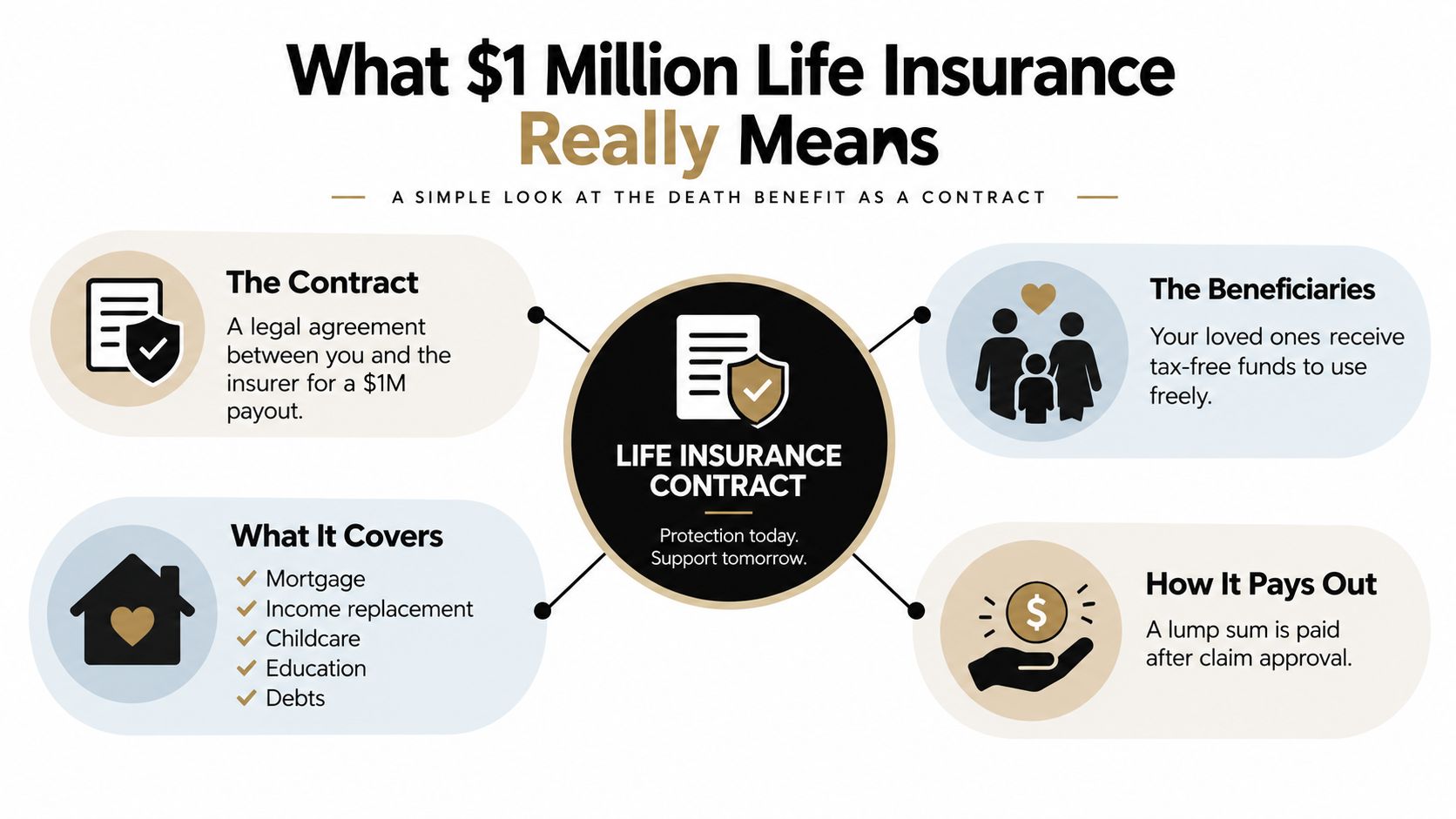
Suppose Maya and Daniel have a young child, a mortgage, and one income that covers most household bills. They like the idea of a $1 million policy because it sounds large enough to create a safety net. Yet the benefit isn't a savings account that automatically grows. It's a contractual promise from an insurer to pay the chosen beneficiaries after an approved claim, provided the policy is active and its terms are met.
The family could use that lump sum for income replacement, mortgage payments, childcare, education, debts, or final expenses. The beneficiaries generally decide how to allocate the money rather than following a preset spending plan. A clearer explanation of this payout structure appears in this guide to what a death benefit means in life insurance.
Why the benchmark feels familiar
A $1 million policy has become a common reference point because household responsibilities can extend far beyond immediate bills. A surviving spouse may need to replace years of earnings, arrange care for children, maintain housing, and preserve education plans. The policy is best understood as a pool of purchasing power, not as proof that every family needs exactly that amount.
The broader U.S. market shows why context matters. The ACLI life insurance market data reports 134 million policies in force with a combined face amount of $14.1 trillion. The same source says the median face value of in-force coverage reached $150,000 in 2022, while 56% of households had any life insurance coverage. A $1 million policy is therefore more than six times that household median, but a median is not a recommendation. It doesn't account for a particular family's earnings, debts, assets, or dependents.
Practical rule: Treat $1 million as a starting point for a conversation, not as a universal answer.
The benefit might be enough for a household with modest obligations and substantial assets. It might leave a serious gap for a high earner with several dependents, a large mortgage, and long-term education goals. The calculation comes from the people and expenses behind the policy.
Who Typically Needs 1 Million Life Insurance Coverage
A $1 million death benefit often deserves careful consideration when another person depends on your income, labor, or financial commitments. That includes young families, newly married couples planning a shared future, homeowners with a mortgage, business professionals, and high earners supporting children or other relatives.
Start with four questions:
- Income: How many years would your household need financial support?
- Debt: Which mortgage, loans, or other balances would become someone else's responsibility?
- Future costs: What would childcare, education, or other planned goals require?
- Existing resources: Which savings, investments, employer coverage, or individual policies could already help?
This approach is more useful than choosing a face amount because it connects the benefit to actual obligations. A stay-at-home parent also creates economic value through childcare, household management, and other services, even without a paycheck. If that work disappeared, the surviving parent might need paid help or reduced working hours.

Situations that can justify a larger benefit
A newly married couple without children may need less coverage than parents with a mortgage and childcare responsibilities, but marriage can still create shared debts and income dependence. A homeowner may want the death benefit to protect the surviving partner from selling the home under pressure. A business professional may need enough coverage to replace earnings while dependents become financially independent.
A household can also underestimate its need by counting only the mortgage. The surviving family may still face groceries, utilities, transportation, childcare, education, and lost retirement contributions. A needs-based estimate should account for the whole transition, not just the largest bill.
Use this life insurance needs framework to organize the calculation, then subtract resources that would be available to beneficiaries. Employer coverage deserves caution because changing jobs can change or eliminate that protection.
The coverage gap is wider than many households assume. A 2024 coverage-gap model estimated that 83.5 million U.S. households, or 64% of all households, collectively faced a $33.2 trillion shortfall. The same source cites LIMRA's 2025 finding that about 100 million Americans lacked adequate coverage. Those figures don't prove every household needs $1 million, but they do show why a small existing policy may not match real responsibilities.
For a personal test, write down what your family would need to preserve, what it could pay immediately, and how long income support might last. If the total exceeds $1 million after subtracting available resources, the benchmark may be too low.
Term vs Permanent Options for 1 Million Life Insurance
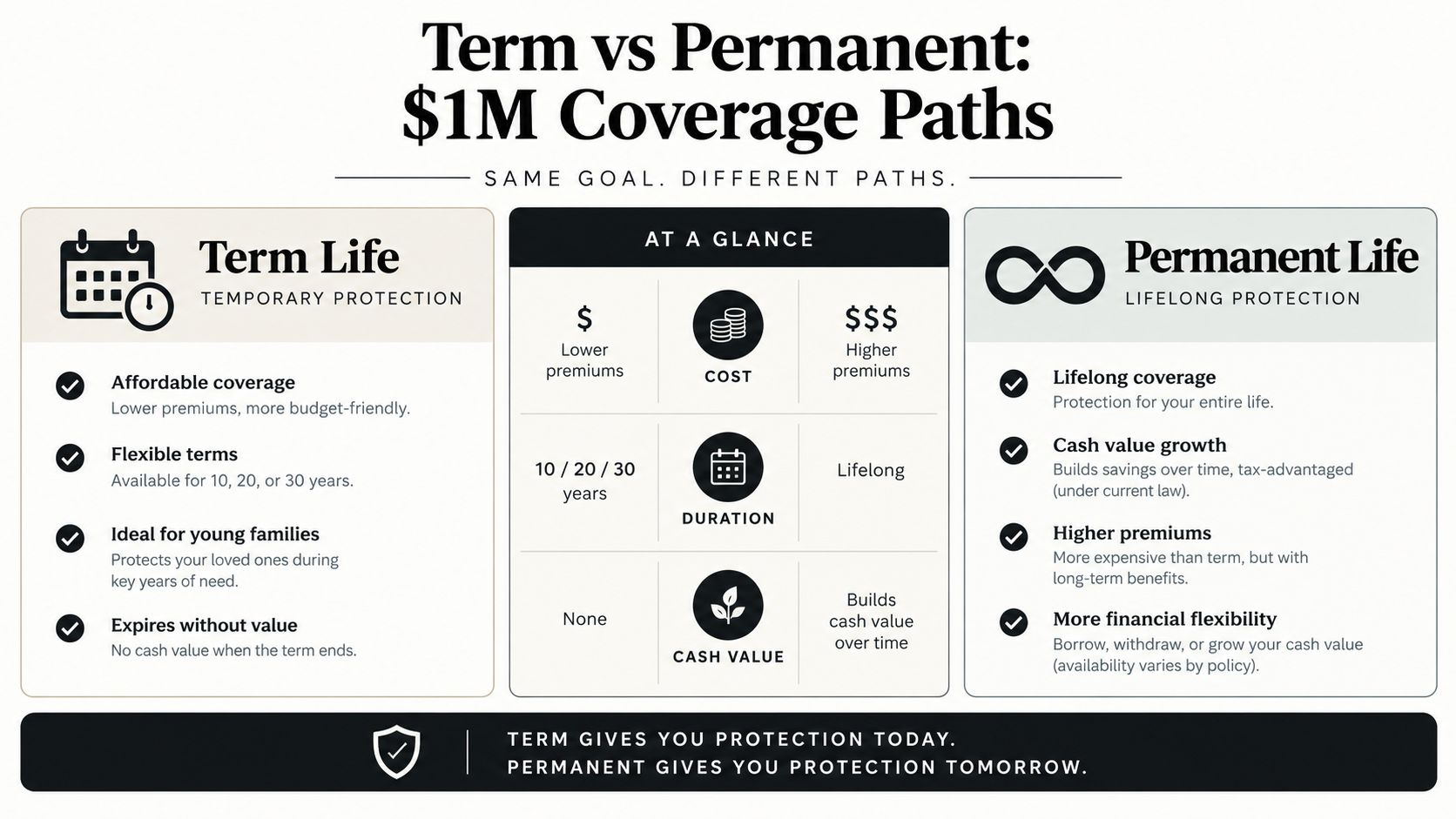
Once you estimate the need, choose the type of policy that matches the timeline. Term life insurance covers a defined period, commonly 10, 20, or 30 years, while permanent insurance is designed to remain in force for life if premiums and policy conditions are maintained.
A parent with young children may want coverage during the years when the household has its greatest income-replacement and childcare exposure. Term insurance fits that temporary responsibility. A permanent policy may suit someone who wants lifelong protection for a legacy, final expenses, or other needs that don't disappear when children become independent.
The trade-off between duration and features
Term coverage usually focuses on a death benefit for a set period. It doesn't build cash value, so its appeal is straightforward protection for a defined financial window. Permanent coverage lasts for life and can build cash value, but the added feature set generally comes with higher premiums and more complicated policy mechanics.
| Feature | Term life | Permanent life |
|---|---|---|
| Coverage period | Set period such as 10, 20, or 30 years | Lifelong, subject to policy conditions |
| Cash value | No cash value | May build cash value |
| Typical use | Income replacement, mortgage, childcare, education years | Legacy planning, lifelong needs, cash-value goals |
| Main trade-off | Coverage ends or may become more expensive after the term | Higher premiums and greater complexity |
A young professional seeking a large benefit while protecting a spouse or children may prioritize the amount of coverage per premium dollar. Someone with a permanent estate objective may value duration more than initial affordability. The relevant comparison isn't “cheap versus expensive.” It's temporary protection versus lifelong structure.
Read this comparison of term and whole life insurance before choosing. The right policy should match both the size of the obligation and the period during which that obligation exists.
How Much 1 Million Life Insurance Costs by Age and Term
A $1 million policy can cost one family a manageable monthly amount and another family much more. Age, health, tobacco use, occupation, term length, and underwriting class all affect the quote. A healthy nonsmoker applying young will generally receive different pricing from an older applicant or someone with significant health risks. The face amount alone does not determine the premium.
The ranges below are illustrative estimates for healthy nonsmokers. Actual premiums vary by carrier and underwriting class.
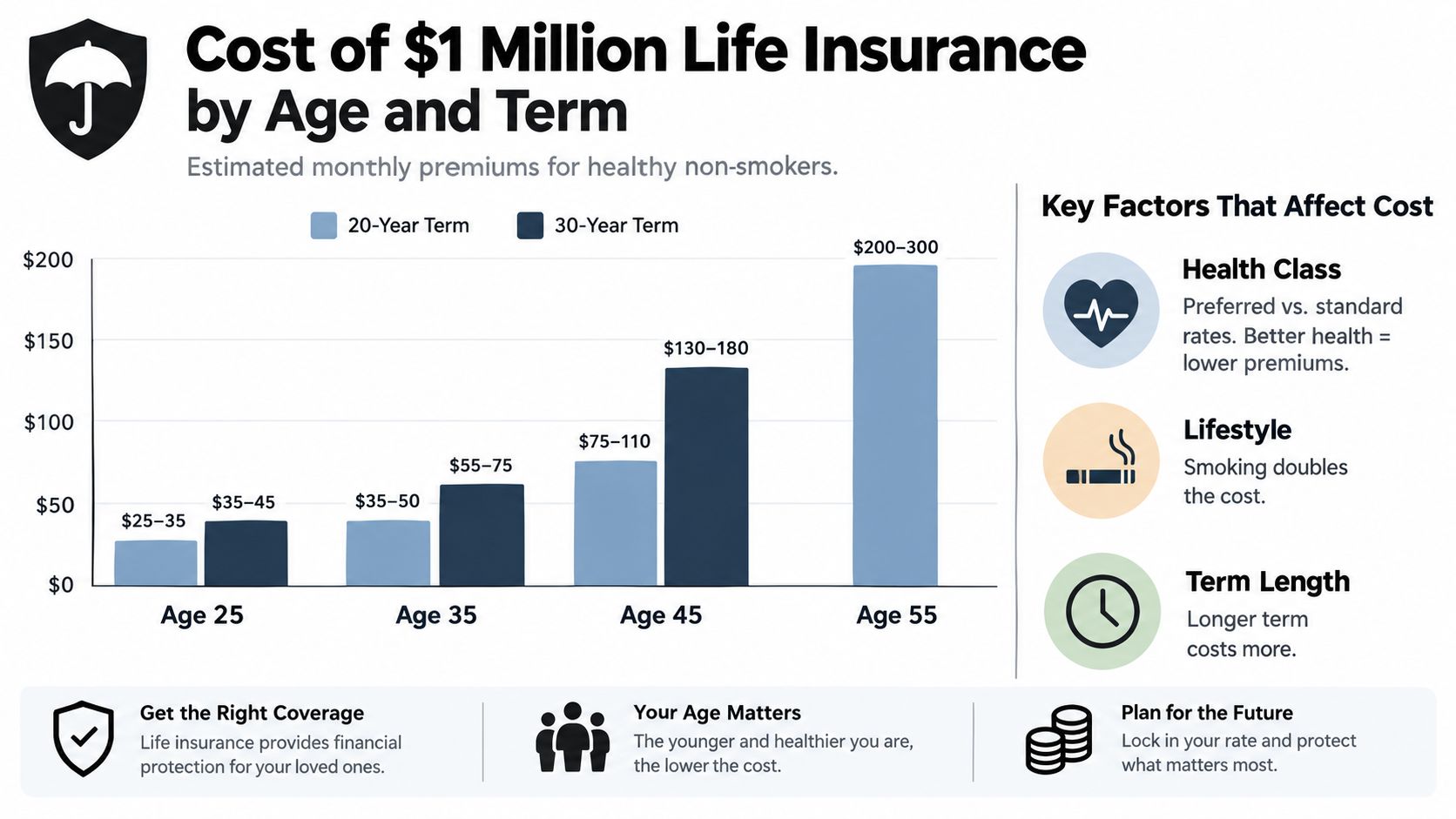
| Age | 20-year term | 30-year term |
|---|---|---|
| 25 | $25 to $35 monthly | $35 to $45 monthly |
| 35 | $35 to $50 monthly | $55 to $75 monthly |
| 45 | $75 to $110 monthly | $130 to $180 monthly |
| 55 | $200 to $300 monthly | Not specified |
These figures are based on the premium comparison data. Use them to compare the shape of the market, not as a guaranteed personal rate.
Why quotes separate
A longer term usually costs more because the insurer covers a longer period in which a claim could occur. Age also affects pricing because the insurer is evaluating how long the policy may remain at risk. Smoking, medical history, prescription use, driving records, and occupation can move an applicant into a different underwriting class.
Large policies may receive more detailed review, while some applicants may qualify for accelerated underwriting. The practical lesson is simple: a $1 million policy is not priced from the face amount alone. Personal risk and the insurer's rules still shape the offer.
Compare quotes using the same face amount, term length, payment frequency, and health disclosures. A lower initial quote may reflect a different policy design, so matching the details keeps the comparison useful. For a young family, the right question is whether the premium fits the budget while the term covers the years of greatest need. A round $1 million benchmark may be enough for one household and leave a gap for another, depending on income replacement, debts, childcare, and future goals.
No Exam Options for Getting 1 Million Life Insurance Quickly
“No exam” doesn't mean “no underwriting.” It means the insurer may evaluate risk through digital data and records rather than requiring a traditional physical examination with labs.
Three paths are commonly confused:
- Accelerated underwriting: The carrier uses application answers, electronic data, and rules-based triage. It can support larger face amounts for eligible applicants.
- Simplified issue: The application asks health questions but usually requires less evidence than traditional underwriting.
- Guaranteed issue: The insurer generally asks no health questions, offers a much smaller benefit, and may apply graded benefits.
The no-exam coverage guide notes that accelerated underwriting can reach up to $5 million, simplified issue often tops out around $1 million, and guaranteed issue is typically capped near $50,000 with graded benefits and no health questions. These are product-category ranges, not promises of eligibility.
What carriers check instead
At the $1 million level, an insurer may review prescription history, Medical Information Bureau records, motor vehicle records, and sometimes physician notes. The no-exam underwriting explanation makes the central point clearly: skipping an exam doesn't eliminate the carrier's review of health and risk information.
Industry capacity has expanded. A Munich Re accelerated-underwriting survey reports an average maximum face amount of $2.5 million among surveyed programs, with $1 million the most common maximum face amount among participating companies. That makes $1 million a meaningful operational threshold for digital triage, not an unusual request.
Approval speed still depends on the carrier, application accuracy, data matches, age, health history, and whether the file is referred for more evidence. A 2026 Wall Street Journal summary said eligible applicants may skip an exam for policies ranging from $3 million to $10 million, depending on the carrier. Gen Re reported in 2026 that 59% of individual life applications qualified for an accelerated path across 30 carriers representing more than $827 billion of coverage, according to the verified data provided.
Some products are even faster but narrower. A 2026 independent review of no-exam insurers says SBLI's simplified-issue product offers up to $1 million, same-day approval, and no blood tests, urine samples, or physician statements, while also noting reduced limits for applicants ages 61 to 70. Another 2026 no-medical-exam comparison reports that some products reach $1.5 million to $5 million for qualified applicants, depending on age and insurer.
How to Get Your 1 Million Life Insurance Policy Step by Step
A digital application feels easier when you separate the decisions. The process starts with the need, not the quote.
Start with the coverage design
Write down income support, debts, mortgage obligations, childcare, education goals, and final expenses. Subtract liquid assets and existing individual coverage that beneficiaries could use. Then choose a term that matches the years your family expects to depend on your income.
Next, compare insurers using identical inputs. Ask whether the quote is for term or permanent coverage, whether the application may qualify for accelerated underwriting, and what could trigger a medical exam or additional records. Keep the requested face amount consistent so the comparison stays meaningful.
Complete the application carefully
Gather medication names, physician details, addresses, employment information, driving history, and current policy details before starting. Accurate answers matter because data services may verify them. A mismatch doesn't automatically mean denial, but unexplained omissions can cause delays or a revised offer.
The insurer may use prescription databases, Medical Information Bureau records, motor vehicle information, and physician records. If the file qualifies for automated review, the carrier may make a quick decision. If it doesn't, the insurer can request an exam or more evidence.
Review the offer before activating coverage
Read the premium, term, exclusions, contestability language, beneficiary designation, payment schedule, and conversion options. Confirm that the policy is active before relying on it, and don't cancel existing coverage until replacement coverage has been issued and accepted.
For a digital option, Coveredly offers online term life insurance with coverage options up to $3 million and a free term life insurance calculator, making it one place to explore a starting coverage amount alongside other carrier quotes. Your final decision should still reflect the policy contract and your household's needs, not just application speed.
Making Your 1 Million Life Insurance Decision With Confidence
A $1 million policy can be a sensible foundation, but it isn't automatically sufficient. The answer depends on how much income your family would need to replace, which debts would remain, what future costs matter, and how much coverage or savings already exists.
Use this short readiness check:
- Need: Can you explain what the benefit would pay for?
- Timeline: Does the term cover the years when dependents rely on you?
- Policy type: Do you need temporary protection or lifelong coverage with cash value?
- Underwriting: Are your health, prescription, driving, and application details ready?
- Affordability: Can you maintain the premium without putting the policy at risk?
- Beneficiaries: Have you named the people or entities intended to receive the benefit?
No-exam underwriting can make a $1 million application more convenient, but speed shouldn't replace comparison. A fast approval with the wrong term or insufficient benefit still leaves the central problem unsolved. Conversely, a carefully selected term policy can give a young family meaningful protection while its largest obligations are still outstanding.
The best face amount is the one that connects a clear financial need with a policy you can keep in force.
Review the number after major life changes, such as marriage, home ownership, children, a new business responsibility, or a significant shift in income. Your coverage should evolve as your family's balance sheet and obligations change.
Coveredly offers a digital way to explore term life insurance, including coverage options up to $3 million and a calculator for estimating a starting need. Visit Coveredly to begin comparing a $1 million life insurance option with the term length and protection your family requires.