Guaranteed life insurance has a simple, powerful promise: you cannot be turned down because of your health. It’s a specific type of final expense insurance, built for people who might not be able to get other policies, that helps ensure their families have money for end-of-life costs. This no-questions-asked life insurance offers a crucial financial safety net for many seniors and individuals with significant health issues.
The best part? It completely skips the medical exams and long health questionnaires.
What Guaranteed Life Insurance Really Means

Imagine a life insurance application that only cares about your age. That, in a nutshell, is guaranteed issue life insurance. It’s an open-door policy for anyone who has been turned down for traditional coverage due to significant health problems. This makes it a key type of life insurance for seniors with pre-existing conditions.
Think of it as a financial safety net. While most insurance policies dig deep into your medical history to figure out their risk, guaranteed life insurance simply removes that barrier. As long as you meet the basic age and residency rules, you’re in.
This type of policy is almost always a form of whole life insurance, meaning it’s designed to last your entire life as long as premiums are paid. The rate you pay is locked in and will never go up, and the death benefit is also a fixed amount.
Who Is The Typical Applicant
Guaranteed issue policies aren't for everyone. They are built for a very specific group of people—not for healthy individuals who could easily get other types of life insurance. The most common applicants are:
- Seniors: These policies are typically available to people between the ages of 45 and 85. This makes it a popular form of life insurance for elderly individuals.
- Individuals with serious health conditions: This includes those with a history of cancer, heart disease, or other chronic illnesses that lock them out of standard policies.
- Those wanting peace of mind: Many applicants just want to know their funeral, burial, and other final expenses are covered, so their family won’t have to worry about the bills.
Because the insurance company accepts everyone within the age limits, it's taking on a lot of risk. That trade-off is why the policy’s cost, structure, and benefits look very different from other life insurance products.
The Graded Death Benefit Explained
One of the most critical features of nearly every guaranteed life insurance policy is the graded death benefit. This is how the insurer protects itself from taking on too much risk right away.
Simply put, if the insured person dies from natural causes (like an illness) within the first two or three years of the policy, the beneficiaries won't get the full death benefit. Instead, the insurer will typically refund all the premiums that were paid, usually with a bit of interest (often around 10%).
However, if death is the result of an accident, the full death benefit is paid out from day one, no matter when it happens.
Once you’ve passed that initial two- or three-year waiting period, the full death benefit is paid out for any cause of death. This unique structure makes it a specialized tool for planning for final expenses.
These policies are a huge part of the global insurance market, showing a worldwide need for financial protection that’s easy to access. Guaranteed acceptance life insurance, especially whole life products, made up about 36% of global life insurance premiums in 2026, within a market of roughly $3.1 trillion. You can see more global insurance stats on Openkoda.com.
Who Actually Needs This Type of Policy

The promise of 100% acceptance is hard to ignore, but guaranteed life insurance isn't for everyone. Think of it less as a first choice and more as a crucial safety net—a targeted solution for specific situations where other insurance options just aren't on the table.
This policy is really built for people who’ve been turned down for traditional or simplified coverage because of their health. It fills a real need, offering a way for them to leave behind funds for loved ones to handle final arrangements and other immediate costs. It's often the only option for high-risk life insurance applicants.
Covering Final Expenses and Small Debts
The number one reason people buy a guaranteed issue policy is to cover final expenses. These costs can stack up fast, often catching grieving families by surprise. When you factor in the service, burial plot, and headstone, the average funeral in the U.S. can easily top $10,000.
This is where a guaranteed policy really shines. It creates a dedicated fund for those immediate, post-life bills.
- Funeral and burial costs: This ensures the financial weight of a ceremony doesn't fall on your kids or a surviving spouse. This is a primary function of burial insurance.
- Medical bills: It can help clear up any leftover co-pays, hospital bills, or end-of-life care expenses.
- Small debts: It's also useful for paying off minor credit card balances or personal loans, giving your family a cleaner slate to start from.
By creating this financial buffer, a guaranteed policy helps loved ones avoid dipping into their own savings or taking on debt to manage your final affairs.
A Solution for Those with Serious Health Conditions
For anyone who can't medically qualify for other plans, guaranteed life insurance is often the go-to option. It’s designed to provide a safety net for people managing chronic or severe health problems.
Let's imagine "David," a 62-year-old who has lived with a serious heart condition for years. After being denied a standard term life policy, he felt stuck, thinking he had no way to leave money behind for his final wishes. A guaranteed issue plan gave him a path to coverage without a single health question. For David, it meant his kids wouldn't have to shoulder the cost of his funeral.
These policies are a lifeline for people with pre-existing conditions like cancer, chronic obstructive pulmonary disease (COPD), or those who have had an organ transplant. For them, the certainty of acceptance outweighs the higher cost and lower benefit amount.
That certainty is the core value here. It removes the stress and disappointment of a medical denial, offering a clear, direct path to getting coverage when it feels like all other doors have closed.
Peace of Mind for Older Applicants
Many people who seek out guaranteed life insurance are seniors who simply want to get their affairs in order. Take "Sarah," a 68-year-old retiree on a fixed income. Her main goal is making sure her children aren't burdened with her funeral costs down the road.
She doesn't need a huge policy to replace an income or pay off a mortgage. She just needs enough to handle end-of-life expenses and maybe leave a small gift for her grandkids. A guaranteed policy with a $15,000 or $20,000 death benefit fits her needs perfectly. It’s an affordable and straightforward way for her to maintain her independence and protect her family from a sudden financial hit.
Weighing The Pros And Cons
Guaranteed life insurance is a powerful tool, but it's not a one-size-fits-all solution. It’s built to solve a very specific problem, and that means it comes with its own unique set of trade-offs. Walking in with your eyes open is the best way to know if it’s the right move for you.
The core benefit is simple and incredibly powerful: 100% acceptance, regardless of your health. This is the main reason people seek it out, and it's a game-changer for those who need it.
The Big Wins: Guaranteed Acceptance and Unmatched Speed
Let's start with the main event: you cannot be turned down for health reasons. For anyone who has faced rejection for other policies due to pre-existing conditions, this offers an immediate path forward and a huge sense of relief.
On top of that, the application process is lightning-fast. There are no medical exams to schedule and no health questions to answer. You can often get a policy in place in just a few minutes or hours—not the weeks it can take with other types of insurance.
- No Medical Exams: Forget seeing a doctor or giving blood or urine samples. This is a true no medical exam life insurance policy.
- No Health Questions: The application won't dig into your medical history, prescriptions, or chronic illnesses.
- Immediate Peace of Mind: Knowing you have coverage for final expenses removes a massive worry for both you and your loved ones.
This combination of speed and certainty is something no other life insurance product can offer. It absolutely delivers on its promise of guaranteed coverage without the long, and often stressful, underwriting process.
The real value of guaranteed life insurance lies in its accessibility. It's an open door for those who thought all insurance options were closed to them, providing a way to cover final expenses without adding a financial burden to their loved ones.
The Trade-Offs: Higher Costs and Key Limitations
Of course, this accessibility comes at a price. By not screening applicants, the insurance company takes on a completely unknown level of risk. It has to protect itself financially, which leads to the main drawbacks of guaranteed life insurance.
First off, the premiums are significantly higher than what a healthy person would pay for the same death benefit. You're essentially paying for the guarantee of being accepted, no questions asked.
Second, the coverage amounts are low. Most policies max out around $25,000 to $50,000. This makes them perfect for covering final expenses like a funeral or medical bills, but they aren't designed for bigger needs like replacing income or paying off a mortgage.
But the most critical limitation to understand is the graded death benefit. As we touched on earlier, if you pass away from natural causes (not an accident) within the first two or three years of the policy, your beneficiary won't get the full death benefit. Instead, they'll typically receive a refund of all the premiums you paid, plus a little interest. The full payout only becomes available after that waiting period ends.
Comparing Your Options Side By Side
Seeing how guaranteed issue stacks up against other policies can make its purpose crystal clear. It helps you see where it fits in the bigger picture of life insurance. For a deeper look at how different policies are structured, our guide on term versus whole life insurance breaks it all down.
Here’s a simple table comparing guaranteed life insurance with other common policy types.
Guaranteed Issue vs. Other Life Insurance Policies
| Feature | Guaranteed Life Insurance | Simplified Issue Life Insurance | Fully Underwritten Life Insurance |
|---|---|---|---|
| Medical Exam | Never required | Never required | Usually required for high coverage |
| Health Questions | None | A few basic questions | Detailed health questionnaire |
| Approval | Guaranteed (within age limits) | Not guaranteed, but fast decision | Not guaranteed, can take weeks |
| Coverage Amount | Low (Typically <$50,000) | Moderate (Up to $500,000) | High (Often $1,000,000+) |
| Cost | Highest per dollar of coverage | Moderate | Lowest per dollar of coverage |
| Waiting Period | Yes (Graded Death Benefit) | No | No |
This table really highlights the fundamental trade-off: guaranteed life insurance exchanges a higher cost and a smaller death benefit for the certainty of approval. It’s a last-resort option, but for those who truly need it, it’s an invaluable tool for ensuring final expenses don't fall on their family's shoulders.
How The Graded Death benefit Works
If there’s one detail you absolutely must understand about guaranteed life insurance, it’s the graded death benefit. This is the insurance company’s way of managing the risk of approving coverage without a medical exam or health questions. Getting a firm grip on how it works will prevent any unwelcome surprises for your loved ones down the road.
Think of it as a built-in waiting period. For the first two or three years of the policy, the death benefit is "graded," which is just a technical way of saying the payout depends on the cause of death.
If the insured person dies from natural causes—like an illness or old age—during this initial window, the beneficiary won’t get the full policy amount. Instead, they’ll receive a full refund of all the premiums paid, plus a little extra. That extra is typically interest, usually around 10%, but it can vary between insurers.
The Two Phases of Coverage
A graded benefit splits your policy into two distinct phases. It’s crucial to know what’s covered and when.
Phase 1: The Graded Period (Years 1-2 or 1-3)
This is the initial waiting period, right after the policy starts. During this time, the payout works in two very different ways:
- Death by Natural Causes: If death is from an illness, a pre-existing condition, or any non-accidental cause, the beneficiary gets back all the premiums paid, plus interest. So, if you paid $100 a month for 18 months ($1,800 total) and the interest was 10%, your family would receive $1,980.
- Death by Accident: If the death is from a qualifying accident, like a car crash, the full death benefit is paid out immediately. This is true even if it happens on the very first day of coverage.
Phase 2: Full Coverage Period (After Year 2 or 3)
Once you’re past the graded period, everything changes. The policy now works just like any other life insurance plan. From this point on, the full death benefit is paid to your beneficiaries for any cause of death, whether it’s from an accident or natural causes.
This simple timeline shows the quick path from applying to getting full coverage.
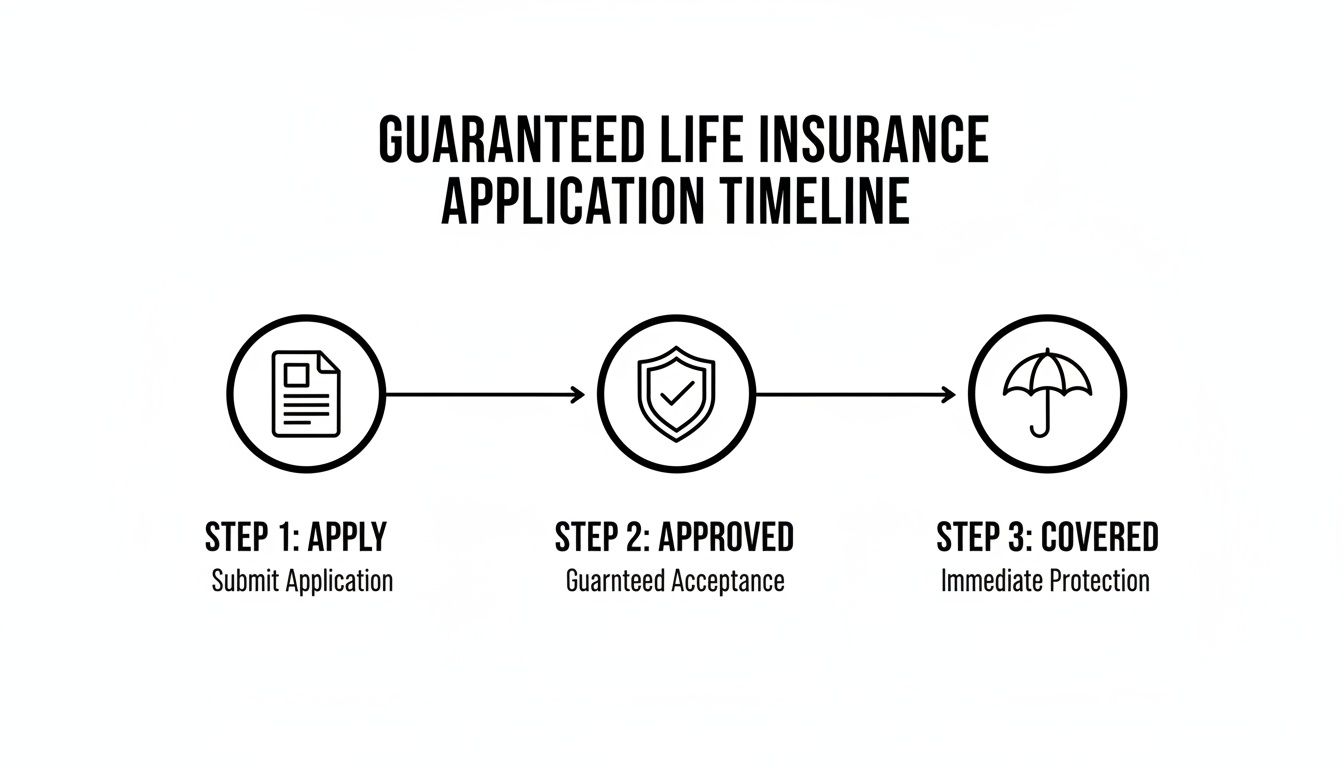
As you can see, approval is fast, and you get a level of protection right away, even with the graded benefit structure in place.
A Real-World Example
Let's walk through a clear example to see this in action. Suppose Robert buys a $20,000 guaranteed life insurance policy that has a two-year graded death benefit.
Scenario A: Death in Year One
Robert passes away from a heart attack 14 months after buying the policy. Because this is a natural cause of death inside the graded period, his beneficiary will not receive the $20,000. Instead, they will get a full refund of the 14 months of premiums he paid, plus interest.
Scenario B: Death in Year Three
Robert passes away from the same heart condition, but this time it’s three years after he bought the policy. Since he is now past the two-year graded period, his beneficiary receives the full $20,000 death benefit, tax-free.
This structure is a trade-off. You get guaranteed approval, and in exchange, the insurer limits its immediate risk for non-accidental deaths. It's a protection for them that makes this type of policy possible. That's why understanding every part of your coverage is so important; for more on this, take a look at our guide on how to read a life insurance policy. It’ll help ensure you and your beneficiaries know exactly what to expect.
Modern Alternatives For More Coverage
While guaranteed life insurance is a critical safety net for people with serious health problems, one of the most common—and costly—mistakes we see is assuming it’s the only way to get coverage without a medical exam. Many folks in good or decent health end up with these high-cost, low-benefit plans when they could have easily qualified for something much better.
The truth is, the world of "no-exam" life insurance is much bigger and more interesting than just guaranteed issue. Modern insurers have found faster, smarter ways to approve people, often without ever asking for a doctor's visit or a blood test. These alternatives can provide a whole lot more coverage for a fraction of the cost, making them the right choice for the vast majority of applicants.
The Power of Simplified Issue Policies
Think of simplified issue life insurance as the happy middle ground. It sits right between a policy that requires a full medical exam and one that guarantees approval with no questions asked. It’s built for people in reasonably good health who want to skip the hassle of an exam but are fine with answering a few health questions.
Instead of a deep dive into your medical history, a simplified issue application relies on a short set of "yes" or "no" questions about major health events.
- Have you been diagnosed with cancer in the last five years?
- Do you have HIV or AIDS?
- Have you been advised to have an organ transplant?
If you can honestly answer "no" to these knockout questions, you're likely a great candidate. These policies can offer coverage up to $500,000 or more, and approvals often come through in days, not weeks. They're a fantastic option for people with well-managed conditions like high blood pressure or cholesterol—those who might not get the absolute best rates but are far too healthy for an expensive guaranteed plan.
If this sounds like it might fit your situation, you can take a closer look at our guide on simplified issue life insurance to learn more.
Accelerated Underwriting: The New Standard
For healthy applicants, the best modern alternative is accelerated underwriting. This tech-driven process uses data analytics to approve policies quickly and affordably, often without any medical exam whatsoever.
It's how platforms like Coveredly can offer significant coverage amounts—sometimes up to $3 million—in a fraction of the time it used to take. Here’s a quick look at how it works:
- You start by filling out a detailed online application about your health and lifestyle.
- The insurer’s algorithm then cross-references your answers with third-party data sources, like your prescription history and motor vehicle records, to verify the information.
- If the data confirms you’re a low-risk applicant, you can get approved for a fully underwritten policy at a great rate, often within minutes or hours.
Accelerated underwriting isn't a different type of policy; it's a faster, smarter way to approve a traditional term or whole life policy. It gives you the same low costs and high coverage amounts as a fully underwritten plan but skips the time-consuming exam for most healthy people.
The insurance market is constantly evolving to meet people where they are, especially since so many feel underprotected. We're seeing a rise in products with guaranteed components, like indexed universal life (IUL), which shows a clear demand for more security. This kind of innovation directly addresses a significant protection gap, as an estimated 41% of U.S. adults feel their life insurance coverage is not enough, according to a Milliman report on market dynamics.
The bottom line is simple: unless you have severe or multiple pre-existing health conditions that have already caused you to be denied coverage, you should always explore these modern alternatives first. Don't pay the high price for guaranteed life insurance until you're absolutely certain you don't qualify for something better.
Got Questions About Guaranteed Life Insurance? Let's Answer Them.
As you dig into your options, questions are bound to pop up. Guaranteed life insurance is a different kind of product, and getting a handle on its quirks is the key to making a decision you feel good about. Let's clear up the confusion with some direct answers to the questions we hear all the time.
We'll tackle the big ones head-on, from whether you can actually be turned down to what the deal is with cash value. The goal here is simple: to give you the practical knowledge you need to decide if this is the right final piece of your financial puzzle.
Can You Ever Be Denied Guaranteed Life Insurance?
It seems like a trick question, but the answer is yes, you can be denied guaranteed life insurance—though it’s incredibly rare. The "guarantee" is all about your health. You won't be turned down because of pre-existing conditions, your medical history, or the prescriptions you take.
But insurers do have a few other non-medical boxes you need to check. A denial almost always happens because an applicant doesn't meet one of these basic eligibility rules.
Here are the usual suspects for a rejection:
- Age: These policies have a strict age window. Most are for applicants between 45 and 85 years old. If you're younger or older than that range, you won't qualify.
- Location: Not every insurance product is sold in every state. If the policy isn't licensed for sale where you live, the company legally can't offer it to you.
- Fraudulent Information: This one’s a no-brainer. If you provide false information—like fudging your age or identity—the application will be denied immediately.
For the vast majority of people who meet the simple age and residency rules, approval is practically a sure thing. The entire point of this policy is to offer a direct path to coverage for those who are locked out of other options, and insurers keep the process as simple as possible.
Is The Cash Value A Good Investment?
In a word: no. While it’s true that almost all guaranteed life insurance policies are a form of whole life insurance and do build a small amount of cash value, you should never think of this feature as an investment.
Think of the cash value as a minor, secondary perk, not a reason to buy the policy. The growth is exceptionally slow and the amount is tiny, especially when you consider the high premiums you're paying for a relatively small death benefit.
The primary purpose of a guaranteed issue policy is to provide a death benefit to cover final expenses. The cash value component is simply too small and grows too slowly to function as a meaningful way to build wealth.
If your goal is to invest or save for the future, you'd be far better off with financial products designed for that purpose, like a 401(k) or an IRA. The cash value in a guaranteed policy might eventually add up to a small sum you could borrow against or cash out, but its performance doesn't even come close to what a true investment vehicle can do. It's a small bonus, not a strategy for building wealth.
What Happens If You Stop Paying Premiums?
If you stop paying the premiums on your guaranteed life insurance policy, it will eventually lapse. Once a policy lapses, your coverage ends, and the insurance company is no longer on the hook to pay a death benefit to your loved ones.
Because these are whole life policies, you typically don't get back the premiums you’ve already paid, particularly if the policy lapses in the first several years. That money has gone toward the cost of the insurance itself and administrative fees.
Now, if you've been paying consistently for many years, you might have built up enough cash value to trigger what’s called a "non-forfeiture option." These could include:
- A Reduced Paid-Up Policy: The cash value you've built is used to buy a much smaller policy that is completely paid for, with no more premiums due.
- Cash Surrender: You can cancel the policy entirely and receive whatever cash value has accumulated, minus any fees.
Just remember, it takes a very, very long time to build enough value for these options to be meaningful. That’s why it’s so important to pick a premium you know you can comfortably afford for the long haul to keep your coverage secure.
Are There Better Options For Minor Health Issues?
Absolutely. And honestly, this might be the most important takeaway. Guaranteed life insurance should always be your plan of last resort, never your first choice. It's built specifically for people with serious health conditions who have already been turned down for other types of coverage.
If your health problems are minor or well-managed—things like controlled high blood pressure, high cholesterol, or managed diabetes—you are almost certainly a great candidate for a much better and more affordable policy. These other options give you way more coverage for far less money.
Before you ever settle for a high-cost guaranteed plan, make sure you explore these other "no-exam" options first:
- Simplified Issue Life Insurance: This type of policy asks a few health questions but doesn't require a medical exam. It can offer much higher coverage amounts (often up to $500,000) for significantly lower premiums.
- Accelerated Underwriting: This modern approach uses data and technology to quickly approve healthy applicants for standard term life policies, often without an exam. It can open the door to coverage of $1 million or more.
Don't just assume your health will knock you out of the running. So many people overestimate how much their health conditions will affect their eligibility. Always try to qualify for a more traditional policy first—it could save you thousands and give your family much greater protection.
Finding the right life insurance doesn't have to be complicated. At Coveredly, we make it simple to explore your options and find a policy that fits your life and budget, with no medical exams for most applicants.