When you hold your newborn for the first time, your entire world shifts. That overwhelming wave of love comes with an equally powerful sense of responsibility. For new parents, life insurance isn't just another item on a financial checklist—it's the financial car seat for your family. It’s the essential safety device you put in place, hoping you’ll never need it, but knowing you can’t imagine life without it. This guide on life insurance for new parents will help you make the best choice for your growing family.
Why Life Insurance Is a New Parent's First Priority
Becoming a parent reshapes your priorities in a heartbeat. Suddenly, you're responsible for a tiny human who depends on you for absolutely everything. This new reality makes financial protection more than just a good idea; it becomes an urgent necessity. A solid life insurance policy provides a critical safety net, ensuring your child can be cared for financially, no matter what happens down the road.
This modern family is securing their future, a crucial step for any new parent.
The Modern Parent's Dilemma
Many of today's parents are starting families a bit later in life, often after focusing on a career or buying a home. While this brings financial stability, it also creates a unique challenge. Choosing the right life insurance coverage becomes a key decision.
Research from LIMRA shows a staggering 68% of adults under 40 see life insurance as essential for a healthy financial future, yet many put off getting it. The gap between knowing you need it and actually buying it is where so many new parents get stuck. But getting coverage doesn't have to be a complicated chore—in fact, it has never been easier for busy parents to get straightforward, reliable protection.
From Chore to Act of Love
Thinking about life insurance can feel overwhelming, but it helps to reframe it. This isn't just a complex financial task. It's one of the most powerful expressions of love you can give your new family—a promise that their dreams and opportunities will always be protected.
The reasons for getting life insurance for new parents are simple but incredibly powerful. It all comes down to building a shield around your family’s future.
We’ve summarized the most critical reasons in the table below.
Top 5 Reasons New Parents Need Life Insurance
| Reason | What It Protects |
|---|---|
| Income Replacement | Your family's ability to pay bills, the mortgage, and daily expenses. |
| Childcare Costs | The surviving parent’s ability to work without facing financial strain from childcare expenses. |
| Future Education | Your child's opportunity to go to college or pursue their dreams. |
| Debt Repayment | Your family’s freedom from inheriting debts like a mortgage, student loans, or credit cards. |
| Peace of Mind | Your ability to focus on the joyful moments of parenthood, knowing they're secure. |
By securing a policy, you're not just buying a product; you’re building a financial foundation that allows your family to thrive, no matter what.
For a deeper look into the fundamentals, check out our complete guide on what life insurance is and why you need it. This simple action provides lasting peace of mind, letting you focus on what really matters.
How to Calculate the Right Amount of Coverage
Deciding to get life insurance is a huge first step. But the next question can feel even bigger: how much coverage do you actually need? This is a key part of financial planning for new parents.
For new parents, this isn’t about guessing or pulling a number out of thin air. It’s about creating a real, reliable safety net that’s built specifically for your family’s future.
Thankfully, you don’t need a finance degree to get a solid estimate. One of the most popular and straightforward methods is the DIME formula. It’s a simple acronym that helps you walk through the four biggest financial responsibilities your family would face if you were gone.
The DIME Formula Explained
The DIME method gives you a clear roadmap to follow. It’s an easy way to turn a huge, overwhelming question into a simple addition problem, helping you determine your ideal death benefit.
Here’s what it stands for:
- Debt: This includes all your non-mortgage debts—think student loans, car payments, and any lingering credit card balances. These are the obligations you don’t want to leave behind for your partner or family to worry about.
- Income: How much of your annual income would need to be replaced? Multiply that by the number of years your family will need support, which is typically until your youngest child is financially independent.
- Mortgage: The remaining balance on your home loan. Paying this off would lift a massive weight, ensuring your family can stay in their home without the stress of a monthly mortgage payment.
- Education: This is for the future. Factor in the estimated cost of college, trade school, or other educational goals you have for your children.
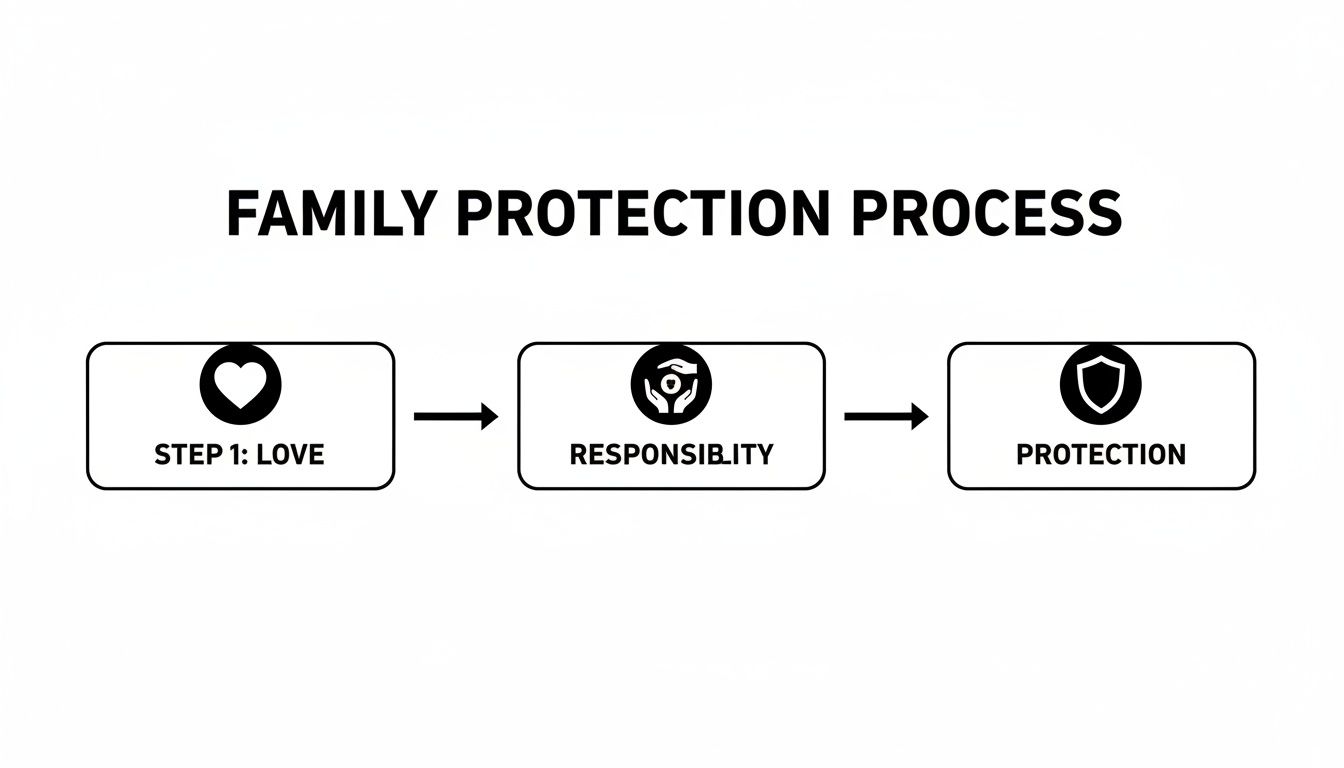
It's a process that moves from the love and responsibility you feel as a parent to the practical, powerful step of protecting their future.
A Real-World Example: Meet Alex and Jordan
Let's put this into practice. Meet Alex and Jordan, a couple navigating the beautiful chaos of life with a new baby. They know they need life insurance but feel stuck on the "how much" part.
First, they jot down their financial picture:
- Combined Income: $120,000 per year
- Remaining Mortgage: $300,000
- Student Loans: $40,000
- Car Loan: $15,000
- Credit Card Debt: $5,000
Now, let's walk through the DIME formula with them to see how a real number takes shape.
D (Debt): They add up all their debts, leaving out the mortgage for now.
$40,000 (Student Loans) + $15,000 (Car Loan) + $5,000 (Credit Cards) = $60,000I (Income): They decide to get a policy for Alex first. They want to replace his $70,000 salary for 20 years, long enough to see their child through college.
$70,000 x 20 years = $1,400,000M (Mortgage): Their outstanding mortgage balance is $300,000.
E (Education): They look ahead and estimate that college costs for one child could be around $200,000.
With all the pieces on the table, the last step is to simply add them all together.
Alex & Jordan's Total:
$60,000 (Debt) + $1,400,000 (Income) + $300,000 (Mortgage) + $200,000 (Education) = $1,960,000
Suddenly, a big number starts to make sense. Based on their calculation, a $2 million term life insurance policy for Alex would be an excellent choice, giving their family a comprehensive financial cushion. Jordan would then do a similar calculation to figure out her own coverage needs.
Even with a solid number in mind, it's natural to wonder about the monthly cost. Premiums are influenced by your age, health, and coverage amount. You can get a better sense of what to expect by looking into the average life insurance costs per month.
The DIME formula isn't about finding a perfect, magical number. It's about empowering you to choose a coverage amount that’s grounded in your family’s real-world needs, so you can move forward with confidence.
Alright, you’ve figured out how much coverage your family needs. Now comes the next big decision: what kind of policy is the right fit? When you start looking at life insurance for new parents, you'll quickly see two main players: term and permanent. This choice is a big deal because it shapes both your monthly budget and your long-term financial plan.
I’ve always found it helpful to think about it like housing.
Term life insurance is like renting an apartment. You get affordable protection for a specific period of time—the "term"—which is perfect for the years your kids are young and depending on you for everything.
Permanent life insurance is like buying a house. It costs more upfront, it’s designed to last your entire life, and it builds equity through something called "cash value." While that might sound great on paper, it's usually not the right move for young families trying to make every dollar count.

Why Term Life Is the Go-To for Most New Parents
Let’s cut to the chase: for the vast majority of new parents, term life insurance is the clear winner. Its biggest superpower is affordability. Because it only covers a set window of time—say, 20 or 30 years—you can get a massive death benefit for a surprisingly low monthly payment. This means you can lock in millions of dollars in protection during the years your financial risk is at its peak, all without blowing your budget.
Think about it. Your greatest need for life insurance is right now, when your kids are little, your mortgage is huge, and your savings are just getting started. Affordable life insurance is built for exactly this chapter.
A term life policy provides maximum protection when you need it most. It aligns perfectly with the timeline of raising a family, ensuring that if anything were to happen, your children would be financially secure until they can support themselves.
The other huge plus is simplicity. Term life is pure protection. There are no confusing investment accounts or hidden fees to worry about, which makes it incredibly easy to understand and manage. This no-fuss approach has become more and more popular, especially with younger families seeking family financial protection.
Term Life vs. Permanent Life: Which Is Right for Your Family?
While permanent life has its uses—mostly for complex estate planning for the very wealthy—its high costs and bundled investment features are major drawbacks for new parents. That "cash value" component grows incredibly slowly, often gets eaten up by high fees, and is almost always a less efficient way to save than just putting your money in a 401(k) or an IRA.
To make it even clearer, let's put them side-by-side to see which is a better fit for your family's goals and budget.
Term Life vs. Permanent Life: Which Is Right for Your Family?
| Feature | Term Life Insurance | Permanent Life Insurance |
|---|---|---|
| Cost | Significantly lower premiums for a high death benefit. | 5 to 15 times more expensive than a comparable term policy. |
| Duration | Covers a specific term (e.g., 10, 20, or 30 years). | Lasts your entire life as long as premiums are paid. |
| Main Purpose | To provide a large, affordable safety net during your highest-need years (raising kids, paying off a mortgage). | Lifelong coverage, estate planning, and a tax-deferred cash value savings component. |
| Best For | Nearly all new parents who need maximum protection on a budget. | High-net-worth individuals with complex estate needs or those who have maxed out other investment vehicles. |
The market data backs this up. We know that while only 52% of Millennials have life insurance, cost is one of the biggest things holding them back. At the same time, we're seeing a huge surge in term life sales, driven by competitive digital pricing that makes it more accessible than ever. It shows that when given the choice, families are voting for the simplicity and incredible value that term policies offer. You can see more on these trends in life insurance ownership for yourself.
For new parents, the decision is almost always straightforward. Locking in a solid term life policy gives you the complete peace of mind you need. It lets you stop worrying and get back to focusing on the joys of parenthood, knowing your family is 100% protected.
Selecting Your Policy Term Length and Riders
Once you’ve settled on term life insurance, it’s time to make it your own. This is where you move beyond the basics and start fine-tuning the policy to fit your family’s specific timeline and potential curveballs. You’ll choose how long your coverage lasts (the term) and decide if you want to add optional features called “riders.”
Think of your term length as a financial bridge. You want it to be long enough to get your family safely from today to the day your kids are standing on their own two feet, financially independent. For most new parents, that means looking at a timeline that stretches until your youngest is out of college and launched into their own career.

The trick is to work backward from your biggest financial finish lines—like a paid-off mortgage and the last college tuition check clearing.
How to Choose the Right Term Length
The whole point is to align your coverage period with your longest-running financial responsibilities. If you’re holding a newborn, your financial runway is going to last for at least the next 20 to 25 years. This is exactly why 20-year and 30-year term policies are the go-to choices for new parents.
For a new parent, a 30-year term policy is often ideal. It provides a consistent, affordable safety net that covers everything from daycare costs and the mortgage to high school sports and college tuition, ensuring protection throughout your child’s entire journey to adulthood.
Here’s the real advantage: choosing a longer term when you’re young and healthy locks in the lowest possible rate for the entire duration. It’s a huge win, protecting you from having to buy a more expensive policy later in life when your age and health will work against you.
Customizing Your Policy with Riders
Riders are simply optional add-ons that give your policy extra powers beyond just the standard death benefit. They provide more specific financial help for certain life events, turning a basic policy into a much more comprehensive safety net. These life insurance riders are crucial for comprehensive planning.
It's no surprise that younger buyers are looking for this kind of robust protection. Research shows that about 25% of under-40s prioritize policies with "living benefits" that can offer support for events beyond death. You can learn more about what younger generations want from insurance and see how the industry is evolving.
While riders aren't exactly the same as living benefits, they come from that same desire for more complete protection. Here are the most valuable riders for new parents to consider:
Child Rider: This is a popular and incredibly cost-effective add-on. It provides a small amount of life insurance for your children under your own policy—and it usually covers all of your kids (present and future) for one small, flat fee. Later on, this can often be converted into a small permanent policy for them, no medical exam required.
Waiver of Premium Rider: Think of this as policy insurance. If you become totally disabled and can’t work, this rider kicks in and pauses your premium payments while keeping your life insurance completely active. It ensures your family’s financial protection stays in place even if you lose your income due to a serious illness or injury.
Accelerated Death Benefit (ADB) Rider: Often included at no extra cost, this rider is a compassionate and practical feature. It allows you to access a portion of your own death benefit while you are still alive if you're diagnosed with a terminal illness. These funds can be used for anything—medical bills, in-home care, or even just creating lasting memories with your family—easing the financial strain during an already difficult time.
The Modern No-Exam Application Process
For many new parents, the biggest hurdle to getting life insurance isn't the cost or the coverage amount—it's the idea of a complicated, time-consuming application. Scheduling medical exams, giving blood samples, and then waiting weeks for an answer is enough to make anyone put it off. Thankfully, that old-fashioned process is quickly giving way to a much simpler, faster digital experience.
The single biggest shift in getting life insurance for new parents is the rise of no-exam policies. Instead of relying on in-person exams, these policies use powerful data to evaluate your application instantly. For healthy applicants, this means you can often get approved for coverage in minutes, not weeks, all from your phone or computer.
The New Way to Buy Life Insurance
This modern approach cuts out all the friction that used to make buying a policy feel like a chore. For busy parents juggling a newborn and a chaotic schedule, it’s a total game-changer. You no longer have to find a babysitter or take time off work just to meet with a nurse.
Instead, the online life insurance application is built for your life. You’ll answer a series of straightforward questions about your health, lifestyle, and family history, and the insurer’s technology will quickly assess your information to make a decision.
Here’s an example of what a clean, simple digital quote interface might look like.
This clean layout shows how you can adjust coverage and term lengths to see an instant price update, making the whole process transparent and easy to navigate.
Your Step-by-Step Digital Application Guide
Getting your family protected online is incredibly straightforward. The entire journey, from getting a quote to activating your policy, can often be done during your baby's naptime.
Here’s what the process usually looks like:
Get an Instant Quote: You'll start by entering some basic, non-personal information like your age, gender, and the coverage amount you're considering. In seconds, you’ll see an estimated monthly premium.
Complete the Online Application: Once you find a price that works for you, you'll move on to the full application. This is where you’ll answer more detailed questions about your health and lifestyle. Be honest—it’s crucial for ensuring your policy is valid down the road.
Receive an Instant Decision: For most healthy people, the system provides an immediate decision. If you’re approved, you can review your final offer right away.
E-Sign and Activate: The last step is to review your policy documents, name your beneficiaries, and provide a payment method. You’ll electronically sign your policy, and just like that, your family is protected.
The entire process is designed to be completed in about 10 minutes. It’s proof of how much easier it is to get vital financial protection for your family.
This efficiency is a lifesaver for parents who need solid coverage without the old-school hassle. If you're interested, you can learn more about how simplified issue life insurance makes this fast-track approval possible. The fear of a complex application process should no longer be what stops you from securing your family’s future.
Your Top Life Insurance Questions, Answered
Once you get the basics of life insurance down, a whole new set of "what if" questions usually pop up. It's completely normal. You're not just buying a policy; you're trying to make sure you've covered every angle for your family's future.
We get it. Here are straightforward answers to the most common questions we hear from new parents, so you can feel confident you're making the right moves.
Should Both Parents Get a Life Insurance Policy?
Yes, without a doubt. It’s a huge mistake to think only the primary earner needs coverage. This thinking completely misses the massive economic value a stay-at-home parent or a lower-earning partner brings to the table. This is a critical aspect of estate planning for parents.
Just try to imagine the cost of replacing everything they do. Childcare alone can run into the tens of thousands each year. Then add cooking, cleaning, school runs, and managing the entire household—the financial hit from their absence would be staggering.
Securing a policy for both parents is one of the most important things you can do. It ensures the whole family unit stays stable, giving the surviving parent the resources to truly maintain the family's life, not just scramble to replace an income.
Think of it like this: your family is a home held up by two pillars. If one is suddenly gone, the other needs serious support to keep everything from falling apart.
Is Life Insurance from My Job Enough?
Employer-provided life insurance is a great perk, but for new parents, it's almost never enough. It's best to see it as a small bonus, not your main financial safety net.
There are two big reasons for this:
- The Coverage is Usually Too Small: Most group plans only offer a death benefit that’s 1 to 2 times your annual salary. When you think about the DIME method—covering your mortgage, replacing your income for 20+ years, and saving for college—that amount just doesn't cut it.
- It Isn't Portable (This is the big one): Your policy is tied to your job. If you switch companies, get laid off, or go out on your own, you lose your coverage. You're then forced to shop for a new policy when you're older, and your rates will be significantly higher.
Owning a private term life policy that you control is the only way to lock in a stable, reliable safety net that follows you no matter where your career goes.
When Is the Best Time to Buy Life Insurance?
The absolute best time to buy life insurance is right now. It might feel like you have a million other things on your to-do list, but when it comes to life insurance, procrastination is your worst enemy.
Premiums are set based on two main things: your age and your health. The younger and healthier you are, the cheaper your rates will be. Even better, you can lock in that low rate for the entire term of the policy, which could be up to 30 years.
Waiting even a year or two can cause a noticeable jump in your monthly premium. Putting it off for five or ten years could literally cost you thousands of extra dollars over the life of the policy. The ideal time is during pregnancy, even before the baby arrives. Locking in that low rate today is one of the best financial gifts you can give your family.
Can I Get Covered If I Had Pregnancy Complications?
For most people, the answer is yes. It's a common worry that having something like gestational diabetes or preeclampsia will make it impossible to get affordable coverage. But insurers are mostly focused on your current, long-term health.
If those conditions went away after delivery, they typically won't stop you from getting a great policy. Underwriters know that pregnancy can cause temporary health shifts. As long as you're healthy otherwise, you can often qualify for excellent rates.
The key is to be 100% honest on your application. Insurers can access your medical records, so transparency is everything. Don't let a past complication scare you away from applying—many modern carriers can assess your situation quickly and fairly, often without even needing a medical exam.
Do I Need a Will Too?
Yes. A will and life insurance are two different tools that work together to create a complete protection plan for your family. They are both equally critical.
- Life Insurance provides the money your family will need to carry on.
- A Will provides the instructions for who will care for your child and how your assets should be handled.
If you don't have a will, a court will decide who becomes your child’s legal guardian. No parent wants a stranger making that choice. A will is the only legal document where you can name the person you trust to raise your child if you and your partner are gone.
Creating a will isn't the complex, expensive process it used to be. Online services now let you create a legally binding will in just a few minutes, making it incredibly easy for busy parents to check this off their list.
How Do I Choose a Beneficiary for My Child?
This seems simple on the surface, but there’s a crucial detail every new parent needs to know: you should never name a minor child as your direct beneficiary.
Legally, kids can't inherit or manage large sums of money. If you name your child on the policy, a court will have to step in and appoint a financial guardian to oversee the funds until your child turns 18. It’s a slow, expensive, and public process—exactly what you want to avoid.
You have two much better options:
- Name Your Spouse: This is what most couples do. You name each other as the primary beneficiary, which gives the surviving parent immediate access to the funds to care for the family.
- Create a Trust: For the most control, you can set up a trust and name the trust as the beneficiary. You then appoint a trustee (often the same person you chose as guardian) to manage the money according to your specific rules, like setting age milestones for when your child receives the funds.
Taking this extra step ensures the money is managed exactly how you want, providing seamless support for your child. Proper planning for life insurance for new parents is all about getting these details right so your protection truly works when it matters most.
Protecting your family’s future is the most important promise you can make as a new parent. With Coveredly, you can get a term life insurance policy that fits your life and your budget, often in just minutes and without a medical exam.
Get your free quote from Coveredly today and secure your family's tomorrow.