Your parent mentions they want to “get things in order,” and suddenly a topic you've avoided becomes real. You're not just thinking about death. You're thinking about funeral costs, unpaid bills, a surviving spouse, and whether you'd be left trying to solve a financial problem in the middle of grief.
That's why life insurance for parents over 60 comes up so often in families. It's practical, emotional, and easy to misunderstand. In the United States, over 31.7 million life insurance policies were held by individuals aged 60 and above in 2023, and over 62% of those policyholders used them for estate planning and final expense coverage, according to senior life insurance market data. You're far from the only adult child trying to figure this out.
The hard part is that there isn't one answer for every family. A healthy parent in their early 60s has very different options from a parent in their late 70s with medical conditions. Cost, legal eligibility, and the right type of policy all depend on details that are typically unknown until one begins their search.
Table of Contents
- Is It Time to Think About Life Insurance for Your Parents?
- Decoding Your Options Policy Types for Parents Over 60
- What to Expect on Price Sample Quotes and Key Cost Factors
- Navigating the Application No-Exam Policies and Legal Hurdles
- How to Calculate the Right Amount of Coverage
- Your 5-Step Guide to Getting Coverage for Your Parents
- Making a Confident Decision for Your Family
Is It Time to Think About Life Insurance for Your Parents?
Many adult children arrive at this question gradually. A parent retires. Another has a health scare. You realize no one has talked through burial wishes, debts, or what happens if a surviving parent needs help after a loss. The concern often starts small, then becomes urgent.
It can also feel awkward. You may worry that bringing up life insurance sounds cold or intrusive. Most parents hear it differently when the conversation is framed the right way. This isn't about putting a price on their life. It's about protecting dignity, preserving choices, and avoiding chaos later.
Signs the conversation shouldn't wait
Some families benefit from acting sooner rather than later.
- Shared financial exposure: You help with housing, medical costs, or other regular expenses.
- Loose ends: Your parent has debts, limited savings for final expenses, or no written plan.
- Health changes: Even modest health issues can narrow options and affect cost.
- Family complexity: There are siblings, a surviving spouse, or estate concerns that could create confusion.
A delayed decision can turn a manageable planning task into a rushed purchase with fewer options.
A useful mindset is to separate the emotional question from the product question. First ask, “Would your family face a financial problem if this parent died?” If the answer is yes, then life insurance may be worth exploring. After that, you can decide what kind of policy, if any, fits the situation.
Some parents over 60 still need substantial coverage. Others only need enough for funeral costs, medical bills, or a small buffer for loved ones. That difference matters. It changes what type of policy you should even bother pricing.
Decoding Your Options Policy Types for Parents Over 60
A lot of adult children get stuck here. They know there may be a financial risk if a parent dies, but the policy names start to blur together. The easiest way to sort them is to match each policy to the job it is meant to do.
Most choices for parents over 60 fall into three buckets: term life, final expense or whole life, and guaranteed issue. Each one solves a different kind of problem. Shopping gets frustrating when a family wants lifelong burial coverage but keeps pricing term, or needs a larger temporary safety net but only looks at small final expense plans.
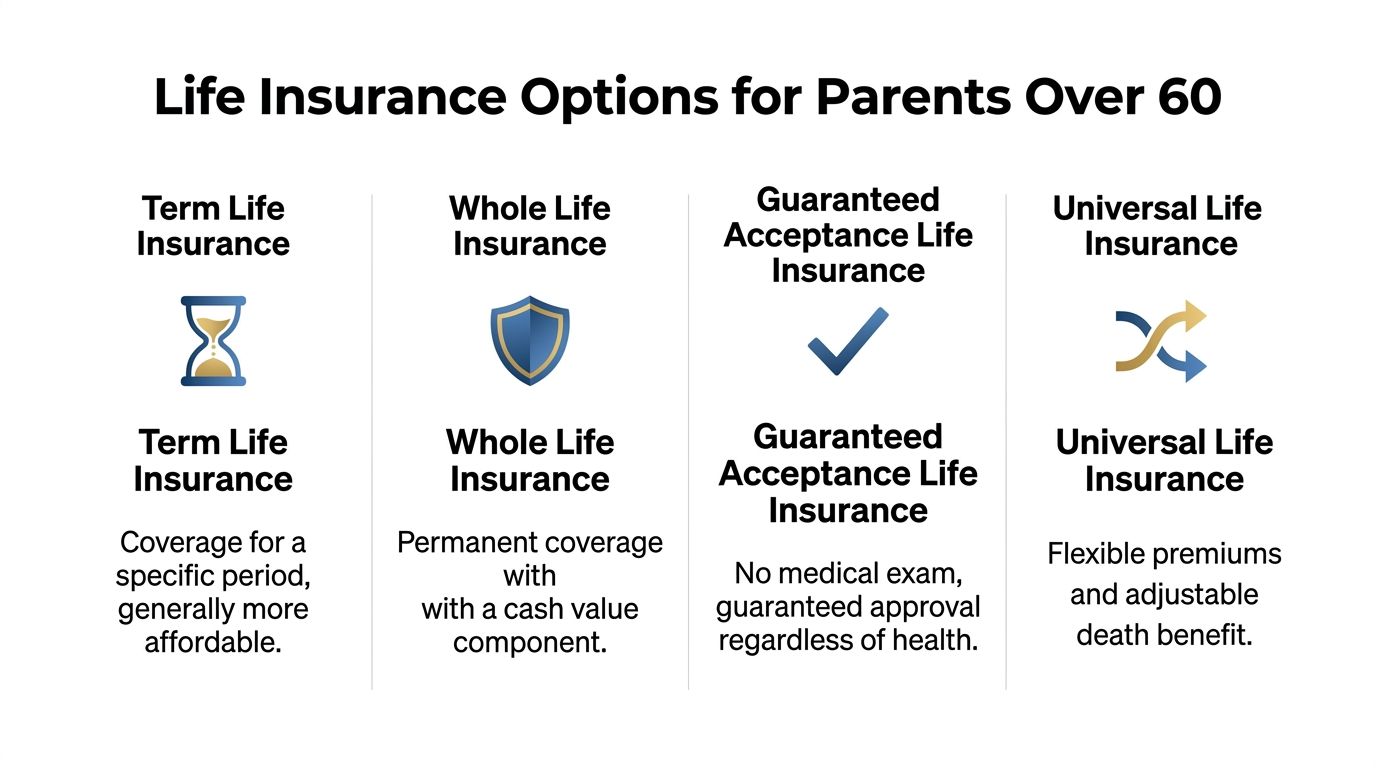
A simple filter helps: ask how long the need will last, how much coverage is needed, and whether health is likely to limit approval.
When term life makes sense
Term life covers a set period, such as 10, 15, or 20 years. It works like renting coverage for a defined window of time. Because it is temporary, it can sometimes offer a larger death benefit than permanent coverage for the same parent.
This type usually fits a temporary need. Maybe your mother still has a mortgage. Maybe your father supports a spouse who would struggle for the next decade. Maybe you and your siblings would need time to absorb housing or caregiving costs after a loss.
That said, term has an expiration date. If your parent outlives the term, the coverage usually ends unless the policy allows renewal or conversion. For older applicants, that matters a lot because replacing coverage later can become much more expensive. If you want a plain-English comparison of the two basic structures, this guide on term vs. whole life insurance can help.
When final expense or whole life fits better
Final expense insurance is usually a small whole life policy. The goal is narrower. Instead of replacing years of income, it is often meant to cover funeral bills, small debts, medical balances, or a modest amount left to family.
For many families, this is the cleaner fit because the need is permanent. Funeral costs do not disappear after 10 years. Neither does the desire to leave a small cushion so loved ones are not reaching for a credit card during a stressful week.
These policies are often appealing for three practical reasons:
- The coverage lasts for life as long as premiums are paid.
- The purpose is focused, which makes it easier to choose a realistic coverage amount.
- Premiums are usually predictable, so there is less guesswork for a parent on a fixed income.
The tradeoff is size. These policies are often better for targeted needs than for large income replacement.
When guaranteed issue is the fallback option
Guaranteed issue is often the last door still open when health has become a major barrier. Approval does not depend on a medical exam, and in many cases there are no health questions. That easier entry usually comes with lower coverage amounts and higher costs per dollar of coverage. NerdWallet's guide to senior life insurance explains how guaranteed issue differs from simplified issue, which asks some health questions but still skips the exam.
This option can make sense if your parent has serious medical conditions or has been declined elsewhere. It is less useful if you need a large policy, because the coverage is usually designed for final expenses, not major long-term income replacement.
One caution matters here. Many guaranteed issue policies have a graded death benefit. That means full benefits may not be available during the first few years unless death is caused by an accident. Families should read that part slowly. It is one of the most misunderstood details in this part of the market.
A practical decision framework for adult children
If you are the one doing the research, use this order:
- Define the job. Burial costs, a mortgage, support for a surviving spouse, or debt payoff all point to different policy types.
- Estimate the time horizon. A 10-year need and a lifelong need should not be priced the same way.
- Be honest about health. Health often determines whether term, simplified issue, or guaranteed issue is realistic.
- Check the legal setup. If you plan to own or pay for the policy, you usually need your parent's consent and a valid insurable interest. In plain English, you must show that their death would cause you a real financial loss, not just emotional loss.
- Set expectations before getting quotes. Small permanent policies are often more realistic than large late-life policies.
Decision shortcut: Use term for larger temporary needs, final expense for smaller lifelong needs, and guaranteed issue when health rules out other options.
That framework keeps the decision grounded in real family needs instead of product labels. It also helps you avoid sticker shock later, because the right policy type is usually the first and biggest pricing decision.
What to Expect on Price Sample Quotes and Key Cost Factors
A common family scenario goes like this. You ask for a quote thinking a policy will cost about as much as a cable bill, then the number comes back high enough to stop the conversation cold.
That reaction is normal. For parents over 60, price is often the hardest part of the decision, not because coverage is impossible, but because the math changes quickly with age and health. If you are the adult child comparing options, it helps to treat the quote as a budgeting exercise first and a product comparison second.
Why prices can jump so much by age
For a healthy applicant, the monthly premium for a $250,000 10-year term policy rises sharply as age increases. A healthy 60-year-old may pay about $63 to $83 per month, a healthy 70-year-old may pay $173 to $245 per month, and a healthy 80-year-old may face $718 to $960 per month for the same coverage, according to Policygenius pricing examples for seniors.
That pattern surprises families because the coverage amount stays the same while the price changes dramatically. Insurance works a lot like replacing a roof after years of wear. The job is the same, but the likelihood of a near-term claim is much higher, so the cost rises fast.
Sample monthly premiums for a 250000 term policy
| Age | Sample Monthly Premium Range |
|---|---|
| 60 | $63 to $83 |
| 70 | $173 to $245 |
| 80 | $718 to $960 |
The practical lesson is simple. Large policies can still look reasonable around age 60 for a healthy parent, get much harder to justify by 70, and often become budget-breaking by 80.
Sample monthly premiums for a 25000 final expense policy
Final expense pricing is less standardized across carriers, so broad ranges are more useful than pretending every quote should look the same.
| Age | Male | Female |
|---|---|---|
| 50s to early 60s | $25 to $80 | $25 to $80 |
| Early 60s healthy parent, 10-year term for modest coverage | $50 to $150 | $50 to $150 |
| 70+ final expense policy | $60 to $160 | $60 to $160 |
| Over 70 with health conditions, $10,000 to $25,000 final expense whole life | $50 to $100 | $50 to $100 |
As noted earlier, these examples are directional. The useful takeaway is that smaller permanent coverage is often more realistic than a large late-life policy, especially if your goal is to cover funeral costs, a small debt, or a brief income gap for a surviving spouse.
If your parent has some health issues but may still qualify without a full medical exam, it helps to review how simplified issue life insurance works for older applicants. That option often sits in the middle on price. It is usually more expensive than fully underwritten coverage and less expensive than guaranteed issue.
The five factors that usually shape the quote
A quote is basically the insurer answering one question. How likely is it that they will need to pay the benefit soon?
These factors do most of the work:
- Age at application: Older applicants usually pay more because the risk to the insurer is higher.
- Health history: Chronic conditions, recent diagnoses, hospital visits, and medications can all affect price and eligibility.
- Policy type: Policies with fewer health questions usually charge more for the same coverage.
- Coverage amount: More coverage means a higher premium, just as a larger mortgage means a larger payment.
- How long the policy needs to last: Lifetime coverage usually costs more than temporary coverage because the insurer expects to pay the claim eventually.
Here is a useful way to pressure-test a quote before your family says yes. Ask whether the premium still looks affordable if your parent keeps it for years, not months. A policy only helps if it stays in force.
Focus on the monthly payment and the job the policy needs to do. A smaller policy that stays affordable often protects the family better than a larger policy that gets canceled after a year.
That mindset helps avoid sticker shock and leads to better choices. It also gives you a clearer framework as the adult child doing the research. Start with the need, compare the likely price range, and rule out any option your parent probably will not keep.
Navigating the Application No-Exam Policies and Legal Hurdles
The application process for life insurance for parents over 60 isn't always as old-fashioned as people expect. Many insurers no longer require every applicant to schedule a nurse visit or complete a full medical exam. That change has made buying coverage less intimidating, especially for older adults who don't want one more appointment on the calendar.

How no-exam underwriting works
A modern no-exam process often relies on accelerated underwriting. For applicants with no significant medical history in the last two years, insurers may issue policies up to $750,000 without a physical exam by reviewing electronic health records and other data, according to Guardian's explanation of underwriting.
That usually means the insurer looks at records instead of asking your parent to complete a traditional exam. It can feel much smoother, but it still isn't a casual approval. The company is still evaluating risk. It's just using records, prescription history, and related information rather than a paramedical visit in every case.
If you want to understand how this path differs from full underwriting, a plain-language guide to simplified issue life insurance helps clarify what “no exam” usually does and doesn't mean.
What insurable interest really means
Many adult children encounter a hurdle here. You can't just decide to buy insurance on a parent because you love them or want to be prepared. The law usually requires insurable interest.
MoneyGeek explains the missing detail clearly. A purely personal or emotional connection doesn't meet the legal standard, and the coverage amount must be proportionate to the financial losses, such as co-signed loans or shared expenses, in this explanation of insuring a parent.
That rule confuses people because it sounds abstract. In plain English, the insurer wants to know whether your parent's death would create a real financial loss for you or someone else with a valid stake. A shared mortgage, financial dependence, or out-of-pocket obligations can support that case. Love alone can't.
If you can't explain the financial loss in a sentence or two, you may not be ready to apply yet.
The other hurdle is consent. Your parent has to be involved, aware, and willing. That's not a formality. It's a legal safeguard, and families should treat it that way.
How to Calculate the Right Amount of Coverage
Many families either overbuy from fear or underbuy because they only think about funeral costs. A better approach is to build the number from actual responsibilities. The goal isn't to guess. It's to arrive at a coverage amount you can defend.
A simple worksheet you can use
Use a fill-in-the-blanks approach with your parent. Write down the amounts that apply and skip the ones that don't.
- Final expenses: Funeral, burial, cremation, memorial, and related family travel.
- Medical bills: Any likely out-of-pocket balances you don't want landing on survivors.
- Shared debts: Mortgage balance, car note, personal loan, or credit card obligations tied to your parent.
- Co-signed risk: Any loan where you or another family member would be financially exposed.
- Support for a spouse: A cash cushion for housing, groceries, and basic bills.
- Legacy goal: A small gift, charitable intention, or amount set aside for grandchildren.
Add those items together. The total gives you a working target.
If you want help pressure-testing the number, this resource on how much life insurance you need can help organize the conversation.
A practical way to avoid overbuying
Try dividing the need into two buckets.
First, list the must-cover costs. These are the expenses that would create immediate hardship if your parent died soon. Second, list the nice-to-cover goals, such as leaving a gift or creating a larger family cushion.
That distinction matters because it helps you make tradeoffs without losing the plot. If the quote for the ideal number is too high, you can still protect the urgent costs first.
Reality check: The right amount of coverage isn't the biggest number you can buy. It's the amount that solves the problem your family would actually face.
A focused target also makes shopping easier. When you know the purpose of the policy, the right product tends to become more obvious.
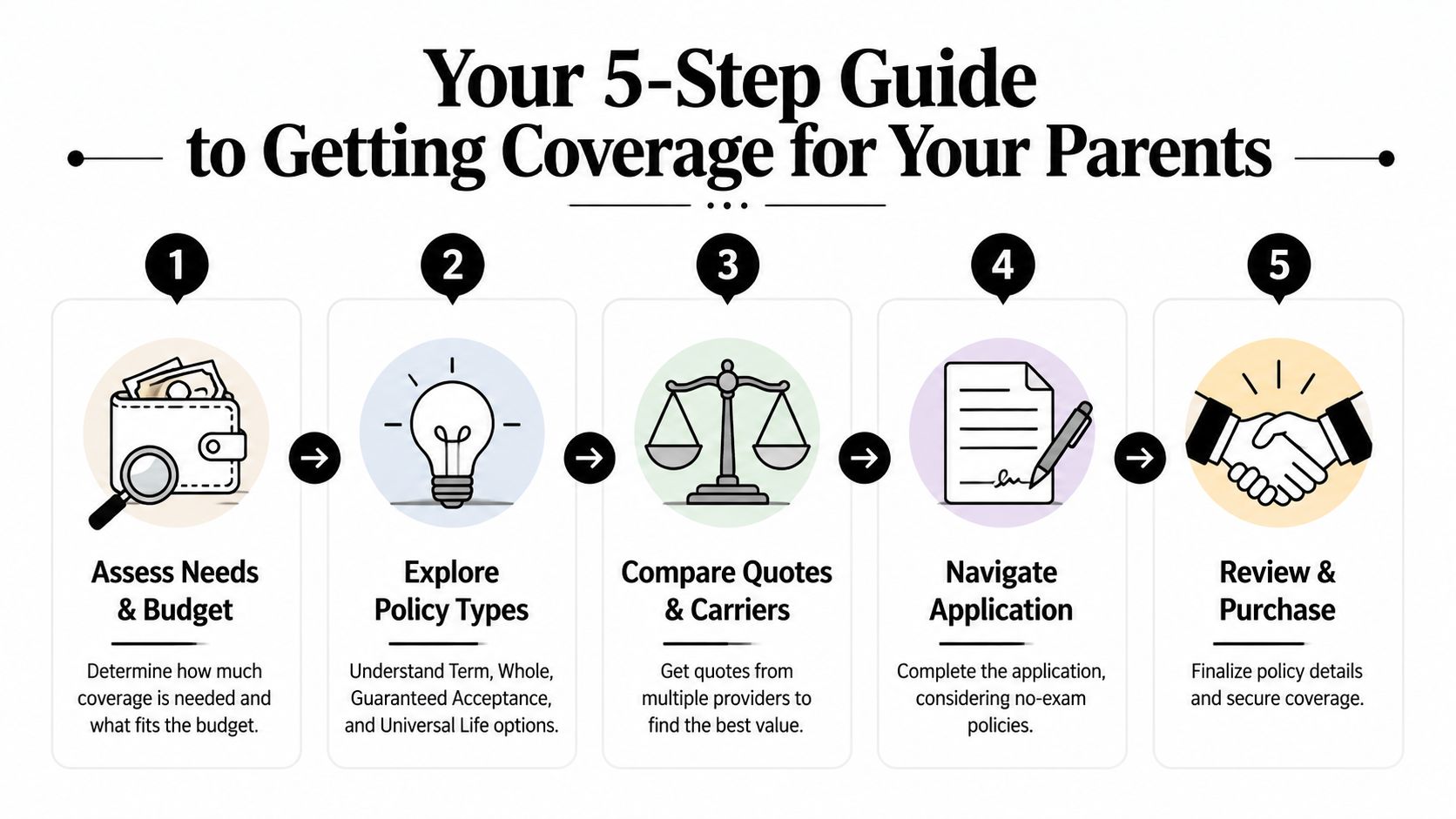
Your 5-Step Guide to Getting Coverage for Your Parents
The process feels more manageable when you treat it like a family project instead of a one-time shopping sprint. Take it one step at a time.
Step 1 start the conversation early
Pick a calm moment, not a crisis. A hospital stay, funeral, or family argument is usually the worst time to raise the topic.
You don't need a perfect script. Try something simple: you want to make sure the family isn't left scrambling later, and you'd like to understand what protections are already in place.
Step 2 gather the right details
You'll need basics before any useful quote comparison can happen.
- Health picture: Current conditions, recent diagnoses, medications, and tobacco history.
- Financial picture: Debts, monthly obligations, and any support a surviving spouse would need.
- Existing coverage: Employer policies, older life insurance contracts, burial plans, or veterans benefits.
- Personal preferences: Whether your parent wants temporary coverage, lifetime coverage, or just help with final expenses.
Step 3 choose the coverage target
Use the worksheet from the earlier section and agree on the number together. This keeps the search grounded in a purpose instead of drifting toward random quote shopping.
A clear target also makes difficult tradeoffs easier. If the budget is tight, you can decide whether the priority is a larger temporary policy or a smaller permanent one.
Before moving forward, remember the legal rule. To buy coverage on a parent, you must establish insurable interest and get explicit written consent from the parent, who must be legally competent to sign the application. A Power of Attorney is typically insufficient, according to Progressive's explanation of buying life insurance for parents.
A short explainer can help some families before they apply.
Step 4 compare policy types and quotes
Don't compare premiums in a vacuum. Compare what each policy is designed to do.
One quote may be cheaper because it expires. Another may cost more because it lasts for life. A no-exam option may feel easier, but the tradeoff could be lower coverage or stricter health questions in another part of the application.
Step 5 complete the application together
Sit with your parent while the application is filled out. That reduces mistakes and makes it easier to answer health and financial questions accurately.
Be careful here. A rushed answer can create problems later. It's better to pause, verify, and submit clean information than to guess.
Making a Confident Decision for Your Family
The best decision usually isn't the most complicated one. It's the one that matches the actual need, fits the budget, and can stay in force. For some families, that means a larger term policy while a major debt still exists. For others, it means a smaller final expense policy that protects survivors from immediate bills.
What matters most is clarity. Know why you're buying the coverage, whether your parent is eligible, and what the monthly cost will feel like in everyday life. That alone can prevent a lot of regret.
If you've been putting this off, start with the least intimidating step. Have the conversation. Ask what coverage already exists, what your parent wants, and what financial gap would be left behind. A calm, informed discussion now can spare your family from a much harder experience later.
If you're ready to explore a modern, straightforward way to shop for coverage, Coveredly offers online life insurance designed to be digital, affordable, and flexible. It's a practical place to compare options and see whether no-exam coverage may fit your situation.