You've got a new baby, a mortgage payment due, and a budget that suddenly feels tighter than it did a year ago. Maybe your spouse is asking whether the work benefits at least cover enough, or maybe you've been putting off life insurance because it still feels like one more adult decision you don't want to rush. A term life insurance policy is built for exactly this kind of season, when the biggest financial risks are tied to raising kids, keeping the home, and protecting income.
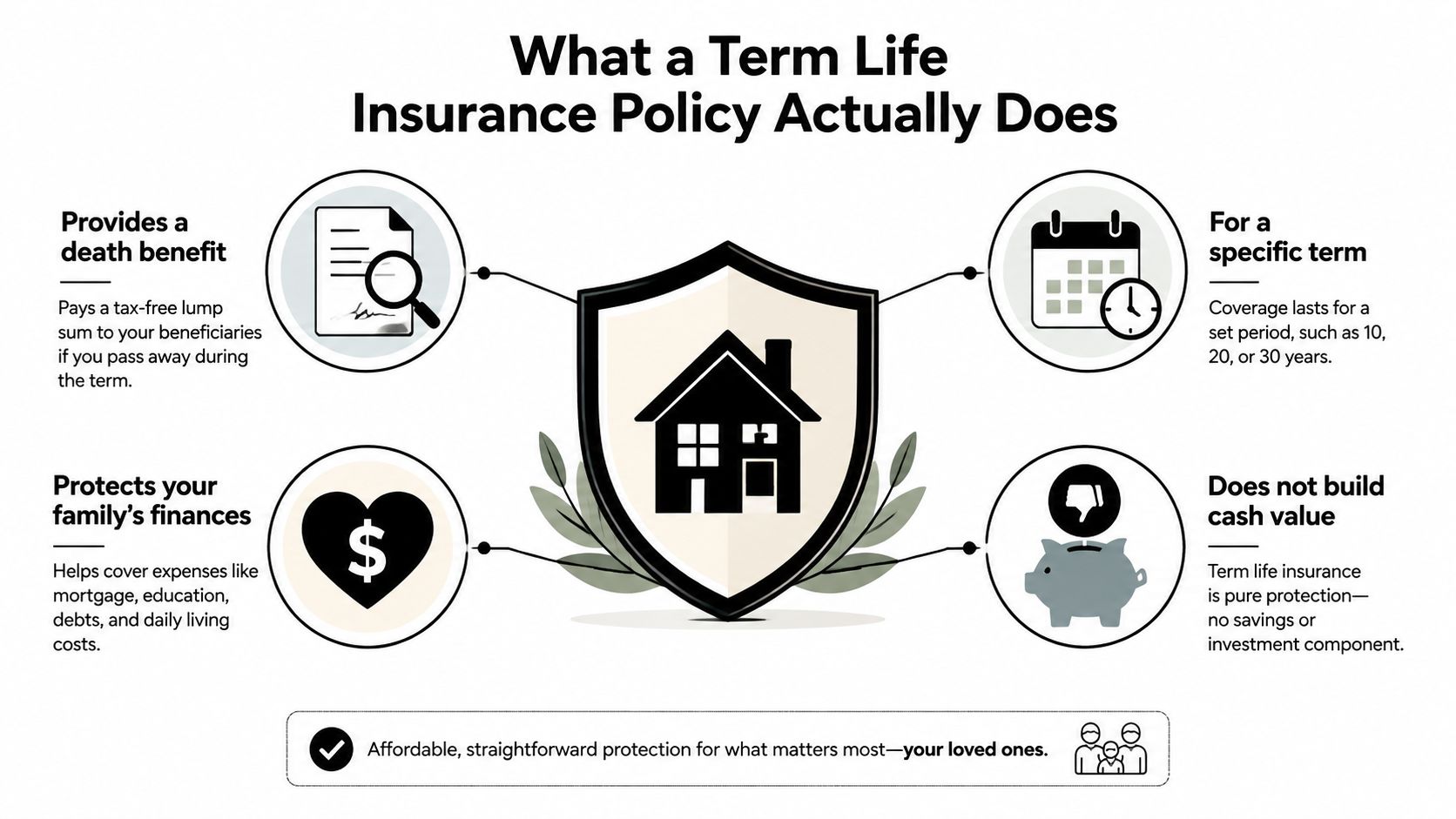
Table of Contents
- What a Term Life Insurance Policy Actually Does
- How Term Length, Coverage Amount, and Premiums Work
- What Actually Drives the Cost of a Term Life Insurance Policy
- How Term Life Compares to Whole Life and Other Coverage Types
- Who Benefits Most From a Term Life Insurance Policy
- Common Mistakes and Misconceptions to Avoid
- Next Steps, FAQs, and How to Apply With Confidence
What a Term Life Insurance Policy Actually Does
A young family usually feels the need for life insurance before they feel confident about buying it. The reason is simple, if one income stopped tomorrow, the other adult would still have to cover rent or a mortgage, groceries, childcare, and every monthly bill that doesn't pause for grief. A term life insurance policy exists to protect that exact stretch of life with temporary coverage.
The contract is straightforward. You pay premiums, and if the insured person dies during the policy term, the policy pays a death benefit to the chosen beneficiary. If the term ends first, the coverage generally expires and there's no payout or cash value accumulation, which is why term insurance is often described in plain language as protection for a fixed window of time, not a lifetime savings vehicle (Cornell Law School).
A simple way to think about it
Think of term life like renting a safety net for the years your family needs it most. You're not paying for ownership features, investment features, or lifelong coverage. You're paying for the part that matters most when a household depends on steady income, which is the promise that a large sum can be there if the worst happens.
That's also why term and permanent coverage serve different jobs. Term is designed around temporary obligations, while permanent insurance is built for lifelong coverage and other goals. If you're trying to understand term life for the first time, the key question isn't whether it “has value” in the abstract, it's whether your family would be financially exposed if income disappeared during the next phase of life.
The U.S. market reflects that role clearly. In 2023, the American Council of Life Insurers reported 3.8 million term policies sold as new individual policies, which was 39.5% of new policies, but those policies represented $1.4 trillion in face amount, or 71.9% of the individual life face amount issued (ACLI 2024 Fact Book). In other words, term doesn't always lead in policy count, but it carries a very large share of the protection dollars.
By the end of this guide, you'll be able to look at your own household and decide whether term coverage fits your current obligations, how long that coverage should last, and what details matter before you apply.
How Term Length, Coverage Amount, and Premiums Work
A term policy works best when you separate its parts instead of treating it like one mysterious product. The three moving pieces are term length, coverage amount, and premium. Once those click, the policy becomes much easier to compare.
Term length matches the job you want it to do
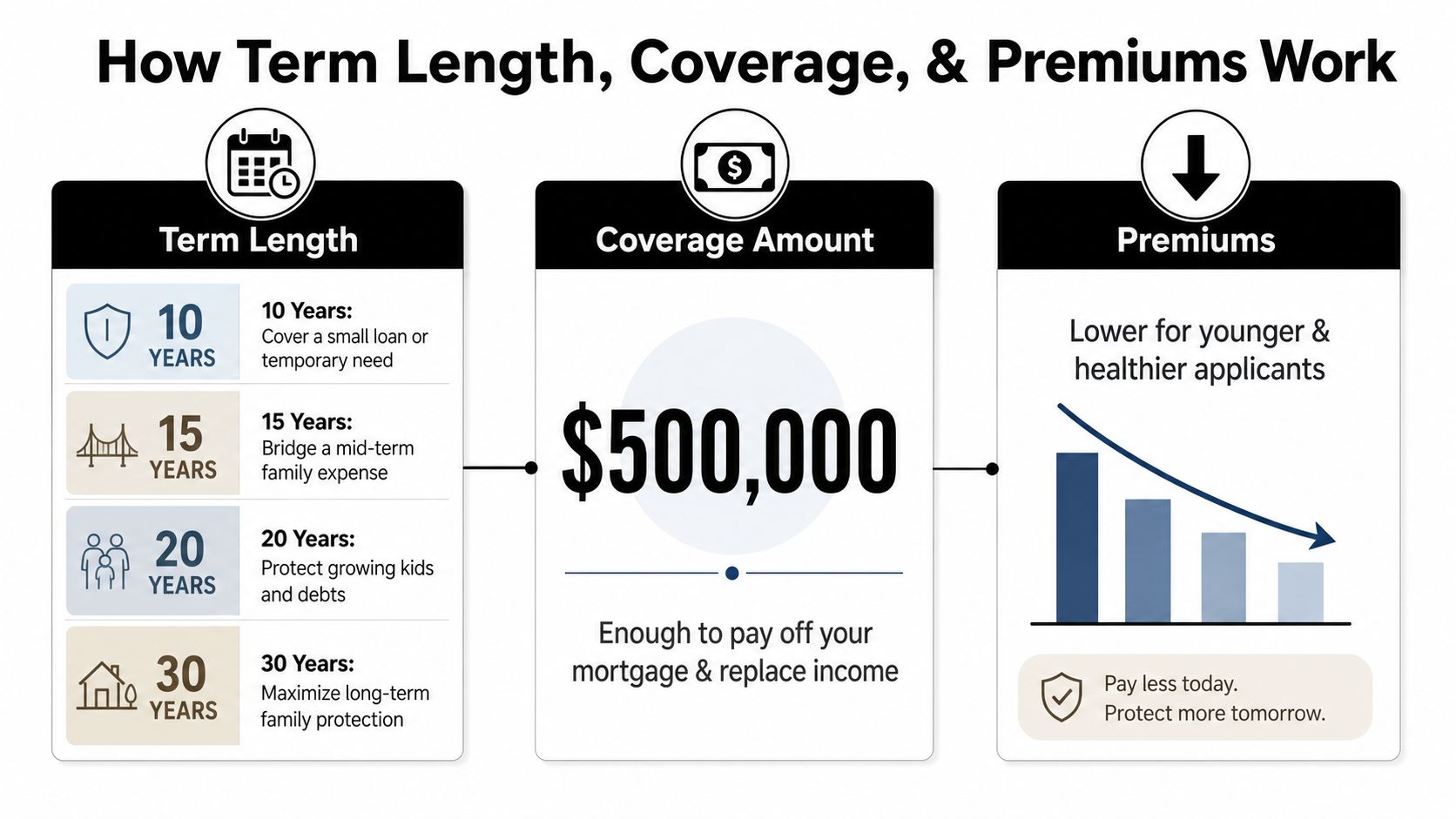
Common term lengths are 10, 15, 20, and 30 years. A shorter term can make sense if you're covering a temporary obligation, like a smaller loan or a child who'll be financially independent sooner. A longer term is more useful when the obligation is clearly stretched out, such as a mortgage, years of childcare, or a business loan that would hurt a family balance sheet if something happened to the borrower.
The cleaner way to choose is to ask, “How long would my family need support if I died tomorrow?” That's the period you're trying to cover. A 20-year term is often a practical middle ground for young parents, while 30 years fits better when the household's risk window is longer.
Coverage amount should follow the household, not the brochure
Coverage amount is where many first-time buyers get stuck. The easiest mental model is income replacement plus major obligations. If the policy is meant to keep the household stable, it should be large enough to pay for the obvious fixed costs your family would still owe after a death, not just a nice round number that feels affordable.
Practical rule: choose the amount you'd want available if your paycheck vanished and your family needed time to adjust, not the smallest policy that fits a monthly budget.
A level premium means the price stays the same for the full term. That stability matters because budgeting is already hard enough without a moving insurance bill. The insurer prices the policy based on factors like age, health, occupation, and lifestyle risk at issue, so younger and healthier applicants are usually offered materially lower rates because the expected mortality risk over the term is lower (Guardian Life).
The mechanics are what make the policy predictable. Some term policies are renewable, which means you can continue into another term without a medical exam, and some are convertible, which means you can exchange term coverage for permanent coverage later without a medical exam or health questions (FTC life insurance cost disclosure material). If you want a deeper look at one common pricing style, the level term life insurance guide is a useful companion.
What Actually Drives the Cost of a Term Life Insurance Policy
The price of a term life insurance policy is mostly an underwriting decision, not a guess. Insurers look at age, health, term length, and coverage amount, then price the policy around the risk they believe they're taking on.
The four inputs that matter most
Age is the most obvious one. A younger applicant usually looks less risky because the probability of death over the selected term is lower than it would be for an older applicant. Health matters because current conditions, medications, and family history can change how an insurer views the chance of a claim during the term. Term length and coverage amount both affect price too, because a longer promise and a larger benefit both increase the insurer's exposure.
That's why two people asking for the same face amount can get very different quotes. A healthy 30-year-old and a 55-year-old don't sit in the same risk bucket, even if they want the same protection. The pricing difference isn't about fairness in the moral sense, it's about how insurers calculate expected claims over time.
The buying experience has changed
A lot of first-time buyers still think life insurance means scheduling an exam, waiting around, and mailing forms. That used to be the common path. Today, digital applications and simplified issue underwriting have made the process much less cumbersome for many eligible buyers, and some policies can be approved without a paramedical exam.
The main shift isn't just convenience, it's friction removal.
That matters because the Geneva Association identified affordability and low understanding as major barriers to buying life insurance, with affordability the single biggest roadblock for term life in most markets studied (Geneva Association study). In other words, people don't just need a product, they need a process that doesn't add another reason to delay.
For some eligible applicants, no-exam term coverage can go into effect much faster than the old paper-first model. Coveredly is one digital option that offers term life insurance with no exams for most applicants, and its no-exam approach can support up to $3 million in coverage for eligible buyers. That kind of structure matters less as a sales point and more as a practical answer to a real barrier, especially when you're trying to protect a family without turning insurance into a project that drags on for weeks.
How Term Life Compares to Whole Life and Other Coverage Types
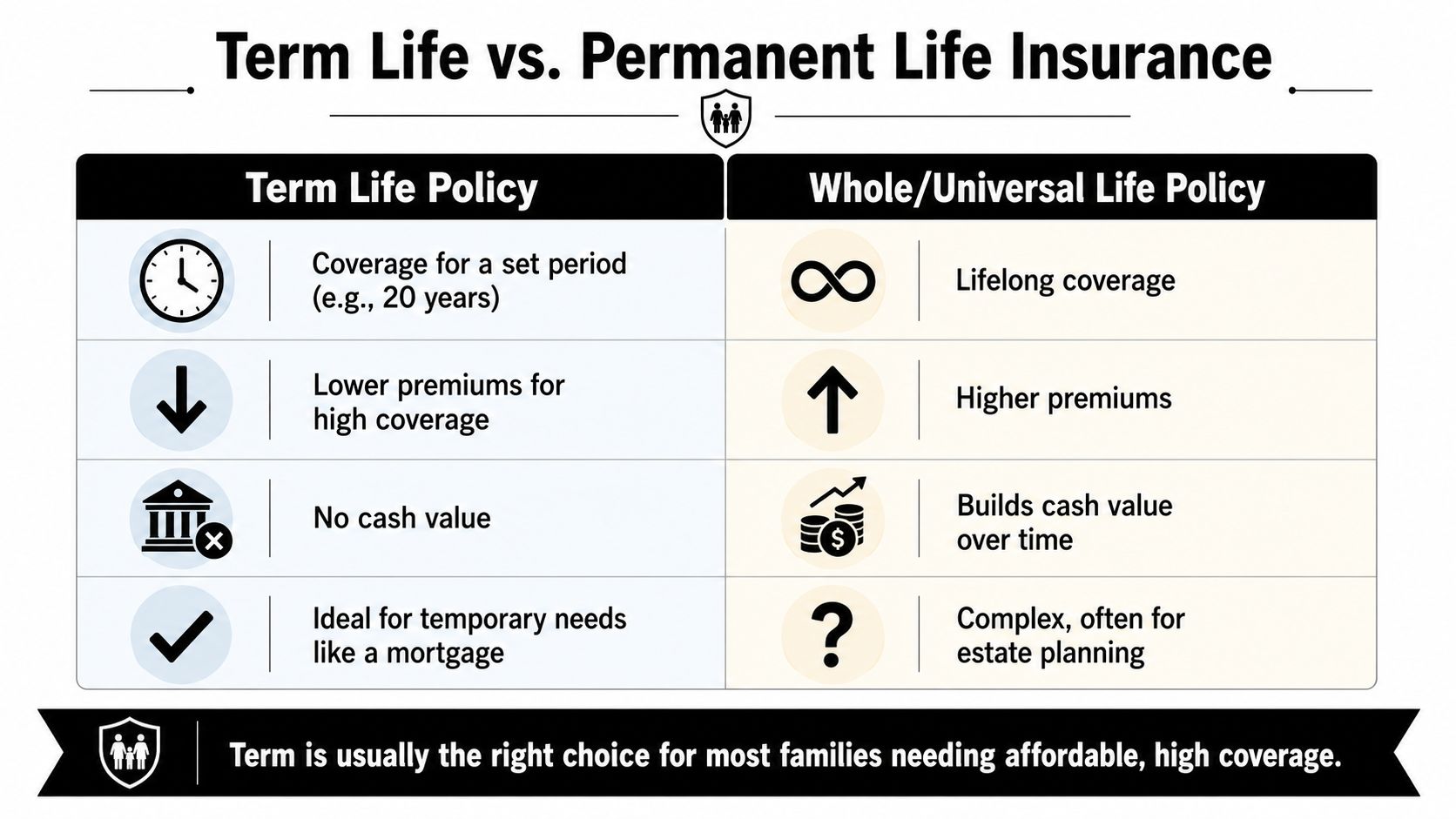
Term and permanent coverage often get treated like opponents, but they're really tools for different jobs. If you need the most death benefit for a defined period, term usually fits better. If you need coverage that lasts for life and includes a cash value component, permanent insurance does a different kind of work.
The decision is about purpose, not prestige
Whole life and universal life are permanent products. They're often used for lifetime guarantees, estate planning, or long-range balance sheet goals that go beyond income replacement. Term is usually the more natural starting point for people trying to protect a mortgage, children, or a business obligation during a specific period.
That's why many households begin with term and only later decide whether they also need a permanent policy. The first question is rarely “Which type is fancier?” It's “Which type protects my family better right now?”
A quick comparison frame
If your goal is the largest death benefit per premium dollar during a defined window, term usually wins. If your goal is lifelong coverage with a savings component, permanent coverage is the better fit even though it generally costs more. The two aren't rivals, they're different answers to different financial problems.
A useful real-world example is business protection. Stewart Accounting Services has a helpful guide on key person policies and tax relief that shows how insurance can be used in a business context where the goal isn't family income replacement but continuity and risk management. That's a very different use case from a young parent insuring income at home.
Video for a broader view of the comparison:
The same principle appears in market data. Term policies may not outnumber every other product by count, but they dominate new coverage dollars in the individual market (ACLI fact book). That's a strong clue that the product's job is protection size, not lifetime accumulation.
Who Benefits Most From a Term Life Insurance Policy
A term policy becomes most useful when a household has obligations that would still exist if a paycheck disappeared. That doesn't describe every adult equally, which is why the best buyers are usually people in the middle of a high-responsibility season.
A young family with a new baby
A couple with a newborn usually needs three things covered at once. There's the mortgage or rent, the income that keeps groceries and childcare flowing, and the emotional reality that one adult could be left carrying the full load alone. In that situation, a 20-year or 30-year term can make sense because the protection window should overlap with the years when the child is still dependent and the mortgage is still outstanding.
If the household relies mostly on one earner, the coverage amount should reflect more than funeral costs. It should be large enough to help replace several years of income and keep the home in place while the surviving adult makes longer-term decisions. That's the basic reason term is so often the first policy young families buy.
A mid-career professional with specific obligations
A mid-career professional might need a different structure. Maybe there are private student loans, dependent parents who rely on support, or a retirement account that the family doesn't want to touch in a crisis. In that case, a shorter term with a higher face amount may be the right fit, because the goal is to bridge a clearly defined set of obligations rather than insure a lifetime.
A person in that situation may also value speed and flexibility. Digital underwriting can shorten the path from application to coverage, which matters if health is changing or if the family doesn't want the process to drag on. In some cases, a no-exam application makes the difference between buying coverage now and postponing it again.
The key is to match the policy to the household role, not to a generic rule. Women, lower-income households, disabled people, and minority communities are often underinsured, and standard life-insurance content doesn't always explain how coverage needs differ by household role or health status (Pacific Life Re 2024 report). That's why a one-size-fits-all recommendation usually misses the mark.
If you're trying to estimate your own need, this life insurance needs guide is a useful starting point. The right answer usually comes from your obligations, not from someone else's rule of thumb.
Common Mistakes and Misconceptions to Avoid
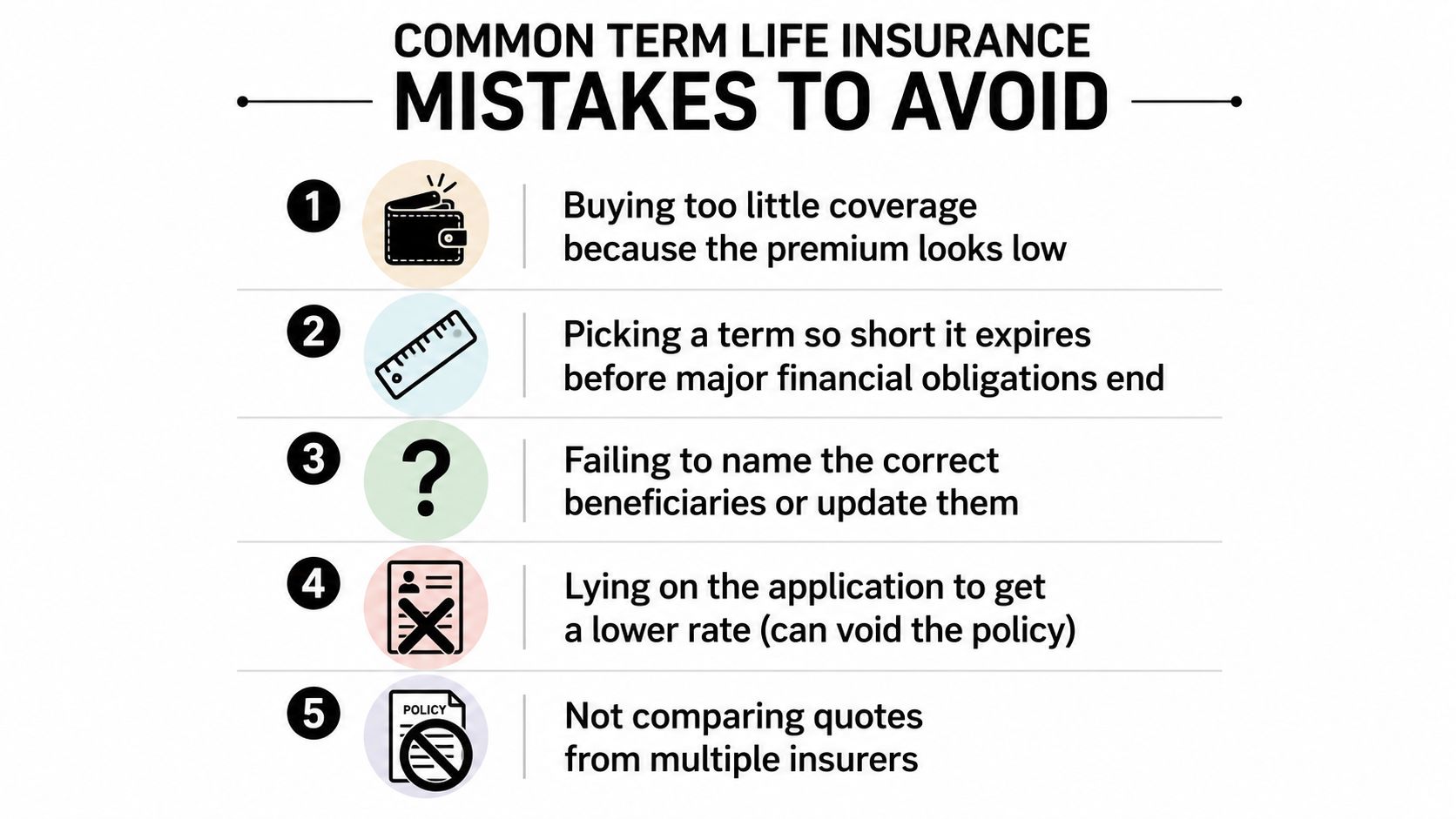
The biggest mistake is buying a policy that feels affordable but doesn't protect the household. A low premium can be comforting, but it doesn't matter much if the coverage amount is too small to replace income or keep the mortgage manageable.
Don't let the premium drive every decision
People also buy terms that are too short. That usually happens when someone focuses on the lowest monthly price and forgets that a policy needs to last through the years of highest financial exposure. If the coverage ends before the mortgage is gone or before children are independent, the policy has expired at exactly the wrong time.
Important: employer coverage is helpful, but it's rarely a complete plan on its own.
Another common error is assuming a medical exam is always required. That used to be a much bigger issue than it is now. For eligible applicants, digital and no-exam paths can remove that delay and make coverage easier to put in place while the family is still motivated to act.
There's also a basic administrative mistake that creates avoidable problems, which is failing to keep beneficiaries current. Life events change fast. Marriage, divorce, a new child, or the death of a parent can all make an old designation wrong even if the policy itself is still fine.
Finally, never misrepresent health information to get a lower rate. That can create bigger problems than a higher premium ever would. If your household also needs optional policy features, the riders guide can help you think through what's worth adding and what isn't.
The clean corrective frame is simple. Size coverage to real obligations, match the term to the years those obligations exist, treat employer coverage as a bonus rather than the whole plan, and compare policies while you're healthy enough to have choices. Term life is flexible, but it still works best when it's tied to a real household balance sheet.
Next Steps, FAQs, and How to Apply With Confidence
Start with four decisions: coverage amount, term length, beneficiaries, and any riders you need. Then compare digital applications with traditional ones, because the process matters almost as much as the policy itself. A no-exam digital application can be a better fit if you want speed and less friction, while a traditional route may still suit buyers who want to work through everything slowly with an advisor.
| Term Length | Common Use Case | Typical Buyer |
|---|---|---|
| 10 Years | Short loan or temporary obligation | Buyer with a short financial runway |
| 20 Years | Mortgage plus child-rearing years | Young family |
| 30 Years | Longer income-replacement window | Household with extended obligations |
Quick answers first-time buyers usually want
What happens if I outlive the term? The coverage usually ends, and there's no payout unless the policy has a separate feature that changes that outcome.
Can I convert later? Some policies are convertible, which means you can exchange term coverage for permanent coverage later without a medical exam or health questions.
How fast is a no-exam application? It's generally much faster than the traditional process, because you skip the medical appointment step.
What if my situation changes? Revisit your coverage when you get married, have a child, buy a home, change jobs, or pay down a major debt.
A term life insurance policy doesn't need to be perfect to be useful. It just needs to fit your real life closely enough to protect the people who depend on you.
If you want a policy that's built for real households, Coveredly offers digital term life insurance with no exams for most applicants and coverage options designed to fit changing needs. Visit Coveredly to compare term life options, review your household's protection gap, and apply when you're ready.