You're probably here because life got more real, fast.
Maybe you just bought a home. Maybe a baby is on the way. Maybe you got married, combined finances, and realized your household now depends on two people showing up, earning, caring, and keeping everything moving. That's usually the moment life insurance stops feeling like a boring financial product and starts feeling like a responsibility.
Most families don't need something fancy. They need something that works if the worst happens. Bills still arrive. Childcare still needs to be covered. A mortgage doesn't pause for grief. The best life insurance for families is the policy that protects the people you love without wrecking your monthly budget.
A lot of households delay the decision because they assume coverage will be expensive or hard to get. That hesitation is common. In 2026, about 52% of Americans had life insurance, while 100 million+ people still lacked coverage, according to Choice Mutual's life insurance statistics roundup. For young families, that gap usually isn't about not caring. It's about uncertainty.
This guide keeps it practical. You'll see how to estimate the right amount, how to think about term versus whole life, how to choose useful policy features, and why families should insure caregivers too, not just the higher earner.
Table of Contents
- Why Your Family's Story Needs a Financial Safety Net
- How Much Life Insurance Does Your Family Really Need
- Choosing Your Foundation Term vs Whole Life Insurance
- Customizing Your Policy with Riders and Term Lengths
- Navigating the Application and Exam-Free Options
- Securing Your Family's Future and What Comes Next
Why Your Family's Story Needs a Financial Safety Net
On paper, many young families look fine. The paychecks cover the mortgage, daycare, groceries, and car payment. In practice, the plan is often tight. If one parent died, the problem would not be emotional only. It would be a cash-flow shock that hits the household immediately.
That is the right way to view life insurance. It is a tool that gives your family money when income disappears, bills stay put, and the surviving parent needs time to make careful decisions instead of rushed ones.
I tell clients to start with one plain question. If you died this year, what expenses would your family still need to cover over the next month, the next year, and the next decade? That framing is more useful than copying a coworker's coverage amount or relying on the small policy that came with a job.
Practical rule: If your death would force someone you love to change homes, take on debt, return to work too soon, or scramble for childcare, you likely need life insurance.
For families with children, the risk is broader than replacing a paycheck. One parent may earn most of the income. The other may handle school pickups, meals, doctor appointments, sick days, summer schedules, and the constant admin work that keeps family life functioning. A stay-at-home parent has economic value even without a salary. If that parent died, the surviving spouse might need to pay for childcare, after-school help, housekeeping, transportation, or reduced work hours.
Delaying the decision has a direct cost. Younger and healthier applicants usually have more options and lower premiums. Waiting can mean higher rates, more underwriting questions, or fewer carriers willing to offer the amount you want.
A family policy decision is really a cash-flow decision
The strongest family coverage plans solve specific money problems.
A policy can help with things like:
- Income replacement so regular bills still get paid
- Mortgage or rent coverage so housing decisions are not made under pressure
- Childcare and household help if one parent handled unpaid care work
- Debt payoff for loans that would otherwise fall on the surviving family
- Time to grieve and regroup without an immediate financial cliff
This is also why simple planning frameworks help. A good estimate ties coverage to real obligations instead of a slogan. If you want a practical starting point before you apply, this life insurance needs guide for families can help you pressure-test your number.
Good life insurance planning does not try to predict every detail. It gives your family enough margin to keep the house, care for the kids, and make clear decisions during a hard year.
How Much Life Insurance Does Your Family Really Need
The fastest way to buy too little coverage is to rely on a rule of thumb and stop there. Multiples of income can be a helpful starting point, but they aren't a finished plan.
The National Association of Insurance Commissioners says families should evaluate how much income they provide, who depends on them, how debts and final expenses would be handled, and how inflation could affect future needs. It also notes that some experts suggest 5–8× current income, while other guidance uses 10–15× annual income, but a needs-based calculation is more accurate than a simple multiple, as explained in the NAIC consumer guide to life insurance.
A simple way to do that is the DIME method.

Start with needs, not a slogan
DIME stands for Debt, Income, Mortgage, and Education. It's not perfect, but it's one of the clearest ways to keep families from forgetting major obligations.
If you want a second calculator to compare your estimate, this life insurance needs guide from Coveredly is a useful companion.
Use DIME to build a real number
Start with the pieces your family would have to fund.
Debt
Add family debts you'd want paid off or reduced. Think beyond the mortgage. Include personal loans, car loans, or other balances that would strain the surviving household budget.Income
Estimate how much income your family would need replaced, and for how long. Many people underinsure when making these calculations. Salary alone doesn't capture taxes, benefits, or the cost of suddenly outsourcing work you used to do at home.Mortgage
Decide whether your goal is to pay off the home, reduce the balance substantially, or provide enough cash that the family can stay put while adjusting. A mortgage is often the biggest fixed expense, so it deserves its own line item.Education and final expenses
Include future education funding if that matters to you, plus funeral or other end-of-life costs your family would otherwise have to cover from savings.
Here's the practical formula I prefer:
| Item | What to include |
|---|---|
| Debts | Loans and balances your family shouldn't carry alone |
| Income replacement | Ongoing household cash needs for dependents |
| Mortgage | Full payoff or a target reduction amount |
| Education and final expenses | School funding goals and immediate end-of-life costs |
| Minus assets | Savings, existing coverage, and other resources available |
That “minus assets” step matters. If you already have group life insurance through work, savings earmarked for emergencies, or another policy, subtract those resources so you don't buy blindly.
A short explainer can help make the framework stick:
A quick way to pressure-test your estimate
After you calculate the total, ask two questions.
- Would this keep my family in the home?
- Would this let the surviving parent avoid making immediate income decisions while caring for children?
If the answer to either is no, your number probably needs work.
The biggest mistake I see is treating life insurance as a salary multiple instead of a family continuity plan.
For families with one parent working part time, taking career pauses, or carrying most of the caregiving load, the best life insurance for families often looks higher than expected. That isn't overbuying. It's recognizing how expensive it would be to replace what the household currently gets from one person's labor, income, or both.
Choosing Your Foundation Term vs Whole Life Insurance
A lot of parents reach this point and assume there must be one “best” policy type. There usually is not. There is a better fit for your budget, your timeline, and the job the policy needs to do.
For many young families, life insurance is replacing a paycheck, protecting the mortgage payment, and buying the surviving parent time to keep the household steady. That job usually points to term life first.
How the two policy types differ
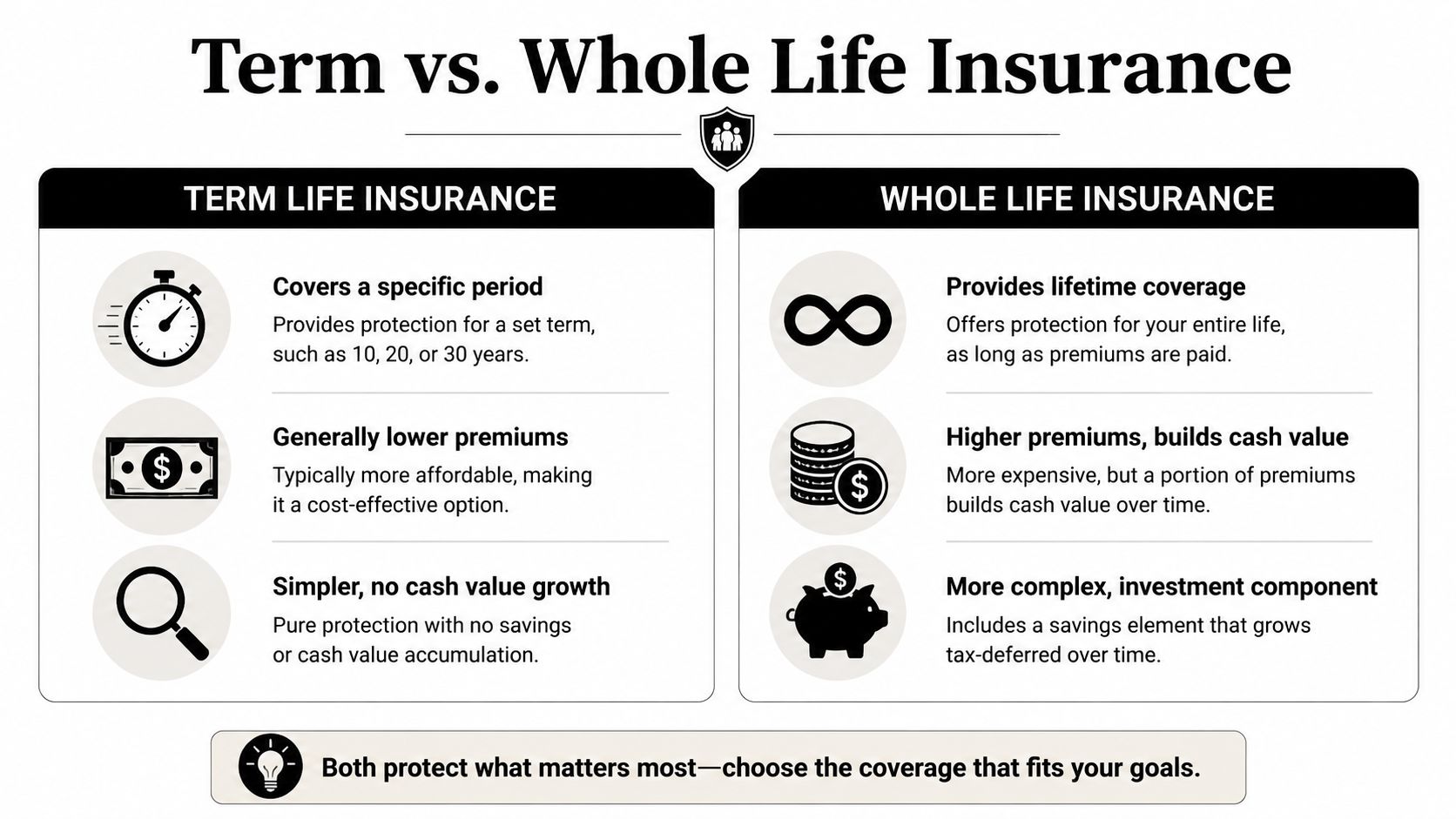
Here is the practical distinction.
| Policy type | Best use | Main trade-off |
|---|---|---|
| Term life | Covering the years when your family is most financially exposed | Coverage ends after the term you choose |
| Whole life | Permanent coverage that also builds cash value over time | Higher premiums and more moving parts |
Term life covers you for a set number of years, such as 10, 20, or 30. If your main goal is to protect your family through the child-raising years, while debts are high and savings are still catching up, term usually matches the problem well.
Whole life stays in force for life if premiums are paid and includes cash value, which is money that builds inside the policy over time. That feature can be useful, but it also makes the policy more expensive and less straightforward than simple income protection.
Why term is the foundation for many families
In practice, term is often the strongest starting point because it lets families buy more coverage while the budget is still doing a lot of work. Diapers, daycare, one income covering a bigger share of expenses, or one parent stepping back from full-time work all put pressure on cash flow.
I see the same trade-off often. A parent likes the idea of permanent coverage, but the premium for whole life means they end up buying far less death benefit than the family would need if someone died this year. That is a bad trade if the immediate goal is protecting children and housing.
If your first priority is family stability, term usually gives you more protection per dollar.
That does not mean whole life is wrong. It can make sense for families with a permanent insurance need, a strong savings rate, or estate planning goals. It can also appeal to households that want lifelong coverage and are comfortable paying more for it over many years.
But most young families are not trying to solve every long-term planning question with one policy. They need a solid base now.
A simple way to choose
Ask these two questions:
Do I need the largest practical death benefit for a defined period of time?
If yes, term is usually the better fit.Do I have a long-term reason to keep coverage for life and room in the budget for much higher premiums?
If yes, whole life may be worth a closer look.
For stay-at-home parents, this framing matters too. Their coverage often does not need to solve an estate planning problem. It needs to replace childcare, household management, transportation help, and the flexibility they provide every day. That points many families toward term coverage on both parents, not just the one bringing home a paycheck.
If you choose term, the next step is shaping it to your family's timeline and deciding whether common life insurance riders and optional add-ons are worth the cost.
Customizing Your Policy with Riders and Term Lengths
Buying term life is only half the decision. The next question is whether the policy matches the shape of your family's actual obligations.
A generic term can still leave gaps if the length is wrong or if you skip features that would help during a health or income shock.
Match the term to the obligation
Start with timing, not product names. Ask what you're trying to protect and when that need should fade.
- Young children at home often point toward a term long enough to cover the years until they're more financially independent.
- A recent mortgage can justify matching the policy term to the years when the payment would be hardest to carry on one income.
- A couple with uneven earnings may choose terms that reflect how long the lower-earning spouse would still need support if the higher earner died.
The term doesn't need to solve every future planning problem. It needs to cover the years of maximum vulnerability.
Riders that can make sense for parents
A rider is an optional add-on that changes how your base policy works. Some are useful. Some are nice in theory but unnecessary for a tight budget. This guide to life insurance riders from Coveredly gives a good overview of common options.
Here are the ones families usually ask about most:
Accelerated death benefit
This can allow access to part of the death benefit if the insured develops a qualifying serious illness. For a family, the value is simple. It may create cash when medical strain and household disruption hit at the same time.Waiver of premium
If the insured becomes disabled and can't work, this rider may keep the policy in force without requiring premium payments. That matters most for households where losing income could trigger a chain reaction of canceled coverage and missed bills.Child rider
Some parents like this for a modest amount of coverage on children. I usually tell families to keep the main focus on protecting parental income and caregiving capacity first.
Buy riders the same way you buy tools. Pick the ones your family would realistically use, not the ones that merely sound comprehensive.
There's no prize for the most customized policy. A clean term policy with a well-chosen length often beats a more complicated contract you don't fully understand. If you can explain in plain English when your family would use a rider, it may be worth considering. If you can't, keep the policy simpler.
Navigating the Application and Exam-Free Options
A lot of parents get all the way to the application stage, then stall out when the process starts asking for medical history, prescriptions, and scheduling details. I see it often with young families. The need for coverage is clear, but the process feels like one more task in a week that already has no extra space.
Traditional life insurance applications usually ask about your health, medications, work, travel, and habits such as tobacco use. Insurers use that information in underwriting, which means they assess your risk and set your price based on it. That process is normal. What trips families up is the time and follow-through it can require.

What underwriting looks at
Insurers tend to focus on a few practical categories:
- Age and health history, because both affect expected risk
- Lifestyle details, such as nicotine use or higher-risk hobbies
- Medical background, including current diagnoses and prescriptions
- Coverage amount and policy type, since larger policies often need more review
For some applicants, that also includes a medical exam. For others, it does not.
That difference matters for modern families. If both parents work, or one parent is handling most of the childcare load, an extra appointment can be enough to delay the whole decision. And delay has a cost. Coverage for the primary earner gets postponed. Coverage for a stay-at-home parent often gets skipped altogether, even though replacing childcare, transportation, meal prep, and household management can be expensive fast.
Why exam-free buying appeals to busy families
Exam-free options remove a common sticking point. If you qualify, you may be able to apply online, answer health questions, and get a decision without scheduling a nurse visit. For families trying to protect both income and caregiving value, that simpler process can make the difference between “we should do this” and “we finished it.”
If you want to compare that route, this no-medical-exam life insurance resource hub from Coveredly is a useful place to start.
Exam-free does not automatically mean better. It means faster and easier for eligible applicants. In some cases, a fully underwritten policy can offer lower pricing, especially for healthy people applying for larger amounts of coverage. The practical question is not which path sounds best in theory. It is which option gives your family the right amount of protection at a price you can keep, with an application you will complete.
A good policy in force beats a slightly better policy that stays on your to-do list.
What to prepare before you apply
A smoother application starts with a short prep list:
- Your target coverage amount, based on the calculation you already ran
- A medication list, plus doctor names if you have them
- Beneficiary information, including full legal names and relationships
- Basic financial details, such as income and the coverage amount you want
- Honest answers about health and habits, because accuracy matters more than speed
Keep this part simple. You do not need to master insurance language before applying. You need a clear coverage number, a monthly cost that fits your budget, and a process that matches real family life.
Securing Your Family's Future and What Comes Next
A family usually feels the need for life insurance in a very ordinary moment. One parent is packing lunches. The other is checking the mortgage payment, daycare bill, and calendar for next week. Then the core question shows up. If one adult died this year, how would the household keep running without blowing up the budget, the routines, and the care the kids depend on?
That is the decision life insurance is meant to solve.
Don't skip coverage for a caregiver
I see one mistake often with young families. They insure the higher earner and leave the stay-at-home parent or part-time caregiver uninsured.
That misses a major cost.
A caregiver may not bring in the larger paycheck, but they often handle school pickups, meals, laundry, sick days, scheduling, and a large share of childcare. If that parent died, the surviving adult might need to pay for childcare, transportation help, after-school coverage, meal support, or reduced work hours. NerdWallet discusses this in its family life insurance guide.
For many families, that means each parent needs coverage, even if the amounts are different.
What to do next
Skip the urge to keep researching for another month. Set aside 20 minutes and make one decision.
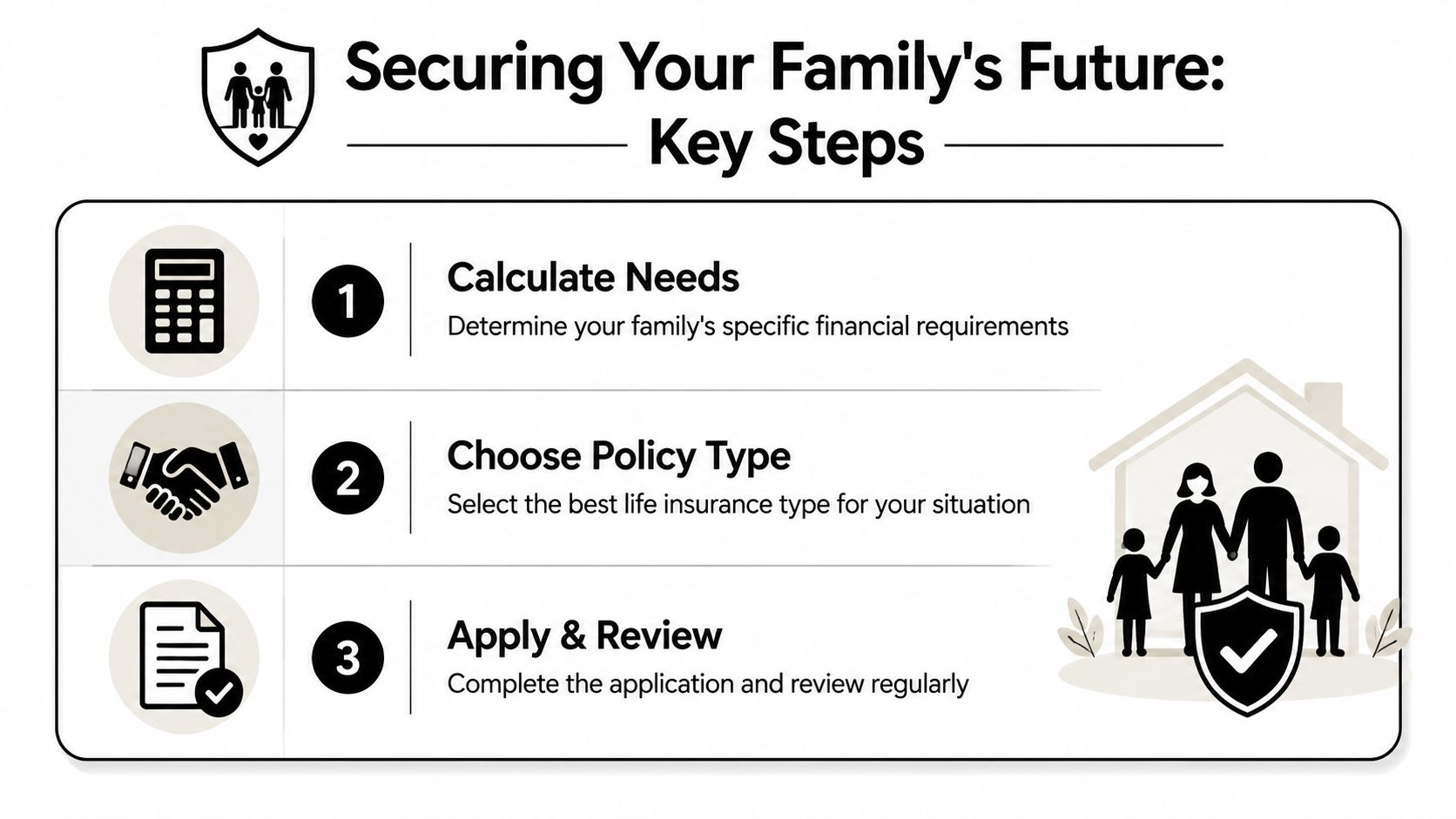
Use the coverage number you already calculated, choose the parent or caregiver who still needs protection, and submit one application. If both adults need coverage, start with the one whose loss would create the biggest immediate cash strain, then finish the second policy right after.
That approach keeps this manageable. It also reflects how families make progress. One clear action beats a perfect plan that never gets submitted.
Coveredly makes that process easier for busy households who want a modern way to buy coverage. If you want a digital application experience and flexible term life options designed to fit real family life, take a look at Coveredly.