For most young adults, the best life insurance is almost always an affordable term life insurance policy. It might sound surprising, but you can lock in serious financial protection for the people you care about for less than the cost of a few lattes a week—all by taking advantage of your age and health right now. An affordable life insurance policy for young people is a key part of building a strong financial future.
Why Life Insurance Is A Smart Move For Young Adults

When you're in your 20s or 30s, life insurance probably feels like something for your parents. It's easy to think, "Do I really need this right now?" But for more and more young professionals, the answer is a firm yes. Finding the best life insurance rates is easiest when you're young.
Let's be real—you're already juggling a lot. Between student loans, saving for a down payment, or planning a wedding, your budget is tight. So it’s no wonder people assume a life insurance policy costs as much as a car payment. That one misconception is the biggest reason young adults put off getting coverage.
The True Cost of Waiting
The reality is completely different. The single biggest factor that determines your life insurance premium isn't your income or your job—it's your age. Buying a policy in your 20s or early 30s means you can lock in an incredibly low rate that's guaranteed for decades. This is crucial for getting cheap life insurance.
Think of it as getting an early-bird discount on your financial future. You pay less now, and you keep paying that same low rate even as you get older and your health changes. Putting it off for just a few years can mean paying noticeably more each month for the exact same protection.
A recent study found that young adults overestimate the cost of a term life policy by a staggering 10 to 12 times its actual price. Many assume coverage runs into the hundreds per month, but a healthy 30-year-old might pay only around $25 per month for a $500,000 policy. You can read more in the 2025 Insurance Barometer Study.
A Modern Approach for a Tech-Savvy Generation
In the past, getting life insurance was a long, drawn-out ordeal filled with confusing paperwork and mandatory doctor visits. Not anymore. The entire system has been rebuilt for speed and simplicity, making it the best insurance for young adults.
Modern providers like Coveredly have turned getting covered into a quick, digital experience that fits how you already manage your life. Here’s what has changed:
- No Medical Exams: Many applicants can qualify for major coverage—sometimes up to $3 million—without ever stepping into a doctor’s office. Instead, the process uses data to assess risk instantly. This is a key feature of life insurance for millennials.
- Fast Online Applications: What used to take weeks of back-and-forth can now be done in about 15 minutes on your phone or laptop.
- Affordable and Clear Pricing: You can get instant quotes online to see exactly how affordable peace of mind really is.
This is the way it should be. It’s not just life insurance anymore; it's a smart, simple financial tool designed to protect your future and the people who matter most.
Decoding Term vs. Whole Life Insurance
Once you’ve decided to get covered, you’ll hit the first major fork in the road: which type of policy should you get? This usually boils down to two main choices—term life and whole life—and a simple analogy makes the difference crystal clear. Understanding these life insurance options is the first step.
Think of term life insurance like renting a home. It’s affordable, straightforward, and gives you protection for a specific period of time (the “term”). You get exactly what you need—a financial safety net—for the years you need it most, without any expensive, built-in extras. This makes it an almost perfect fit for young adults covering significant but temporary financial duties, like a mortgage or raising kids.
On the other side, whole life insurance is a lot like owning a home. It's a much bigger financial commitment that’s designed to last your entire life. Besides the death benefit, it also builds a “cash value” component, which is sort of like building equity in a house. While that sounds great on paper, the premiums are substantially higher, often making it an impractical choice when you’re just starting out.
Why Term Life Is the Smart Choice for Most Young Adults
For the vast majority of people in their 20s and 30s, term life insurance is the clear winner and the best life insurance for young adults. Its biggest advantage is affordability. Because the policy is temporary and doesn't have a complex investment vehicle attached, the premiums are dramatically lower than whole life.
This lets you lock in a huge amount of coverage—enough to replace your income, pay off the mortgage, and fund college tuition—for a small monthly payment. For example, a healthy 30-year-old might find a $500,000 term policy for around $25 per month. A whole life policy with the same death benefit could easily cost over $250 per month.
That cost difference is massive. It frees up hundreds of dollars every single month that you can put toward other critical financial goals, like investing for retirement, crushing student loan debt, or saving for a down payment.
Term life insurance is all about pure protection. You pick a term length—usually 10, 20, or 30 years—that lines up with your longest financial responsibility. If you pass away during that term, your beneficiaries get the full, tax-free death benefit. Simple as that.
To give you a clearer picture, here’s a quick side-by-side comparison of the key differences that matter most when you're just starting out.
Term Life vs. Whole Life At A Glance
| Feature | Term Life Insurance (Renting) | Whole Life Insurance (Owning) |
|---|---|---|
| Cost | Low premiums, very affordable. | High premiums, often 5–15x more expensive. |
| Duration | Covers a specific term (e.g., 20 or 30 years). | Covers your entire life as long as you pay. |
| Main Goal | Pure death benefit protection for a set time. | Lifelong protection plus a cash value savings component. |
| Complexity | Simple and easy to understand. | Complex, with investment-like features. |
| Best For | Covering temporary needs like a mortgage or raising kids. | Complex estate planning or lifelong dependent care. |
Ultimately, term life gives you the most protection for your dollar during the years you need it most, while whole life is a specialized tool for different, more complex financial goals.
When Does Whole Life Make Sense?
While term is the go-to for most, whole life insurance does have its place. It’s typically a tool for high-net-worth individuals who need it for specific estate planning strategies or to create a trust to fund care for a lifelong dependent, such as a child with special needs. It's a form of permanent life insurance.
Because of its high costs and complexity, it’s almost never the right first policy for young adults. Your priority at this stage should be getting enough affordable protection to cover your bases, not tying up your cash in an expensive, complicated product. If you want to dive deeper into the nuances, you can check out our detailed guide on term vs. whole life insurance.
The Must-Have Feature: Convertibility
Here’s a pro tip: one of the most valuable features to look for in a term policy is convertibility. This powerful rider gives you the right to convert your term policy into a permanent one down the road, without having to take another medical exam.
Think of it as locking in an option to buy the house you’ve been renting. Your life can change in ways you don't expect. A new health issue later on could make it incredibly difficult or expensive to get new coverage. Convertibility is your safety net—it guarantees your ability to get lifelong coverage if your health or needs change. It’s a crucial bit of flexibility that makes term life an even smarter choice for anyone planning for the long haul.
How Much Life Insurance Coverage You Actually Need
Deciding to get life insurance is a great first step. But then comes the big question: how much coverage is actually enough? You’ve probably heard rules of thumb like “buy 10 times your annual salary,” but those one-size-fits-all suggestions rarely hit the mark for your specific life.
The goal isn’t to just pick a big number out of thin air. It’s about calculating the right amount of protection to cover your real financial responsibilities. Luckily, there’s a simple framework that cuts right through the confusion. It’s called the DIME method, and it helps you build a clear picture of what you truly need by looking at four key parts of your financial life.
Calculating Your Needs with the DIME Method
The DIME method is just an easy-to-remember acronym that stands for Debt, Income, Mortgage, and Education. It turns the abstract question of “how much?” into a concrete, personalized plan. This is a vital step in choosing the best life insurance policy.
Here’s how to break it down:
- Debt: Start by adding up all your non-mortgage debts. This means student loans, car payments, credit card balances, and any personal loans you might have. The idea is to make sure these burdens don't get passed on to your loved ones.
- Income: Think about how many years of your income your family would need to maintain their standard of living without you. Multiply your annual salary by the number of years you want to provide that support—for example, until your kids are grown and out of the house. This is often the biggest piece of the puzzle.
- Mortgage: Add the full remaining balance of your mortgage. A life insurance payout can lift this massive financial weight, allowing your family to stay in their home without having to worry about payments.
- Education: If you have children (or plan to), estimate the future cost of their college education. This is about protecting their future opportunities, no matter what happens.
Once you add these four figures together (D + I + M + E), you’ll have a personalized coverage amount that really reflects what your family would need.
DIME in Action: A Relatable Example
Let’s imagine a young couple, both 30 years old. They have a combined $50,000 in student loans and a $10,000 car loan. They just bought their first home with a $300,000 mortgage and have a newborn, with a goal to save $100,000 for college. The primary earner makes $70,000 a year, and they decide they’d want to replace that income for 15 years.
Here’s what their DIME calculation looks like:
- Debt: $50,000 (student loans) + $10,000 (car) = $60,000
- Income: $70,000 x 15 years = $1,050,000
- Mortgage: $300,000
- Education: $100,000
Total Coverage Needed: $60,000 + $1,050,000 + $300,000 + $100,000 = $1,510,000
A figure like $1.5 million might sound huge, but for a healthy young adult, a term life policy makes this level of coverage surprisingly affordable. This simple calculation gives them a clear target and takes all the guesswork out of the process.
Of course, you don’t have to do all this math on your own. For a quick and precise estimate, you can use our easy guide and find out how much life insurance you might need in just a few minutes.
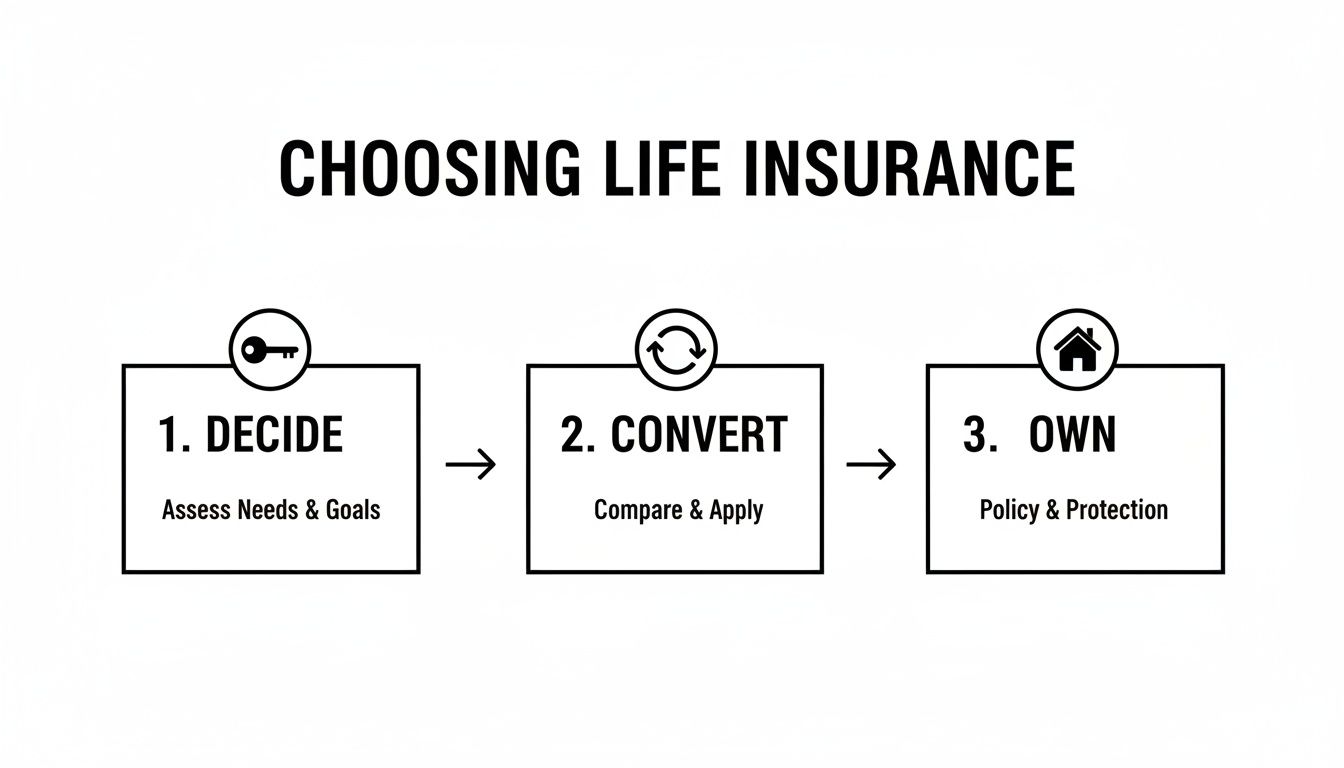
Getting covered is a straightforward journey: first you decide on your needs, then you consider your options for the future, and finally, you own a policy that brings you peace of mind.
Key Policy Features Young Adults Should Look For
Once you have a ballpark figure for your coverage amount, it’s time to look past the price tag. Not all life insurance policies are built the same, and a few key features can make a world of difference in how well your policy serves you over the decades. These are essential features of the best life insurance for young adults.
Focusing on these details is what turns a generic safety net into a plan that actually fits your life. Getting them right is the key to making a smart long-term decision.
Matching Your Term Length to Your Life
With a term life policy, the "term" is simply the number of years your coverage stays active. For young adults, the most common options are 10, 15, 20, or 30-year terms. Picking the right one isn't a random guess—it should line up with your longest financial responsibility.
Think of it this way: if you just bought a home with a 30-year mortgage, a 30-year term policy is a perfect match. It guarantees your single biggest debt is covered if anything happens before the house is paid off. Or, if you have a newborn, a 20-year term can provide a safety net until your child is grown and independent.
The goal is to match your policy’s expiration date with the date your major financial obligations end. This ensures you have protection when you need it most, without paying for coverage you no longer require.
This simple strategy makes sure you're not over-insured later in life or under-insured when it counts. It’s about getting the right protection for the right amount of time.
Convertibility: Your Future-Proofing Safety Net
One of the most valuable—and easily overlooked—features for a young adult is convertibility. A convertible term policy gives you the right to trade your temporary term coverage for a permanent whole life policy down the road, all without having to pass another medical exam.
Why is this a big deal? Your health is the biggest factor in getting approved for life insurance. If you develop a health condition later in life, buying new coverage could become incredibly expensive, or you might not be able to get it at all.
Convertibility is your get-out-of-jail-free card. It locks in your insurability, giving you the affordable rates of term life now with a guaranteed option to secure lifelong coverage if your health or financial needs change.
The Power of No-Exam Policies
In the past, applying for life insurance was a chore. It meant scheduling a medical exam, giving blood and urine samples, and then waiting weeks for an answer. For a busy young professional, that hassle was a huge barrier.
Today, no-exam life insurance has completely changed the game.
Thanks to sophisticated data analytics, providers like Coveredly can accurately assess your risk profile almost instantly. By using public records and the information you provide, insurers can approve healthy applicants for significant coverage—sometimes up to $3 million—in a matter of minutes.
Here’s what makes this so appealing:
- Speed: The entire process, from quote to active policy, can be done in the time it takes to watch a movie.
- Convenience: You can apply online from your couch. No needles, no appointments.
- Simplicity: The experience is designed to be completely straightforward, cutting out confusing paperwork and long waits.
This modern approach removes all the old friction from the buying process, making it unbelievably easy to get the protection you need without disrupting your life.
Living Benefits: Protection While You're Alive
Traditionally, life insurance only paid out after you were gone. But many modern policies now come with living benefits, also known as accelerated death benefit riders. These powerful features allow you to access a portion of your own death benefit while you are still alive if you're diagnosed with a qualifying terminal, chronic, or critical illness.
This can be a financial lifesaver during a major health crisis. The funds can help cover medical bills, pay for in-home care, or replace lost income so you can focus on your health, not your finances. To understand more about these valuable add-ons, you can learn about what riders in life insurance are and how they add another dimension of protection to your policy.
Overcoming Common Reasons For Delay
We get it. Life insurance can feel like one of those “I’ll get to it later” tasks, especially when your 20s and 30s are packed with more immediate priorities. But putting it off is one of the most common and costly mistakes you can make.
Most young adults run into the same mental roadblocks. Let's walk through these common reasons for waiting and see why they don't hold up—and how getting past them is the smartest move for your future.
Myth 1: "I'm Healthy and Young"
This is hands-down the biggest reason people delay, but it’s based on a huge misconception. Your youth and health are the very reasons you should get coverage now, not later.
Life insurance is all about risk. The younger and healthier you are, the lower the risk you represent to an insurer, and the cheaper your premiums will be. By buying a policy in your 20s or 30s, you can lock in an incredibly low rate for decades. Waiting until you’re older or develop even a minor health issue means you’ll pay significantly more for the exact same coverage. This is the core principle for finding the best life insurance for young adults.
Myth 2: "My Job Provides It"
Relying only on your employer's life insurance is a gamble. While it’s a fantastic perk, these policies are rarely enough on their own and come with some serious strings attached.
- Limited Coverage: Most workplace plans only offer coverage worth 1-2 times your annual salary. For most people, that’s not nearly enough to cover a mortgage, replace your income for a decade, and clear other debts.
- It’s Not Portable: If you switch jobs, you almost always lose your coverage. This can leave your family unprotected during a career transition and force you to apply for a new policy when you're older and rates are higher.
Think of your work policy as a great bonus, but a personal term life policy is the true foundation of your financial safety net.
"I’m single and don’t have kids, so I don’t need life insurance."
This is another myth we hear all the time. Even if no one depends on your income, you likely have financial loose ends that would fall to your family. This often includes private student loans, which aren't always discharged upon death and could leave a cosigner on the hook. A small policy can also cover final expenses, which average over $7,800, sparing your loved ones that financial burden during a difficult time.
Myth 3: "It's Not in My Budget"
The fear of high costs is probably the biggest barrier for young adults, but the reality is often a pleasant surprise. Many people overestimate the price by a wide margin—sometimes ten times or more—and never even bother to get a quote.
The truth? A healthy 30-year-old can often get a $500,000 policy with a 20-year term for around $20-30 per month. That's less than a couple of streaming subscriptions. With modern tools like Coveredly, you can compare quotes in minutes and find a plan that actually fits your budget. This highlights why term life is often the most affordable life insurance.
Recent data shows a worrying trend. Life insurance ownership among younger generations has dropped, with only 36% of Gen Z adults having coverage today compared to 65% of young adults in 1989. While big life milestones like marriage and kids might be happening later, financial responsibilities are still very real, leaving many feeling under-covered. You can discover more about this generational shift in this insightful report.
Your Action Plan To Secure Life Insurance Today

Alright, you've got the concepts down. Now it’s time to turn that knowledge into real protection. This isn’t some long, drawn-out process. Getting covered can take less time than ordering and eating dinner.
The key to getting the best life insurance for young adults is simply moving from thinking about it to doing it. Here’s a straightforward path to get you there.
Step 1: Calculate Your Coverage Number
Before you can shop for a policy, you need a target. This is where the DIME method (Debt, Income, Mortgage, Education) we talked about earlier comes in handy. It cuts through the noise and gives you a clear, personalized number.
Just add up your major financial obligations: what’s left on your mortgage, any other debts, the income your family would need to replace, and an estimate for education costs. Don't get hung up on perfection; a solid estimate is all you need to start.
Step 2: Compare Quotes from Modern Providers
Once you have your number, it’s time to see what’s out there. This part is easier than ever, thanks to online platforms that let you pull instant quotes from multiple top-rated insurers in minutes. This is how you find the best life insurance companies for young adults.
As you compare, keep your eye on these three things:
- Term Length: Does it cover your longest financial responsibility, like a 30-year mortgage?
- Price: What’s the most affordable premium for the coverage amount you need?
- Convertibility: Does the policy give you the option to convert it to a permanent plan down the road, no questions asked?
Remember, the goal isn't just to find the cheapest policy. It's about finding the right blend of cost, coverage, and features that gives you flexibility for whatever life throws your way.
Step 3: Get Your Info Ready
To make the application fly by, just have a few basic details handy. We’re not talking about your entire life story.
You’ll just need your personal details, some basic health info like height and weight, and maybe your driver’s license number. That’s usually it.
Step 4: Apply Online in Minutes
This is the final step—and the most empowering one. With a modern provider like Coveredly, you can do the entire application online from your couch.
Thanks to new underwriting technology, many healthy applicants can skip the medical exam entirely. The process is incredibly fast, and it’s not uncommon to get approved on the spot.
There’s no more waiting around for weeks to hear back. You can go from starting your application to having an active policy in about 15 minutes.
The best life insurance you can get is the one that's actually in place, protecting your family. The best time to lock it in is right now, while your age and health are working in your favor. Take a moment to secure that peace of mind today.
Answering Your Top Questions
Stepping into the world of life insurance for the first time always brings up a few questions. That's completely normal. Getting clear, straightforward answers is the best way to feel confident about your decision, so let's tackle some of the most common things young adults ask.
Is Term Life Insurance a Waste of Money if I Never Use It?
This is probably the most common question we hear, and it comes from a misunderstanding of what insurance is for. Term life isn't an investment you hope to cash in on; it's protection you hope you never need.
Think about your car insurance. You pay for it every month, but you’re not hoping to get into an accident. If you go a full year without a claim, you don't see that money as wasted—you see it as the price you paid for peace of mind on the road.
That’s exactly how the best life insurance for young adults works. Your small monthly premium is the cost of knowing that if the absolute worst happens, the people you love will be financially secure.
How Fast Can I Get a No-Exam Policy Approved?
You might be surprised. For many healthy young adults, approval for a no-exam policy can take as little as 15 minutes.
This is a world away from the old way of doing things, which often involved waiting weeks after a medical exam for an answer. Today, modern providers like Coveredly use secure data to assess your application instantly, meaning you can go from applying to having active coverage in one short session.
This speed and simplicity are game-changers. You can lock in meaningful financial protection for your family online, often right from your phone, without having to upend your schedule.
Can I Get Life Insurance if I Have Student Debt?
Yes, absolutely. Having student loans or any other kind of debt doesn’t stop you from getting life insurance. In fact, it’s one of the strongest reasons to get a policy. Life insurance for young professionals often needs to account for this.
Think about it: if you have a cosigner on any private student loans, they could be on the hook for the entire balance if you were to pass away. A life insurance policy can be set up specifically to pay off those loans, protecting your parents or other family members from inheriting that financial burden.
What Happens to My Policy if I Have Kids?
Your policy itself doesn't automatically change, but your needs definitely do. Having a child is one of the most important moments to review your coverage.
When you have kids, you suddenly have tiny dependents who will rely on your income for the next 20+ years. You’ll want to make sure your coverage amount is enough to not just replace your income but also fund huge future costs like college. Many people buy a new, larger policy or add more coverage when they start a family to account for these massive new responsibilities.
Ready to take the next step and see just how affordable real peace of mind can be? Get your free, no-obligation quote from Coveredly in just a few minutes and lock in your protection today. Find your personalized rate at https://coveredly.com.