A parent finishes work, checks on a sleeping child, then opens a laptop at the kitchen table to look for life insurance. The questions come quickly: How much protection would help the family stay in the home? Can the application be completed online? And if no medical exam is needed, how does an insurer assess the application?

For busy parents, newly married couples, and professionals, digital term life insurance can make it easier to explore coverage on their own schedule. An online process can include getting a quote, filling out an application, and signing documents electronically. But convenient doesn't have to mean handling every question alone. A person may want to research online and still speak with a licensed professional before deciding what coverage fits.
That mix of self-service and human guidance reflects how people buy. In a survey of nearly 4,000 Americans conducted by LIMRA and Boston Consulting Group in July and August 2020, 4 in 10 consumers who purchased life insurance used a hybrid process that combined online activity with a financial professional, 10 percentage points higher than before the pandemic. LIMRA later reported that, by 2023, consumers preferred shopping for and purchasing life insurance online over attending in-person meetings for the first time. The findings are summarized in LIMRA and BCG's research on digital life insurance and human support.
This guide starts with what term coverage does, then looks at how a digital application works and what “no exam” really means. It also covers choosing a term that fits your family's responsibilities and the after-purchase tasks that help beneficiaries find the policy and make a claim. The goal isn't to promise an instant answer. It's to help you understand the decisions, prepare clear information, and know when to ask for help.
Table of Contents
- How Term Coverage Protects for a Set Period
- Digital Versus Traditional Policies Compared
- What No Exam Really Means for Underwriting
- Your Online Application Flow From Quote to Approval
- Pricing Expectations and Coverage Examples for Families
- After Purchase Steps That Protect Your Loved Ones
How Term Coverage Protects for a Set Period
Term life insurance covers a defined period, not the insured person's entire lifetime. The National Association of Insurance Commissioners (NAIC) lists common periods such as 1, 5, 10, or 20 years, as well as coverage lasting until a specified age, such as 65. The policy pays a death benefit to beneficiaries if the insured dies while the policy is in force and the policy's requirements are met. The NAIC's overview of life insurance explains this basic distinction.
Think of the term as a bridge across years when other people rely on your income. A couple with a mortgage and young children might choose protection that spans a substantial part of the time their children depend on them financially. If the insured dies during that period, the benefit can help the family manage expenses such as housing and everyday needs. It isn't a savings account, and term policies generally don't accumulate cash value.
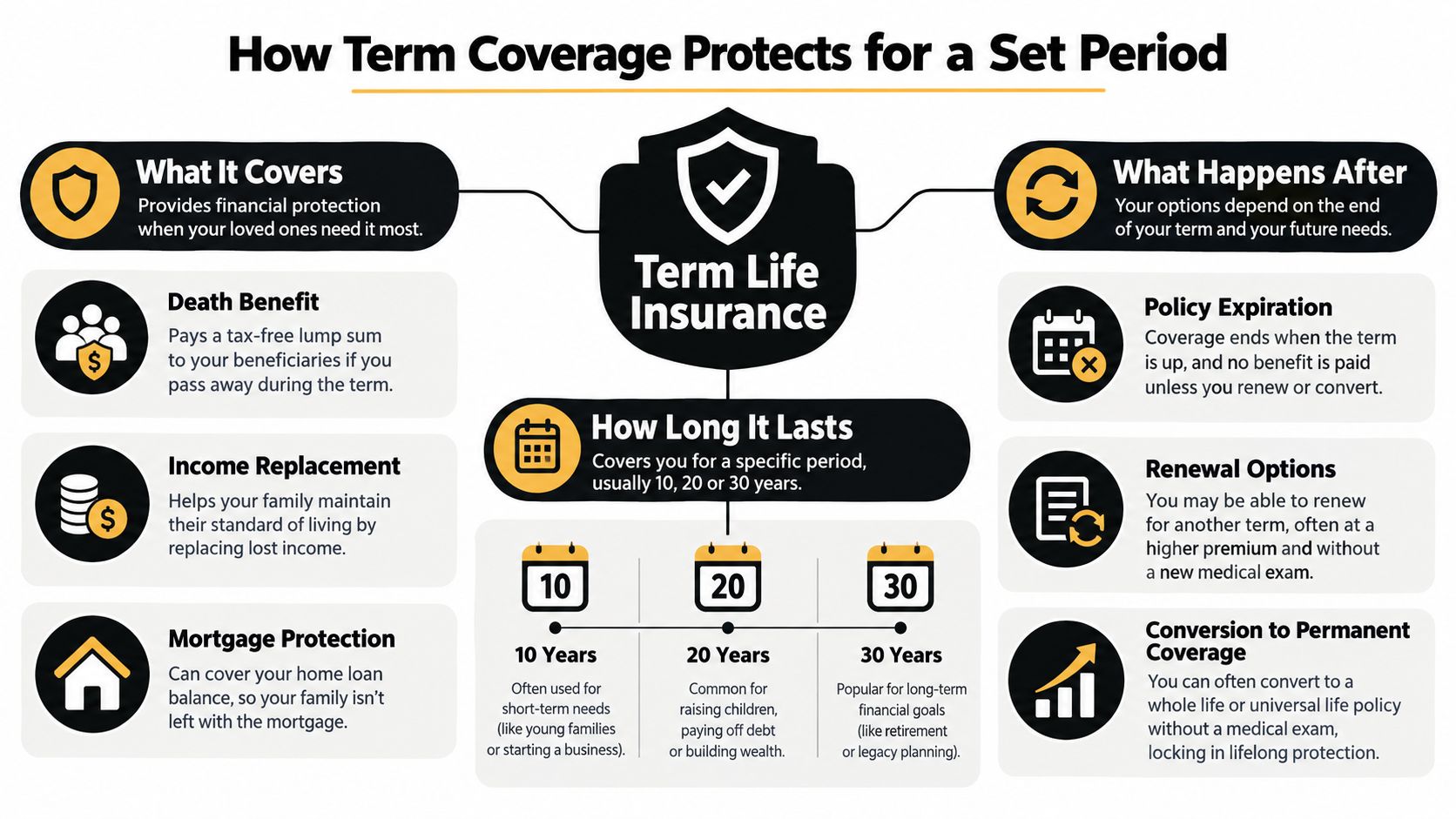
The core promise: A death benefit is payable if the insured dies during the selected term. The policy isn't designed to build cash value or guarantee coverage for life.
Match the term to the responsibility
Start by naming the financial responsibility you want the policy to help cover. For one household, that may be mortgage payments. For another, it may be income replacement while children are still dependent or support for a business obligation. The term should make sense alongside the length of that responsibility, rather than being chosen just because a particular number looks familiar.
The benefit amount and term length are separate choices. The amount describes the policy's potential death benefit. The term describes how long the protection lasts. A family might need to consider both the remaining mortgage timeline and how long children may rely on a parent's income, rather than treating one factor as the whole answer.
Know what happens at the end
If the insured outlives the term, the policy doesn't pay a death benefit for that period. Some policies may offer renewal or conversion options, but the details depend on the contract. The NAIC cautions that renewal premiums are higher, and buyers should check the renewal terms and any age limit in advance in its consumer guide to life insurance.
That's why the policy's end date deserves attention when you buy, not just when the term is nearly over. Read the contract to understand available choices and costs before relying on future renewal as a substitute for selecting an appropriate term now.
Digital Versus Traditional Policies Compared
Choosing digital or traditional coverage is largely a choice about how you want to apply and get help. A digital process may let you request a quote, submit information, review documents, and sign online. A traditional process may rely more on scheduled meetings, paper forms, and in-person conversations. Hybrid options combine online steps with help from a licensed professional.
The application channel does not determine whether the policy suits your needs. It shapes how you ask questions and complete tasks. Underwriting can also differ by insurer and applicant, so an online application does not guarantee a particular decision or remove the possibility of additional requirements.
| Feature | Digital Path | Traditional Path |
|---|---|---|
| Getting started | Explore quotes and begin an application online | Arrange a meeting or start through an agent |
| Communication | May use email, phone, chat, or video | Often centers on scheduled conversations |
| Documents | Can include electronic forms and signatures | May involve paper forms or in-person signing |
| Underwriting | May use digital information sources to assess risk | May involve medical evidence or an exam, depending on the application |
| Personal guidance | Support may be available, but it may need to be requested | Conversation with a professional may be built into the process |
Choose the interaction that helps you decide
An online process can suit someone who wants to compare options privately and complete forms on a flexible schedule. It may also be convenient if you are comfortable reviewing digital documents and entering information online. Still, a quick interface cannot choose coverage for your family. You need to understand what the policy covers and what its terms mean before you buy.
A traditional or hybrid process may fit better if you want to talk through choices with a professional. That conversation can help clarify unfamiliar terms, but ask questions until you understand the answers. You can also request personal support during a digital application. Check how to reach a licensed professional before you begin, rather than assuming help will be built into every online process.
LIMRA and Boston Consulting Group reported that 32% of people who bought policies after the pandemic began did so entirely in person, compared with 44% before it. Their study also found that among Gen Z respondents, 18% preferred researching and completing a purchase entirely online, while 34% preferred researching online and buying through a company by phone, mail, or online chat. These findings show that preferences differ, even as digital tools such as online scheduling, video meetings, and electronic signatures become more common. LIMRA and BCG's study of digital and human support in life insurance
Your decision process should include what happens after approval, too. Confirm that you can update beneficiary information and find the insurer's claims instructions. Keep policy documents where your beneficiary can locate them, and make sure they know whom to contact if a claim is needed. These simple checks connect the application experience to the support your loved ones may need later.
What No Exam Really Means for Underwriting
No exam doesn't mean no underwriting. Underwriting is how an insurer evaluates the information in an application to decide whether to offer coverage and on what terms. When an insurer offers an accelerated or simplified process, it may use application answers and available data instead of relying on a traditional medical exam for every applicant.
A LIMRA survey of U.S. and Canadian life insurers found that two-thirds of responding companies had implemented automated underwriting for at least part of their business, while another 32% were planning implementation. The survey also reported that insurers used information from MIB, prescription databases, laboratory results, and motor-vehicle records as part of automated underwriting. LIMRA's report on insurers using technology and data to streamline underwriting describes this shift.
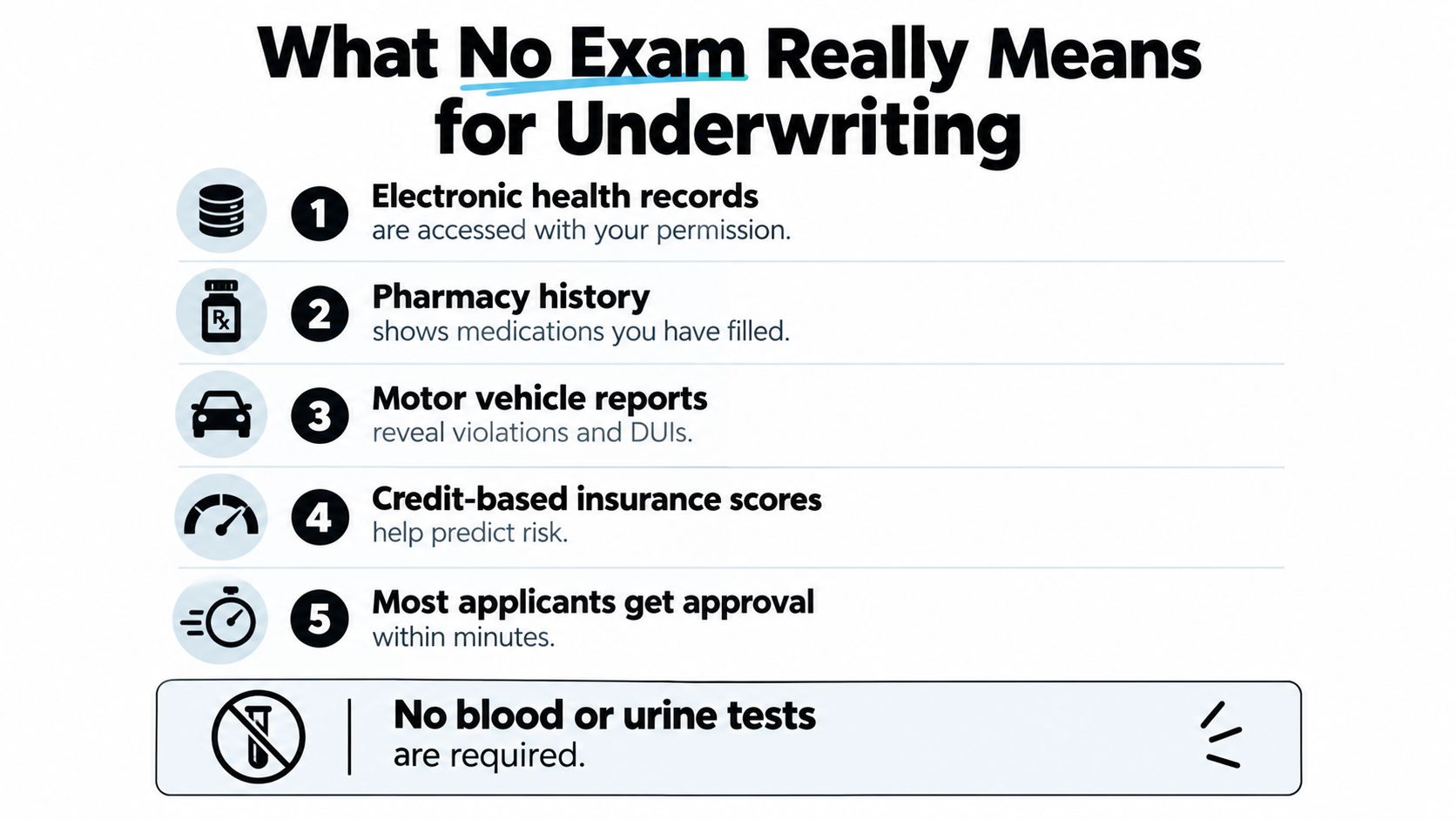
A transparent decision map
The outcome depends on the details of the application and the records an insurer can evaluate. A straightforward file may be eligible for a faster decision. If information conflicts or needs clarification, the insurer may ask follow-up questions, seek additional evidence, refer the application for human review, or make a different decision.
- Application details match available records: The insurer may be able to assess the risk without requesting an exam.
- A medication or health history needs context: You may be asked to explain a treatment, diagnosis, or date.
- An identity or record mismatch appears: Confirm the information and ask what source needs correction or clarification.
- The insurer requests more evidence: Ask what is needed, why it's required, and whether any alternative documentation is accepted.
- You disagree with a decision: Contact the insurer to ask about reconsideration or the process for correcting inaccurate records.
A no-exam offer is about the evidence used, not a promise that every applicant will receive instant approval or identical pricing.
The underlying data also need careful handling. In its discussion of accelerated and algorithmic underwriting, the National Association of Insurance Commissioners' research on life-insurance underwriting describes how digital medical information and models can inform risk decisions. For applicants, the useful takeaway is simple: ask how to resolve a record that seems wrong, and don't assume a fast process removes the possibility of additional review.
For a plain-language explanation of how insurers assess applications, see Coveredly's guide to life insurance underwriting.
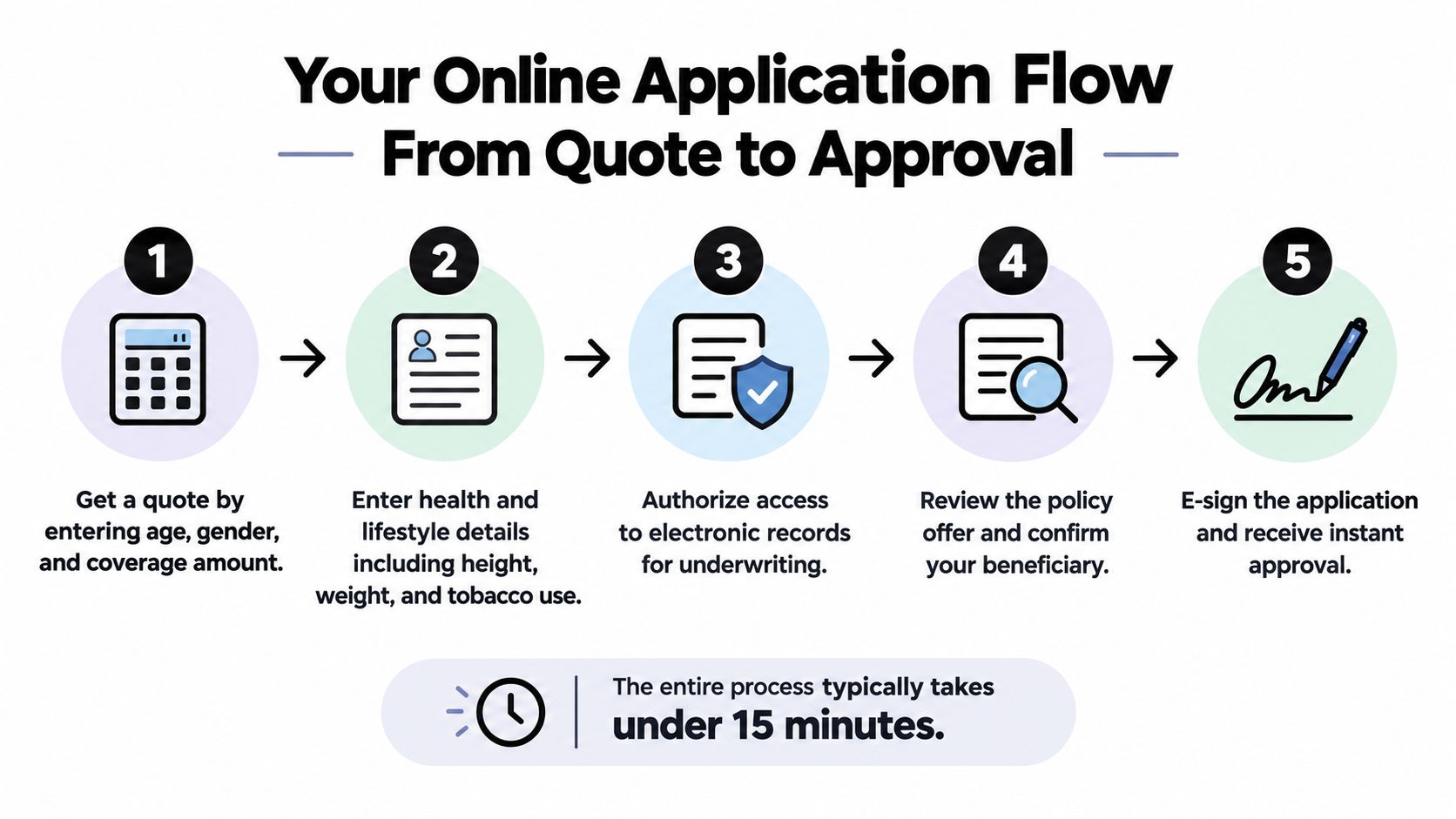
Your Online Application Flow From Quote to Approval
An online application is easier to complete when you prepare before opening the form. Think of it as a request for accurate information, not a test to finish as quickly as possible. Clear, consistent answers can reduce avoidable follow-up; guessing or leaving out relevant details can create questions later.
Prepare before you begin
Have the information you'll need to answer health and lifestyle questions accurately. Depending on the insurer's form, that may include details about medical history, medications, tobacco use, and other personal information. Read each question carefully, and ask for clarification if a term or request isn't clear.
The application may also ask permission to check electronic records as part of underwriting. Review the consent language before agreeing, and use the insurer's support channels if you want to understand what information may be accessed. An application that doesn't qualify for a fast path may need additional review, so don't treat a rapid-decision feature as a guaranteed outcome.
Follow the process, and check the details
A typical online journey moves through a few practical stages:
- Explore a quote: Enter the details requested to see an initial option.
- Complete the application: Answer the health and lifestyle questions truthfully and consistently.
- Review and consent: Read the relevant permissions and policy information before proceeding.
- Respond to follow-up: If the insurer flags a question or asks for more evidence, provide the requested clarification.
- Check and sign: Review the offer and application details before signing electronically.
Accelerated underwriting can appeal to consumers who want a simpler process. Munich Re, summarizing LIMRA research, reported that 47% of American consumers found accelerated or simplified underwriting more appealing than traditional underwriting. The same analysis noted that preference for online life-insurance purchasing had increased over time. See Munich Re's analysis of accelerated underwriting.
A fast quote isn't the same as a final approval. If a decision is delayed, ask what information is outstanding and how to submit it securely. Coveredly's overview of the online life insurance application can help you understand what to expect from a digital application.
Pricing Expectations and Coverage Examples for Families
A parent comparing term policies can start with two questions: how much financial support would the family need, and for how long? Term insurance generally provides more protection per premium dollar than permanent insurance because it does not include a cash-value component. That describes a broad policy feature, not a promise of a particular price or approval. Applicants' costs and eligibility depend on their circumstances and the policy terms.
Compare coverage amount with the years you need it
For example, a 30-year-old parent who does not smoke could compare quotes for $500,000 of coverage over 20 years and $250,000 over 30 years. These are comparison options, not price estimates: the actual monthly premiums would depend on the insurer's assessment and policy details. The first option offers a larger benefit for a shorter period; the second offers a smaller benefit for longer. Comparing quotes this way helps show how coverage amount and duration affect the choices available, without assuming one option is right for every family.
A mortgage, childcare, and income needs can help shape the amount and term you compare. A shorter policy could end while children still depend on your income, while a longer term may cover more of those years. Someone without children may instead weigh a mortgage or business obligations. List the expenses the benefit might help cover, then account for savings, other insurance, or resources that could also support your household. Coveredly's guide to estimating how much term life insurance may fit your needs can help organize that estimate.
Check what happens when the term ends
An initial premium only tells you about the current term. Some policies allow renewal after it ends, even if the insured person's health has changed, but the renewed premium is higher. Before choosing, check whether renewal is available, how the premium changes, and whether renewal ends at a specified age.
Review your assumptions after a marriage, a new child, a home purchase, or an employment change. Those events may affect the amount or length of protection your household wants, but they do not automatically mean you need another policy. Checking the policy details and your family's needs can help you identify questions to raise with the insurer.
After Purchase Steps That Protect Your Loved Ones
Buying a policy is not the last task. Beneficiaries need to know that coverage exists, understand how to find the policy information, and know whom to contact when it's time to make a claim. A 2024 U.S. consumer survey found that 59% of respondents didn't know how to determine whether they were a life-insurance beneficiary, and consumers were largely unaware of the NAIC Life Insurance Policy Locator. The findings are discussed in TransUnion's life-insurance outlook.
Make the policy easy to find, but keep access secure
- Name beneficiaries carefully: Check that the names and contact details are correct. Consider whether contingent beneficiaries are appropriate for your situation.
- Tell someone where the policy is: A spouse or trusted person should know how to locate the document and the insurer's contact information.
- Protect private credentials: Don't share passwords or expose sensitive account details. Use a secure way to store policy documents and instructions.
- Review after major life changes: Revisit beneficiary details after marriage, the birth of a child, or another change that affects your plans.
- Explain the claim starting point: Let beneficiaries know whom to contact and what basic policy information they may need to begin asking about a claim.
If you're unsure how a beneficiary should be named or how policy ownership fits with a spouse or business, ask the insurer or a qualified professional for help. Digital-first coverage should still offer a path to human support when a family needs clear answers, especially after a death. A little preparation now can make it easier for loved ones to locate the policy and take the next step without searching through accounts or guessing whom to call.
Coveredly offers online term life insurance applications, digital policy management, and coverage of up to $3 million, with no medical exam required for most applicants. If you're comparing digital term life insurance for your family, visit Coveredly to explore the process and consider what questions you want answered before applying.