A new baby has arrived, the mortgage payment is due, and one partner has heard their job may change in a couple of years. Life insurance may already be on the family's checklist, but choosing a policy that still fits after those changes is a different challenge. Flexible life insurance is about making coverage fit the household's needs as they evolve, not just buying the policy with the most adjustable features.
The useful question isn't “Which policy can change the most?” It's “Which changes are likely, and what contract terms would help us respond without creating a new problem?” Understanding that distinction can help a family choose between stable, straightforward protection and flexibility that earns its cost.
Table of Contents
- What Flexible Life Insurance Really Means for Your Family
- The Five Levers That Make a Life Insurance Policy Flexible
- How Each Flexible Feature Works in Practice
- Flexible Policies vs Fixed Policies: What You Give Up
- A Young Family's Flexible Coverage Journey
- Common Myths About Flexible Life Insurance
- Choosing the Right Flexible Design for Your Situation
What Flexible Life Insurance Really Means for Your Family
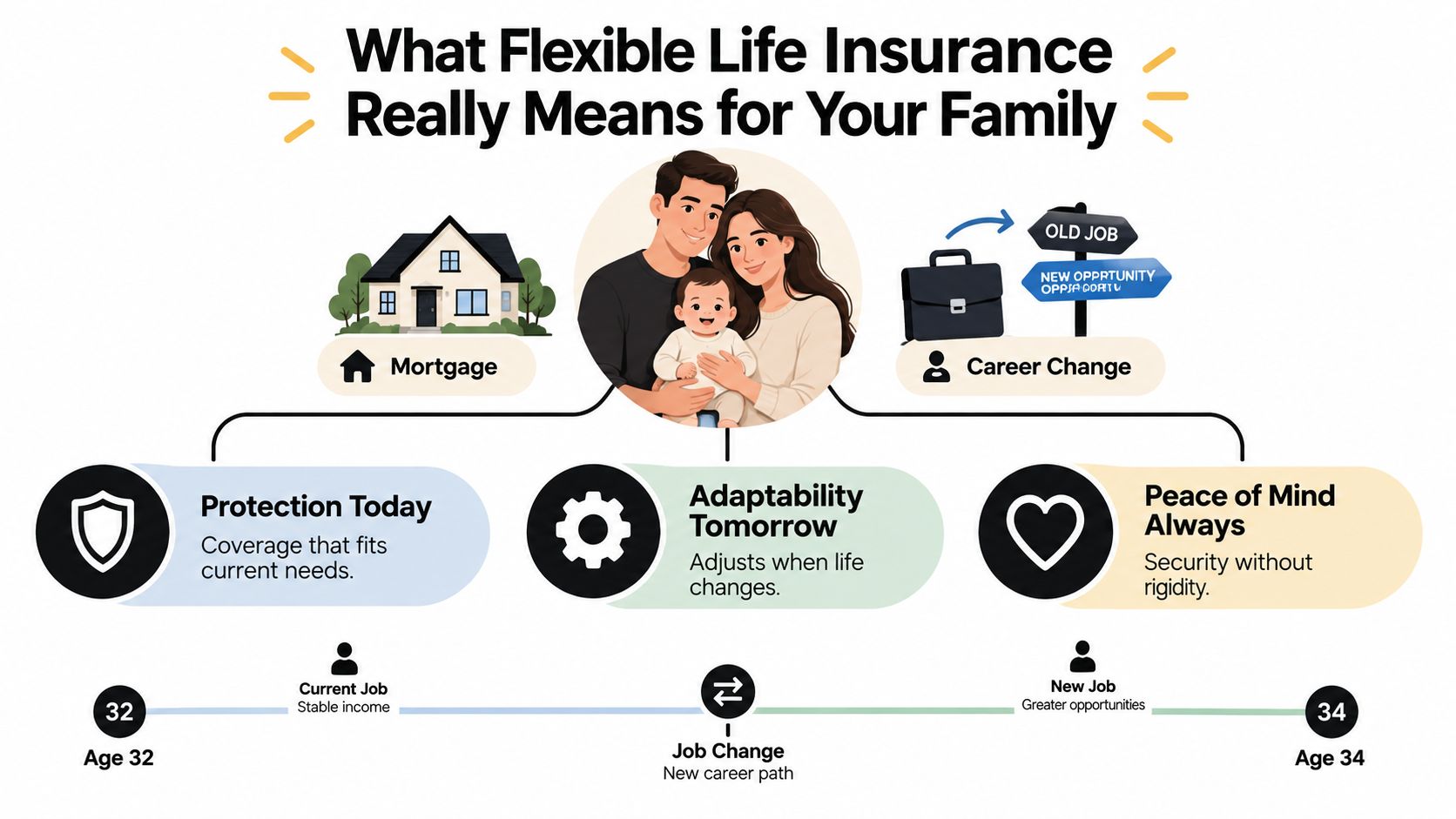
Consider a 32-year-old professional and their spouse, settling into life with a new baby. They have a mortgage, childcare costs, and a household budget built around two incomes. One partner's job may change in two years, which could affect income, workplace benefits, or the family's ability to save.
A policy that seems right today might not fit every later version of this household. The family's need for income replacement may be greatest while the child is young and the mortgage is substantial. Over time, debts may shrink, income may change, and the child may become more independent. The right amount and type of coverage can depend on how those obligations shift.
The National Association of Insurance Commissioners (NAIC) describes term policies with different durations and structures, including level-term, renewable-term, convertible-term, and decreasing-term designs. Each offers a different kind of contractual flexibility. A policy may hold premiums steady for a set term, allow renewal, permit conversion to permanent coverage, or reduce the death benefit over time. These features aren't interchangeable, and they don't automatically make a policy suitable for every family. The NAIC's overview of life insurance explains why the contract, rather than a general label like “flexible,” is what matters.
The family should also review who receives the death benefit and how that designation interacts with its broader estate plans. For Texas readers, this resource on beneficiary designation vs probate in Texas can help clarify why naming a beneficiary deserves careful attention.
Practical rule: Choose flexibility to address a plausible future need, not just because having more options sounds reassuring.
The Five Levers That Make a Life Insurance Policy Flexible
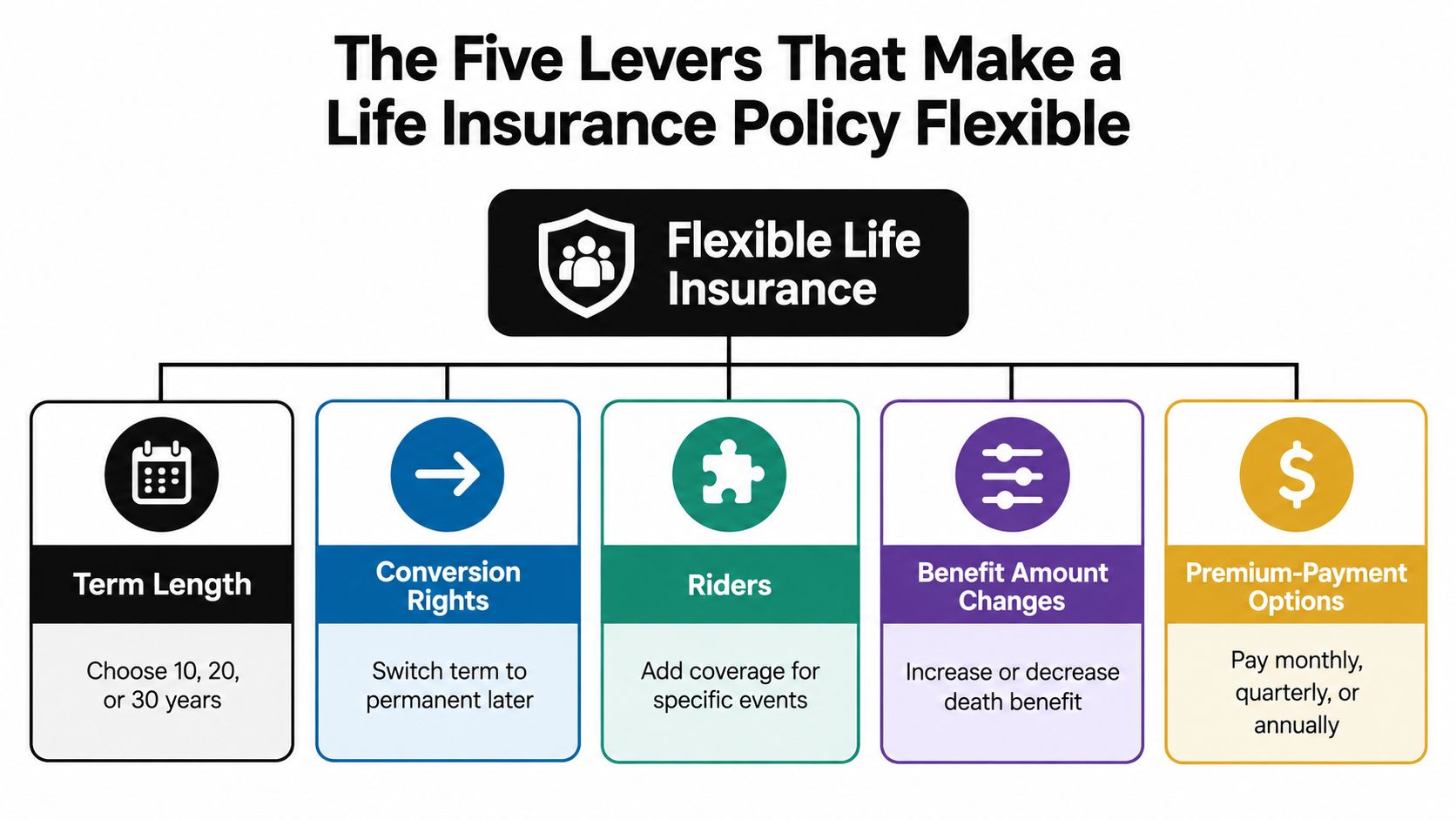
A policy's flexibility comes from several separate contract features, and each one solves a different problem. The five levers are term length, conversion rights, riders, benefit amount changes, and premium-payment options. A lever earns its place when it matches a milestone your household can plausibly expect: a birth, a home purchase, a job change, a divorce, retirement. Options that map to no real milestone tend to be reassurance you pay for.
Term length sets the protection window
Term length sets how many years the household's obligations are covered. The NAIC notes that term policies commonly run for 1, 5, 10, or 20 years, or until a specified age such as 65. A couple signing a 20-year mortgage might match the term to that horizon. Parents of a newborn might count forward to the year the child becomes financially independent. The right answer is the number of years someone would struggle without the insured's income, not the longest period on offer.
Conversion rights preserve a route to permanent coverage
A conversion provision may let a policyholder exchange term coverage for an eligible permanent policy, subject to the contract's conditions and deadlines. The deadline matters. Many contracts close the conversion window well before the term ends, so a family that wants this option should mark that date rather than discover it after expiry. This lever tends to matter when obligations outlive the original plan, such as support commitments after a divorce or a dependent who will need care into adulthood.
Riders add targeted features
Riders are optional add-ons priced into the premium. Some address risks a household faces; others duplicate coverage it already has or protect against events so unlikely the cost outweighs the benefit. Before accepting one, check three things: the added cost, the eligibility rules, and the exact event that triggers payment. A rider that answers a real exposure is useful flexibility. One bought because it sounded reassuring is optionality without a purpose.
Benefit changes adjust the amount of protection
Some policies allow the policyholder to increase or decrease coverage as responsibilities shift. A second child or a larger mortgage may justify raising the benefit, while paid-off debts may justify lowering it. Increases may require fresh underwriting or follow rules set in the contract, so growth is not always guaranteed on request.
Premium-payment options affect how you fund coverage
Payment schedules shape the household budget, though paying monthly versus annually does not by itself make a policy more adaptable. What matters is what happens when money gets tight. Confirm how missed or reduced payments affect the coverage, especially on policies with cash value, where skipped premiums can erode the benefit the family is counting on.
How Each Flexible Feature Works in Practice
The value of a flexible feature becomes clearer when a household can connect it to a specific decision. A feature that addresses a likely change may be worth considering. One that only sounds reassuring may add cost or complexity without solving a real need.

Term length and timing
A couple with a mortgage and a young child might choose a term that broadly matches the years when they expect their financial obligations to be highest. They should compare the coverage window with their own plans, rather than assume a particular term is right for every family. If the policy ends while others still depend on the insured's income, the family may need to seek new coverage under different circumstances.
Conversion when health changes
Suppose a 35-year-old develops a health condition while covered by a term policy and wants permanent insurance. A conversion provision may allow the policyholder to exchange eligible term coverage for a permanent policy without repeating medical underwriting, even if health has deteriorated. But converted coverage usually costs more because the premiums support permanent coverage and cash-value accumulation, not only a temporary death benefit. The contract determines the deadline, available permanent products, and other limits. The NAIC's consumer guide to life insurance describes this trade-off.
Riders and benefit adjustments
A rider should solve a particular coverage problem, not merely make a policy look more complete. Before adding one, ask what event triggers the benefit, whether the household already has similar protection, and how the rider changes the cost. This guide to life insurance riders can help readers understand the different types and questions to raise.
An increase in death benefit may be relevant after a birth or a home purchase. The policyholder should check whether the change is allowed, whether new underwriting applies, and how the added coverage affects premiums. A decrease may fit a household whose responsibilities have declined, but confirm whether the policy permits it and what effect it has on any other policy values.
Premium-payment choices deserve a similar check. If a permanent policy depends on ongoing funding, paying less can affect its cash value or how long coverage lasts. Flexible payment terms aren't a substitute for reviewing the policy's long-term mechanics.
Flexible Policies vs Fixed Policies: What You Give Up
A couple divorcing, a parent taking a lower-paid job closer to home, a family paying off a mortgage early: these are the moments when flexibility earns its cost. If none of them is likely, a simpler contract often wins. The useful question is not whether a policy has options, but which option a household would exercise and at what price.
| Feature | Flexible Policy | Fixed Policy | Best Fit When |
|---|---|---|---|
| Coverage changes | May allow changes, subject to contract terms | Usually keeps coverage structure stable | Future coverage needs may shift and the policy permits useful changes |
| Conversion | May include a right to convert term coverage | May offer no conversion option | Preserving access to permanent insurance matters |
| Premiums | Can change with policy structure or adjustments | May stay level for the chosen term | Predictable payments matter more than optional features |
| Complexity | More provisions to understand and monitor | Often simpler to follow | The household wants fewer moving parts |
Reading that table the wrong way is easy. Each flexible cell describes a possibility, not a promise. As noted earlier, conversion rights come with deadlines and eligible-product limits, and an increase in coverage may require new evidence of insurability. A change in health can affect availability or cost at the exact moment the family wants to use the option.
Permanent designs add mechanics worth pricing before signing. A policy loan uses cash value as collateral and accrues interest; a growing balance can shrink the death benefit or contribute to a lapse. Surrender charges may reduce the cash value if the policy is replaced early, and the replacement policy starts its own surrender schedule. For projected values, request an in-force illustration and separate guaranteed figures from non-guaranteed assumptions. The NAIC explains that distinction in its guide to life insurance illustrations.
A stable policy covering the years your family needs most can be more useful than optional features you pay for but never use.
For households weighing a fixed term against a permanent structure, this comparison of term vs. whole life insurance lays out how the two designs differ. Compare equivalent coverage and equivalent terms rather than labels, and treat flexibility as a purchase: valuable when a likely milestone justifies it, expensive optionality when it does not.
A Young Family's Flexible Coverage Journey
A 30-year-old couple buys a 20-year term policy while they're newly married and planning a family. They choose coverage based on their current responsibilities and budget, then make a note to revisit it after major household changes. The policy is a starting point, not a guarantee that their needs will stay the same.

After their first child is born, the couple reviews how much income the family would need if one parent died. They ask whether their existing policy allows an increase, whether that increase requires underwriting, and whether any rider they're considering addresses a real need. A child rider may be available under some policies, but they compare its terms and purpose with the household's wider protection plan rather than treating it as a required addition.
Later, the couple buys a home. They review the mortgage alongside childcare and income-replacement needs, then check whether their existing death benefit still makes sense. The family's policy documents, workplace coverage, and beneficiary choices all deserve attention during that review. A job change also prompts a check: if the new employer offers insurance, the couple considers whether that coverage is portable and how it fits with the individual policy.
A policy conversation is more useful when both partners can ask questions and compare the contract with their plans. This video can serve as a prompt for that discussion.
As retirement approaches, one partner considers converting part of the term coverage to permanent insurance. They review the conversion deadline, eligible products, premium increase, and how much coverage they'd want to keep. The couple doesn't assume conversion is necessary. They weigh it against their assets, continuing obligations, and the role they want insurance to play.
Flexibility earns its keep at specific moments, not because it exists. A planned review after a birth, home purchase, job change, or other major shift helps the family decide whether to adjust coverage, keep it as is, or leave the policy alone.
Common Myths About Flexible Life Insurance
Myth: Flexible means guaranteed acceptance. A policy feature that allows a future change doesn't mean every change will be approved automatically. The contract may require new underwriting for an increase, while conversion rights apply only within defined limits. Ask what evidence is needed and whether a change can be declined.
Myth: More options cost nothing. A conversion can lead to higher premiums, and a policy with cash value may require sustained funding and careful monitoring. If a policy allows loans or changes to premiums, those actions can affect policy value or how long coverage lasts. Read the provisions before treating flexibility as a no-cost safety net.
Myth: Renewable and convertible mean the same thing. They don't. Renewable term generally concerns continuing term coverage, while conversion allows a switch to permanent insurance if the policy permits it. The NAIC describes these as distinct policy designs, so confirm which right your contract provides rather than relying on a sales summary.
Myth: Digital speed proves a policy is suitable. Online applications can make the process feel more accessible, but approval speed can't determine how much coverage a household needs or whether a particular contract fits. In 2025 research, healthy adults ages 18–30 estimated the cost of a $250,000, 20-year term policy at roughly 10–12 times the median actual cost. Nearly half of Millennials and 39% of Gen Z named perceived cost as a reason for not owning more coverage, according to LIMRA's research on life insurance cost perceptions.
Before applying, ask how underwriting works, when coverage becomes effective, whether a medical exam may be required, and what happens if you want to change the benefit later. A fast process can be convenient, but suitability still depends on the household and the contract.
Choosing the Right Flexible Design for Your Situation
Start with the life changes that would materially affect your family: a birth, home purchase, job change, divorce, or retirement. Then ask which policy feature addresses that change. A household that mainly needs predictable income protection for a defined period may prioritize stable term coverage. A household with a specific reason to preserve conversion rights or adjust its benefit may value a more flexible design, provided it understands the conditions and costs.
In 2022, 56.0% of U.S. households had at least some life insurance, down from 69.0% in 1998. The median face value of in-force policies rose from $61,000 in 1998 to $150,000 in 2022, while LIMRA found that 22% of existing policyowners said their coverage was insufficient. These figures make a review worthwhile, but they can't determine the right amount for an individual household. See LIMRA's life insurance fact sheet and use this guide to think through how much life insurance you need.
Before choosing, check the benefit, premium, term, conversion deadline, rules for increases or decreases, and any assumptions shown in policy illustrations. Revisit the coverage after major changes, and consider speaking with an estate-planning professional about how beneficiary choices fit your wider plans. Texas readers can explore Bryan Fagan estate planning services.
Coveredly offers digital term life insurance with coverage options that may let eligible policyholders increase or decrease protection as their needs change, subject to policy terms. Review your household's milestones and the contract details before choosing a design, then visit Coveredly to explore its online life insurance options.