
A death in the family can turn a familiar kitchen drawer into the starting point for a difficult financial task. The policy card is there, but the beneficiary may not know which number to call, what documents to send, or whether accepting the insurer's default payment option is the right choice.
Understanding how life insurance is paid out makes that moment less confusing. The process usually moves from notification, to documentation, to claim review, and finally to a settlement method that determines how the money reaches the household. The benefit amount matters, but so does the way the family receives and manages it.
Table of Contents
- When the Phone Call Comes
- What a Life Insurance Payout Actually Is
- How the Beneficiary Files a Claim
- Lump Sum, Installments, or Lifetime Income
- Taxes, Interest, and What the IRS Actually Sees
- A Short Checklist for the Week After
- Planning the Payout Before Anyone Has to Claim It
When the Phone Call Comes
The surviving spouse finds the policy card beneath old tax documents and calls the insurer. That call opens a file, much like starting a folder for the household's most urgent bills. A representative explains the required forms and requests proof of death. At the same time, the family may be grieving, arranging a funeral, caring for children, and keeping everyday expenses paid.
The first conversation rarely sends money immediately. The beneficiary must establish identity, show entitlement to the benefit, and provide enough information for the insurer to confirm the policy and claim. The insurer checks whether coverage was active and whether exclusions, contract terms, or questions about the application call for further review.
The payout journey in plain language
The practical path usually follows these steps:
- Find the policy and insurer. Locate the policy number, insurer, and current contact details.
- Report the death. The beneficiary or another authorized person notifies the insurer.
- Submit the claim package. This commonly includes the claim form, proof of death, policy information, and beneficiary identification.
- Wait for review. The insurer confirms coverage and entitlement and examines unresolved issues.
- Choose or receive a settlement. The proceeds may arrive as a lump sum, installments, lifetime payments, or interest-only payments, depending on the policy and the option selected.
U.S. regulators group payment timing into claims paid within 30 days, within 31 to 60 days, and beyond 60 days after due proof of loss, according to the NAIC life and annuity claims instructions.pdf). The timing rules are covered in detail in the claims section below. The clock depends on receiving sufficient documentation, not only on the date of death.
Before accepting the insurer's default settlement, the family can compare the option with its actual cash-flow needs. Immediate bills may call for a lump sum, while predictable future expenses may suit scheduled payments.
Practical rule: Keep the policy easy to find, record the insurer's contact details, and tell the beneficiary where both are stored. That preparation can remove a major obstacle during a difficult week.
What a Life Insurance Payout Actually Is
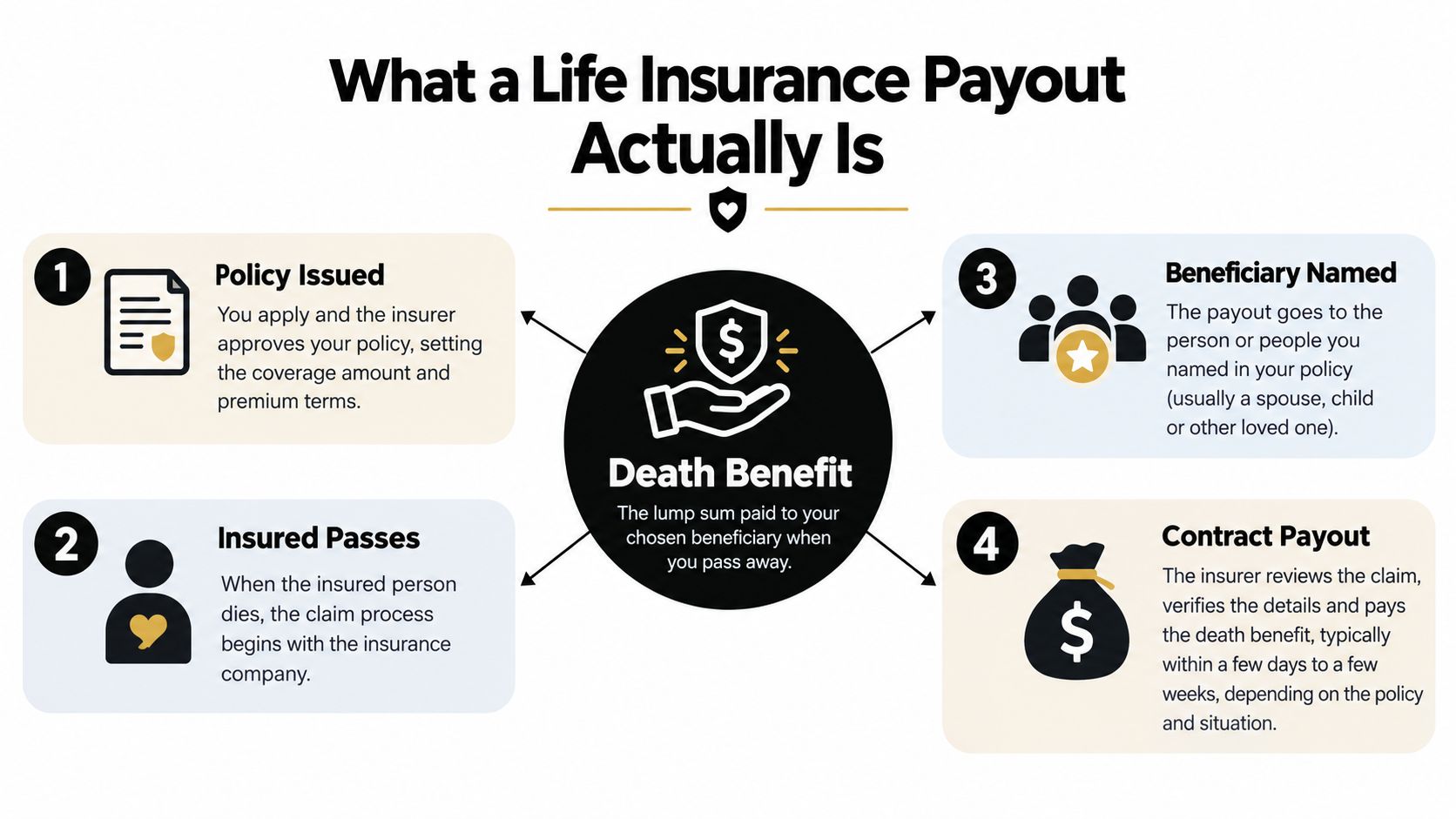
A life insurance payout is the death benefit promised by an active policy. The policyholder pays premiums during the policy period. If the insured person dies while the applicable coverage remains in force, the insurer reviews the claim and generally pays the benefit to the people named in the contract.
The death benefit isn't automatically paid to the closest relative. The policy's beneficiary designation controls the payment path. A policyholder can name multiple primary beneficiaries and allocate the proceeds by percentage or equal shares. A contingent beneficiary receives the benefit if a primary beneficiary dies before the insured person, as explained by the National Association of Insurance Commissioners' life insurance consumer guidance.
Who receives the money
Think of the beneficiary designation as an instruction attached to the policy. It tells the insurer who should receive the funds and how the benefit should be divided.
- Primary beneficiaries are first in line to receive the death benefit.
- Contingent beneficiaries step in if a primary beneficiary isn't living or otherwise can't receive the proceeds.
- The estate may receive the money if no living beneficiary is available or if the policy names the estate.
Naming individuals generally allows the proceeds to pass outside probate. Naming the estate can route the money through probate and may create estate-related tax consequences depending on the jurisdiction. If a beneficiary is a minor, the insurer commonly can't pay that child directly, so a trust or estate arrangement may be needed to administer the funds.
Families sometimes assume that an informal promise, a will, or a divorce automatically changes the policy. The recorded designation usually carries greater weight than family expectations. After marriage, divorce, a birth, a death, or a major financial change, the policyholder should review the designation directly with the insurer.
Families dealing with several benefit systems may also need help understanding how different forms of dependent support work. A resource on family benefit help from Lein Law Offices can provide useful context when life insurance is only one part of the household's financial picture.
How the Beneficiary Files a Claim
A claim starts with a phone call or online notification. The beneficiary tells the insurer that the insured person has died, and the insurer explains which forms and records apply to that policy. Contacting the company early helps reveal missing requirements before the household has organized every document.
The core claim steps
- Notify the insurer. Use the claims phone number, online portal, or contact method in the policy records. Provide the insured person's name, policy number if available, date of death, and your relationship to the insured.
- Complete the claim form. Enter the beneficiary's legal name, address, identification details, payment instructions, and requested policy information. Check spelling and account details carefully.
- Provide proof of death. The insurer usually requests a certified death certificate. It verifies the event that activates the death benefit.
- Send beneficiary and policy information. Include identification, beneficiary documentation, and policy records the insurer requests. Keep copies of every submission.
- Respond to follow-up questions. The insurer may ask about the application, coverage, ownership, or beneficiary entitlement.
- Review the payment decision. After approval, examine the available settlement choices before accepting the proceeds.
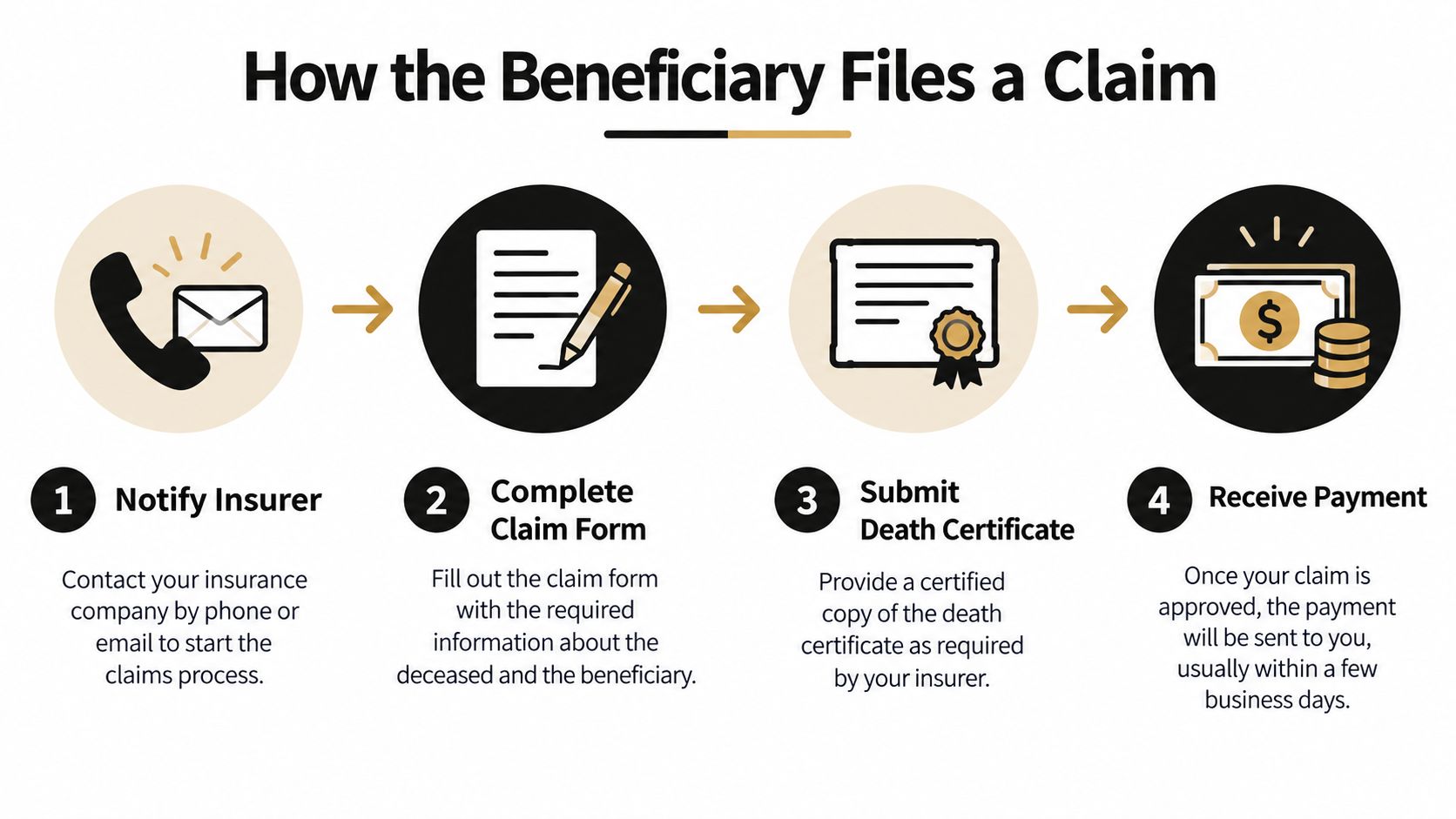
Most straightforward claims are paid within two to four weeks after the insurer receives due proof of loss. A disputed beneficiary designation, unclear ownership, or a pending application review can extend that timeline. The insurer may request medical records or investigate statements made in the application, particularly during the policy's contestability period. That review does not automatically mean the claim will be denied, but it can delay a decision while the company compares the records with the policy terms.
A beneficiary should also treat the first payment explanation as a starting point, not necessarily the only choice. The guide to filing a life insurance claim can help organize documents and questions for the insurer. Ask what evidence is still missing, whether interest may apply during a delay, and which payment methods are available. Those answers connect the claim process to the household's practical needs, such as immediate bills or dependable future cash flow.
When several people are named, the insurer may pay each beneficiary separately, although the event can remain one claim for administrative purposes. Multiple recipients do not necessarily mean separate policy investigations. Each beneficiary still must provide enough information to establish identity and entitlement, and one person's missing documents may affect that person's payment without changing another beneficiary's eligibility.
Lump Sum, Installments, or Lifetime Income
The most visible option is a lump-sum payment, but it isn't the only way a life insurance benefit can be paid. The National Association of Insurance Commissioners identifies a single-payment lump sum, fixed-amount installments, fixed-period installments, lifetime installments, and an interest-only arrangement among the available settlement methods in its consumer guidance on retained-asset accounts and life insurance.
A young family may need immediate access to money for housing, childcare, funeral costs, and debt. Another household may prefer a controlled stream of payments that reduces the risk of spending the benefit too quickly. Neither choice is universally correct. The right structure depends on liquidity needs, income, existing savings, financial confidence, and the beneficiary's need for long-term security.
| Settlement Option | How It Works | Best For |
|---|---|---|
| Lump sum | The insurer pays the full available benefit in one payment. | A household facing immediate costs or needing control of the entire balance. |
| Fixed-amount installments | The beneficiary receives a chosen amount monthly, quarterly, or annually until the proceeds are exhausted. | Someone who wants predictable cash flow while retaining a defined payment amount. |
| Fixed-period installments | The insurer distributes the proceeds over a selected period. | A family coordinating the benefit with a known period of childcare, education, or income replacement. |
| Lifetime installments | The insurer determines periodic payments that continue for the beneficiary's lifetime. | A surviving partner focused on protection against outliving the benefit. |
| Interest-only arrangement | The insurer holds the principal while paying interest to the beneficiary. | Someone who wants ongoing income while preserving the underlying proceeds, subject to the policy terms. |
Match the option to the household
A surviving parent with a mortgage and young children may value the flexibility of a lump sum. Immediate access can help cover a funeral, replace lost earnings, stabilize housing, and create a reserve for childcare. The trade-off is that the beneficiary becomes responsible for managing the entire balance.
Fixed installments create a spending boundary. A beneficiary can use the scheduled amount for household bills without deciding how much of the principal to withdraw each month. The benefit may last longer, but the recipient gives up some control over timing and may have less available for a large expense.
Lifetime income addresses a different concern. A surviving partner with stable housing and other resources may prioritize a payment stream that continues throughout life. The insurer determines the periodic amount, so the beneficiary should understand how the policy calculates payments and whether any guaranteed minimum or refund feature applies.
An election can also be difficult or impossible to change after the claim is settled. Before signing, compare the settlement offer with the household emergency fund, mortgage balance, debt obligations, and expected income. The life insurance settlement options guide can help beneficiaries prepare questions, but the policy and insurer's terms control the final choice.
Taxes, Interest, and What the IRS Actually Sees
For U.S. federal income-tax purposes, the principal death benefit is generally excluded from the beneficiary's gross income. The Internal Revenue Service explains that life insurance proceeds received because of the insured person's death generally don't need to be included as taxable income, while interest paid in addition to the proceeds is taxable interest income in the IRS guidance on life insurance proceeds.
That distinction is easiest to understand by separating the payment into two parts. The principal is the original death benefit promised under the policy. Interest is additional money generated because the insurer holds the funds, delays payment, or distributes them through an arrangement that includes earnings.

The installment example
Consider the example described in TaxAct's explanation of life insurance death benefits. If $75,000 is payable over 120 installments, $625 of each installment represents the original benefit, calculated by dividing $75,000 by 120.
If the monthly payment is $1,000, the remaining $375 is treated as taxable interest in that example. Over a full year, that interest totals $4,500. The principal portion remains the nontaxable return of the death benefit, while the interest portion belongs in the beneficiary's interest-income reporting.
Interest is most likely to appear when the beneficiary delays taking the proceeds, leaves the money with the insurer, chooses installments, or selects an interest-only arrangement. A lump sum can simplify the distinction because it generally delivers the stated benefit without an extended period for additional interest to accumulate, although the insurer's payment terms still matter.
This is why settlement selection isn't only a cash-flow decision. It can also affect tax reporting, the timing of taxable income, and the records the beneficiary should keep. Review any tax form from the insurer and consult a qualified tax professional when the payment includes interest, especially if the proceeds are routed through an estate or trust. The explanation of whether life insurance proceeds are taxable offers a useful starting point for questions to take to that professional.
A Short Checklist for the Week After
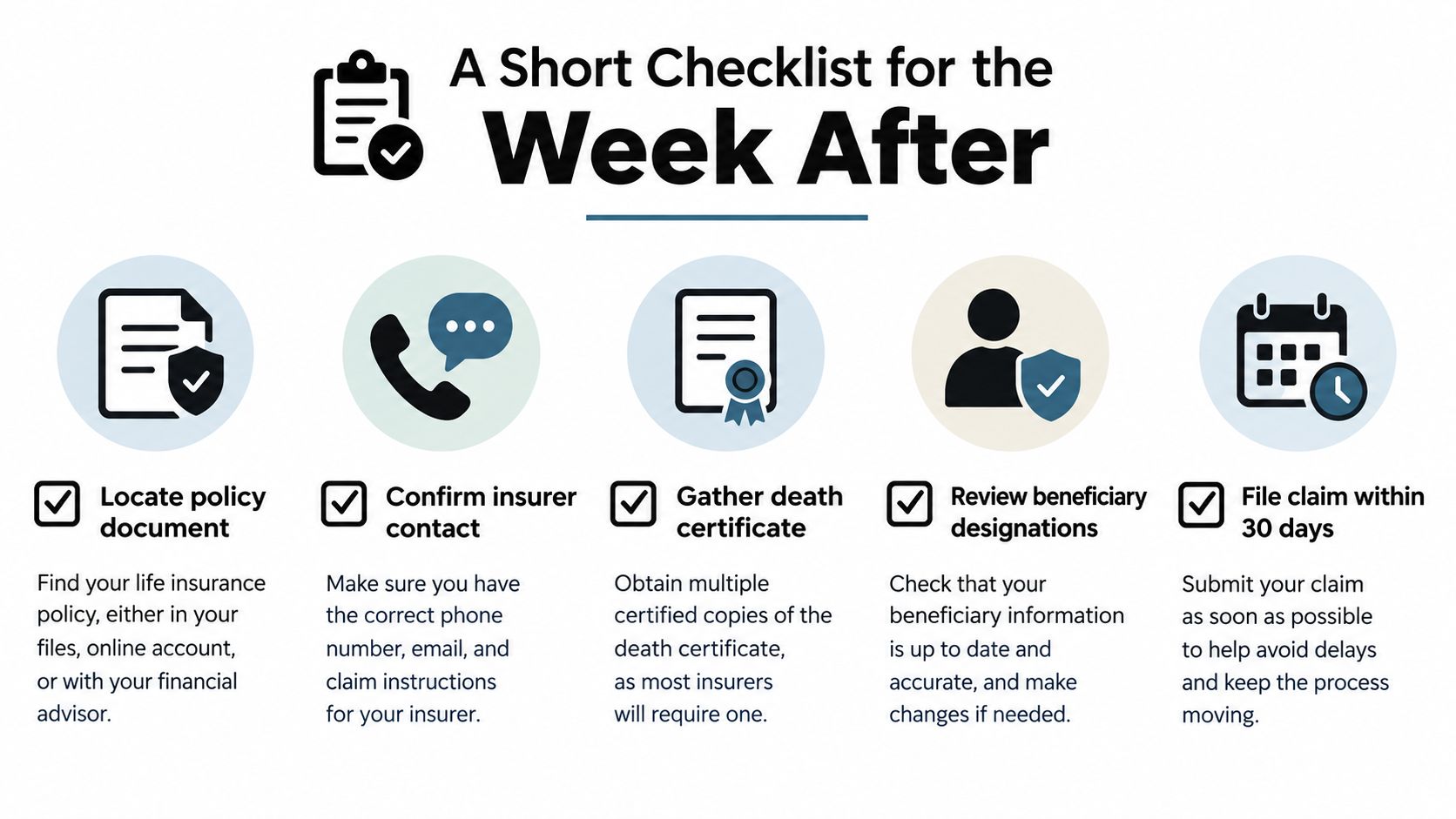
Grief can make routine paperwork feel unfamiliar. Treat the claim like a series of small handoffs: identify the policy, prove the loss, confirm the beneficiary, then choose how the money should reach the household.
Keep the first actions simple
- Locate the policy document: Record the policy number, insurer, ownership details, and beneficiary designation. If the original is missing, household records may still identify the carrier.
- Confirm the insurer's contact details: Use the claims number on the policy or the insurer's official website. Note the representative's name, the date of the call, and any claim reference.
- Gather certified death certificates: Ask the relevant authority or funeral provider how to obtain certified copies. The insurer generally needs proof of death before completing its review.
- Prepare identification: Keep the beneficiary's identification, address, tax information, and payment instructions together. These details help the insurer confirm identity and direct the funds correctly.
- Complete the claim form carefully: Check names, dates, policy numbers, beneficiary shares, and bank information before submitting. Small errors can lead to avoidable follow-up.
- Review the beneficiary designation: Confirm who is named and whether a primary beneficiary has died. An outdated or disputed designation can complicate payment.
- Ask for settlement details in writing: Before signing the election form, ask the insurer to show the first three payment amounts and explain how interest will be treated. This gives the household something concrete to compare with its upcoming bills and income needs.
As covered above, the principal benefit is generally income-tax-free while any interest portion is taxable. Keep the insurer's tax form with the claim file, including any IRS explanation of life insurance and disability insurance proceeds.
Keep a complete copy of the claim package, delivery confirmation, correspondence, and settlement election. These records make follow-up easier if the insurer requests clarification.
Planning the Payout Before Anyone Has to Claim It
A family can make the eventual payout easier to manage while the policyholder is healthy. Keep the policy accessible, tell the beneficiary which insurer provides the coverage, and review the designation after marriage, divorce, births, deaths, or major financial changes. A beneficiary form works like an address label. If it is outdated, the money may not go where the household expects.
The settlement choice should match the job the coverage is meant to do. A young family replacing lost income may need a large amount at once for housing, childcare, and debt. A household with liquid savings may instead prefer installments or lifetime income if regular cash flow matters more than immediate control. The default lump sum is one option, not automatically the right answer.
A practical decision prompt
Discuss these questions before anyone has to file a claim:
- What bills would arrive immediately? Funeral expenses, housing costs, childcare, and debt may make a lump sum useful.
- What income would disappear? Compare the benefit with the household's longer-term cash-flow needs, not only its first month of expenses.
- Who will manage the money? Someone comfortable with budgeting may want control, while another beneficiary may prefer automatic installments.
- Would a minor receive the benefit? As noted above, insurers generally cannot pay minors directly. Discuss whether a trust or another arrangement is needed, including choosing and funding your trust.
- Has the designation kept pace with life? Recheck it after major family or financial changes.
The decision becomes clearer when the family writes down its likely expenses, income gap, and comfort with managing a large balance. That simple exercise turns a distant policy feature into a household cash-flow decision.
U.S. life-insurance benefits and claims across life, annuity, disability, and other categories totaled $965.6 billion in 2024, compared with $831.8 billion in 2023. The scale of those payments does not determine one family's choice. Its obligations, savings, and ability to manage income should guide the settlement method.
A trust may provide structured administration or additional control when the estate plan calls for it. Coordinate the trust with the policy's beneficiary designation and obtain advice suited to the family's jurisdiction.
Coveredly provides online term life insurance, with coverage of up to $3 million and no exams for most applicants, subject to eligibility and policy terms. Families reviewing protection can visit Coveredly to explore coverage and connect the policy's purpose with a clear beneficiary plan.