You open a renewal notice expecting the usual paperwork. Instead, the premium jumps enough to make you stop and read it twice.
That moment pushes a lot of people into finally asking a practical question. Should I stay, negotiate, or switch? If you're comparing options because your rate climbed, your claims experience went sideways, or your family situation changed, you're not overreacting. You're doing routine financial maintenance.

I think about insurance switching the same way I think about refinancing a loan or updating estate documents. You don't do it for entertainment. You do it because the old arrangement may no longer fit your risks, budget, or goals.
For young families, newly married couples, and business professionals, the trigger is often bigger than price. Marriage can change health and life coverage needs. A new baby raises the stakes on life insurance. A home purchase can make bundling worth reviewing. A business owner may need stronger liability protection and more reliable claims handling.
The good news is that how to switch insurance providers isn't complicated when you handle timing, comparisons, and communication in the right order. The bad news is that sloppy switching creates avoidable problems, especially lapses in coverage and poor apples-to-apples comparisons.
Table of Contents
- Your Guide to Changing Insurance Providers
- Key Signals It Is Time to Switch Insurers
- How to Compare Insurance Policies Accurately
- The Step-by-Step Process for a Seamless Switch
- Switching Life Insurance A Unique Guide
- Common Switching Mistakes to Avoid
- Frequently Asked Questions About Switching Insurance
Your Guide to Changing Insurance Providers
Changing insurers is part paperwork, part timing, and part judgment. Errors often occur with timing and judgment.
A clean switch starts with a basic rule. Don't treat insurance like a commodity until you've confirmed the coverage details are comparable. A lower premium can be a win. It can also be a downgrade dressed up as savings.
What a first switch usually looks like
A family gets a renewal notice. The price rises, but the cars haven't changed, the home hasn't changed, and there hasn't been a new claim. They start gathering quotes, then realize each quote looks slightly different. One policy has a higher deductible. Another has weaker rental reimbursement. A third saves money, but the carrier's communication process looks thin.
That's the point where a lot of people stall out.
The practical way through it is straightforward:
- Identify the trigger that's making you shop.
- Pull your current declarations page so you know what you already have.
- Compare quotes line by line, not just premium to premium.
- Set the effective date of the new policy first.
- Cancel the old one only after the new one is active.
Practical rule: Insurance switching goes smoothly when you make decisions in writing, not from memory.
When switching makes sense
Price is the most common reason, but not the only good one.
You should also consider a switch when:
- Your life changed: marriage, children, a move, a new vehicle, a home purchase, or a new business can make old coverage outdated.
- Your insurer became hard to work with: poor claims communication and slow service matter when something goes wrong.
- Your policy no longer fits: maybe you need stronger liability protection, telehealth access, broader networks, or a term life structure that better matches your family responsibilities.
Switching works best when you treat it as a risk review, not just a shopping exercise. That's especially true for life insurance, where health history and policy language matter much more than people expect.
Key Signals It Is Time to Switch Insurers
Your policy renews next month. The premium is up again, your daughter just got her license, and you've been meaning to review your life insurance since your second child was born. That combination is usually enough to justify a serious look at other carriers.
A switch makes sense when the policy no longer matches your risk, your budget, or the way the insurer handles communication. Price matters, but timing matters too. Families who switch well usually do it before renewal, after a major life change, or after a pattern of service problems makes the risk of staying harder to justify.
One market signal is easy to see in auto coverage. Analysts at CivicScience found strong switching intent among U.S. auto insurance customers, with affordability leading the list of reasons. That lines up with what advisors and agents see every renewal season. People shop when costs rise, but they stay when coverage and service still feel fair.
A premium increase that no longer feels justified
This is one of the clearest triggers.
Insurance rates can rise even when you did nothing wrong. Claims trends, repair costs, medical costs, catastrophe exposure, and carrier pricing strategy all affect renewals. Still, a material increase should prompt a review, especially if the explanation is vague or the change strains your monthly budget.
Pay attention when:
- The renewal notice arrives with a larger jump than you expected
- Your coverage stayed mostly the same
- You have not checked competing quotes in a few years
- You are cutting other household spending to keep the policy
That last point matters. Insurance should protect your finances, not squeeze them.
A life change created a timing window
Switching works best when you line it up with a real change in your household.
Marriage, a home purchase, a new baby, a teen driver, a relocation, or a business launch all create a natural review point. The coverage itself may need to change, and the insurer that fit you three years ago may no longer be the best fit now. These moments also create paperwork, underwriting questions, and beneficiary updates, which is why good timing reduces mistakes.
Life insurance deserves extra care here. If your family depends on your income, a switch is not just about finding a better premium. It is about confirming the new policy is issued, accepted, and active before the old one is surrendered or allowed to lapse. If you are reviewing term coverage after a new child or mortgage, start by comparing term life insurance rates for your age and coverage goals, then check underwriting requirements and effective dates before making any cancellation decision.
The safest time to switch life insurance is after the new policy is fully in force, not when you first receive an attractive quote.
Service problems keep repeating
Poor service is expensive in a different way.
One delayed callback is not a reason to leave. Repeated confusion, missing documents, inconsistent answers, or claim updates that stall for weeks are stronger signals. Insurance is a contract, but in practice it is also a communication system. If that system breaks down, the low premium loses some of its value.
Watch for patterns such as:
- Long delays getting policy documents or ID cards
- Claims updates that require repeated follow-up
- Billing or administrative errors that keep returning
- Written explanations that stay vague when you ask direct questions
These issues matter even more for health and life insurance, where enrollment details, beneficiaries, and effective dates can carry serious consequences.
The trade-offs are wrong for your family
Sometimes the problem is not the insurer. It is the design of the policy.
A family with young children may care more about pediatric access, prescription coverage, or a broader provider network than they did a few years ago. A homeowner with growing assets may need higher liability limits. A parent who bought a small life policy before children may now need a longer term period or a larger death benefit. In each case, the signal is the same. You keep accepting compromises that no longer make sense.
That is usually the point to shop, compare carefully, and plan the transition with dates and confirmations in writing.
How to Compare Insurance Policies Accurately
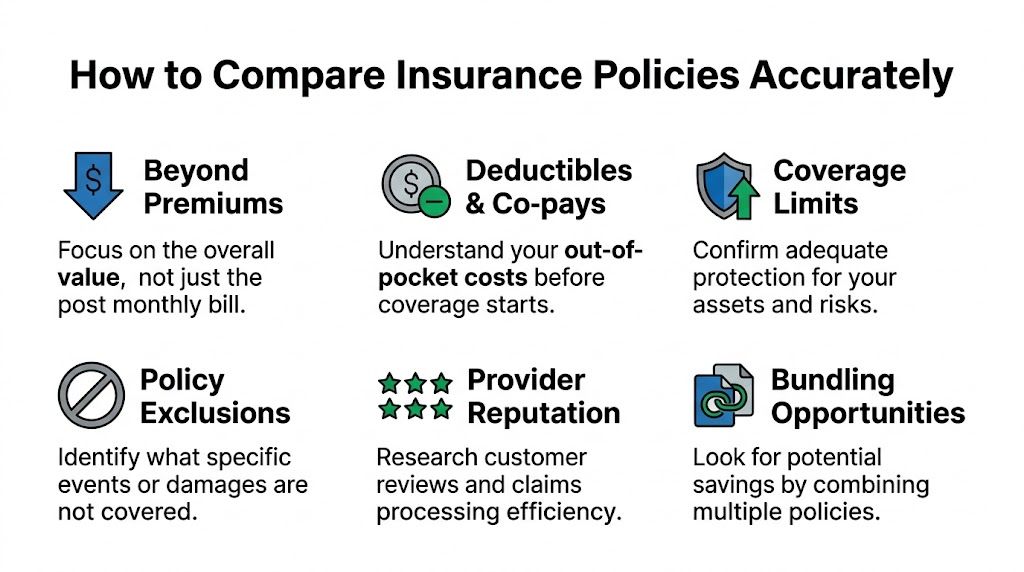
A family switches to a lower premium, feels good for two months, and then finds out the new policy raised the deductible, narrowed a provider network, or left out a rider they assumed would carry over. That is usually how a bad switch happens. The problem is rarely the quote itself. The problem is comparing the wrong things.
Start with your current declarations page and any endorsements or riders attached to the policy. That document is your control sample. Without it, you are comparing sales summaries from memory, and memory is unreliable when coverage details affect claims, cash flow, and deadlines.
Compare premium numbers in context
Price matters. It just cannot be the first and last filter.
Line up quotes side by side and make sure the structure matches before you judge cost. For auto, use the same liability limits, deductibles, rental coverage, roadside assistance, uninsured or underinsured coverage, and named drivers. For homeowners, match dwelling limits, personal property, liability, loss of use, and any scheduled items. For health, compare network design, drug tiers, specialist rules, and out of pocket exposure, not just the monthly premium.
A simple worksheet helps keep the comparison honest:
- Carrier name
- Annual or monthly premium
- Deductible
- Liability or benefit limits
- Riders or endorsements
- Discounts included
- Exclusions
- Payment options
- Claims and service access
If you are also reviewing life coverage, compare policy length, death benefit, conversion rights, and riders in one place. A side by side review of term life insurance rates and policy options helps you check affordability without losing sight of contract design.
Match the policy language, not just the category
Two quotes can both say "home insurance" or "term life" and still protect your family very differently.
This matters most with life insurance, because replacement is not just a pricing decision. It is a timing and underwriting decision. A lower premium on a new term policy means very little if the new carrier changes the health class, excludes a condition, shortens features you rely on, or takes longer to approve than expected. I tell clients to compare life policies with extra care for that reason. Families often focus on the death benefit and miss the provisions that control how secure that benefit really is.
Review these points carefully:
- Coverage amount or death benefit
- Policy term or renewal structure
- Cash value features, if permanent coverage is involved
- Conversion options
- Waiver of premium, child rider, and other riders
- Waiting periods, exclusions, or contestability concerns
- Beneficiary setup requirements
For property and auto policies, compare the triggers for payment. For life insurance, compare the conditions that could delay approval, change the offer, or affect replacement timing. That is where many high-stakes switching mistakes begin.
Read deductibles, exclusions, and sub-limits carefully
A cheaper quote often results in weaker protection.
A higher deductible may be reasonable if your emergency fund can absorb it without strain. Exclusions deserve even more attention. A policy can look similar on the first page and still carve out losses that matter to your household. Sub-limits create another common problem. Jewelry, electronics, water damage, business property at home, and similar categories often have lower caps than clients expect.
Ask the agent or broker a direct question in writing: What is different from my current policy that could affect a claim or payout? A careful professional can answer that clearly. A vague answer is useful information too.
A quote is not ready for a decision until you know what it pays for, what it limits, and what it leaves out.
Check insurer quality before you switch
A low premium loses value quickly if billing is messy, policy documents arrive late, or claim communication breaks down. That trade-off is especially important for families who need clean beneficiary records, lender notifications, or proof of coverage by a specific date.
Review:
- Financial strength ratings
- Complaint history
- Claim handling reputation
- Billing accuracy
- Ease of getting declarations pages, ID cards, and written confirmations
For life insurance, insurer quality matters twice. First at issue, because underwriting and policy delivery can take time. Then at claim time, when your family needs accurate records and prompt communication. Many guides treat life insurance like any other policy swap. It is not. The comparison should account for the contract and the handoff process, because both affect whether the switch goes smoothly.
Good comparisons feel methodical. Clear documents, matched terms, and written answers usually point to a better decision than a low number on a quote screen.
The Step-by-Step Process for a Seamless Switch
A switch usually goes wrong in the last 48 hours, not at the quote stage. A parent picks a lower premium, assumes the start date is handled, cancels the old policy too early, and then learns the new carrier still needs one document or one signature. That is how preventable gaps happen.
The handoff deserves as much attention as the comparison. Timing, written confirmation, and the order of each step matter. That is especially true if your family relies on uninterrupted auto, home, or life coverage for a loan closing, school commute, estate plan, or basic peace of mind.
Build your switching file first
Before you apply, gather the documents that control the handoff.
Start with your current declarations page, policy number, insured details, property or vehicle information, and recent claims history. If another party needs proof of coverage, include lender, lessor, or mortgage servicer contact details. For life insurance, add the full policy and any riders so you can verify what would be replaced.
If you need help reviewing contract language before making a change, use this guide on how to read a life insurance policy. Small wording differences can change conversion rights, exclusions, or premium guarantees.
Put the new policy in force before ending the old one
This order works well because it reduces the chance of a gap and gives you a paper trail if anything is delayed.
Approve the final version of the new policy
Confirm limits, deductibles, endorsements, named insureds, beneficiaries if applicable, and premium. Make sure the policy issued matches the quote you accepted.Set an exact effective date
Do not rely on verbal assumptions. The start date should be confirmed in writing, and it should line up with the old policy's end date or begin slightly earlier.Get proof immediately
Save the binder, ID card, declarations page, or policy delivery email as soon as it is available. If a lender or leasing company needs proof, send it the same day.Check any third-party requirements
Auto lenders, landlords, mortgage servicers, and umbrella carriers may all need updated evidence of coverage. Missing this step can create fees, force-placed coverage, or administrative problems even when your new policy is active.Cancel the old policy in writing
Request cancellation only after the replacement coverage is active and documented. Keep the confirmation with your records.
For life insurance, this timing issue carries more risk. A new policy can be approved, then delayed in delivery, amended after underwriting, or issued with terms you did not expect. Replacement should wait until the new coverage is fully in force and you have confirmed that the policy matches your plan.
Do not cancel your current policy until the replacement coverage is active and documented.
Required Documents and Information Checklist
| Document/Information | Where to Find It | Why You Need It |
|---|---|---|
| Current declarations page | Online account, renewal packet, agent email | Lets you verify limits, deductibles, endorsements, and insured names before you switch |
| Policy number | ID card, billing statement, declarations page | Needed for cancellation and account reference |
| Driver's license or insured details | Personal records | Required for quoting and identity verification |
| Vehicle information or property details | Registration, prior policy, ownership records | Helps the new insurer issue the correct coverage |
| Claims history notes | Prior insurer portal or personal records | Reduces quote errors and last-minute underwriting surprises |
| Lender or leasing company details | Loan documents, mortgage records | Needed to update any party that requires proof of coverage |
| New policy effective date confirmation | New carrier binder, declarations page, email confirmation | Helps prevent accidental gaps between policies |
Use a short cancellation message
Clear beats polished.
Use wording like this:
Please cancel my policy effective on [date] because replacement coverage is in force. Send written confirmation of cancellation and any refund due for unused premium.
If you start by phone, send the same request through email or the insurer portal right after the call. Written records solve a lot of disputes about dates, refunds, and whether the request was received.
Switching Life Insurance A Unique Guide
Life insurance replacement is a commonly underestimated category. They assume it works like switching auto coverage. It doesn't.

With life insurance, time and health can change the economics of the decision. A term policy you bought a few years ago may no longer be available on the same terms if your health changed, even if your financial need for coverage increased.
A 2025 LIMRA survey indicates that 40% of millennials have considered switching life insurance providers, yet many guides don't address practical concerns like new medical exams or how incontestability clauses are reset, according to The Zebra's discussion of insurance switching gaps. That gap matters because mistakes in life insurance don't just create inconvenience. They can leave a family exposed.
Why life insurance replacement is different
Auto and home policies usually revolve around property, liability, and service. Life insurance adds underwriting.
Before replacing a policy, ask:
- Has your health changed since the old policy was issued
- Will the new insurer require fresh underwriting
- Are you giving up a useful rider
- Will the new contract restart time-sensitive provisions
- Does your existing policy offer conversion rights
If your health is worse today than when you first bought coverage, replacing a life policy can backfire. The premium may rise, the approval may change, or the application may not get approved at all.
Watch this walkthrough if you want a visual overview before making a replacement decision.
Portability conversion and replacement are not the same
These terms often get blurred together, and that creates expensive misunderstandings.
Portability usually refers to taking certain coverage with you when employment changes, if the policy allows it.
Conversion usually means changing a term policy into a permanent policy, often subject to the contract's rules.
Replacement means ending one policy and putting a new one in its place.
Those are very different moves.
If you have term coverage and you're considering a permanent option, review the mechanics of converting term life to whole life before you terminate anything. In some cases, conversion rights can be more valuable than a shopper realizes.
Replacing life insurance is not a paperwork exercise. It's a new underwriting event unless your existing contract gives you another path.
Questions to ask before signing a new life policy
Use this short checklist before you approve replacement:
- What happens to my old policy if the new one is delayed? Keep the old one active until the new contract is fully issued and accepted.
- Am I losing favorable terms? Older underwriting outcomes can be worth preserving.
- Does the new policy restart key contract periods? Ask directly and get the answer in writing.
- Do I need more coverage or different coverage? A replacement isn't always the answer. Sometimes an additional policy is cleaner.
- Are my beneficiaries and ownership details current? A switch is a good time to correct outdated records.
For families, caution is more important than speed. If a parent dies during a period of confusion, no one in that household will care that the new quote looked cleaner online. They will care whether the coverage existed, whether beneficiaries were correct, and whether the claim process is straightforward.
Common Switching Mistakes to Avoid
A switch usually goes wrong in the handoff, not in the quote comparison. A parent changes auto carriers on a lunch break, assumes the new ID cards are enough, and learns a week later that the old policy never canceled correctly or the lender never received updated proof. The price looked better. The process was not handled tightly enough.
Buying on premium alone. Lower cost matters, but it is only one line on the page. Check deductibles, exclusions, liability limits, out-of-pocket maximums, network rules, and endorsements before you decide. A cheaper policy that shifts more risk back onto your family is not a savings win.
Letting dates drift. Effective dates, renewal dates, grace periods, and cancellation dates need to line up. If they do not, you can end up with a gap in coverage or with two policies billing at once. I tell clients to put every date in writing and confirm who is responsible for each step.
Stopping payment instead of canceling properly. Missed payments create a paper trail you do not want. Carriers may continue the policy for a period, send notices you miss, or report unpaid balances to collections. Submit the cancellation the way the insurer requires and keep confirmation.
Treating communication as an afterthought. Third parties often need notice. Mortgage servicers, auto lenders, landlords, escrow departments, and employer benefits teams may all need updated policy details. If they do not get them on time, they may force-place coverage, reject proof of insurance, or keep charging based on old information.
Overlooking service quality. A policy is only as good as the company handling billing, endorsements, claims, and corrections. If an insurer is difficult to reach before the sale, expect more frustration after the sale. Read complaint patterns, test the customer service line, and pay attention to how clearly they answer questions in writing.
Switching life insurance too casually. This is the costliest mistake because the consequences fall on the people depending on you. A new life policy can involve fresh underwriting, new waiting periods, and different approval timing. If you cancel first and the new policy is delayed, repriced, or declined, your family is exposed. Life insurance switches require patience, confirmation, and careful communication with every person involved in the decision.
The safe rule is simple. Do not treat switching as a single click. Treat it as a timed sequence, and do not mark it done until the new coverage is active, the old coverage is canceled correctly, and every affected party has the updated documents.
Frequently Asked Questions About Switching Insurance
When should I start shopping before renewal
A rushed switch is where costly mistakes happen. Start shopping early enough to compare quotes, check policy details, and fix any paperwork problems before your current policy renews. For auto and home coverage, that usually means giving yourself enough time to confirm the new effective date and avoid even a one-day gap.
For life insurance, start even earlier. Approval can take longer than families expect because the insurer may review medical records, prescription history, and financial information before issuing the policy.
Should I call my current insurer before I switch
Yes, if you are prepared to ask specific questions.
Ask whether they can re-rate the policy, apply any missed discounts, or offer a different coverage structure that lowers the premium without creating a gap in protection. Then compare that revised offer against the new quote line by line. A lower price is not enough if deductibles rise, endorsements disappear, or service has been poor when you needed help.
Get any revised terms in writing before you decide.
What if I have an open claim with my old insurer
The insurer that covered the loss date usually keeps handling that claim after you switch. Your new carrier does not take over a claim tied to the old policy period.
Keep a copy of the policy, claim number, adjuster contact information, and every claim-related email or letter. If repairs, medical bills, or liability questions continue for months, that file will save time and reduce confusion.
Can I get refunded for unused premium after cancellation
Often, yes. The amount and timing depend on the policy terms and the insurer's cancellation rules. Ask whether the refund will go back to your card, be mailed by check, or be sent to your escrow account if a mortgage is involved.
Also ask whether any minimum earned premium or cancellation fee applies. That matters more than many families realize, especially when the savings from switching are modest.
Is switching life insurance the same as switching auto or home insurance
No. Life insurance needs a more careful sequence.
With auto or home, the main job is matching effective dates and updating proof of coverage with the right parties. With life insurance, the larger risk is replacing a policy that may never be replaced on the same terms. Age, health changes, new underwriting results, or a delayed approval can all change the cost or the outcome.
Keep the current life policy in force until the new policy is approved, issued, accepted, and funded. Then review the old policy for surrender charges, lost riders, or tax consequences before canceling it. If other family members, a trust, or a business are involved, make sure everyone who needs the new policy details gets them promptly.
If you're reviewing life insurance and want a simpler way to find flexible coverage, Coveredly is worth a look. It offers online life insurance designed for real life changes, with up to $3 million of term life insurance and no exams for most applicants. For young families, newly married couples, and busy professionals, that kind of flexibility can make the switching process far more practical.