You opened your policy statement to check the death benefit, and another line caught your eye: cash value. That can feel equal parts reassuring and confusing. Is it your money? Can you use it? And the big question that immediately comes to mind is is cash value in life insurance taxable?
For young families, newly married couples, and busy professionals, this matters because cash value can look like a backup savings pool inside a policy you already own. But the tax treatment depends on how you use it. Growth inside the policy follows one set of rules. Loans follow another. Surrendering the policy can create a very different result.
The good news is that the core ideas are manageable once you break them into plain language. Think of cash value as a savings bucket attached to certain life insurance policies. The tax question usually comes down to three things: how the bucket grew, how much of your own money went in, and how you take money out.
Table of Contents
- Your Life Insurance Policy Has Cash Value Now What
- Understanding Cash Value Growth and Your Cost Basis
- How to Access Your Cash Value Without Triggering Taxes
- When Your Life Insurance Cash Value Is Taxable
- Real-World Examples of Cash Value Taxation
- Practical Action Steps for Policyholders
- Conclusion Simplifying Your Financial Protection
Your Life Insurance Policy Has Cash Value Now What
If your policy has cash value, you probably own a permanent life insurance policy, such as whole life or universal life. Unlike term life, these policies can build a pool of money over time inside the contract. That creates opportunity, but it also creates tax questions many people never expected to deal with when they first bought coverage.

A common real-life moment looks like this. A couple has been paying premiums for years. One spouse loses work for a while, or they need money for a business expense, child-related costs, or a housing issue. Then they remember the policy has value they might be able to tap.
That’s when confusion starts. People often assume one of two things, and both can be wrong. Some assume every dollar is tax-free because it’s “insurance money.” Others assume every dollar is taxable because it looks like an investment account. The truth sits in the middle.
Practical rule: Cash value usually gets favorable tax treatment while it stays inside the policy, but certain actions can create a tax bill.
The practical situations that matter most are these:
- Growth inside the policy: You want to know whether yearly increases create taxes now.
- Loans against the policy: You need cash but don’t want a surprise tax consequence.
- Withdrawals: You take money directly out and need to know if it counts as income.
- Surrender: You cancel the policy and collect the cash value.
- Lapse with a loan: You stop paying, the policy ends, and the tax result can get ugly fast.
Life insurance can also become part of broader family legal planning. If your policy is connected to divorce, beneficiary changes, or support obligations, a practical overview like Miles Hansford on life insurance in divorce can help you see how these policy decisions fit into larger financial changes.
You don’t need to memorize tax code language to make smarter choices. You do need to know the handful of trigger points that separate a tax-friendly move from a taxable one.
Understanding Cash Value Growth and Your Cost Basis
A lot of the confusion around cash value life insurance starts here. Your statement shows the value going up, and it is natural to wonder whether that growth creates a tax bill right away.
Why some policies have cash value and others don't
Term life insurance is usually much simpler. You pay for coverage for a set period, and there is no cash account building inside the policy. Permanent life insurance adds another layer. Part of what you pay supports the insurance coverage, and part may build cash value over time.
That difference is important for tax purposes because is cash value in life insurance taxable only becomes a real question if your policy has cash value. If you have term life, there is usually no cash value tax issue to sort through.
For many young families, that simplicity is a real benefit. Term life often gives you pure protection without asking you to keep track of basis, growth, loans, or surrender rules. If you want help decoding policy language before looking at tax treatment, this guide on how to read a life insurance policy can help you identify what kind of contract you have.
The savings bucket idea
Your policy contains two connected parts. One part pays for the insurance protection. The other part works like a savings bucket that can build value inside the contract.
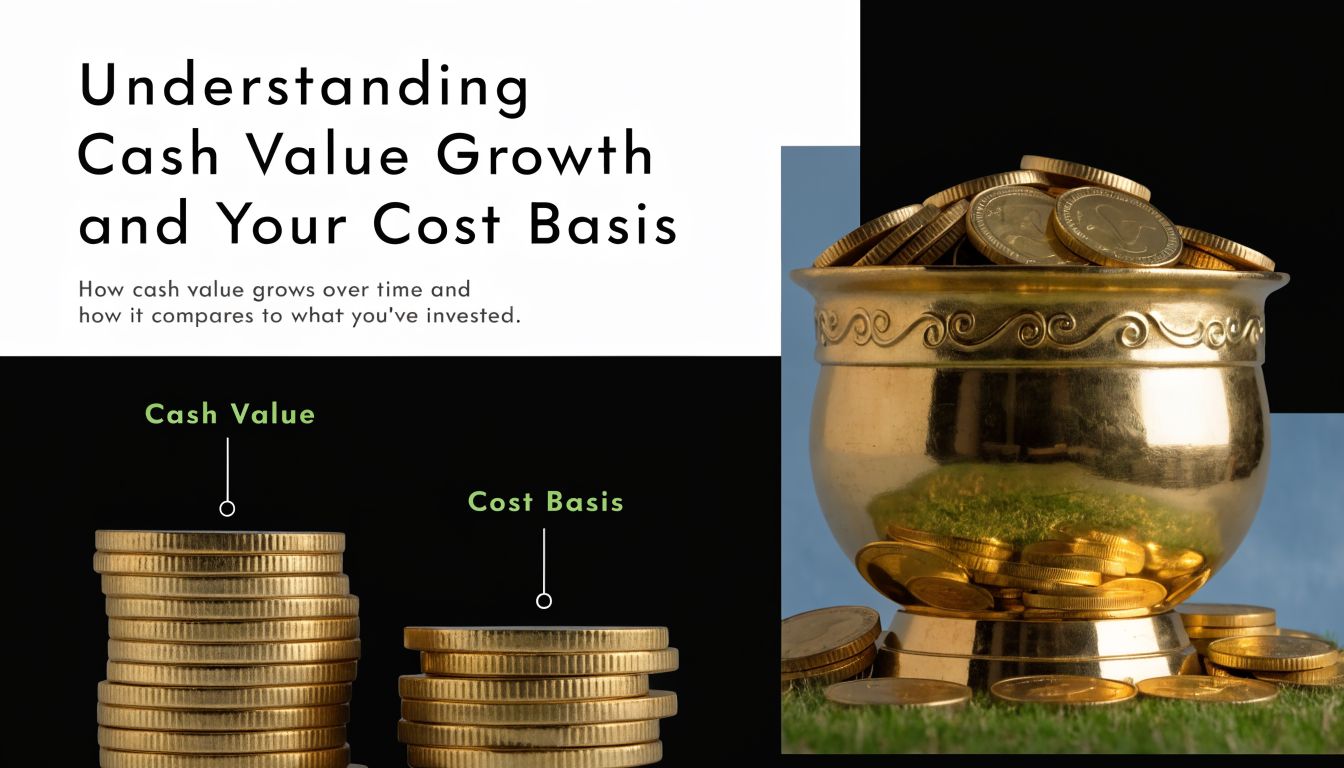
Your cost basis is the amount of your own money that went into that bucket for tax purposes. In plain language, it is usually the premium amount you paid into the policy, adjusted under the policy rules. The IRS generally treats your own contributions differently from the growth that builds later.
Here is the core rule. In a permanent life insurance policy, cash value growth is usually tax-deferred. That means the value can increase inside the policy without creating federal income tax each year while it stays there.
Many people get stuck on the phrase tax-deferred. It does not mean permanently tax-free in every situation. It means the tax question is delayed until certain events happen, such as taking out more than your basis or surrendering the policy for a gain.
A simple example helps.
If you have paid $12,000 in premiums into the policy, your cost basis is generally $12,000. If the cash value has grown to $15,000, the extra $3,000 is growth. That $3,000 usually is not taxed while it remains inside the policy.
A rising cash value on your annual statement usually does not mean you owe tax for that year.
This chart keeps the terms straight:
| Item | Plain meaning |
|---|---|
| Cost basis | Money you put in |
| Cash value | What the policy is worth now |
| Growth | The amount above what you put in |
| Tax-deferred | Growth usually isn't taxed each year while it stays inside |
For a young professional or parent, the practical point is simple. If your policy value rises from one year to the next, that increase alone usually does not create taxable income. Important tax decisions tend to show up later, when someone starts using the cash value through withdrawals, loans, or a full surrender.
How to Access Your Cash Value Without Triggering Taxes
The most attractive part of cash value life insurance is access. You may be able to use the money for a rough patch, a business need, or a planned expense. But the method matters.
Policy loans and why they usually aren't taxed
A policy loan is often the cleanest path from a tax perspective. You’re borrowing against the cash value rather than taking a taxable distribution in the usual sense. That’s why loans are generally treated differently from ordinary income.
Consider it akin to borrowing against a home’s equity. You’re using an asset as collateral. The transaction can give you liquidity without automatically creating a tax bill at that moment.
Still, a loan isn’t free money. It usually accrues interest, reduces the amount available inside the policy, and can reduce what beneficiaries receive if it isn’t repaid. If the policy later collapses while the loan is still hanging out there, the tax story can change sharply.
Watch item: A policy loan can be tax-friendly on the front end and painful on the back end if the policy lapses.
Some policyholders also consider bigger moves, including selling a policy rather than borrowing from it. Before taking that route, it helps to understand the broader market for selling a life insurance policy and how that choice differs from a simple policy loan.
Withdrawals up to basis
The second common path is a withdrawal. Here the tax treatment often depends on whether you’re taking out your own money or dipping into gains.
Using the savings bucket analogy, picture two layers in the bucket:
- The bottom layer is your own premium dollars.
- The top layer is growth.
In many standard cash value situations, money comes out from the bottom layer first. That means a withdrawal up to your cost basis is generally treated as a return of your own money, not taxable income.
A quick plain-language version:
- If you withdraw less than you paid in, that usually isn't taxable.
- If you withdraw beyond what you paid in, the excess may become taxable.
- If you borrow instead of withdraw, the tax treatment is often more favorable up front, but the policy has to stay healthy.
People often mix up loans and withdrawals. A loan leaves the contract in place and creates a debt against the policy. A withdrawal removes value from the policy directly. Both can reduce the death benefit or weaken the policy, but they don’t work the same way for taxes or long-term policy performance.
For professionals who want flexibility, the practical move is to ask for an in-force illustration or policy summary before touching the cash value. That helps you see whether the policy can support the transaction without drifting toward lapse.
When Your Life Insurance Cash Value Is Taxable
A common surprise happens like this. A parent takes a policy loan to cover daycare or a home repair, assumes the cash value is always tax-friendly, and then years later learns the policy can create taxable income if it is handled the wrong way.
That confusion usually starts because cash value life insurance has two different tax stories at once. The money inside the policy often grows without current federal income tax. Accessing that money is where the rules change.
Common taxable events
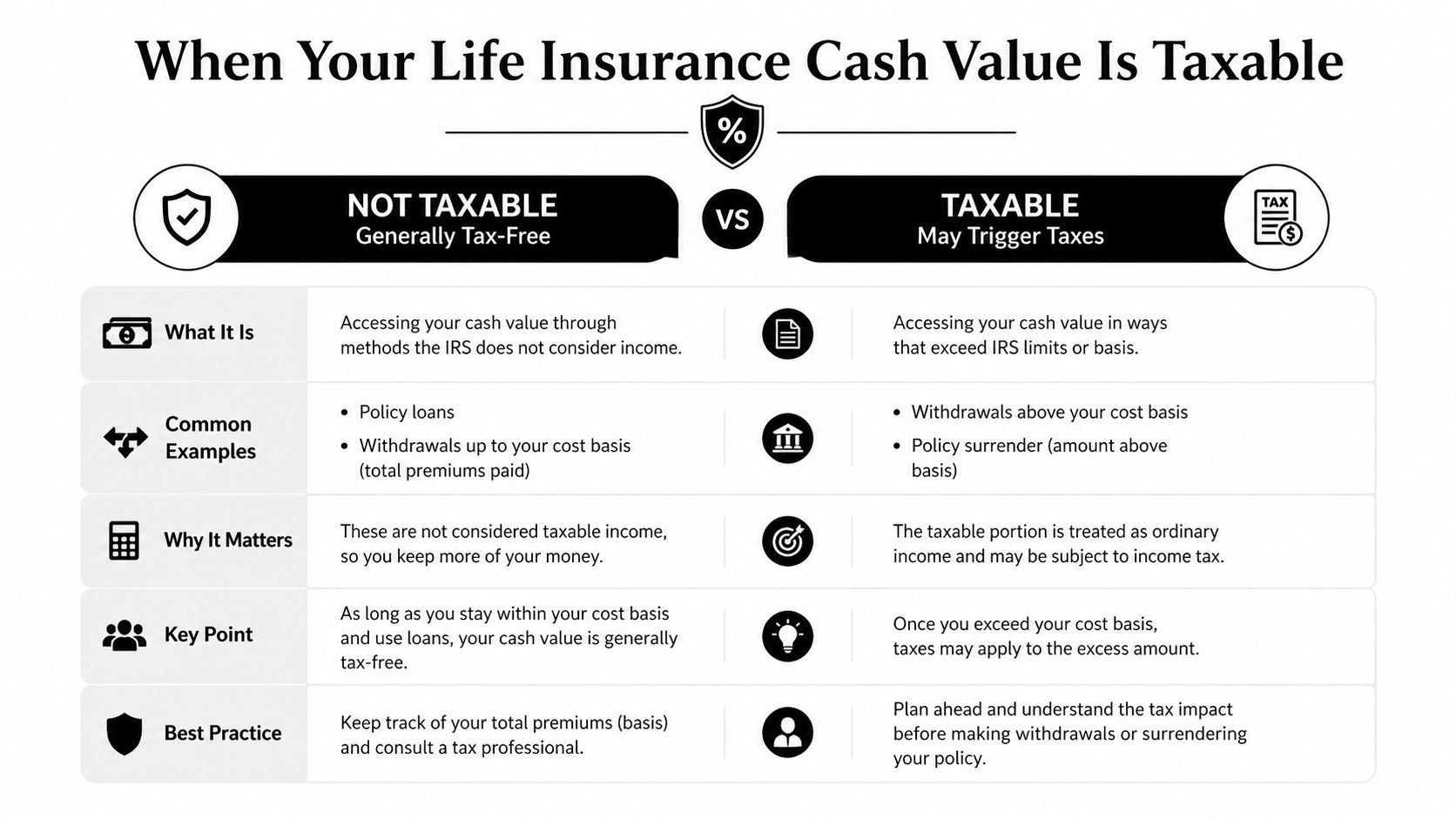
The easiest way to keep this straight is to go back to the savings bucket idea. Part of the bucket is your own premium money, which is your cost basis. The rest is growth. Taxes usually show up when you pull out more than your own contribution or when the policy ends with gain still inside it.
A withdrawal above your cost basis is one common trigger. If you paid in $12,000 over time and later withdraw $15,000, the extra $3,000 is generally the part that may be taxed as income. For a young family using the policy as a backup emergency fund, that detail matters. A withdrawal can feel like using savings, but the tax result depends on how much of the bucket is your money versus growth.
A full surrender can also create taxable income. Surrender means you cancel the policy and take the remaining cash value. If the insurer pays you more than you paid in, the gain is usually taxable. That is one reason some people decide they would rather keep insurance simple with term life. Term insurance does not build cash value, but it also avoids this layer of tax math.
The event that catches many policyholders off guard is a lapse with an outstanding loan. Here is the practical problem. A loan itself is often not taxed when you take it, but if the policy later collapses because premiums stop or interest keeps building, the IRS can treat the unpaid loan balance above your basis as taxable income. You may owe tax even though no new cash hit your checking account.
That can feel backward, but the logic is simple. The policy was carrying value that had not been taxed yet, and the lapse forces the tax issue.
You may also be sorting out a related question about the death benefit. That is separate from cash value taxation, and this overview of whether life insurance proceeds are taxable can help you separate owner tax issues from beneficiary tax issues.
A quick reference point:
| Situation | Often tax result |
|---|---|
| Cash value grows inside policy | Usually no current federal income tax |
| Loan against cash value | Usually not taxable when taken |
| Withdrawal up to basis | Usually not taxable |
| Withdrawal above basis | May be taxable |
| Full surrender with gain | May be taxable |
| Lapse with large outstanding loan | May create taxable income |
The special MEC warning
One policy type needs extra caution. A Modified Endowment Contract, or MEC, follows different tax rules than many policyholders expect.
A MEC is usually a policy that was funded too quickly under IRS limits. Once that happens, withdrawals and loans can lose the friendlier treatment people often associate with life insurance. Taxable amounts may come out first, and younger policyholders can also face an extra penalty.
For a working professional using permanent insurance as a long-term savings tool, MEC status changes the playbook. The same action that might have been manageable in a non-MEC policy can produce a very different tax result in a MEC.
Ask the insurer one direct question before taking money out: Is this policy a MEC? That single answer can prevent an expensive mistake.
Real-World Examples of Cash Value Taxation
Tax rules stick better when you can see them in ordinary life. These examples use simple math and familiar situations, not tax jargon.

Example 1 a tax-free withdrawal
Maya has a permanent life insurance policy. Over time, she has paid $10,000 in annual premiums, and part of that has built cash value. She needs money for a short-term family expense and requests a withdrawal that stays within the amount she has already paid into the policy.
The tax idea is simple. If the withdrawal doesn’t go beyond her cost basis, it’s generally treated as getting back her own money. That usually means no taxable income from that withdrawal.
This is the easiest case to understand. Maya isn’t pulling out gains first. She’s drawing from the amount she funded.
Example 2 a taxable surrender
Jordan decides he no longer wants his permanent policy and plans to surrender it for cash. He compares two numbers:
- What he paid in over the years
- What the insurer will pay him now
If the surrender value is higher than what he paid in, the difference is typically the taxable portion. In plain terms, Jordan gets his own money back first. The amount above that is the gain, and that’s the amount that can be taxed.
The surrender tax question usually comes down to one subtraction problem: value received minus basis.
“But it’s my life insurance policy,” people often say. True, but the tax system still separates your original contributions from growth.
Example 3 a lapse with a loan problem
Elena borrowed heavily against her policy years ago during a business crunch. The loan helped at the time, and because it was a loan, she didn’t face immediate taxation. Then she stopped actively managing the policy. Costs continued, the remaining value shrank, and eventually the policy lapsed.
Now the surprise. If the outstanding loan effectively exceeds the amount she paid in, the excess can become taxable income even though she didn’t receive new cash when the policy ended. That’s often called phantom income because the tax bill feels disconnected from any current payment.
A practical way to remember the three examples:
- Withdrawal within basis usually stays tax-free.
- Surrender above basis can create taxable gain.
- Lapse with a large loan can produce taxable income at the worst possible time.
For many people, the lesson isn’t just about taxes. It’s about policy maintenance. A life insurance loan can solve an immediate problem, but a neglected policy can turn that old solution into a future tax issue.
Practical Action Steps for Policyholders
You don’t need a finance degree to handle a cash value policy well. You do need a repeatable process before making changes.
A simple checklist before you touch the cash value
Use this checklist if you’re considering a loan, withdrawal, surrender, or reduced premium strategy.
Find your basis first: Ask the insurer for the amount of premiums paid and the current cash value. You need both numbers before you can estimate whether a withdrawal or surrender might be taxable.
Ask whether the policy is a MEC: This single question can change how distributions are taxed. If customer service can’t answer clearly, ask for a written policy status confirmation.
Review outstanding loans: Don’t just ask whether a loan exists. Ask how interest is being handled, whether it’s increasing the balance, and how the loan affects policy sustainability.
Request an in-force illustration: This can show whether the policy is likely to remain active after a loan or withdrawal. For universal life, that matters a lot because the policy can weaken over time if values drop or charges continue.
Separate tax questions from coverage questions: A move that looks tax-efficient may still hurt the policy’s protection value for your family. Check the impact on the death benefit, not just the tax line.
Keep your records: Save annual statements, premium history, loan notices, and surrender quotes. If there’s ever a disagreement about basis, your paperwork matters.
A few special issues deserve extra care. Employer-owned policies can follow separate rules. State tax treatment can differ from federal tax treatment. And if the policy is large, old, borrowed against, or tied to estate planning, a qualified tax professional or financial advisor should review it before you act.
Good policy decisions usually happen before money leaves the contract, not after.
That’s especially true with surrender requests. Once processed, the tax and coverage consequences can be hard to unwind.
Conclusion Simplifying Your Financial Protection
Cash value life insurance isn’t automatically taxable, and it isn’t automatically tax-free either. The cleanest way to think about it is this: growth inside the policy is generally tax-deferred, loans are often not taxed when taken, and taxes usually show up when you take out more than you put in or when the policy ends in the wrong way.
If you remember one concept, make it cost basis. That’s your savings bucket starting line. It helps you tell the difference between getting your own money back and taking taxable gain.
For many households, that complexity is the core issue. A permanent policy can be useful, but it asks you to monitor loans, withdrawals, lapse risk, and policy status. If your main goal is straightforward financial protection for a spouse, children, or business partner, term life often avoids that entire web of tax management.
Some families also pair insurance planning with trust or estate planning. If that applies to you, this overview from the Law Office of Bryan Fagan, PLLC can help you understand how a life insurance trust fits into the broader picture.
Simple protection is often the right answer. If you don’t need a savings bucket inside your policy, you may not need the tax complexity that comes with it.
If you want coverage without the moving parts of cash value taxation, explore simple term life options with Coveredly. It’s built for people who want flexible, digital, affordable life insurance that fits real life.