You might be looking at life insurance for one reason and Medicaid for another. Maybe you want to protect your spouse and kids if something happens to you. At the same time, you've heard that owning the “wrong” kind of policy can create problems later if long-term care ever enters the picture.
That mix of goals is common, especially for young families trying to make smart decisions early instead of cleaning up a mess later. The good news is that life insurance and Medicaid don't have to clash. The key is knowing which type of policy sits in a safe harbor, and which type can turn into a countable asset.
When people get confused about life insurance and Medicaid, it usually comes down to one issue: cash value. A term policy is pure protection. A permanent policy, like whole or universal life, can also act like a small asset bucket. Medicaid notices that difference.
Table of Contents
- Understanding Medicaids Asset Test
- How Different Life Insurance Policies Affect Medicaid
- Navigating State Rules and The Look-Back Period
- Smart Strategies to Protect Your Benefits and Heirs
- Common Myths and Costly Mistakes to Avoid
- Frequently Asked Questions About Life Insurance and Medicaid
Understanding Medicaids Asset Test
Medicaid long-term care doesn't just look at income. It also takes a financial snapshot of what you own. Some property is treated as countable, which means it can affect eligibility. Other property is treated as exempt, which means it usually doesn't count the same way.
That snapshot matters because Medicaid is trying to answer a practical question: does this applicant have available resources they can use before public benefits begin? If the answer is yes, those resources may need to be used first.

What countable and exempt usually mean
Think of the asset test like airport security. Some items pass through without much concern. Others trigger extra review. Medicaid does something similar with your property.
In plain language:
- Countable assets are resources Medicaid views as available for your support. That can include cash, savings, and, in some cases, the cash surrender value of a life insurance policy.
- Exempt assets are resources Medicaid generally doesn't force you to cash out first.
- Life insurance lands in one category or the other based on policy type and, for permanent coverage, the face-value rules discussed later.
Practical rule: If an asset can be turned into usable money for care, Medicaid pays attention to it much more closely.
In most states in 2026, the individual asset limit for Medicaid Long Term Care is $2,000, meaning an applicant can hold no more than $2,000 in countable assets, including cash surrender value from whole life policies exceeding the $1,500 face value exemption, according to Medicaid Long Term Care rules on life insurance impact.
Why this matters before you buy or keep a policy
A lot of families focus only on the death benefit. That's understandable. You're trying to protect people you love. But for Medicaid planning, the bigger question is whether the policy builds value during your lifetime.
That's why people often review life insurance alongside wills, trusts, and beneficiary planning. If you're sorting through the broader estate side of the conversation, this overview of Georgia estate planning for trusts can help clarify how different trust structures fit into long-term planning.
It also helps to understand when insurance is treated as property at all. This explainer on whether life insurance is an asset gives a useful foundation for that question.
How Different Life Insurance Policies Affect Medicaid
Not all policies play by the same rules. If you remember one thing, remember this: term life is the safe harbor. Permanent coverage needs a closer look because it can build cash value.
That single difference explains most of the confusion around life insurance and Medicaid.
Why cash value changes everything
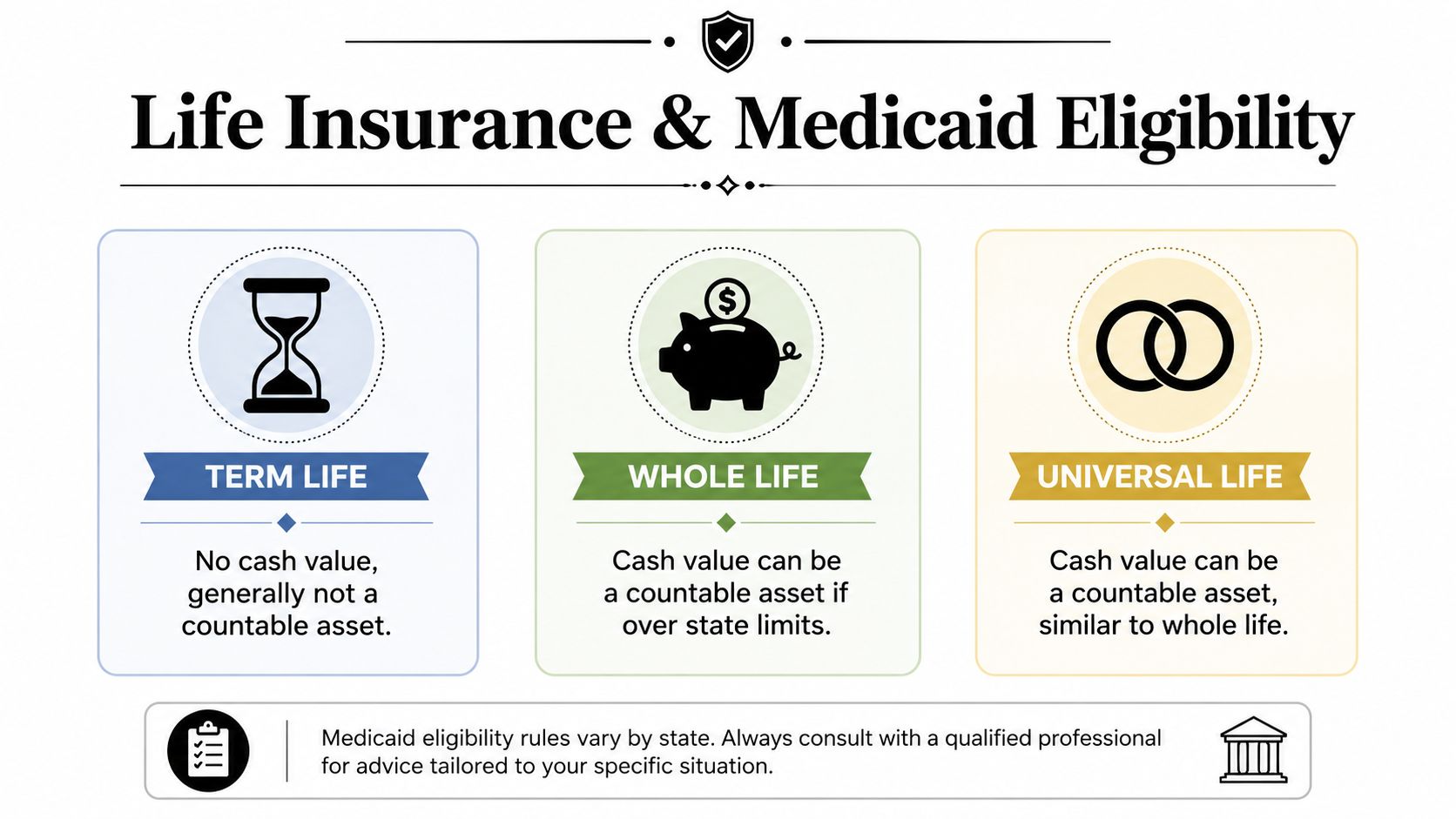
Term life insurance is categorically exempt from Medicaid's asset limit in all 50 states, while whole life insurance is only exempt if the total face value of all combined policies is $1,500 or less. If the face value exceeds that threshold, the entire cash surrender value becomes a countable asset that can disqualify applicants from Medicaid long-term care benefits, as explained by Medicaid Planning Assistance on life insurance eligibility impact.
That sounds technical, but the practical takeaway is simple. A term policy has no cash bucket attached to it. Medicaid sees protection for your family, not a savings-like resource you can tap.
A whole life or universal life policy can be different. Those policies may build value you can borrow against or surrender. From Medicaid's point of view, that available value can look like money sitting on the sidelines.
Term life tends to be invisible for Medicaid asset testing. Permanent life insurance often isn't.
For readers weighing policy types more broadly, this guide to term vs. whole life insurance can help connect the Medicaid issue to the usual cost and coverage tradeoffs.
A quick side by side comparison
| Feature | Term Life Insurance | Whole Life Insurance |
|---|---|---|
| Primary purpose | Income protection for a set period | Lifetime coverage plus cash value |
| Cash value | None | Usually builds cash value |
| Medicaid treatment | Generally safe harbor because there's no cash value | Can become a countable asset if face-value rules are exceeded |
| Risk to eligibility | Low | Higher, depending on policy details and state rules |
| Planning burden | Usually straightforward | Often needs careful review |
Universal life usually belongs in the same caution zone as whole life for Medicaid planning because it can also build cash value. The label on the policy matters less than the economic reality behind it.
Here's the easiest mental shortcut. If the policy is pure protection, it's usually easier to live with in a Medicaid plan. If the policy is protection plus accumulation, slow down and review it carefully.
Navigating State Rules and The Look-Back Period
Federal law sets the broad framework, but states still control many details. That means two families with similar policies can face different planning choices depending on where they live.
Herein lies a common misunderstanding. They hear a national rule, assume it works the same everywhere, and make a move too quickly.

Why state rules matter
One major example is the Community Spouse Resource Allowance, often shortened to CSRA. Medicaid eligibility for long-term care is contingent on the CSRA, which permits a non-applicant spouse to retain up to $157,920 in combined assets as a 2025 benchmark without forcing a spend-down of the applicant's life insurance, enabling the transfer of permanent policies with cash value to the healthy spouse to preserve the exemption, according to Elder Care Resource Planning's explanation of life insurance and Medicaid eligibility.
For married couples, that's a very different conversation than the one a single applicant has. A healthy spouse isn't expected to be left with nothing. That spousal protection can change how families think about ownership, timing, and whether a policy needs to be adjusted at all.
How the look-back period works in real life
The look-back period works like a calendar review. Medicaid may examine certain transfers made before an application and ask whether assets were given away for less than fair value just to qualify.
That matters because a rushed transfer can create a penalty instead of solving the problem. A parent can't assume that signing over a policy to an adult child right before applying will be treated as harmless paperwork.
A safer mindset is to treat Medicaid planning like tax planning. The best moves are usually the ones made early, with records, and with advice from someone who understands the state-specific rules.
Consider these planning habits:
- Check your state first: The exemption limits and related rules can vary, so never assume a friend in another state got advice that fits your family.
- Review ownership, not just beneficiaries: Who owns the policy can matter as much as who receives the death benefit.
- Document any changes: If ownership changes, loans are taken, or a policy is surrendered, keep a clean paper trail.
- Pause before gifting: A transfer that feels logical inside the family can still create eligibility issues.
Smart Strategies to Protect Your Benefits and Heirs
If a permanent policy is creating Medicaid trouble, you're not out of options. Families often have several legal paths, but the right one depends on timing, marital status, state rules, and whether the goal is preserving coverage, preserving value, or simplifying the file.
That matters because Medicaid has grown into a huge part of the long-term care system. Medicaid enrollment surged by 13.9% between February 2020 and January 2021, and with nearly 88 million beneficiaries, its asset rules affect millions of households. Losing eligibility due to a simple miscalculation, like retaining a cash-value life insurance policy above the exemption limit, can have severe consequences for families needing long-term care, according to the Medicaid beneficiary profile report.
Simple moves families often consider
Some solutions are plain and practical.
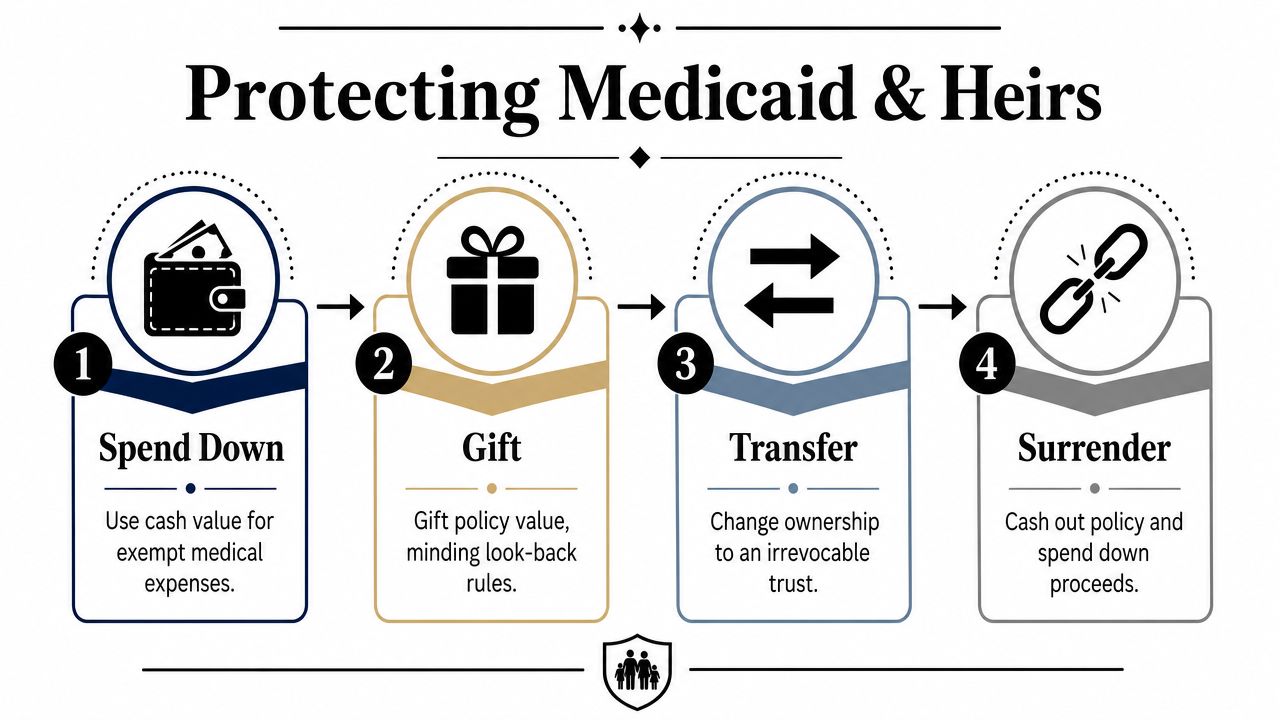
- Spend down the excess: If cash value is making the policy countable, families may use available value for permitted expenses tied to care and planning.
- Surrender the policy: This is the cleanest option in some cases, especially when the policy no longer fits the family's needs.
- Borrow against the policy: In some situations, a policy loan may change the economics enough to support a better planning result.
These aren't one-size-fits-all moves. A surrender solves one problem but may erase a death benefit your family still wants. A loan preserves the policy in some form, but it can make the policy more complex.
Here's a useful reminder before any policy change:
When trusts and ownership changes enter the picture
Other solutions are more advanced. Families sometimes look at irrevocable trusts, ownership transfers, or other legal structures when they want to preserve value for heirs without leaving a countable asset in the wrong place.
If you want a plain-English trust overview, this article on California irrevocable trust benefits is a helpful starting point for understanding why some families use that route.
Beneficiary design also deserves attention. A policy can be structurally fine for Medicaid and still create avoidable estate problems if the beneficiary setup is outdated. This guide on how to change a life insurance beneficiary is a useful checklist if marriage, children, divorce, or caregiving responsibilities have changed.
The best strategy is the one that protects care access without accidentally stripping away protection for the people who depend on you.
A simple family workflow often looks like this:
- Pull the policy documents and confirm whether the coverage is term, whole, or universal.
- Ask for the current cash surrender value if the policy is permanent.
- Match the policy to your state's rules before making any transfer or surrender.
- Get legal and planning advice early if a spouse, trust, or ownership change is involved.
Common Myths and Costly Mistakes to Avoid
Bad advice spreads fast in this area because the rules sound harsh from a distance. People hear one sentence, panic, and assume every life insurance policy is dangerous. That leads to expensive mistakes.
The biggest mistake is treating all policies as if they work the same way.
Myth versus fact
Myth: Any life insurance blocks Medicaid.
Fact: A common misconception is that any life insurance blocks Medicaid, which obscures the critical nuance that term life is 100% exempt while whole life is only exempt if the combined face value is under $1,500. Existing content often fails to explain that the cash surrender value of whole life policies over $1,500 becomes a fully countable asset, forcing applicants to spend down.
Myth: If a policy has a death benefit, Medicaid will automatically take it.
Fact: The primary issue is usually the living value inside certain permanent policies, not the basic existence of a death benefit.
Myth: It's safer to surrender first and ask questions later.
Fact: That can backfire. Surrendering a policy may solve an eligibility issue, but it can also wipe out family protection or create new planning consequences.
If you own term life, don't assume you need to give it up just because Medicaid is part of the conversation.
A few errors show up again and again:
- Confusing face value with cash value: They aren't the same thing, and Medicaid planning often turns on that distinction.
- Ignoring combined policies: Multiple small policies can create a different outcome when reviewed together.
- Waiting until a crisis: Last-minute fixes leave fewer options.
- Skipping document review: Old policies often have forgotten riders, loans, or ownership details.
The smarter approach is calm and methodical. Pull every policy. Confirm the type. Verify whether any cash value exists. Then make decisions based on facts, not fear.
Frequently Asked Questions About Life Insurance and Medicaid
Specific questions usually come up after the broad rules start to make sense. These are the ones families ask most often.
Quick answers to high intent questions
Can I buy life insurance while I'm already on Medicaid?
Yes, that can be legally permissible. Guidance on purchasing life insurance while already on Medicaid is a frequently asked but rarely answered question. The key is that the policy must be strictly term and have no cash value so it doesn't create a new countable asset that would violate the $1,500 face-value exemption rule for whole life and jeopardize existing benefits, as discussed in this article on buying life insurance while on Medicaid.
Will Medicaid take the death benefit after I die?
The answer depends on ownership, beneficiary design, and estate recovery rules in your state. Families should review beneficiary forms carefully and avoid assumptions.
What if I name my estate as beneficiary?
That can create extra complications. In many cases, naming a person or trust directly is cleaner than routing proceeds through the estate, but the right answer depends on the rest of your plan.
If I'm young and healthy now, why should I care about this?
Because insurance choices made early can stay with you for decades. A policy that feels harmless now can create planning work later if it builds cash value and long-term care becomes part of the story.
The broad peace-of-mind takeaway is simple. If your goal is family protection with the fewest Medicaid complications, term life is usually the easiest policy type to live with.
If you're looking for straightforward term coverage that fits a modern family budget, Coveredly offers a digital way to shop for life insurance with flexible options, including up to $3 million of term life insurance and no exams for most applicants. It's a practical place to start if you want protection that stays simple.