You've got a partner, a new baby, a mortgage, and a calendar full of expenses that already feels tight. Then one question interrupts the routine: what would happen to the people who depend on my income if I died? Savings might cover immediate bills, but they may not replace years of earnings, childcare, housing costs, debt payments, or the unpaid work a parent provides.
That's the purpose of life insurance for dependents. It isn't about expecting the worst or putting a price on someone's life. It's about creating a financial bridge for the people who rely on your income, care, or support. This guide explains who counts as a dependent, how to choose a policy, how to estimate coverage, and how to make sure your beneficiaries understand what protection exists and how to claim it.
Table of Contents
- Why Life Insurance for Dependents Matters More Than You Think
- What Counts as a Dependent in Life Insurance
- Policy Types and Dependent Riders Explained
- How to Calculate the Right Coverage Amount
- Real-World Scenarios for Young Families, Newlyweds, and Professionals
- Eligibility, Application, and the Knowledge Gap Most Families Miss
- How to Get Covered and Why Digital Term Policies Make It Easier
- Frequently Asked Questions About Life Insurance for Dependents
Why Life Insurance for Dependents Matters More Than You Think
A young parent may have a stable salary, but the household's financial plan often depends on that salary arriving every month. If the primary earner dies, the surviving family may need to replace income while also managing grief, childcare, housing, debt, and everyday costs. Life insurance gives the surviving household a pool of money designed to absorb that shock.
The risk is larger than many families realize. A Swiss Re analysis of the U.S. mortality protection gap estimated the aggregate gap at close to USD 25 trillion in 2016, with an average shortfall of USD 495,000 per household. The study described that shortfall as about 45% of households' income-replacement needs, after considering resources such as savings, Social Security, and existing insurance.
The practical question: If your income disappeared tomorrow, how long could your household maintain its current life without selling assets, taking on debt, or making immediate sacrifices?
The historical pattern also shows why owning a policy doesn't guarantee adequate protection. An ACLI-referenced summary of life insurance coverage reports that coverage among families peaked at 85.4% in 1971, then declined in most subsequent years. The same source says 52% of Americans have life insurance coverage, while 44% of families say they'd face financial hardship if the primary wage earner died within six months.
The issue isn't just whether a policy exists. It's whether the death benefit can keep dependents housed, cared for, and financially secure through the years when they need support. The sections ahead turn that concern into practical decisions, from identifying every dependent to documenting the claims process.
What Counts as a Dependent in Life Insurance
If your income or daily care disappeared, who would struggle to keep paying for housing, food, education, debt, or basic support? That question identifies dependents more accurately than a standard family form.
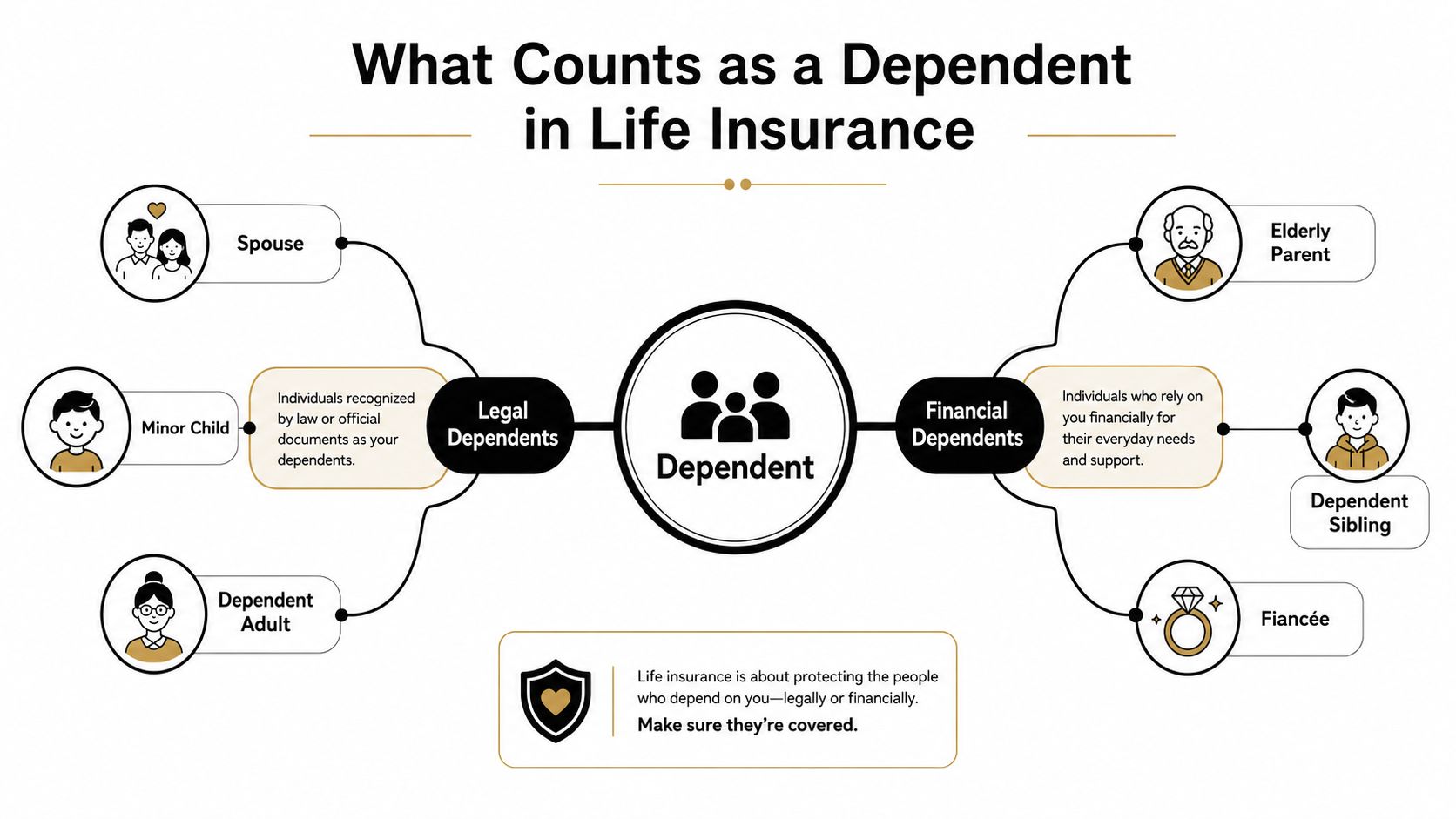
In insurance planning, a dependent can be a legal dependent or a financial dependent. A legal dependent has a relationship recognized by law or an employer benefits plan. A spouse, minor child, or dependent adult may fit this category. A financial dependent may not appear on your tax forms, yet still rely on your money, time, or care.
The protection should extend to everyone whose living arrangements or care would be affected by your death. That may include an aging parent, dependent sibling, domestic partner, or family member with special needs.
Start with the income connection
List anyone who would lose access to your money, services, or care. Then consider how that loss would affect their routine:
- Spouse or partner: A surviving spouse may need help replacing your salary, paying shared debts, or covering household services.
- Children: Children may need support for food, housing, childcare, education, and other costs until they become financially independent.
- Aging parents: Adult children can become the primary source of support for parents who cannot meet their own expenses.
- Dependent adults: A family member with a disability or ongoing care needs may require support for many years.
- Other relatives: A sibling or extended family member may rely on recurring financial help without having a formal legal designation.
Insurers use legal documents to assess beneficiaries and apply policy terms, but you must first identify the people in your dependency network. Families can also overlook older parents who depend on adult children. This “reverse dependency” trend has received growing attention, while independent guidance for this group remains limited, as described in coverage of aging parents as overlooked beneficiaries. Knowing who is covered, and what that person should do if a claim is filed, matters as much as naming the relationship.
Policy Types and Dependent Riders Explained
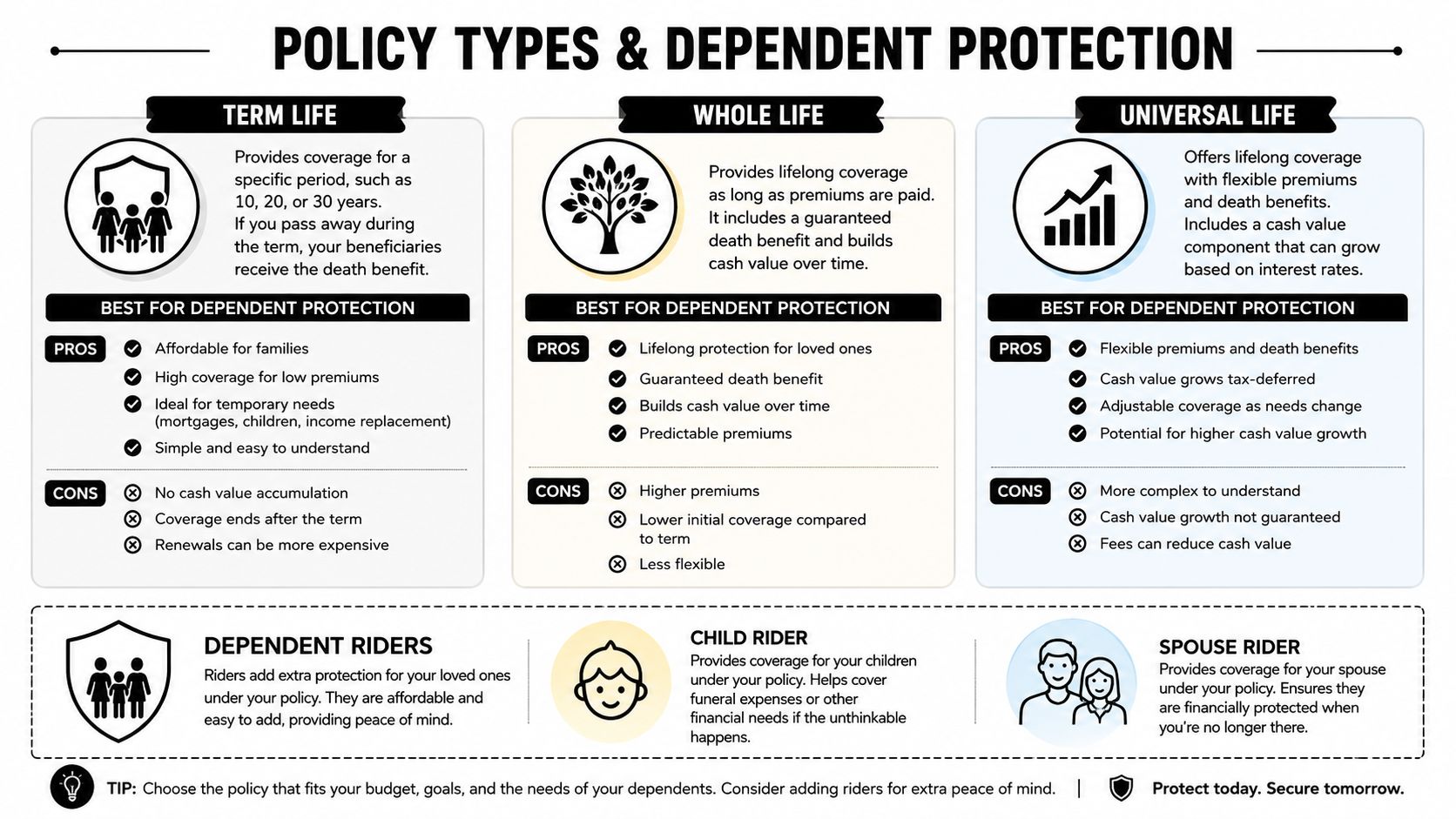
Policy choice follows two questions: how long dependents may need support and how much protection the household requires. Term life insurance covers a selected period, so it often fits income replacement while children are growing, childcare costs continue, or a mortgage and other debts remain. A term should last through the years when dependents would struggle most without your income.
Whole life insurance provides permanent coverage with a cash value component. It can remain in force for life if premiums are paid, although its structure is usually more complex and may cost more than term coverage for the same death benefit. Universal life insurance also offers permanent protection. Depending on the policy, premiums or death benefits may be adjustable, but ongoing monitoring matters because funding and policy performance affect how long coverage lasts.
| Policy structure | What it does | Where it may fit |
|---|---|---|
| Term life | Covers a defined period | Income replacement during a dependency horizon |
| Whole life | Permanent coverage with cash value | Long-term estate or legacy planning |
| Universal life | Permanent coverage with adjustable features | Households comfortable reviewing policy funding over time |
A dependent rider attaches coverage to an existing policy. A child term rider may cover eligible children under a parent's policy, while a spouse rider adds protection for a partner. Keeping these benefits together can simplify administration, but riders usually have coverage limits and rules for eligibility, conversion, or termination.
A standalone policy gives each insured person a separate contract. It also provides more control over coverage amount, beneficiaries, and duration. That arrangement may suit a spouse with significant income or a child whose long-term care needs call for more specialized planning.
Match the term to the dependency horizon
For a parent, the dependency horizon may include childcare, education, and mortgage payments. For newlyweds, it may follow shared debt until both partners build stronger individual assets. Review the term when these responsibilities change.
Coverage only helps if the family knows it exists and understands what happens after a death. Keep the policy details, rider terms, insurer contact information, and claim instructions where the covered person can find them. Riders can address smaller household needs, but they should not replace a full coverage analysis. For a plain-language explanation, review dependent riders and other life insurance riders.
How to Calculate the Right Coverage Amount
A salary multiple can be a quick starting point, but it doesn't show what your family needs. A more useful method treats the death benefit as a way to fund a future cash-flow gap.
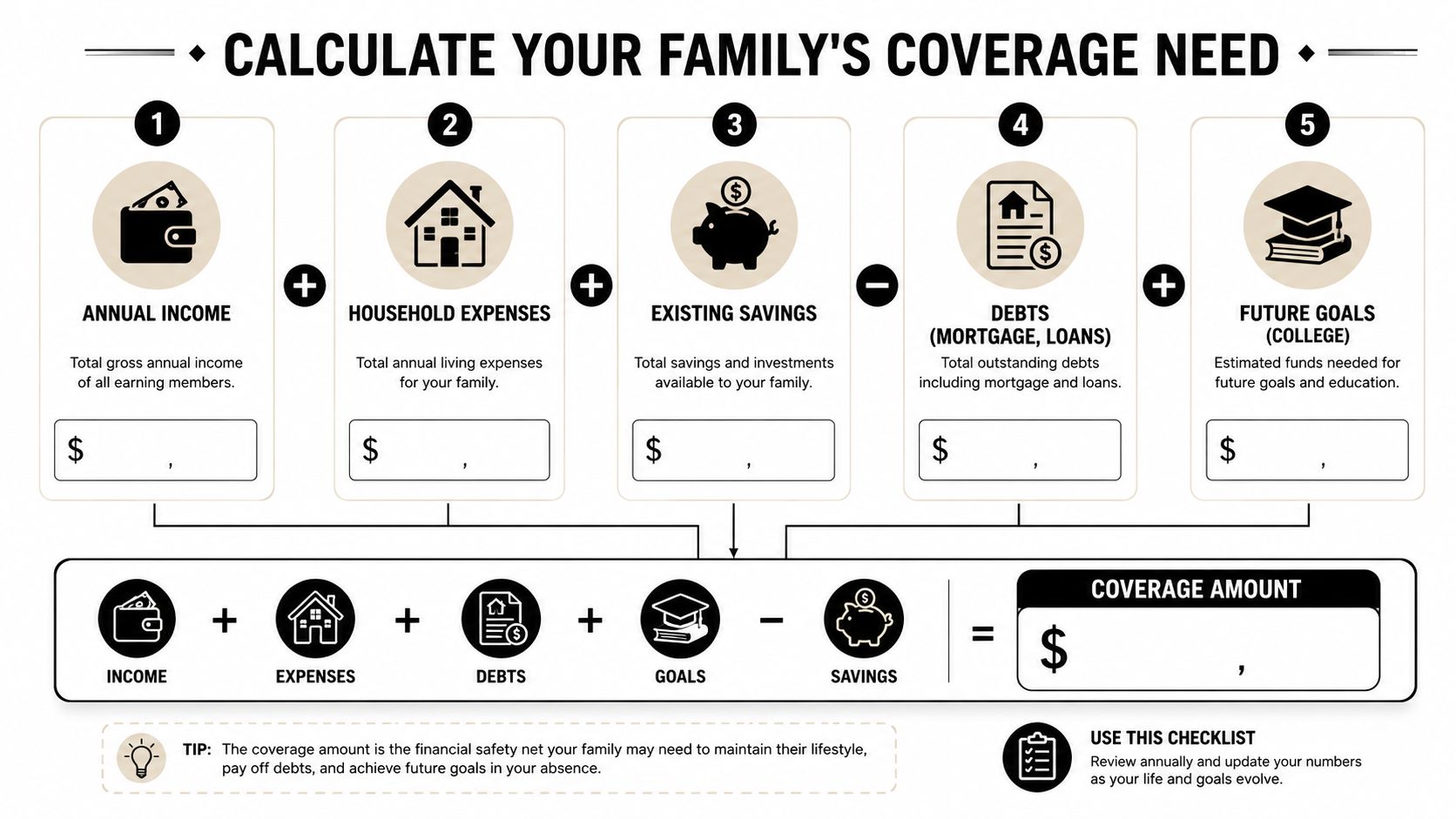
The income-replacement approach described by Protective starts with current annual income, adds continuing expenses and future obligations, then subtracts savings and investable assets. Use this sequence:
- Start with annual income. Estimate the income your household would need to replace, not necessarily every dollar you earn. Consider whether the surviving partner could continue working and whether that income would change after your death.
- Add ongoing household expenses. Include housing, food, utilities, childcare, transportation, insurance, and routine costs that wouldn't disappear.
- Include debts. Add mortgage balances, student loans, credit obligations, and any other liabilities that could burden the surviving household.
- Add future goals. Consider childcare, education, support for a dependent adult, or help for aging parents.
- Subtract available resources. Deduct savings, investments, existing life insurance, and benefits that would be available to survivors.
A simple household example
Suppose one working parent supports a spouse and two young children. The family has a 20-year mortgage, continuing childcare costs, household expenses, and a surviving spouse who earns some income. The working parent shouldn't automatically choose a benefit based only on salary. Instead, the family can estimate the income needed during the years the children remain dependent, add the mortgage and future costs, then reduce that amount by savings and the surviving spouse's expected earnings.
Future expenses also need a time perspective. A dollar needed many years from now isn't the same as a dollar needed immediately. Expert guidance for families with young children commonly uses a finite support horizon and discounts future needs to present value through a money factor or assumed investment return, as explained in this life insurance needs analysis resource.
A useful rule: Build coverage around the obligations your death would create, not around an arbitrary salary multiple.
You don't need perfect figures before speaking with an insurer. Gather your income, debts, savings, household costs, and future goals first. A detailed life insurance coverage needs guide can help you organize those inputs before comparing policies.
Real-World Scenarios for Young Families, Newlyweds, and Professionals
Different households need different forms of protection. The same death benefit may be adequate for one person and far too small for another.
Young families with a mortgage
A family with young children may need coverage for mortgage payments, childcare, daily living costs, and future education. The term should generally follow the years when the children and household debt create the greatest cash-flow pressure. Because the exact income, assets, and expenses aren't provided here, the appropriate starting estimate is the result of the income-replacement calculation, not a made-up figure.
A parent who provides substantial unpaid childcare should also be included in the analysis. The surviving parent may need to pay for services that the deceased parent once handled, even if that parent didn't receive a salary.
Newlyweds with shared obligations
Newlyweds may have fewer child-related costs, but shared rent or mortgage payments, student loans, and plans for future children can still create a meaningful need. Each spouse should assess the financial effect of losing the other's income and household contributions. Buying while younger and healthier may make underwriting easier and can support more affordable premiums, though the actual price depends on the applicant and policy.
Professionals supporting aging parents
A single professional may not have children or a spouse but may still support an aging parent. That's a reverse-dependency situation. Coverage can help replace recurring support, fund final expenses, or provide continuity while relatives arrange long-term care and housing.
Families supporting a child or adult with autism may also need to coordinate life insurance with broader care, guardianship, and financial planning. The autism care financial planning guide offers useful context for organizing those longer-term responsibilities.
For each profile, choose a term that reflects the dependency period. A young family may need protection through the mortgage and child-rearing horizon, newlyweds may align coverage with shared debts and future family plans, and a professional supporting parents may need a term tied to the parents' expected support needs.
Eligibility, Application, and the Knowledge Gap Most Families Miss
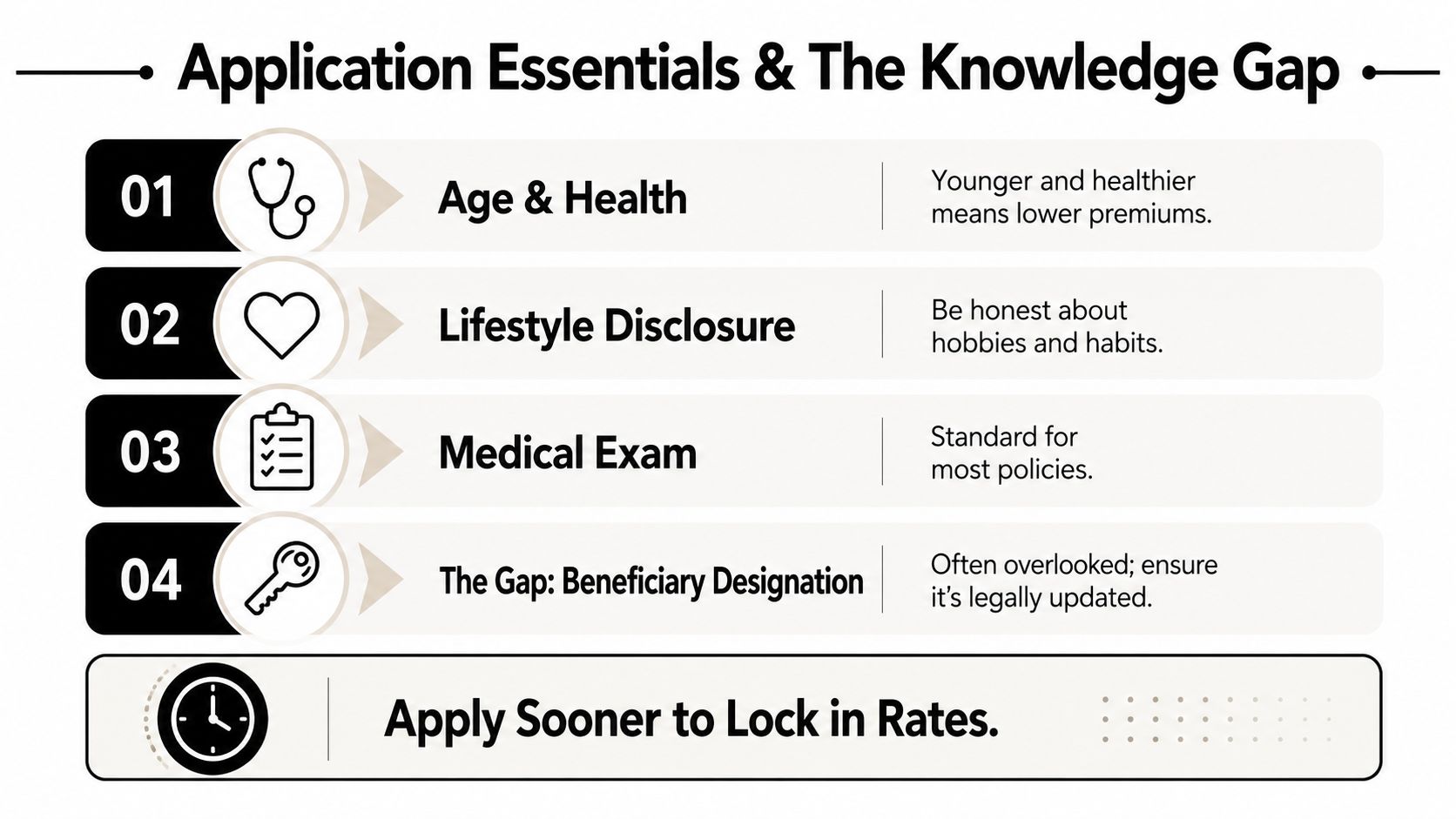
Insurers usually review an applicant's age, health history, lifestyle, and other underwriting information. Some applications require a medical exam, while others may use health questions and available records. The honest approach matters. Incomplete or inaccurate answers can create problems when the insurer reviews a claim.
Applying earlier can help because age and health affect underwriting. It also gives you time to compare policy terms, review exclusions, and coordinate beneficiary decisions before a crisis makes those choices urgent.
A policy only helps if people can use it
A major protection problem occurs after purchase. A 2025 survey reported by the Economic Times found that 60% of dependents didn't know they were covered, only 10% could correctly describe their benefits, and 79% of policyholders were unsure of their coverage.
Those findings point to a knowledge-and-claims gap. Give your partner or another trusted person access to the policy number, insurer contact details, premium information, beneficiary designation, and basic claim instructions. Review the documents after marriage, divorce, a birth, adoption, remarriage, or a major change in financial responsibility.
Minors generally can't receive and manage life insurance proceeds directly. Insurers may require a legal guardian, a custodian under the Uniform Transfers to Minors Act, or a trust arrangement, as outlined in Guardian Life's beneficiary guidance. Naming a child directly without understanding the legal consequences can delay access to funds or create unnecessary administration.
Eligible children may also receive a limited public safety net. Under Congressional Research Service guidance on Social Security survivors benefits, unmarried children are generally eligible until age 18, or 19 if they're full-time elementary or secondary school students. A disability that began before age 22 may allow eligibility at any age. These benefits can supplement private insurance, but they shouldn't be treated as a complete income-replacement plan.
How to Get Covered and Why Digital Term Policies Make It Easier
A practical buying process has four steps:
- Estimate the household's coverage need using income, expenses, debts, future goals, and available assets.
- Choose a term that matches the dependency horizon.
- Compare the death benefit, premiums, exclusions, conversion options, and beneficiary rules.
- Apply accurately, then store the policy where your beneficiaries can find it.
Digital-first providers have reduced some of the paperwork and delays traditionally associated with life insurance. Coveredly offers online term life insurance of up to $3 million, with no medical exams for most applicants, transparent pricing, and flexible terms. Those features can make it easier for young families, professionals, and newly married couples to explore coverage without treating the application as a major administrative project.
Cost remains a valid concern, especially when a household is balancing rent, childcare, debt, and savings. But delaying the decision can leave dependents exposed during the years when income replacement matters most. Learn more about direct term life insurance to understand how a digital application path may fit your situation.
The key is to avoid buying the first policy that appears affordable. Start with the financial problem, then choose the policy structure that solves it.
Frequently Asked Questions About Life Insurance for Dependents
Do Social Security survivors benefits replace private life insurance? No. They may provide support for eligible children, but private coverage is designed around your household's broader income and expense gap.
Can beneficiaries be changed later? Often, yes, if the policy allows a change and the designation isn't irrevocable. Review it after major family changes and make sure it matches your current intentions.
What happens if you outlive a term policy? Coverage generally ends when the term expires unless you renew, convert, or replace it under the policy's rules. Check those options before the end date.
How much coverage should a stay-at-home parent have? Include the cost of replacing childcare, household management, transportation, and other services that parent provides. Income replacement isn't limited to a paycheck.
Coveredly offers digital term life insurance with coverage up to $3 million and no medical exams for most applicants, giving dependents-focused households a straightforward way to explore protection. Review your income, debts, savings, and beneficiary plan, then visit Coveredly to compare your next step.