A young couple reviews their mortgage statement at the kitchen table and asks an uncomfortable question: could either of us keep this home alone? If the higher earner died, the next payment would still be due.
Table of Contents
- What Mortgage Protection Life Insurance Pays
- Policy Types Compared, From Lender-Paid to Family Term
- How Much Coverage and How Long to Buy
- Who Gets the Money and Why It Matters
- Where Mortgage Life Cover Falls Short
- Common Objections, Answered
- Six Steps From Debt Count to Quote
What Mortgage Protection Life Insurance Pays
Life insurance for mortgage protection is coverage intended to repay some or all of a home loan after an insured person dies, or give their family money to keep making payments. The death benefit is the money the insurer pays after a covered death.
Think of the mortgage as a continuing household bill. Losing the person who normally pays it doesn't cancel the obligation, just as losing a paycheck doesn't cancel the electricity bill.
That distinction becomes especially important when a lender has already required insurance. Private mortgage insurance, usually shortened to PMI, protects the lender if the borrower defaults, meaning they fail to meet the loan's payment obligations. Mortgage life insurance addresses a different event, the insured person's death, and the family can remain responsible for the mortgage even when the loan is insured against default, as explained in the Housing Finance Information Network's overview of mortgage insurance.
The practical question starts with the household budget, not the insurance paperwork.

Start With the Family's Bills
A mortgage protection policy might eliminate the loan but leave the survivor needing money for food, childcare and transportation. Alternatively, a policy could provide flexible cash that helps the family manage several obligations together.
Before choosing coverage, separate these questions:
- Housing debt: Would the survivor need the mortgage cleared, reduced or just kept current?
- Household income: What earnings would disappear?
- Family responsibilities: What care, education and everyday expenses would remain?
Practical rule: Protect the household's ability to stay in the home, not just the number printed on the mortgage statement.
The product solves a specific problem after death. Its usefulness depends on both how much it pays and who controls that payment.
Policy Types Compared, From Lender-Paid to Family Term
For a healthy applicant seeking coverage and control, level term life insurance is a sensible starting point when comparing mortgage protection policy types. “Term” means a defined coverage period, while “level” means the stated death benefit stays the same during that period.
That doesn't make it the right answer for everyone. Health, eligibility and the family's purpose all matter, and the lowest price isn't useful if the payout can't meet the survivor's needs.
Mortgage Protection Policy Types Compared
The face amount is the policy's stated coverage amount. A premium is what you pay to keep the insurance in force.
| Policy type | Who receives the money | Death benefit over time | Typical cost pattern | Best fit |
|---|---|---|---|---|
| Lender-paid mortgage life | Lender, paid toward the loan | Falls as the balance is repaid | Often higher per dollar of cover than level term; compare actual offers | Borrowers focused only on clearing the loan |
| Credit life added to loan | Lender | Generally follows the loan balance | Usually higher per dollar, often with fewer medical questions | Borrowers prioritizing a simple application at closing |
| Level term life, personally owned | Named beneficiary, such as a spouse | Flat during the selected term | Often a lower-cost starting point for healthy applicants | Families needing money for income, childcare and debts |
| Permanent life, personally owned | Named beneficiary | Can provide a level benefit; cash value depends on the contract | Generally higher premiums than term coverage | Lifelong protection or estate-planning needs |
| Veterans Mortgage Life Insurance | Lender | Decreases with the balance, subject to the program cap | Obtain a premium calculation from the VA | Eligible veterans considering lender-directed protection |
Permanent life insurance is designed for ongoing coverage rather than a selected term, subject to its contract requirements. Some policies also build cash value, an amount within the policy that can become available under specified conditions. It deserves a separate assessment if the need extends beyond protecting the mortgage.
This visual comparison highlights the difference between loan-directed protection and family-controlled benefits.
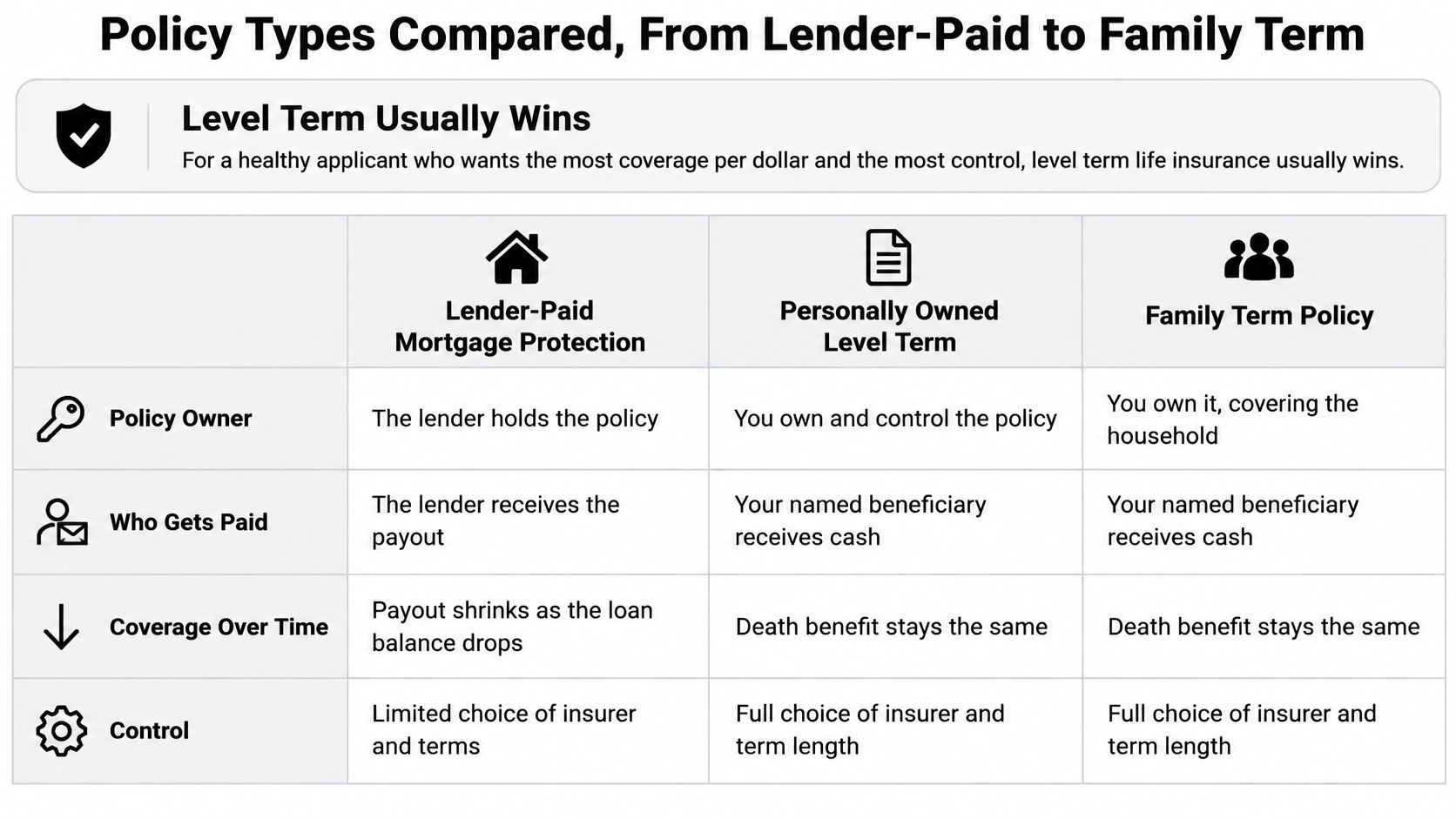
Compare the Contract, Not Just the Label
“Lender-paid” describes the benefit destination here. It doesn't mean the lender necessarily pays your premiums or owns the contract. Similarly, “family term” describes a planning purpose, not necessarily a separate insurance product.
Age, health, tobacco use, term length and face amount can affect an offer. Credit life may feel convenient because it's presented alongside the loan, but convenience doesn't establish value. Ask for the total premium commitment and compare the benefit available to your household.
Veterans' Mortgage Life Insurance, or VMLI, provides a concrete government example. The VA's VMLI program description states that coverage can reach $200,000, pays the lender directly, decreases with the remaining mortgage and ends when the mortgage is fully repaid.
That is decreasing-term insurance, coverage that declines over time. This explanation of decreasing-term life insurance can help you assess whether a shrinking benefit matches your goal.
No verified live premium quotes are available for this comparison, so a dollar range would be misleading. Request individualized quotes using the same coverage amount and duration.
How Much Coverage and How Long to Buy
A mortgage is one part of a household's financial picture. A surviving family may also need money for everyday bills, childcare, other debts, and future plans. Start with the needs the policy should cover:
Coverage need = mortgage objective + income replacement + other debts and family costs − available savings and existing protection.
Your mortgage objective could be full repayment, partial repayment, or help with scheduled payments. Your income gap is what the family still needs after accounting for the income the surviving household member can rely on. If your plan includes paying off the whole mortgage, leave its payment out of the ongoing spending estimate. Otherwise, you count the same cost twice.
Coverage Calculation for Three Household Types
These illustrations show how needs differ, not quoted recommendations. Use your mortgage statement, household budget, savings, and policy records to work out your own figures.
| Household | Mortgage balance | Income gap to cover | Other needs after savings | Suggested face amount |
|---|---|---|---|---|
| Single earner, two young children | Current payoff balance | Essential spending without the earner's income | Childcare, education and other debts, less available savings | Mortgage objective plus substantial family support needs |
| Dual income couple | Current payoff balance | Spending the surviving salary can't support | Shared debts and care costs, less available savings | Mortgage objective plus the remaining household shortfall |
| Empty nesters near payoff | Remaining payoff balance | Any shortfall after surviving income or retirement resources | Final debts and household needs, less available savings | Remaining needs after dependable resources are deducted |
For a single-earner family, replacing income may matter as much as clearing the mortgage. A paid-off home does not cover groceries or the cost of someone collecting the children after school.
A dual-income couple should calculate what remains after one income disappears. Having two paychecks today does not show whether one can cover the household's essential expenses alone.
Near retirement, the needed amount may be smaller or focused on specific obligations. Compare those needs with dependable income and resources, rather than assuming every homeowner needs a large policy. A detailed term life insurance needs calculation can help organize the household inputs.
Match the Duration to Dependence
Pick a term that spans the years when dependents need financial support or the mortgage would strain the household. If those periods do not end at the same time, assess the longer-lasting need instead of automatically matching the mortgage's remaining term.
A repayment schedule shows how the loan balance changes over time. Compare it with the proposed benefit if you are considering decreasing coverage, which falls as time passes. By contrast, a level benefit doesn't fall just because the mortgage amortizes, meaning the principal is gradually repaid.
Research based on the Federal Reserve's Survey of Consumer Finances examined life insurance and mortgage debt among mortgage-holding households. The ACLI housing and life insurance analysis reports an association between mortgage debt and coverage. That finding describes a relationship across households. It does not show whether an individual family's policy matches its needs, so assess your own expenses, resources, and goals.
Owning insurance and having enough insurance are different conclusions.
Revisit the calculation after refinancing, buying a home, renovating, a change in income, marriage, a birth, or divorce. These changes can alter the family's income gap or the length of time financial support is needed.
Who Gets the Money and Why It Matters
A lender-directed benefit is like a gift card restricted to a particular store. A payment to your chosen beneficiary is more like cash, the recipient can decide which needs deserve attention first.
A beneficiary is the person or organization named to receive the death benefit. Before signing, ask who receives the money and whether anyone has a contractual right to part of it.
The paperwork determines the survivor's choices.

Compare Debt Payoff With Available Cash
With mortgage life insurance, the lender generally receives the outstanding insured balance. The household usually doesn't receive excess money to allocate elsewhere. Personally owned term insurance can instead maintain a level benefit payable to a chosen beneficiary, a distinction explained in the Financial Consumer Agency of Canada's comparison of optional mortgage insurance products.
Consider a couple with a manageable fixed-rate mortgage. Clearing it could provide security, but retaining it might preserve cash for childcare, taxes and immediate expenses. Neither choice is automatically better, the survivor needs room to evaluate the whole budget.
- Choose loan-directed protection: Consider it when the specific goal is eliminating the insured loan.
- Choose personally owned level term: Consider it when the survivor needs spending flexibility or must manage several dependents and debts.
- Check lender rights separately: If a lender requests rights over an existing policy, review collateral assignment of life insurance, an arrangement giving the lender rights to proceeds under specified terms.
This video offers another format for thinking through the decision.
Review the beneficiary designation whenever family circumstances change. A well-sized policy can still produce an unsuitable outcome if its payment instructions no longer reflect your wishes.
Where Mortgage Life Cover Falls Short
Life insurance is a parachute for a particular kind of fall. Income protection for mortgage payments and broader mortgage payment protection require a separate look at illness, disability and interrupted earnings.
In a 2025 UK homeowner survey, 46% of mortgage holders said they would struggle with payments within six months of losing income, 21% within two months, and 36% reported no life, income-protection or critical-illness coverage. The same LifeSearch homeowner survey reported some protection among 55% of women with mortgages versus 62% of men.
Those are UK findings, not estimates for US households. US readers should investigate the disability-income, critical-illness and employer benefits available to them.
Which Risk Each Cover Addresses
Income protection can replace part of earnings when qualifying illness or disability prevents work. Critical-illness cover can pay a lump sum when a diagnosis meets the policy's definitions.
| Risk | What pays | Does mortgage life cover it? | Gap to fill |
|---|---|---|---|
| Death of the borrower | Life insurance death benefit | Yes, subject to policy terms and sufficient coverage | Mortgage objective plus household income needs |
| Long-term illness or disability | Qualifying income protection | Not through the death benefit alone | Waiting period, exclusions and uncovered earnings |
| Critical illness diagnosis | Qualifying critical-illness lump sum | Not through the death benefit alone | A lump sum isn't continuing monthly income |
| Job loss | Available emergency savings and qualifying employer benefits | No death-benefit payment | How long available resources cover essential bills |
| Death of a non-earning caregiver | Life insurance covering that person | Only if that person is insured | Replacement childcare and household support |
Check the waiting period, the time before qualifying payments begin, and exclusions, circumstances the contract doesn't cover. A diagnosis alone doesn't guarantee a critical-illness payment, and a lump sum needs a spending plan.
Stress-Test the Household
Add the monthly mortgage payment and essential household costs. Subtract dependable income remaining in the scenario, then divide accessible savings by that monthly shortfall to estimate how long savings could support the household.
Run this separately for death, incapacity and job loss. Don't assume employer benefits apply to every event.
Household check: Insure economic contribution, including unpaid care, rather than looking only at whose name appears on the mortgage.
Common Objections, Answered
Insurance questions often arrive as reasonable shortcuts: the lender has already arranged something, the application at closing looks easy, or work provides a policy. Each shortcut deserves a check against the household's actual need.
My Lender Already Requires Mortgage Insurance, So I'm Covered
The key to PMI versus mortgage protection is the insured event, as distinguished earlier. PMI creates no death benefit for your spouse.
Under the Homeowners Protection Act framework, borrower-paid PMI generally terminates automatically when the balance is scheduled to reach 78% of the property's original value, provided payments are current, according to this explanation of mortgage protection insurance and PMI cancellation. That cancellation rule doesn't address your family's life insurance needs.
Credit Life at Closing Is Easier
An easier application can be useful, especially if health complicates other options. But fewer questions don't tell you whether the contract offers suitable value or enough household protection.
Compare the offer with personally owned coverage before accepting it:
- Payment destination: Can your family direct the proceeds?
- Benefit scope: Does the coverage solve only the loan obligation?
- Total commitment: What will you pay for the protection offered?
I'm Young and Healthy, So I Won't Need It
Your present health doesn't answer whether someone depends on your earnings. The financial need comes from the obligations another person would face without you.
Use the household stress test rather than treating youth as a budget resource. Ask whether the survivor could maintain housing and care without relying on an immediate sale or outside help.
My Employer Policy Is Enough
It might be, but confirm the actual benefit rather than assuming. Ask whether coverage continues after employment ends, whether you can retain it, and what that would cost.
The National Association of Insurance Commissioners' life insurance guidance recommends considering obligations such as a mortgage when assessing protection. Count workplace coverage only after checking its terms against your household calculation.
The useful questions remain practical: who receives the money, what can it fund, and how long will the protection remain available?
Six Steps From Debt Count to Quote
Gather your mortgage statement, household budget, savings balances and existing insurance documents. You can work through this checklist together, then flag any questions that need an insurer's answer or professional advice.
Use the checklist as a record of your decisions, not just a route to an application.
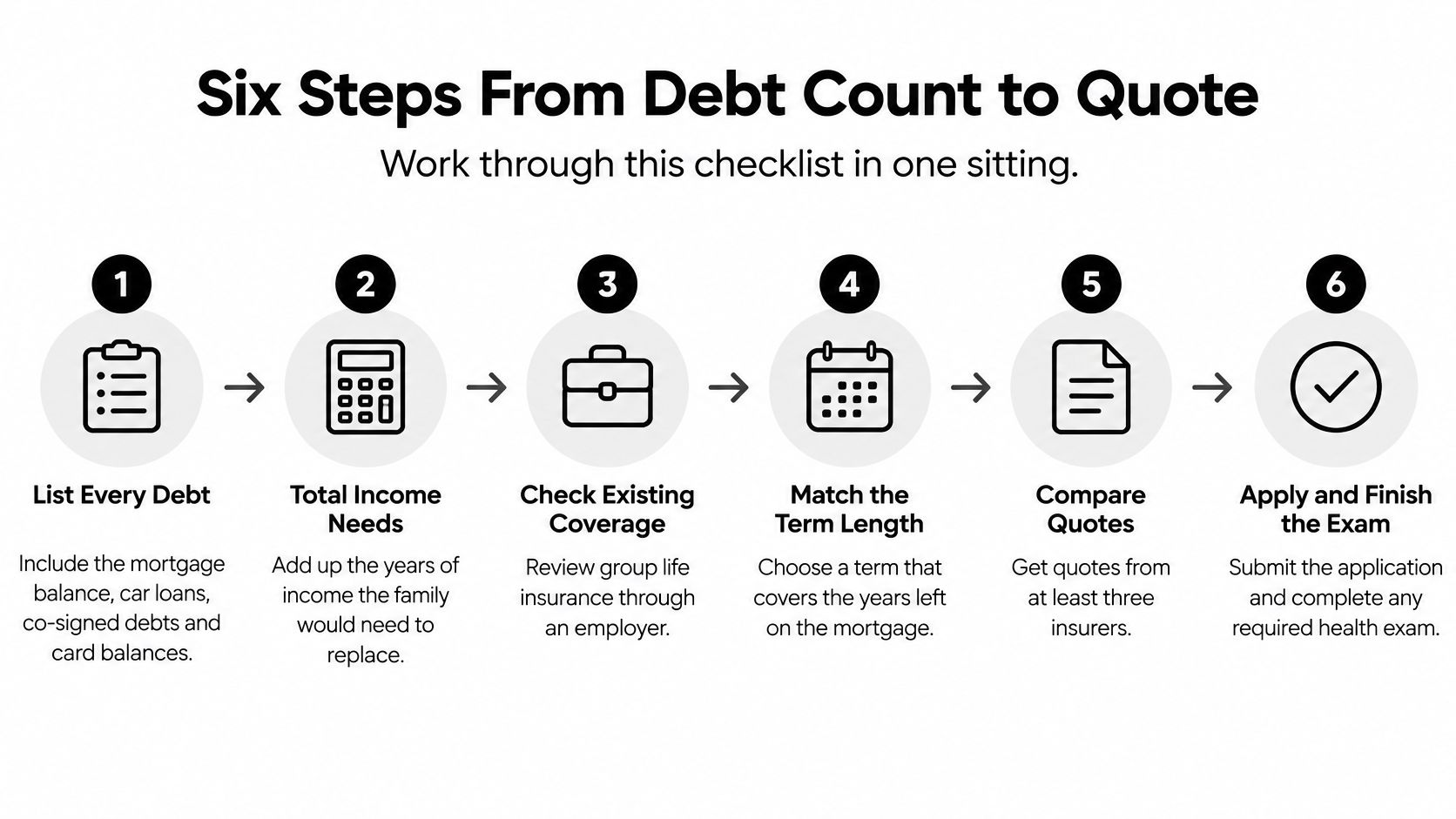
Build the Household Calculation
List every debt the survivor would carry.
Record the mortgage payoff balance, car loans, card balances and co-signed debts. For each obligation, distinguish between something the survivor would legally owe and something they might choose to repay to preserve a shared asset.
The reason is simple: a complete list prevents you from buying coverage around the most visible debt while overlooking another binding obligation. Common mistake: forgetting a co-signed loan because someone else currently makes its payments.
Calculate the income gap and subtract available resources.
Write down essential spending under the planned mortgage approach, then subtract dependable surviving income. Add replacement care costs and other family needs before deducting savings genuinely available for this purpose.
Keep money reserved for unrelated obligations separate. Common mistake: counting the same savings against both debt repayment and living expenses, or deducting an insurance benefit that isn't dependable.
Choose a term that matches the support period.
Identify when dependents are likely to need support and when the mortgage should become manageable. Choose coverage that addresses the longer meaningful obligation, subject to affordability and available policy terms.
A term is a deadline for protection, not merely a pricing choice. Common mistake: choosing a shorter term because the initial premium looks attractive without planning for the uncovered years.
Test the Design Before Applying
Choose who should receive the payout.
Write a plain-language purpose statement, such as “clear the home loan” or “give my spouse money to maintain the household.” Then check that the beneficiary and benefit structure deliver that outcome.
For a loan-only objective, lender-directed coverage may fit. For broader family support, personally owned level term deserves consideration. Common mistake: accepting the lender as beneficiary by default without examining the consequences for other bills.
Identify the non-death gaps.
Review disability income, critical-illness protection, emergency savings and workplace benefits separately. Record any waiting periods, exclusions or limits that would leave essential spending unsupported.
This prevents a complete death-benefit calculation from creating false confidence about other risks. Common mistake: assuming a policy containing the words “mortgage protection” automatically covers illness or unemployment.
Request comparable quotes and confirm application requirements.
Give each insurer the same face amount and term so you're comparing like with like. Ask whether the premium is guaranteed for the selected period, whether a medical examination is required, when coverage begins and what conditions apply.
Consider online term options alongside insurer or adviser-assisted applications. Availability, coverage limits and exam requirements need confirmation for your circumstances. Common mistake: comparing a preliminary estimate with an approved offer, or treating an application as active coverage.
Before accepting a policy, compare the issued contract with your worksheet. Check the insured person, beneficiary, face amount, duration and premium, and ask for an explanation of anything that differs from the offer you expected.
Keep the policy information somewhere the beneficiary can find it. Return to the calculation after a refinance, new home, raise, marriage, birth or divorce so the protection continues to reflect the family it serves.
Coveredly offers online term life insurance that can help provide money for mortgage payments and broader household needs after an insured death. Gather your mortgage balance, income-gap calculation and desired coverage period, then visit Coveredly to explore an option that fits your family's plan.