You're halfway through a life insurance application when it asks about diagnoses, prescriptions, and hospital visits. You take medication, your doctor says things are stable, and you're still working and raising a family. But you're wondering whether checking that box means a rejection or a premium you can't afford.
A diagnosis isn't a reason to give up on coverage. The mistake is buying the easiest policy to obtain before checking whether it protects enough of your family's income, mortgage, and childcare needs. Shopping for life insurance for people with health issues should start with your medical profile and the amount your household needs, not a promise of guaranteed acceptance.
Table of Contents
- Which Coverage Path Fits Your Health Profile
- Policy Types Compared Side by Side
- How to Build Your Medical File Before You Apply
- Timing Your Application and Digital Health Checks
- Alternatives When Full Coverage Is Out of Reach
- Tips for Young Families and Professionals
- Confirm Your Path Before You Apply
Which Coverage Path Fits Your Health Profile
A diagnosis does not automatically rule out life insurance. Your best starting point depends on how well the condition is controlled, whether it has caused complications, and when your health changed. Taking medication alone is not a reason to jump straight to guaranteed issue.
Chronic illness is common among U.S. adults, according to CDC findings published in Preventing Chronic Disease. A diagnosis by itself rarely tells an insurer enough to decide your application. The details in your medical history matter.
Likely Coverage Path by Health Profile
Use these profiles as starting points for shopping, not promises of approval. A “rated” policy costs more than a standard policy because the insurer assesses the applicant as a higher risk.
| Health profile | Likely best path | What moves the price |
|---|---|---|
| Controlled hypertension, consistent treatment | Fully underwritten or accelerated term; simplified term as another option | Blood pressure trend, treatment history, kidney and cardiovascular findings |
| Type 2 diabetes, stable A1C, no complications | Simplified or accelerated term, may be rated up | A1C trend, eye and kidney screening results, age at diagnosis |
| Asthma, no hospital stays in the last two years | Often standard or simplified term | Frequency of steroid bursts, hospitalization dates |
| Depression or anxiety, stable on medication for 1+ year | Simplified term; some carriers decline recent hospitalization | Medication start dates, any psychiatric admissions |
| Cancer in remission for 5+ years | Fully underwritten term; guaranteed issue as a fallback | Pathology report, remission letter, oncologist notes |
| Heart attack or stroke within the last 1–2 years | Guaranteed issue or delayed fully underwritten term | Cardiology notes, stress test results, current medication list |
An underwriter considers more than a diagnosis. How recently the condition developed, how well treatment controls it, and whether complications have occurred can all affect the decision and premium.
Consider a hypothetical 41-year-old man whose blood pressure is 128/82 on one medication. Compared with the same man recording 165/100 despite three medications, his profile may support standard or slightly rated term coverage. The second profile could face a higher rating or postponement. Simplified underwriting does not erase poorly controlled readings, so it is not automatically the better route.
Choose Your Starting Point
If your condition is stable, compare medically underwritten term with simplified issue life insurance. A short health questionnaire may suit your situation, while detailed underwriting can give the insurer more context to assess your risk. Choose based on the amount your family needs, not just the application that looks easiest. A small guaranteed-issue policy may leave a mortgage or childcare gap, while term coverage may better match a larger need if you qualify.
For a recent diagnosis, a treatment change, or an unresolved complication, ask about postponement and temporary protection before submitting applications to multiple insurers.
Practical rule: If your condition has been stable for more than two years, test term options first. That is a sensible starting point, not a guarantee of approval. With recent or unstable disease, compare the actual waiting-period terms before choosing guaranteed issue.
Policy Types Compared Side by Side
| Policy type | Health questions | Typical face amount | Early payout rule | Relative cost per $1,000 |
|---|---|---|---|---|
| Fully underwritten term | Full history, exam and labs when required | Family-income and mortgage-sized coverage, subject to financial justification | Full benefit from the effective date, subject to policy terms | Lowest starting benchmark |
| Simplified issue term | Short questionnaire, usually no exam | Usually lower than fully underwritten limits, set by each carrier | Full benefit; contestability periods vary by policy | Moderate to higher |
| Accelerated underwriting term | Data checks; exam skipped if approved | Often $100,000 to $1 million | Full benefit if approved and coverage takes effect | Similar to fully underwritten if approved |
| Guaranteed issue whole life | No health questions | Smaller amounts intended for final expenses | Graded death benefit in early years | Highest |
The NAIC's accelerated underwriting discussion describes accelerated coverage amounts and draws an important distinction: accelerated underwriting is fully underwritten coverage, not guaranteed acceptance. Treat the amounts as shopping guides, not universal limits. Match the policy to the gap your family needs to cover. A small guaranteed policy may help with final expenses, but it will not replace mortgage-sized protection.
This visual compares application routes. Insurers set their own requirements and decision schedules.
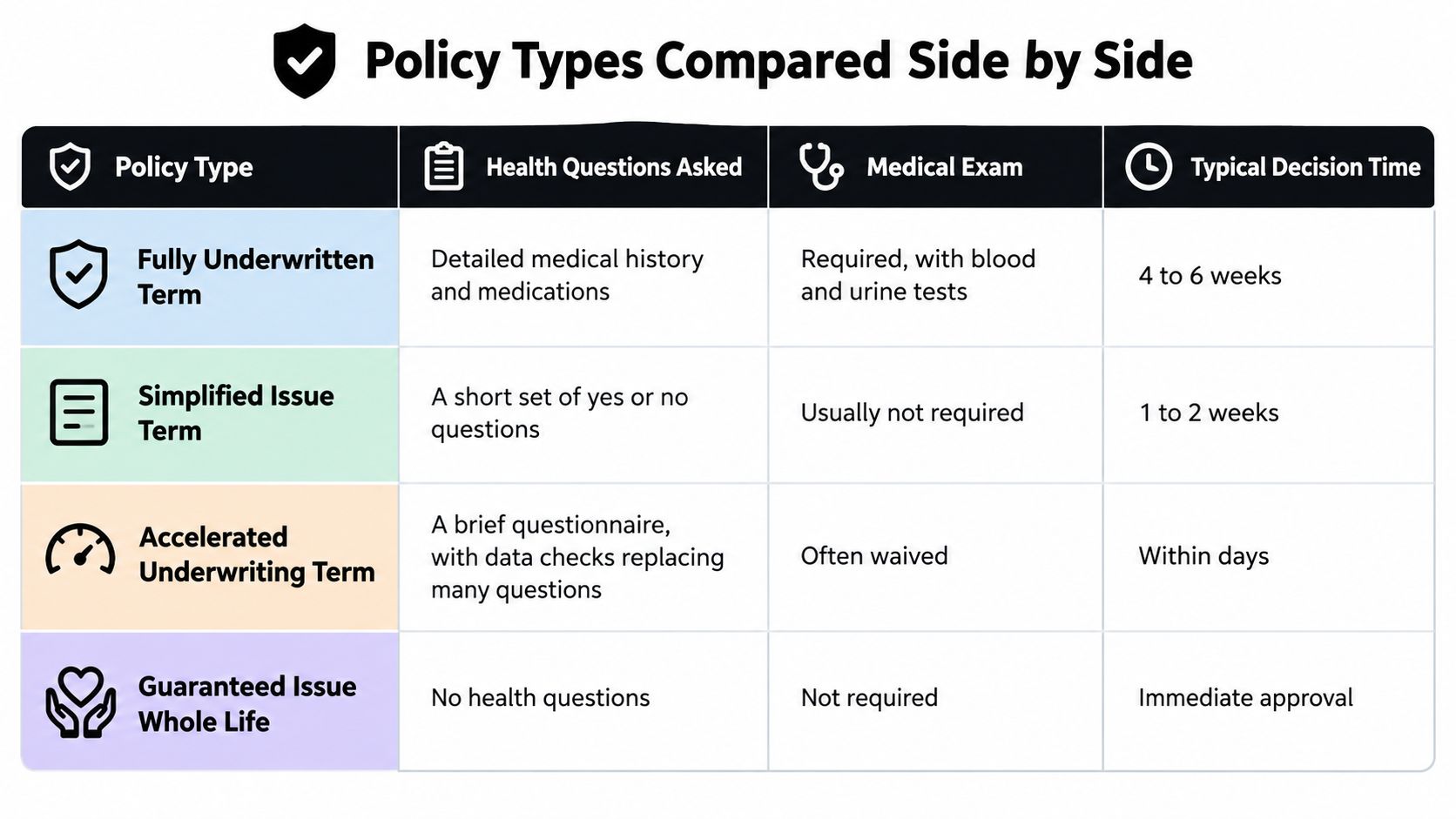
Compare Eligibility, Early Benefits, and Cost
Fully underwritten term is the strongest starting point when you need substantial protection and can document your health. It requires the most evidence, potentially including an exam and lab work, but lets the insurer review your full medical picture. For a mortgage, income replacement, or childcare needs, start here if you can qualify.
Simplified issue term can suit applicants whose conditions fit the insurer's health questions and who want to avoid an exam. Read each question carefully. A short application can still rule out a diagnosis or recent hospitalization, and the available coverage may not be enough for a large family need.
Accelerated underwriting term may offer ordinary term pricing without a traditional exam for eligible applicants. If the accelerated route stops, ask whether the insurer can continue with standard underwriting. A stalled application is not necessarily a final rejection.
Guaranteed issue whole life fits when health-based options are unavailable and a modest permanent benefit covers a specific need, such as final expenses. It is the highest-cost option here, so don't use it as a substitute for larger income or mortgage protection. Check the graded-benefit provision: an early natural-cause death may return premiums with interest rather than pay the face amount. Contestability concerns review of application accuracy; it is separate from the graded benefit.
When Guaranteed Acceptance Is Worth Paying For
LIMRA's 2025 consumer research, surveying 2,015 U.S. life-insurance decision-makers, found stronger interest in guaranteed-issue options among applicants with diabetes or smoking histories despite substantially higher prices.
Guaranteed acceptance has value when other routes are unavailable. Still, don't spend the budget needed for meaningful family protection on a small policy alone. Compare simplified and accelerated options first, then use guaranteed issue for the specific gap it can cover.
How to Build Your Medical File Before You Apply
Give the underwriter a coherent medical history, not a collection of favorable readings. The Society of Actuaries' mortality and morbidity experience studies examine impairments such as build, blood pressure, and diabetes through mortality analysis, rather than diagnosis labels alone.
Organize the file in the same sequence an underwriter needs to understand it: diagnosis, treatment, control, complications, and your broader risk profile.
Assemble Records That Explain Your Condition
Write the timeline. Record the first diagnosis, latest flare, treatment changes, emergency visits, and hospital stays with dates. This helps distinguish an old, resolved episode from an ongoing problem.
Collect laboratory trends. Ask for recent and earlier results so the reviewer can see direction, not just a snapshot. For a practical file, request 12 to 24 months if available, including A1C, lipids, creatinine and eGFR, plus liver testing when relevant to treatment.
Make a medication list. Include names, doses, start dates, and discontinued drugs, then request your pharmacy's fill history. Explain legitimate changes or gaps rather than leaving the insurer to guess what happened.
Request focused specialist notes. Cardiology follow-up, cancer pathology and remission documentation, or a psychiatric treatment summary can supply context that a diagnosis code cannot. Ask for existing clinical records first rather than paying for unnecessary new testing.
Document repeat blood pressure readings. Take two or three readings on separate calm days using your clinician's measurement instructions. Don't change medication or skip doses to influence an application.
Include related conditions. Sleep apnea, tobacco history, eye changes, and kidney findings belong in the file when relevant. A complication can matter even when your main condition feels well controlled.
Reconcile your answers. Compare the application against your records before submitting it. Use the insurer's exact lookback periods rather than answering from memory.
Use this checklist to keep the documents together.
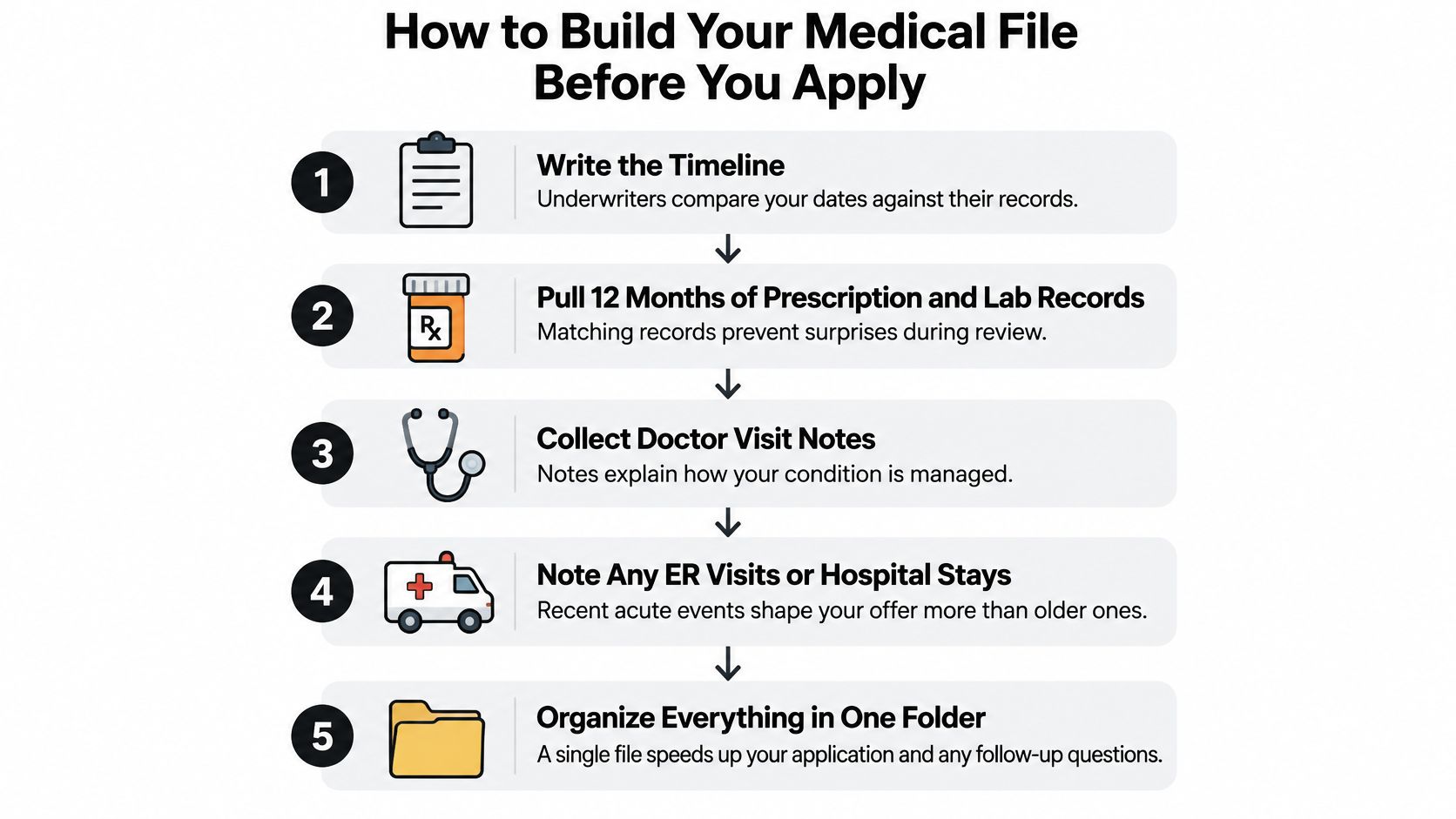
Resolve Questions Before Submission
If you don't understand a result, Stride's guide to what to do after blood tests can help you prepare questions for your clinician. Don't self-diagnose an abnormal flag or assume a result outside the reference range automatically determines your insurance rating.
Review common life insurance health questions while preparing your answers, but respond to the actual application wording. The most common mistake is presenting today's good result while leaving out prior complications or inconsistent treatment. Complete context is more useful than selective disclosure.
Timing Your Application and Digital Health Checks
No medical exam doesn't mean no medical scrutiny. In a 2025 survey of 25 U.S. life insurers reported by PartnerRe, 88% used electronic health records and 84% used medical-claims data in underwriting.
An insurer may compare your answers with prescriptions, billing diagnoses, and clinical notes. A forgotten steroid prescription or emergency visit can prompt questions even when you consider the underlying problem resolved.
Give application timing the same attention as the quote.

Wait for Evidence, Not an Arbitrary Anniversary
After a medication change, ask your clinician when follow-up measurements will show whether treatment is working. Then ask the adviser whether applying with those results would change the available options.
Don't assume waiting automatically saves money. You'll be older, your health could change, and your family remains exposed unless you already have protection.
- Check pending results. Don't submit an application as though an unresolved investigation has already been cleared.
- Correct factual errors. Ask the provider or pharmacy to amend an inaccurate record, and retain the correction.
- Explain real discrepancies. A legitimate historical diagnosis may need context, not deletion.
- Read authorizations. Understand which records the insurer may obtain and how to request clarification about an adverse decision.
Separate Clinical Timing From Insurance Timing
If you receive care in Britain, The Patients Guide's explanation of UK blood test result waiting times can help you plan when to request completed results. Those clinical turnaround expectations aren't a timetable for a U.S. insurer's underwriting decision.
If a fast digital application can't proceed, ask whether a human underwriter can review the fuller record. An automated route may lack context that a standard review can consider. Keep any existing coverage active while that review takes place.
Alternatives When Full Coverage Is Out of Reach
| Alternative | Best for | Main trade-off |
|---|---|---|
| Smaller term policy sized to the mortgage | Young families on a set budget | Less total protection than the full income need |
| Employer group life coverage | Applicants whose job offers guaranteed enrollment | Often 1 to 2 times salary; usually ends when the job ends |
| Converting group coverage to individual | Applicants who recently left a job after a diagnosis | Conversion window is often 31 days; premiums reflect the conversion terms and age |
| Final expense whole life | Older applicants needing funeral costs | Small face amounts at a high cost per dollar |
| Business or key person coverage | Founders, partners and executives | Ownership and beneficiary arrangements need professional advice |
A partial solution should protect a named obligation. Buying whatever benefit fits the monthly budget without deciding what it must accomplish can leave your family with the wrong kind of protection.
Employer benefits and conversion rights are contract-specific. Request the certificate and conversion notice from your benefits administrator rather than relying on the table's common arrangements.
Size the Need Before Choosing the Product
Build your target from the mortgage balance, other debts, income replacement, and childcare or household support costs. Subtract reliable existing coverage and assets your family can realistically use, without counting retirement money they'll need later.
Consider a hypothetical 34-year-old freelancer with asthma, a $300,000 mortgage, and two young children. Suppose she compares an available 20-year, $300,000 term policy with a $25,000 guaranteed policy. The term policy could clear the mortgage if she dies during the term; the smaller policy cannot serve that purpose.
The remaining mortgage gap under the smaller policy would be $275,000 in this example, before income or childcare needs. That doesn't make the guaranteed policy useless. It makes it a final-expense tool rather than mortgage protection.
Buy a policy for the job it can do. Don't treat a funeral-sized benefit as a substitute for family-income coverage.
Preserve Options You Already Have
If you're leaving employment after a diagnosis, contact the plan administrator immediately about conversion or portability. Ask for the deadline, eligible benefit amount, available policy, and premium in writing.
Final expense insurance can be appropriate when burial costs are the primary need, but final expense isn't synonymous with guaranteed issue. Some products ask health questions and may offer different benefit terms.
Before choosing guaranteed life insurance, compare it with a smaller medically underwritten policy and any workplace protection you can preserve. The right fallback reduces a meaningful financial risk without consuming a budget needed for other essentials.
Tips for Young Families and Professionals
Your household needs protection for more than the person earning the largest paycheck. Unpaid childcare, household management, and business responsibilities all have replacement costs.
Make the planning conversation about what would need to change if either partner died.

Newly Married and Raising Children
Say one spouse earns the income while the other manages childcare. Insuring only the earner leaves the working spouse facing paid care, reduced working hours, or both if the caregiving spouse dies.
- Newly married couples. Review each partner's individual need and update beneficiaries after marriage. Don't assume a policy on your spouse also insures you.
- Parents of young children. Match the term to the period of financial dependence, not just the remaining mortgage. Consider education, caregiving, and a child who may need longer-term support.
- Parents managing a diagnosis. Keep medical letters, the submitted application, and policy documents together. That makes future reviews easier and gives your beneficiary a clear record.
Use this video as a prompt to discuss responsibilities and financial priorities together.
Professionals and Business Owners
A business owner may need personal family coverage and separate protection for the company. A key person policy payable to the business doesn't automatically provide money to the owner's spouse.
- Founders and partners. Ask your attorney and insurance adviser whether key person coverage or buy-sell funding fits the business agreement. Confirm ownership and beneficiary arrangements before applying.
- Employees with benefits. Check how individual coverage can supplement the employer plan rather than assuming workplace enrollment meets the whole need.
- Mid-career applicants. Don't cancel an existing policy until replacement coverage is approved, accepted, paid for, and effective.
- Every household. Disclose tobacco use accurately and tell your beneficiary where to find the policy and whom to contact.
Choose a premium you can maintain during a difficult month, not only during a good one. A policy that lapses won't protect the family you bought it for.
Confirm Your Path Before You Apply
Choose the coverage strategy before completing applications. The objective isn't collecting approvals. It's obtaining enough dependable protection at a sustainable cost.
Make the Decision in One Sitting
Identify your starting profile. Write down whether the condition is established and stable, newly diagnosed, or complicated by another illness. Use that distinction to decide which insurers and underwriting routes deserve the first inquiry.
Finish the medical file. Gather the timeline, available laboratory trends, medication history, and relevant specialist letters. Mark unresolved questions so you can answer them accurately instead of guessing.
Request comparable quotes. Where eligible, compare at least three policy types using the same intended benefit and duration. Put the premium, face amount, early payout rules, exclusions, and renewal provisions beside each other.
Use guaranteed issue deliberately. Choose it when medically underwritten options are unavailable or unaffordable and its benefit meaningfully serves your goal. Don't let a simple application replace a coverage-needs calculation.
Judge the Offer, Not Just the Application
Coveredly is one practical starting point for checking online no-exam or accelerated term eligibility. Compare its available route with other suitable insurers rather than assuming any single application represents the whole market.
If you're declined, ask whether the decision concerns the product, a temporary medical issue, missing evidence, or the insurer's risk limits. Then choose a targeted next step: standard review, a different carrier, preserved group coverage, or a smaller benefit.
Before accepting an offer, ask yourself what your beneficiary could actually pay with the proceeds. If the answer doesn't match the obligation you meant to protect, revise the amount or strategy.
The right policy protects the amount your family needs at a price you can keep paying.
Coveredly offers online term life insurance with no-exam options for eligible applicants. Visit Coveredly to check your available options, then compare the benefit amount and policy terms against your family's mortgage, income, and childcare needs.