You finally decide to apply for life insurance. Maybe you just bought a home, got married, had a baby, or realized that “I should really do this” has been sitting on your to-do list for too long. The application feels manageable until one phrase shows up and changes the mood fast: medical exam required.
That's usually the moment people start worrying. Is this a full physical? Will it be awkward? What if one odd result changes the price? What happens to all that personal health data after the appointment? Those questions are normal, and most guides only answer the easy ones.
A life insurance medical exam is usually much simpler than people expect. It's a short health snapshot used for underwriting, not a hospital-style workup. The details matter, though, because the exam can affect your rate class, your premium, and in some cases your future applications too.
Table of Contents
- Your Guide to the Life Insurance Medical Exam
- What a Life Insurance Medical Exam Actually Involves
- How Exam Results Affect Your Life Insurance Rates
- How to Prepare for Your Medical Exam
- Navigating Common Concerns About the Exam
- When You Can Skip the Medical Exam Entirely
- Frequently Asked Questions About the Exam
Your Guide to the Life Insurance Medical Exam
A lot of people assume the exam is a test they can pass or fail. That framing makes the whole process feel more intimidating than it needs to be. In reality, the life insurance medical exam is closer to a snapshot than a final grade.
Think about a parent in their thirties applying for coverage after their second child is born. They answer the online questions, pick a coverage amount, and then learn an exam may be part of the process. Their first thought is often, “What if they find something wrong?” Their second is, “What if this makes coverage too expensive?”
Both concerns are understandable. The exam does influence pricing, but it's also routine. It usually happens at home, at work, or in a clinic, and the appointment itself is brief. In many cases, the hardest part is not knowing what to expect.
Practical rule: The more clearly you understand the exam, the less power it has to feel scary.
Another point often gets missed. This isn't just about what gets measured. It's also about how insurers interpret those results, how small changes can affect your rate class, and how your information may live inside underwriting systems long after the appointment is over.
That's why an informed applicant has an advantage. If you know what's being checked, how to prepare, when privacy questions are worth asking, and when a no-exam path may be available, you can make choices with a lot more confidence.
What a Life Insurance Medical Exam Actually Involves
A life insurance medical exam is usually a short screening visit, not a full physical with a doctor. In many cases, a paramedical professional comes to your home or workplace, asks a few health questions, takes basic measurements, and collects samples for lab testing.
Why insurers ask for it
Insurers are trying to confirm the health picture in your application with objective information. Your application tells one part of the story. The exam adds measured details, similar to how a lender may check your credit report instead of relying only on self-reported income.
That information feeds into the insurer's life insurance underwriting process, where underwriters compare your application, medical history, and lab results before assigning a rate class.
Typical exam items include:
- Basic measurements: Height, weight, blood pressure, and pulse
- Blood sample: Often used to review markers such as glucose, cholesterol, kidney function, and liver function, and sometimes nicotine or drug indicators
- Urine sample: Often used alongside blood work to check health markers and substance use
- Health questions: The examiner may confirm medications, doctors, past diagnoses, and family health history
The phrase “medical exam” sounds bigger than the appointment usually feels. For many applicants, it is closer to a structured data check than a traditional office visit.
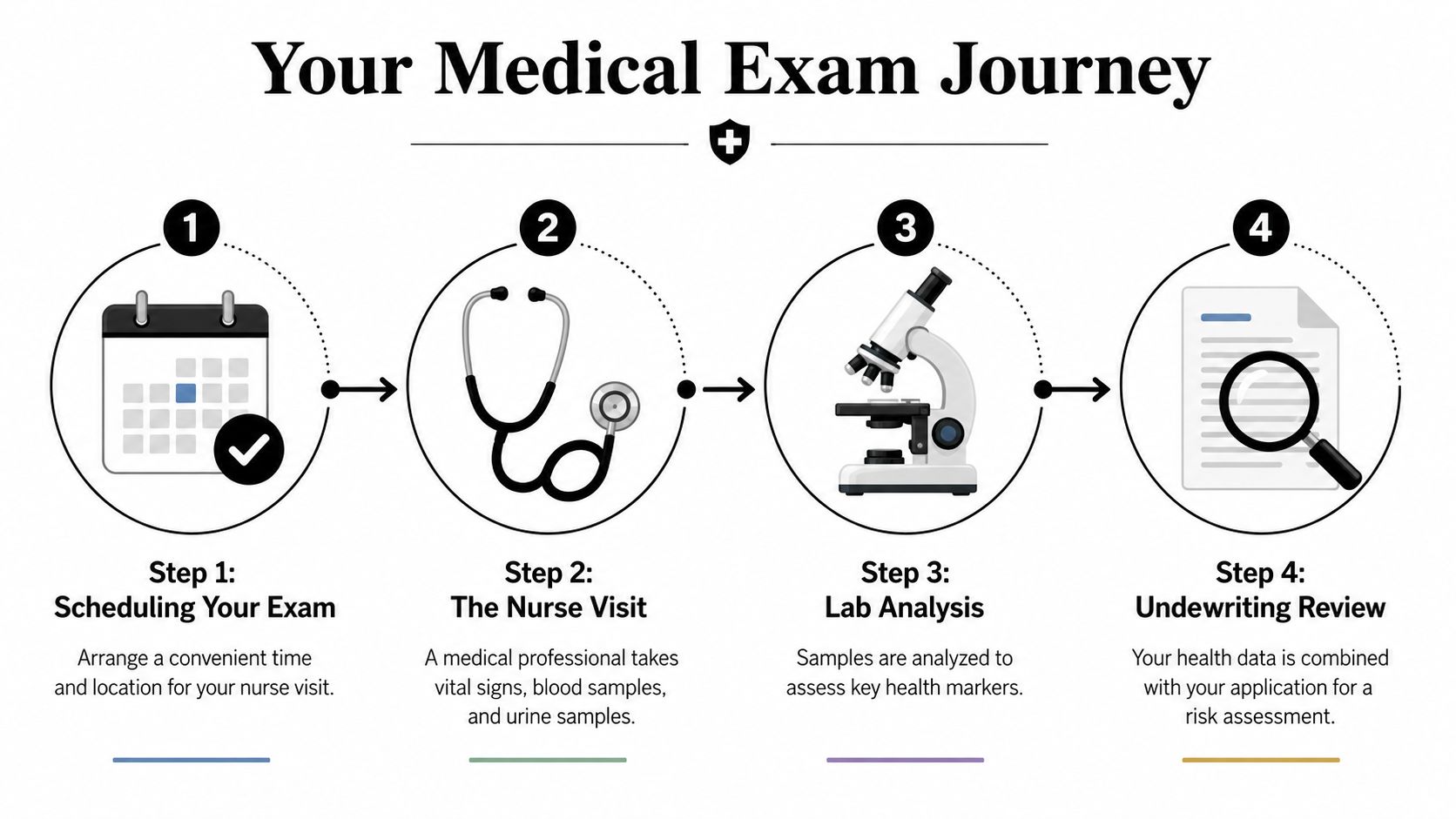
What happens during the appointment
The visit usually follows the same simple pattern.
Scheduling
After you apply, the insurer or exam company contacts you to set a time and location. Many exams happen at home because it is easier for the applicant and keeps the application moving.Identity check and short interview
The examiner confirms your identity and reviews a short questionnaire. This step is mainly about consistency. If your application says one thing and the interview says another, underwriting may pause to ask follow-up questions.Vitals and sample collection
The examiner records your height, weight, blood pressure, and pulse. Then they collect blood and urine samples. The appointment is usually straightforward, and the testing itself is limited.Lab processing and review
The samples go to a lab, and the results are sent to underwriting. That review matters because the raw numbers alone do not set your price. The insurer interprets them in context, along with age, medical history, prescriptions, and lifestyle details.
A point many guides skip is what happens to your information after the appointment. Your results may be shared with the insurer, the lab, and third-party exam vendors involved in processing your application. If data privacy matters to you, it is reasonable to ask who handles your records, how long they are stored, and whether a no-exam policy could limit how much new medical data is collected.
Many applicants expect something stressful and clinical. The real experience is usually brief, routine, and focused on gathering consistent information.
Some people are asked to complete extra testing, especially if they are applying at an older age or for a larger policy amount. That does not automatically signal a problem. It often means the insurer wants a clearer picture before making a pricing decision.
Relevant keywords readers often search at this stage include paramedical exam, blood and urine test, life insurance underwriting, and what happens at a life insurance nurse visit.
How Exam Results Affect Your Life Insurance Rates
You finish the exam feeling fine, then the actual question shows up later. What does all of that mean for your price?
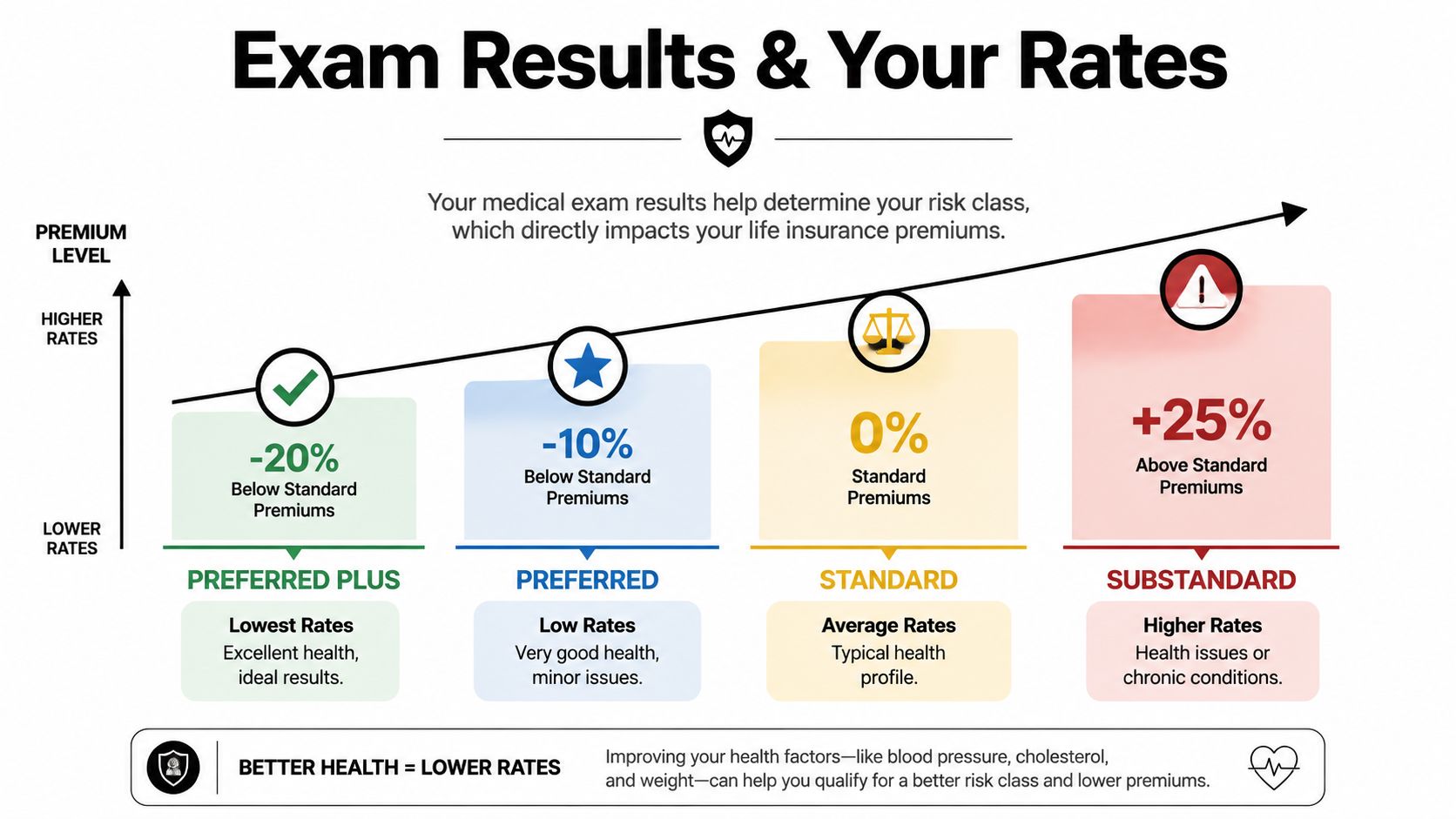
The answer usually comes down to your risk class. That is the pricing bucket an insurer places you in after reviewing your health, history, and habits. A stronger overall profile usually leads to lower premiums. More risk factors usually lead to higher ones.
How underwriters turn results into rate classes
Underwriting works a lot like sorting drivers into insurance groups. Two people may both qualify for coverage, but the one with fewer risk signals usually gets the lower rate.
Carriers use different labels, but the general structure looks like this:
| Risk class | What it usually means |
|---|---|
| Preferred Plus | Excellent overall health profile with very favorable results |
| Preferred | Strong health profile with only minor concerns |
| Standard | Average risk based on common health patterns |
| Substandard | Higher risk due to more significant findings or chronic conditions |
Your exam results are only one part of that decision. Underwriters also review prescription history, past diagnoses, family history, driving record, tobacco use, and details from your application. A single number rarely decides everything by itself. The insurer is looking for the full pattern.
Some findings tend to matter more than others. Blood pressure, cholesterol, blood sugar, nicotine markers, and body build often have a noticeable effect because they can change how an insurer views long-term risk.
A simple way to read this process is to treat the exam like a snapshot, not a verdict. If the snapshot lines up with a healthy history, you may qualify for better pricing. If it shows a concern, the insurer may place you in a more expensive class or ask for more context.
A simple example of what can change your premium
A borderline blood pressure result can be enough to shift someone from a top-tier class to a middle-tier one. That does not always mean the person is unhealthy in everyday life. It means the reading fell outside the insurer's best-price range on the day it was reviewed.
That distinction matters.
Someone who exercises, eats well, and feels healthy can still receive a higher quote if a few numbers come in just above a carrier's cutoff. Underwriting uses thresholds. If your results sit near the edge, even a modest change can affect the price you are offered.
If you want a clearer picture of how carriers review applicants beyond the exam itself, this guide to life insurance underwriting basics explains the broader process.
What underwriters care about most: a consistent pattern. One isolated result may not change much, but several borderline findings can push your application into a different pricing tier.
This is also the part many guides skip. Your results do more than affect approval. They shape your premium, and they may influence whether an exam-based policy is the best fit for you at all. If privacy is a concern, or if you know your readings fluctuate under stress, a no-exam option may be worth comparing because it can reduce how much new medical data is collected during the application.
That can make the decision feel more practical and less personal. You are not being judged. You are being sorted into a pricing system with rules, cutoffs, and data-sharing steps that are often invisible unless someone explains them clearly.
How to Prepare for Your Medical Exam
Preparation isn't about gaming the system. It's about giving the insurer an accurate picture of your usual health rather than a distorted reading caused by a stressful day, poor sleep, dehydration, or a heavy meal.
Following evidence-based preparation, like avoiding alcohol for 24 hours and limiting strenuous exercise, can help reduce transient noise in biomarkers. A 12-hour caffeine- and alcohol-free period can reduce unnecessary upward rating by one full risk class for a meaningful subset of applicants as noted in Progressive's exam preparation guidance.

The day before your exam
A short checklist can make a real difference.
- Skip alcohol: Alcohol can affect hydration and some lab markers, so it's smart to avoid it in the day leading up to the appointment.
- Go easy on intense workouts: Hard exercise can temporarily change certain readings and make your body look less stable than it usually is.
- Limit caffeine before the appointment: If your blood pressure tends to run high when you're rushed or overstimulated, caffeine can add extra noise.
- Drink moderate water: Hydration helps with both the blood draw and the urine sample, but there's no need to overdo it.
- Prioritize sleep: Poor sleep can leave you stressed, increase blood pressure, and make the whole appointment feel worse than it is.
Some people also prefer early morning appointments because the day hasn't had time to pile on stress, food choices, and schedule chaos.
A good prep plan doesn't change who you are. It lowers the odds that a temporary blip gets treated like your normal baseline.
What to have ready
Logistics matter too. The easiest exams are the ones where you're not hunting for details five minutes before the nurse arrives.
Keep these ready:
- Photo ID: The examiner will usually need to confirm identity.
- Medication list: Drug names, dosages, and why you take them.
- Doctor information: Names and contact details for your primary care physician or specialists.
- Basic health history: Prior diagnoses, surgeries, and family history if you know it.
If you're also trying to understand the broader application timeline, this guide on how long life insurance can take helps connect the exam step to the full approval process.
One final tip: don't rush into the appointment after climbing stairs, taking a stressful call, or running errands. Taking a few minutes to sit still before your blood pressure is taken can help the reading reflect your normal state more accurately.
Relevant keywords here include how to prepare for a life insurance medical exam, life insurance blood test tips, and best time of day for life insurance exam.
Navigating Common Concerns About the Exam
The biggest worries usually cluster around three issues: cost, privacy, and the fear that the experience itself will be uncomfortable. Each one deserves a direct answer.
Cost and comfort
First, the cost question is easy. The applicant typically doesn't pay for the exam. The insurer covers it because the exam serves the underwriting process.
Comfort is more personal. Some people don't mind the appointment at all. Others are fine until they hear “blood draw.” If needles make you anxious, tell the examiner right away. Paramedical professionals do this work every day, and a simple heads-up often changes the tone of the visit for the better.
A useful mental reset is to treat the appointment like a mobile screening visit rather than a dramatic medical event. It's brief, routine, and structured.
Privacy and long-term data use
Many guides fall silent on this aspect.
Consumer-facing guides rarely discuss data privacy, but a single exam can influence future approvals for a decade. Insurers increasingly use centralized data repositories, raising questions about consent and data longevity that are particularly relevant to digitally native audiences as discussed in Aflac's overview of life insurance medical exams.
That doesn't mean your information is casually floating around without rules. It does mean you should read authorization forms carefully and understand that exam data may become part of the record used in later underwriting decisions.
Ask practical questions such as:
- Who receives my results?
- How long are they retained?
- Can future applications reference prior exam information?
- Can I request a copy for my own files?
Privacy matters most when you assume the exam is a one-time event, but underwriting systems may treat it as long-lived data.
That's especially relevant if you're younger and expect to shop for additional coverage later. The exam may feel like a short appointment, but its impact can stretch much further than the day it happened.
When You Can Skip the Medical Exam Entirely
Not every applicant needs the traditional route. In many cases, insurers can evaluate risk without sending a nurse to your home or asking for blood and urine samples.
That option is commonly called accelerated underwriting or no-exam life insurance. Instead of relying on a paramedical appointment, the insurer uses health questionnaires, medical records, prescription history, and public records to make a decision.
How accelerated underwriting works
Many insurers offer accelerated underwriting for applicants under age 50, with coverage caps often up to $1 million or more. These pathways use data from public records and health questionnaires to render an approval decision in days rather than the weeks required for traditional underwriting as explained in Amica's life insurance exam guide.
That makes accelerated underwriting appealing for people who value speed and convenience.
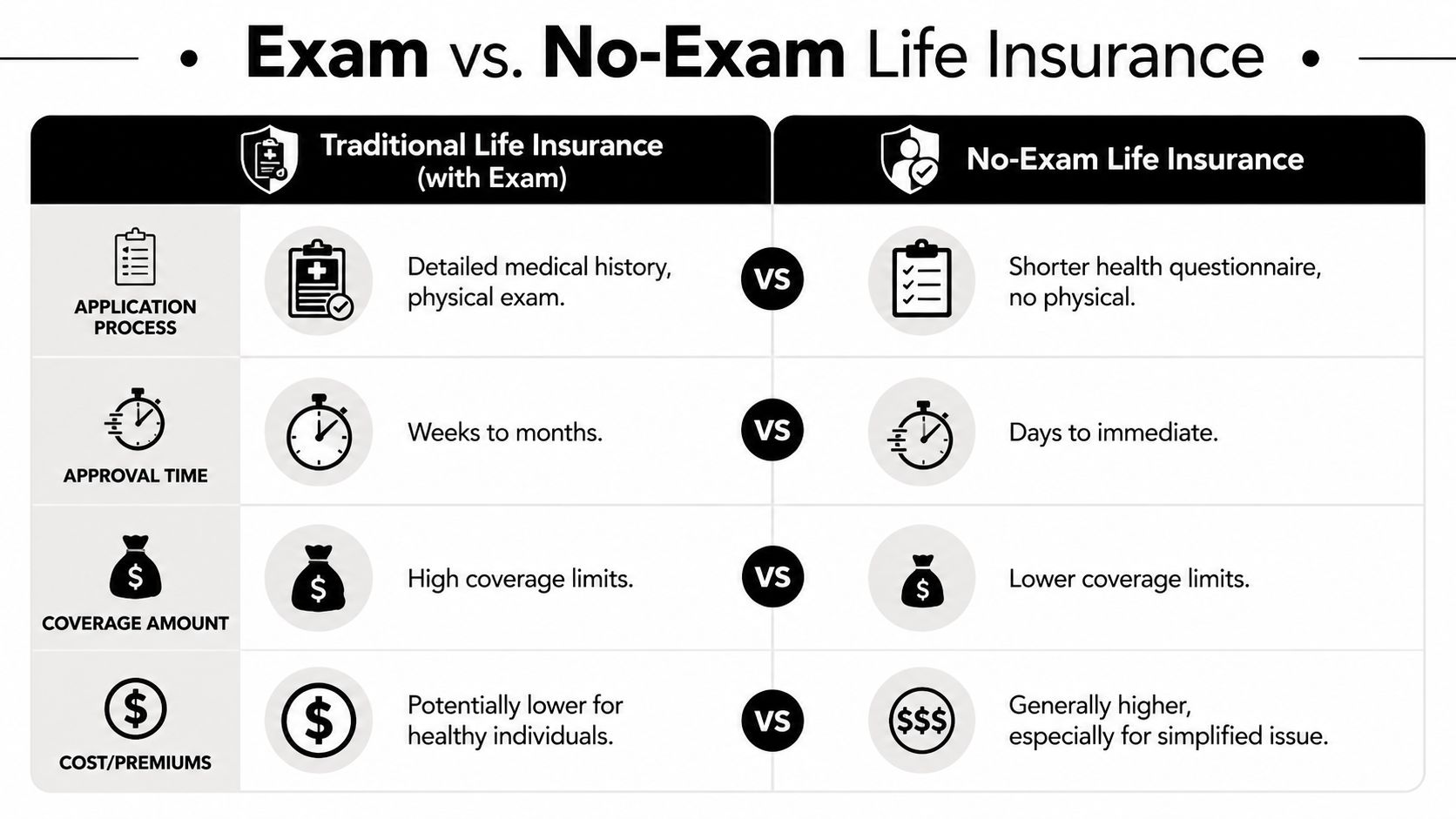
A side-by-side view helps:
| Traditional exam route | No-exam route |
|---|---|
| Includes a paramedical visit | No physical exam |
| Lab work may be required | Uses digital data sources and application answers |
| Approval can take longer | Decision may come much faster |
| Often suited to higher coverage needs | Often best for eligible applicants within carrier limits |
If you're comparing options, this roundup of no-exam life insurance paths can help you see where accelerated underwriting fits.
Who may prefer the no-exam route
A no-exam option may appeal to you if:
- You want speed: You'd rather avoid waiting on scheduling, labs, and manual review.
- You dislike medical visits: If the idea of a blood draw keeps pushing life insurance off your list, a modern application path can remove that friction.
- Your situation is straightforward: Younger applicants with uncomplicated health histories often find these routes especially appealing.
Traditional underwriting still has a place. Some shoppers want the broadest carrier options or need coverage amounts that naturally fit a more detailed review. Others prefer the convenience of a digital process and are happy to accept the underwriting approach that comes with it.
The key is that “life insurance” no longer means one rigid path. For many people, the better question isn't “Will I need an exam?” It's “Which underwriting path fits my timeline, comfort level, and coverage goal?”
Frequently Asked Questions About the Exam
What if the exam finds something unexpected
That can feel alarming, but it isn't always bad news. In some cases, the insurer may ask for more information, place you in a different rate class, or continue with a standard review rather than decline coverage outright. If a result suggests a possible health issue, it may also be worth following up with your own doctor.
Can I reuse results or get a copy
You can often request a copy of your exam results for your records. Whether another insurer will accept prior results depends on that insurer's process and how recent the information is. If you're thinking about applying elsewhere, ask early rather than assuming the exam transfers automatically.
What if I hate needles
Tell the examiner before the blood draw starts. That gives them a chance to slow down, explain what they're doing, and help you stay comfortable. Many people who dread the exam end up saying the anticipation was worse than the appointment itself.
Will a slightly imperfect result ruin my chances
Usually, no. Borderline results often affect pricing more than eligibility. Many applicants don't land in the very best class, but still qualify for solid coverage.
Should I choose exam or no-exam life insurance
It depends on your priorities. If you want the most traditional underwriting path, an exam may be part of it. If convenience, speed, and a fully digital experience matter more, a no-exam option may be the better fit.
If you want a simpler way to shop, Coveredly offers online life insurance built for real life. It's digital, flexible, and designed to help many applicants get term coverage without exams, often with coverage amounts up to $3mm. For young families, newly married couples, and busy professionals, it's a practical way to explore life insurance without turning it into a drawn-out project.