Frank sits at the kitchen table after a friend's funeral, sorting through a stack of mailers that all promise relief in different ways. One says “guaranteed.” Another says “no medical exam.” A third looks simple enough to be safe, until he wonders what he's giving up by skipping the doctor visit.
That confusion is common, because life insurance no medical exam for seniors isn't one product. It's a group of products with very different rules, prices, and payout timing. Some skip the nurse visit but still ask health questions. Some ask no health questions at all and make up for that with smaller coverage or a waiting period.
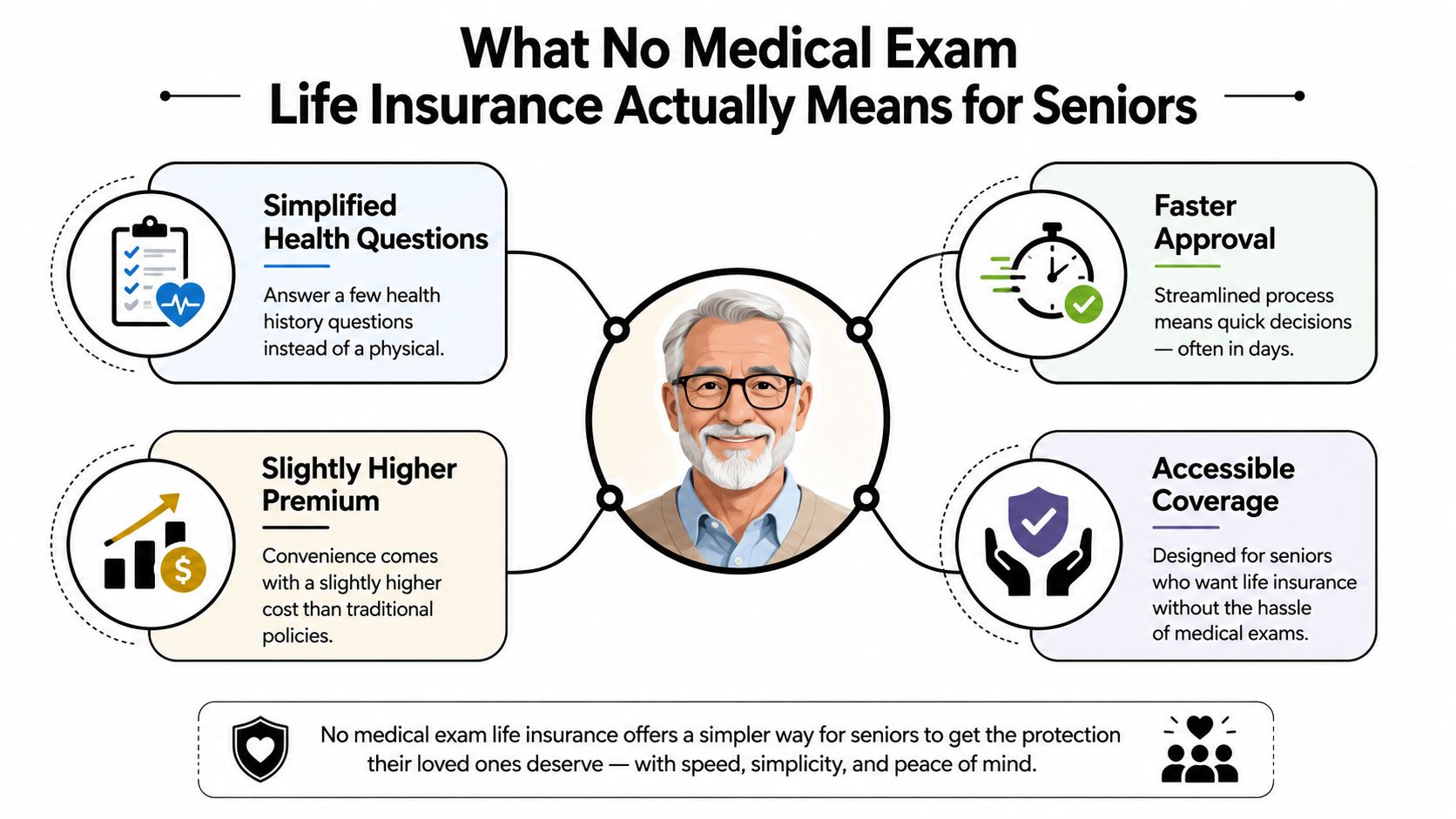
Table of Contents
- What No Medical Exam Life Insurance Means for Seniors
- The Four Underwriting Paths Behind No Exam Coverage
- Simplified Issue vs. Guaranteed Issue The Real Decision
- What No Exam Coverage Actually Costs and How Much It Pays
- How to Apply for No Exam Life Insurance Step by Step
- Common Pitfalls That Catch Seniors Off Guard
- How Coveredly Fits In and Practical Next Steps
- Frequently Asked Questions About No Exam Life Insurance for Seniors
What No Medical Exam Life Insurance Means for Seniors
Frank's mailers all use the same promise, but they do not mean the same thing. No medical exam usually means there is no nurse visit, no blood draw, and no urine sample. It does not mean the insurer stops looking at risk. The company may still use a health questionnaire, prescription history, motor vehicle records, and prior application data to judge the application, so the process is less invasive, not less careful. Ethos explains the electronic checks used in no-exam underwriting
For many seniors, that difference is the point. A medical exam can feel like another hurdle when travel is difficult, a doctor visit is already on the calendar, or a recent diagnosis makes the usual route feel harder than it should. Policygenius outlines how no-exam senior coverage works Decisions can come back in minutes to days, which is a very different experience from waiting on a lab appointment and then waiting again for results.
A senior who wants a shorter application, less paperwork, and fewer appointments often starts here. If you are comparing options for older buyers, the guide to over 60 life insurance coverage can help frame what these policies are trying to solve. The appeal is simple, you may be able to get coverage without the exam room becoming part of the process.
What the label leaves out
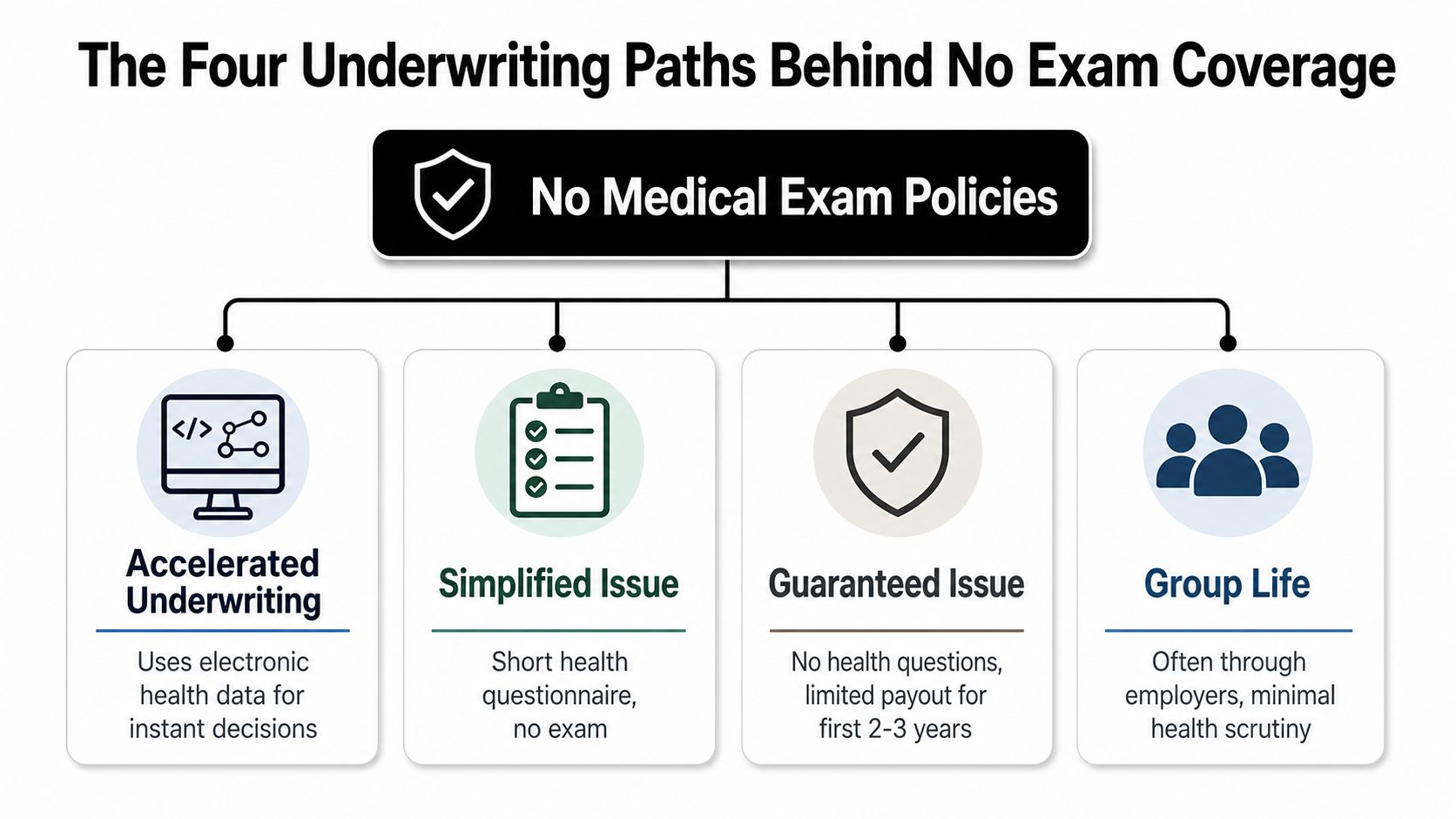
The label hides the question that matters most, which is what kind of no-exam policy is this? A senior may be looking at accelerated underwriting, simplified issue, guaranteed issue, or group life. They can sound similar in a sales pitch, but they do very different things once the application starts.
Practical rule: if a policy says “no exam,” ask whether it still asks health questions. That answer tells you far more than the headline does.
A useful way to read the label is this. No exam means less medical friction. It does not mean the insurer is giving up on underwriting. The company has replaced the physical exam with other records and checks, and that tradeoff can work well for the right buyer. For a senior who wants speed and less hassle, that may be enough. For a senior who wants the largest possible benefit, the underwriting path matters just as much as the label.
That is also where health questions can matter more than people expect. A healthier senior may do better by answering a few questions than by skipping them and falling into a narrower option. For someone watching their heart and circulation, for example, the right answer depends on how the insurer views the condition, not on the absence of an exam alone.
The Four Underwriting Paths Behind No Exam Coverage
Think of no-exam coverage like four checkout lanes at the grocery store. You can leave without the long line, but each lane has different rules about what you need to show at the register. That's why two policies can both avoid an exam and still land at very different prices and coverage limits.
The lanes that matter
Accelerated underwriting is the fastest lane for healthier applicants. The insurer uses electronic data to make a decision without a medical exam, and it's built for people whose records line up cleanly with the application. Simplified issue is the lane with a short health questionnaire plus database checks, so the insurer still asks about health but skips the nurse appointment. Trustage breaks down these no-exam structures clearly.
Guaranteed issue is the broadest lane and the least selective. There are no health questions, and approval hinges on age and identity, not on medical history. That's why it's often the fallback for seniors with serious conditions or recent declines. Group life is the fourth path, usually tied to an employer or association, where underwriting can be lighter because the coverage is part of a broader group arrangement.
Why the lane matters more than the headline
The underwriting path controls the tradeoff. A healthier senior often belongs in simplified issue or accelerated underwriting, because those routes can offer better coverage and faster approval. A senior with more serious health concerns may need guaranteed issue, even though the benefit is smaller and the policy usually has more restrictions.
If you want a plain-language resource on how heart conditions and circulation issues can fit into the broader health picture, heart and circulation is a helpful reference to keep nearby. That kind of context matters because insurers are usually judging risk from records, not from the fact that no exam was scheduled.
Simplified Issue vs. Guaranteed Issue The Real Decision
This is the fork in the road. Simplified issue still asks a few health questions, but in return it can give a senior much larger coverage and immediate full protection if the answers fit the insurer's guidelines. Guaranteed issue skips health questions entirely, which makes it useful for people with more complicated medical histories, but the tradeoff is usually a smaller benefit and a waiting period before full natural-death coverage applies. Senior Living's comparison of no-exam options for seniors highlights this split.
Side by side
| Feature | Simplified Issue | Guaranteed Issue |
|---|---|---|
| Health questions | Yes | No |
| Medical exam | No | No |
| Typical use | Seniors healthy enough to answer questions honestly | Seniors who need acceptance despite health problems |
| Coverage level | Can be meaningfully higher | Usually smaller, often final-expense focused |
| Benefit timing | Can be immediate if approved | Often includes a waiting period |
| Best fit | Seniors who want to avoid an exam but still qualify medically | Seniors who need coverage even with major health issues |
A healthy 70-year-old who can answer no to questions about recent cancer, heart attack, or dialysis may be a much better fit for simplified issue. That person may access a policy like the kind Coveredly's simplified issue explainer describes, where the application still asks health questions but the coverage can be far more flexible than guaranteed issue.
A 75-year-old with multiple conditions may not have that option. In that case, guaranteed issue can still do important work, especially for final expenses. The key is being honest about what problem the policy is solving. If the goal is immediate, fuller protection and the senior can still answer health questions truthfully, simplified issue is usually the first lane to check. If the goal is getting some coverage no matter what, guaranteed issue is the backstop.
Decision rule: if the senior can still answer the health questions without stretching the truth, simplified issue is usually worth a look before defaulting to guaranteed issue.
What No Exam Coverage Actually Costs and How Much It Pays
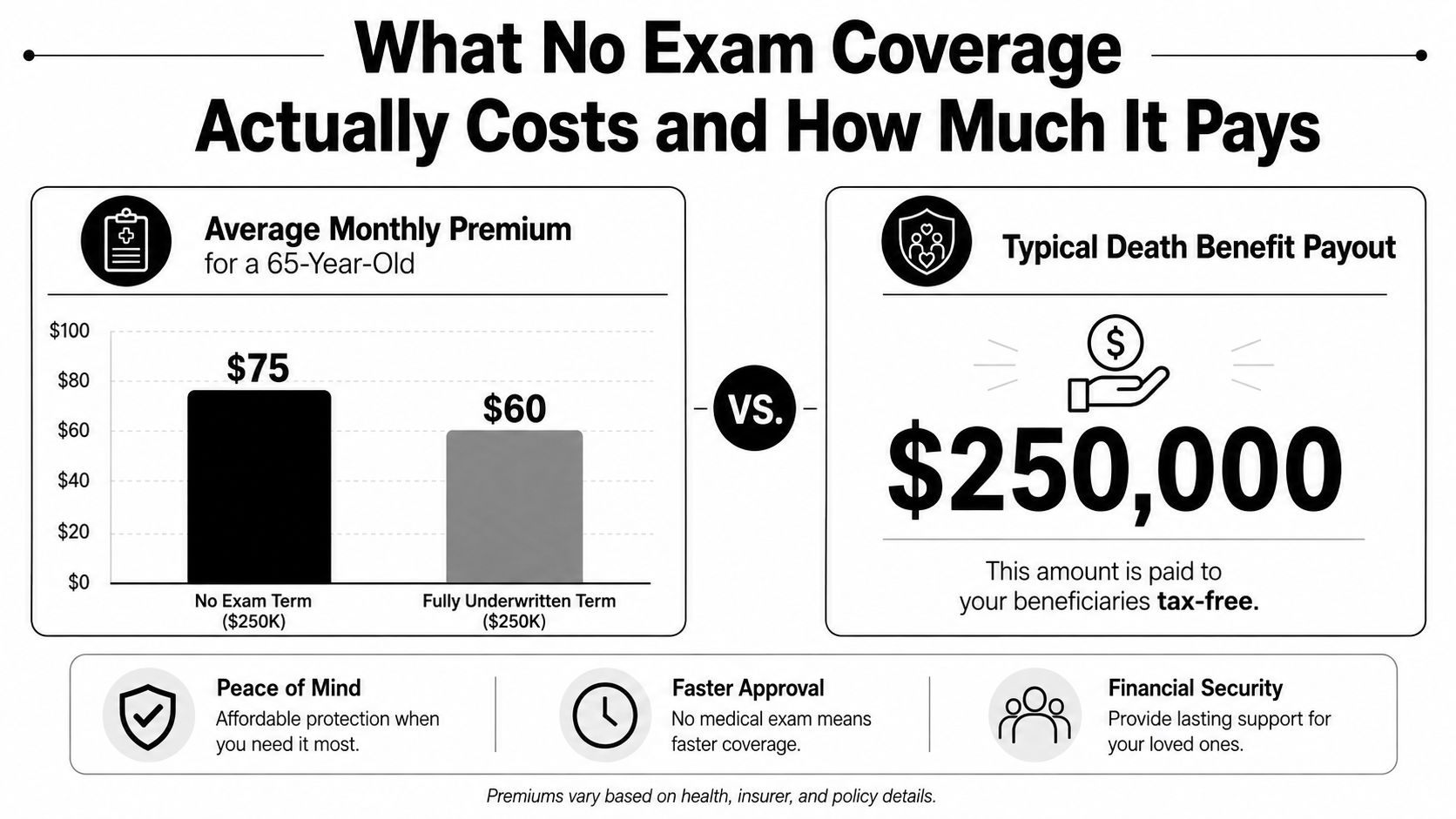
Skipping the exam doesn't make coverage cheap, but it does make it accessible. For a 65-year-old buying a 10-year, $100,000 policy, MoneyGeek's 2026 comparison found average monthly premiums of about $34 for women and $56 for men at the cheapest no-exam carrier, and it estimated no-exam policies cost 10% to 20% more than traditional policies with a medical exam. MoneyGeek's comparison of no-exam life insurance is a useful benchmark for what that speed usually costs.
Premiums are only part of the story
The bigger limiter is often the face amount. Senior-focused guidance shows guaranteed issue policies are commonly much smaller, often around $5,000 to $25,000, while simplified issue can reach higher amounts such as $50,000, $100,000, or $150,000 in some programs. Independent senior guidance also reports that simplified issue can reach up to $500,000, while some no-exam term or permanent policies can go as high as $2,000,000 for selected applicants. Ogletree Financial's senior guide to no-medical-exam coverage lays out that range plainly.
Age changes the available menu
Many accelerated or fluidless programs top out around 60 or 65, which is why the no-exam market tightens as people age. Some no-exam term or permanent policies can run to around 75 to 80, while guaranteed issue or final-expense options can extend to 85 or even 90. That doesn't mean every carrier goes that far, but it does explain why the same search looks very different at 64 than it does at 78.
If you're also thinking about what this coverage is meant to protect, this families guide to end of life care is a thoughtful companion resource. It helps frame the world costs families are often trying to handle, beyond just the premium itself.
Bottom line: no-exam coverage usually costs a bit more for the convenience, but the more important constraint is often the coverage ceiling and the applicant's age band.
How to Apply for No Exam Life Insurance Step by Step
A senior application often feels simpler than a full medical exam, but the form still needs to be filled out with care. Start at the kitchen table with your driver's license, Social Security number, beneficiary details, current medications, and the names of your doctors. If you are also preparing to age in place or helping a parent plan ahead, the DME Superstore aging in place guide can help you think through the bigger picture around home and care needs. The insurer may not send a nurse to your home, but it still wants enough information to decide whether to ask health questions, offer simplified issue, or move you toward guaranteed issue.
What happens on the application
The first part usually verifies your identity. After that comes a health questionnaire, then a consent form that lets the carrier check the information you gave.
That review can include the kinds of records discussed earlier in the article, such as prescription history and other underwriting files. If your answers and those records do not line up, the application can slow down, or the carrier may change the offer it is willing to make.
A good way to picture it is this. The medical exam is missing, but the underwriting still has a paper trail. The company is trying to understand your risk through records and answers instead of a blood draw or a nurse visit.
How fast each lane moves
The timeline depends on the path you take. Accelerated underwriting can return a decision quickly, simplified issue usually takes a few days, and guaranteed issue can be approved the same day. Those windows help set expectations, but they are not promises, because each carrier handles review a little differently.
If you want the process to stay moving, keep your paperwork in one place and answer every health question exactly as written. Read the consent language before you sign it, because that is how the insurer gets permission to review electronic records.
Multiple applications can also create confusion. If you apply with several companies at once, later carriers may see the earlier applications and spend more time sorting out the file.
- Gather documents first. Keep your ID, Social Security number, doctor names, and medication list within reach before you begin.
- Answer the health questions carefully. Short answers are fine, but they need to match your records.
- Read the consent form slowly. That is the part that allows the carrier to review your information.
- Wait for one decision before starting another application. Repeated submissions can make the review process harder to untangle.
A few seniors try to shop everywhere at once, hoping more applications will create more choices. In practice, that can do the opposite, because each new file may give the next insurer more to sort through.
Common Pitfalls That Catch Seniors Off Guard
The most expensive mistake is assuming all no-exam policies work the same way. They don't. A senior can buy a policy with no physical and still end up facing a two-year waiting period, graded benefits, or a benefit cap that's too small to do the job. Choice Mutual's senior no-medical-exam guide is a clear reminder that “no exam” and “immediate full coverage” are not identical.
The traps that matter
Waiting periods are the first trap. With guaranteed issue, the insurer commonly limits full natural-death coverage for the first 24 months, so if the insured dies from natural causes in that period, the beneficiary usually does not get the full face amount. Graded benefits are another version of the same idea, where the payout rises over the first two to three years instead of starting at full value on day one.
Age cutoffs are the second trap. Many no-exam programs end earlier than people expect, often around 70 or 75, so a 73-year-old may find fewer options than the marketing suggested. That's one reason it helps to look at the underwriting path first, not the ad copy.
Small policy syndrome is the third trap. A $5,000 to $10,000 final-expense policy can be useful, but it may not stretch far if the policyholder wants to cover a funeral, leftover bills, and a little cushion for the family. The wrong policy size can solve one problem and leave two others untouched.
Read the schedule before you sign
The most useful page in the policy is often the Schedule of Benefits. That's where the waiting period, graded payout, and accidental-death treatment are usually spelled out. If you're also thinking about how aging in place affects long-term planning, DME Superstore's aging in place guide is a practical resource to pair with the insurance conversation.
How Coveredly Fits In and Practical Next Steps
Coveredly fits best for people who want a digital path, fewer moving parts, and a quick decision without a medical exam. The process is built for speed and simplicity, and for many applicants that means an online application, a fast review, and coverage that doesn't require the old-school lab visit. For seniors, the right fit still depends on age, health, and how much coverage they need. Coveredly's no-exam company overview gives a useful starting point for comparing the broader market.
A simple checklist for this week
- Estimate the need first. Start with final expenses, debts that would remain, and any legacy gift you want to leave.
- Gather your records. Use the same ID, medication list, and doctor details you'd use for any no-exam application.
- Choose one application path. One clear application is usually better than scattering multiple requests.
- Read the policy terms. Check the grace period, waiting period, and renewal language before you sign.
- Match the product to the goal. If the aim is fuller coverage and the health questions are manageable, don't skip that option too quickly.
The hardest part for many families isn't buying the wrong policy, it's not buying one at all. If the conversation has been sitting on your kitchen table for months, this is a good week to deal with it instead of putting it off again.
Frequently Asked Questions About No Exam Life Insurance for Seniors
Can someone in their 70s or 80s still get meaningful coverage? Yes, but the product type usually shifts. Seniors in that age range often move toward simplified issue whole life or guaranteed issue final-expense coverage rather than larger no-exam term options.
What happens if the insured dies during the waiting period? With guaranteed issue, the beneficiary usually does not receive the full face amount right away. Many policies return premiums, sometimes with a small added amount, instead of paying the full benefit during the waiting period.
Do conditions like diabetes, heart disease, or COPD disqualify applicants? Not always. Guaranteed issue generally does not ask about health, while simplified issue may still limit options based on the answers given on the application.
Are life insurance payouts taxable to beneficiaries? In general, life insurance death benefits are received income-tax-free under current federal rules. That's one reason these policies remain useful for final expenses and family support.
If you're trying to choose between simplified issue and guaranteed issue, Coveredly can help you compare a no-exam path without the usual confusion. Visit Coveredly to review options, see how the application works, and take the next step while the question is still fresh.