You're at the kitchen table with two browser tabs open. One life insurance online quote looks affordable. The other is much higher. Both ask about your age, tobacco use, and health, so you're wondering whether one carrier is overcharging you or whether the cheaper number is hiding a problem.
The answer usually comes down to the inputs and the underwriting behind them. An online quote is useful, but it isn't magic. If you want the number on your screen to resemble the premium you'll pay, you need accurate disclosures, a realistic coverage target, and a clear understanding of what happens after you submit.
Table of Contents
- What an Online Quote Actually Gives You
- What to Prepare Before You Start the Form
- How Online Quoting and Instant-Issue Actually Work
- Comparing Offers Side by Side Without Getting Played
- Two Realistic Scenarios From Quote to Decision
- Red Flags and Common Mistakes to Avoid
- Next Steps With Coveredly
What an Online Quote Actually Gives You
A quote is an estimate built from limited information. It may use your age, state, coverage amount, term length, tobacco status, and broad health answers to produce an initial premium from a carrier's rate table. It generally isn't a binding offer, and it doesn't prove that you're eligible for the quoted risk class.
That explains the familiar scenario where three carriers return three different prices. Each carrier has its own underwriting rules, preferred risk categories, product design, and tolerance for particular medical or lifestyle factors. One insurer may treat a medication as routine. Another may request records or assign a different risk class after reviewing the same prescription.
Practical rule: Treat the first number as a planning estimate, not a promise.
The gap between an illustrative premium and a final offer can come from details people often enter casually:
- Tobacco classification: Cigarettes, vaping, nicotine replacement, and past use may be handled differently.
- Build information: Height and weight affect the carrier's build chart. An incorrect entry can distort the result.
- Prescription history: A medication you forgot about can appear during external-data checks.
- Health disclosures: A diagnosis, blood-pressure history, or family-history answer can trigger a closer review.
- Occupation and activities: Hazardous duties or recreational activities may affect eligibility or pricing.
- State rules: Underwriting and policy availability can vary by jurisdiction.
“No exam” also needs a precise interpretation. It usually means the carrier may evaluate you through an electronic application and permitted data sources rather than requiring a nurse visit. It doesn't mean the insurer skips underwriting or accepts every applicant at the displayed price.
The right objective isn't finding the cheapest number in a browser window. It's creating a quote with inputs that accurately reflect your situation, then checking whether the resulting offer provides the coverage your household needs.
What to Prepare Before You Start the Form
A rushed application creates a quote you cannot trust. Before opening the form, gather the information an underwriter will check and decide what coverage you need. Accurate inputs give you a better chance of matching the displayed premium to the eventual offer.
Build a one-page preparation sheet
Keep these details in one place:
- Personal details: Prepare your date of birth, state of residence, occupation, and citizenship or residency information.
- Coverage target: Choose an approximate death benefit and decide whether term or permanent coverage fits your goal.
- Term length: Match the term to a real obligation, such as the years until your children become financially independent or your mortgage is expected to be repaid.
- Beneficiaries: List the people or entities you plan to name, using their legal names and relationship to you.
- Medical information: Record current medications and dosages, diagnoses, surgeries, hospitalizations, and recent primary-care visits.
- Lifestyle details: Include tobacco and nicotine use, hazardous activities, and occupational exposure.
- Financial context: Note existing individual coverage and employer-sponsored life insurance.
Measure your height and weight instead of estimating. Check each medication's name, dosage, and date. Underwriters compare your answers with permitted external information, so “I think it was nothing” is a poor application strategy.
LIMRA reports that 95% of surveyed insurers used MIB application data, while about 60% used prescription databases, lab results, and motor-vehicle records. 48% said those sources reduced the need for Attending Physician Statements, according to LIMRA's research on easier life-insurance underwriting.
Answer the health questions precisely
Choose “none” only when it is factually correct. “Prefer not to say” leaves information unresolved and can prompt follow-up questions or referral.
If you are unsure how to describe a diagnosis, medication, or prior treatment, review this guide to life insurance health questions before applying. Use plain language and disclose the relevant facts. Avoid dramatic explanations, but never minimize a condition to protect a quote.
Tobacco questions require careful attention. Report current and previous cigarette use, vaping, chewing tobacco, nicotine gum, patches, and other nicotine products when requested. If you quit recently, enter the actual stopping date rather than choosing “never.”
The insurer is reconciling your answers with information it is permitted to obtain. A forgotten prescription or inconsistent date can change your risk class, trigger a records request, or send the application to manual review. Prepare the details first, then submit an application designed to produce a quote you can reasonably expect to pay.
How Online Quoting and Instant-Issue Actually Work
You enter your age, coverage amount, and health details, and the screen returns a premium. That number is useful, but it is not yet the insurer's final decision. The application still has to pass underwriting.
The quote stage
The form gathers structured information, including your jurisdiction, term, tobacco use, occupation, health history, family history, and hazardous activities. It also checks required fields, confirms product availability, and standardizes details such as height, weight, and dates.
The carrier applies an indicative rate table to those answers. That produces the initial quote. It reflects what you entered at that moment, not every fact the insurer may verify later.
Consent follows. Depending on the product and jurisdiction, you may authorize the insurer to obtain permitted information from MIB records, prescription databases, motor-vehicle records, or medical providers. Required disclosures explain how those sources may be used under insurance and consumer-reporting rules.
The underwriting stage
The insurer compares your application with the information it retrieves. A match may support an accelerated decision. A discrepancy involving medication, tobacco use, height and weight, a diagnosis, or driving history can trigger questions, medical evidence, a revised offer, or a decline.
That is why no-exam life insurance still involves underwriting. The carrier may replace a paramedical visit with electronic evidence, but it still evaluates eligibility and risk.
The Society of Actuaries' research on predictive models in life insurance describes machine-readable application data and model-development work involving variable generation, exploratory analysis, and variable transformation. For applicants, the practical lesson is simple: precise, consistent answers give the system usable information.
Accelerated underwriting can reduce the time after submission. One LIMRA study found that automated or accelerated programs reached the medical questionnaire or interview sooner than traditional underwriting and reached a final decision sooner as well. The comparison starts after an application is in good order, not when you first open a quote page.
Instant issue remains conditional. It is more likely when your product choice, coverage amount, health disclosures, build, and external data fit the carrier's rules. A form marked “no exam required” can still result in a referral.
Read this explanation of how life insurance underwriting works to understand the gap between an initial estimate and the final eligibility decision. To make the quote match the premium you can actually pay, enter complete facts, use exact dates, and treat every answer as underwriting data, not a rough guess.
Comparing Offers Side by Side Without Getting Played
A quote is a number. An offer is a contract. Compare the contract, not just the premium shown in large type.
Start with the coverage amount and term length. A lower premium may only reflect less protection or a shorter period. Then examine the carrier's financial-strength rating, the exact policy form, conversion rights, exclusions, riders, and any table rating or special condition attached to the offer.
The conversion privilege deserves particular attention. It may allow you to convert term coverage to a permanent policy later without new evidence of insurability, subject to the policy's rules and deadlines. That option can matter if your health changes or your long-term needs evolve.
Use this checklist before choosing:
| What to Compare | Why It Matters | Where to Find It |
|---|---|---|
| Coverage amount | Confirms the death benefit matches your household need | Quote and policy illustration |
| Term length | Shows how long the protection lasts | Quote summary and policy form |
| Monthly premium | Reveals the ongoing cost at the offered risk class | Final offer |
| Carrier rating | Helps you evaluate financial strength | Carrier materials and independent rating sources |
| Exam requirement | Clarifies whether additional evidence may be requested | Application disclosures |
| Conversion rights | Shows whether you can change policy type later | Policy form and conversion provision |
| Exclusions and riders | Identifies limitations and optional features | Policy form and offer documents |
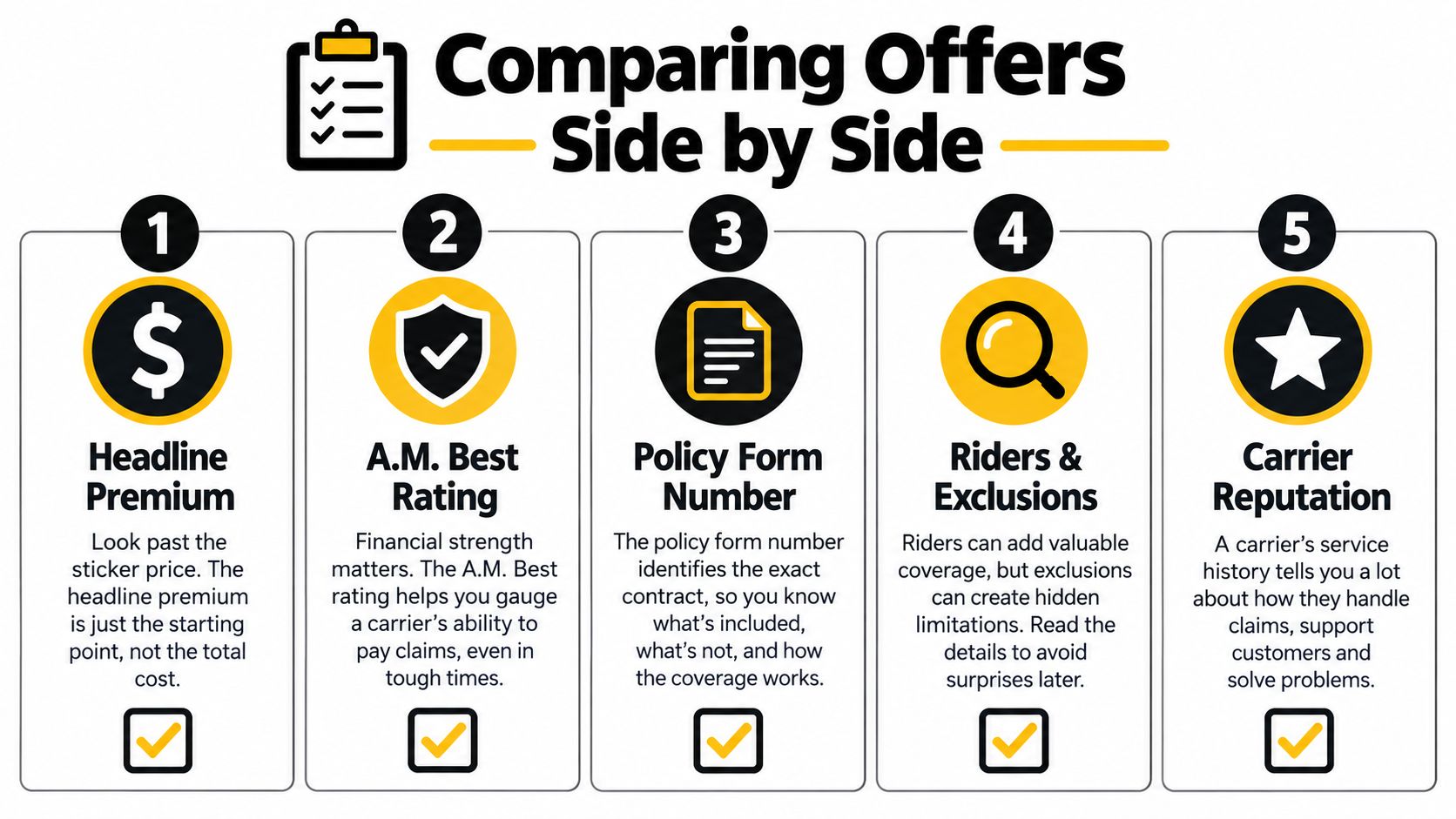
The policy form number is not decoration. It identifies the contract you're reviewing. If two offers look similar but use different forms, read the provisions rather than assuming the products are interchangeable.
You can also use this comparison of term life insurance rates to organize quotes, but don't let a rate table replace the offer documents. The lowest premium is only the best choice if the coverage amount, duration, carrier, and contract terms fit your household.
Two Realistic Scenarios From Quote to Decision
Numbers become easier to evaluate when you connect them to a household's obligations. Consider two applicants with very different starting points.
Scenario one, a new parent with a mortgage
A 32-year-old parent has a newborn, a $400,000 mortgage, and a partner who would need to replace $75,000 of income. The applicant begins by deciding how long the family's largest obligations are likely to last.
A 20-year level term policy may fit this situation because it can cover the period when the child is dependent and the mortgage remains a major obligation. The applicant shouldn't choose the benefit by looking only at the mortgage. The household also needs to consider income replacement, childcare, debts, education goals, and the unpaid work the surviving partner would need to replace.
On the form, the applicant reports:
- Age and state accurately.
- The intended coverage amount and 20-year term.
- No tobacco use, if that's true under the carrier's definition.
- Exact height and weight.
- Current medications and diagnoses.
- Occupation and hazardous activities.
- The newborn's financial dependency through the needs discussion.
- Primary and contingent beneficiaries.
If the answers are complete and the external data match, the applicant may receive a clean offer. If the applicant forgets a medication or reports an outdated weight, the quote may not survive reconciliation.
Scenario two, a professional with workplace coverage
A 40-year-old professional has a newborn and $150,000 of employer group life insurance. That workplace benefit may help, but it may not be enough to replace income, cover household obligations, and fund childcare. It may also be tied to the current job rather than portable individual ownership.
The applicant should ask what happens to the group benefit after a job change, then calculate an individual coverage target around the family's actual needs. The form asks about employer coverage, income, dependents, health history, tobacco use, and occupation. The applicant discloses well-controlled blood pressure instead of selecting an overly broad “no conditions” answer.
That disclosure may lead to a standard offer, a different risk class, or additional review depending on the carrier's rules and the rest of the medical profile. The honest answer is still the correct answer. Concealing a condition creates a claims and underwriting problem that no cheap quote can solve.
A 2024 LIMRA and Life Happens study found that 42% of U.S. adults, about 102 million people, said they needed life insurance or more of it. The same study found that only 25% of life-insurance owners had both individually purchased and employer-sponsored coverage, according to the 2024 life insurance fact sheet. Employer coverage belongs in the calculation, but it shouldn't automatically end it.
Red Flags and Common Mistakes to Avoid
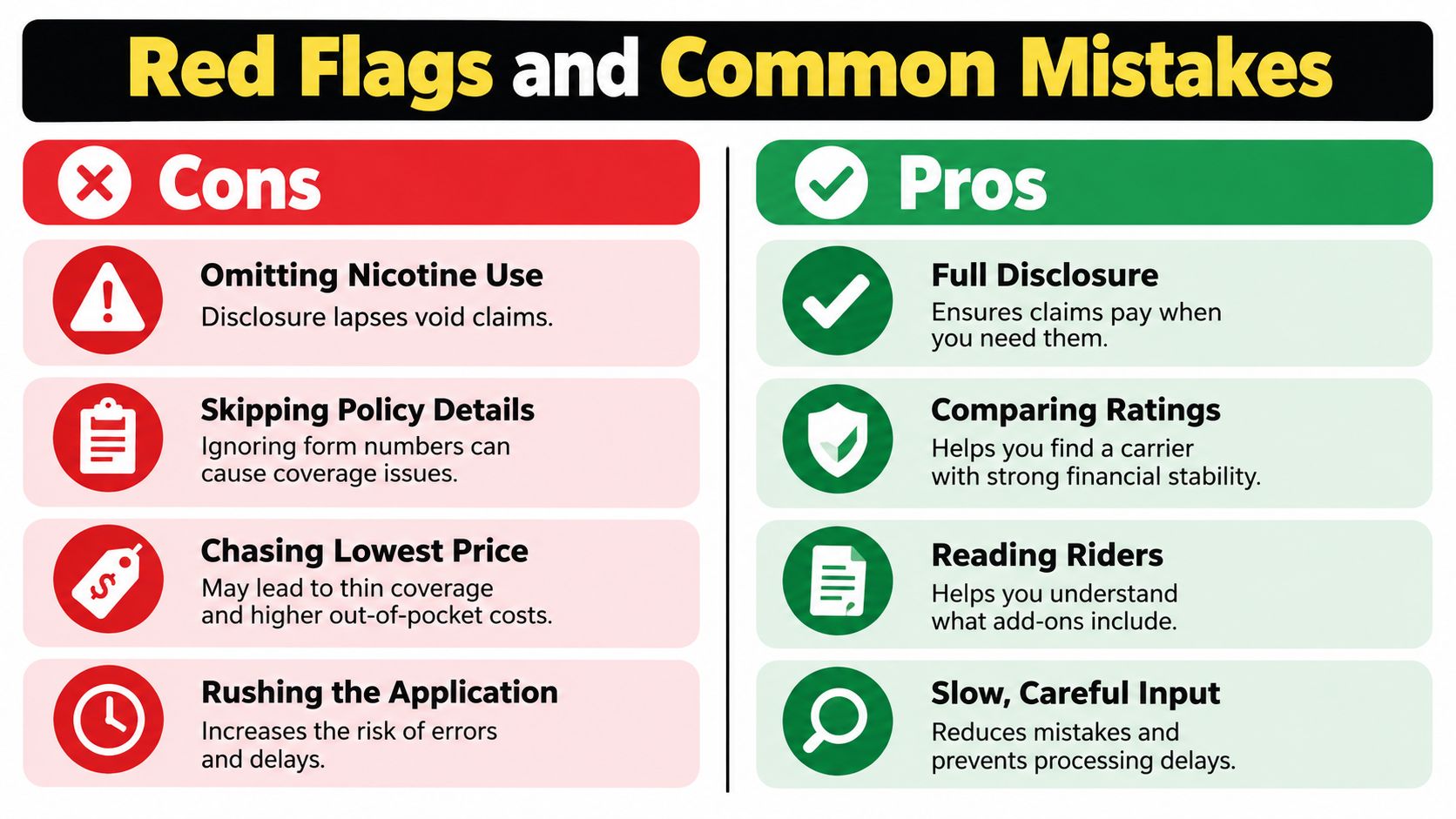
Fast quoting encourages careless answers. The mistakes below can produce a misleading premium or leave your household with less protection than it needs.
- Omitting nicotine use: Include vaping, chewing tobacco, nicotine replacement, and relevant past use when asked.
- Guessing height and weight: Use current, accurate figures. Build charts can move an applicant between risk classes.
- Choosing the wrong tobacco category: Read the carrier's definition instead of assuming “occasional” means “non-user.”
- Chasing the cheapest anchor: A low estimate can make you underinsure because the number feels reassuring.
- Skipping beneficiary review: Check primary and contingent beneficiaries after marriage, childbirth, divorce, or other major changes.
- Ignoring conversion rights: A cheaper policy may offer less flexibility later.
- Treating the quote as final: External-data reconciliation can change the offer.
Claims such as “approved in 60 seconds for everyone” or “no health questions ever” should make you stop. Those messages don't describe ordinary individual life insurance underwriting in the United States as advertised.
Cost confusion also causes people to delay. LIMRA reported that nearly half of consumers believed life insurance was too expensive, while 72% overestimated its actual cost. In related 2025 research, 66% of prospects said they hadn't purchased because they thought it was unaffordable, according to LIMRA's coverage-gap research.
Next Steps With Coveredly
Start with the preparation sheet. Gather medication details, health history, tobacco information, exact measurements, occupation details, beneficiaries, existing coverage, and your target term and benefit.
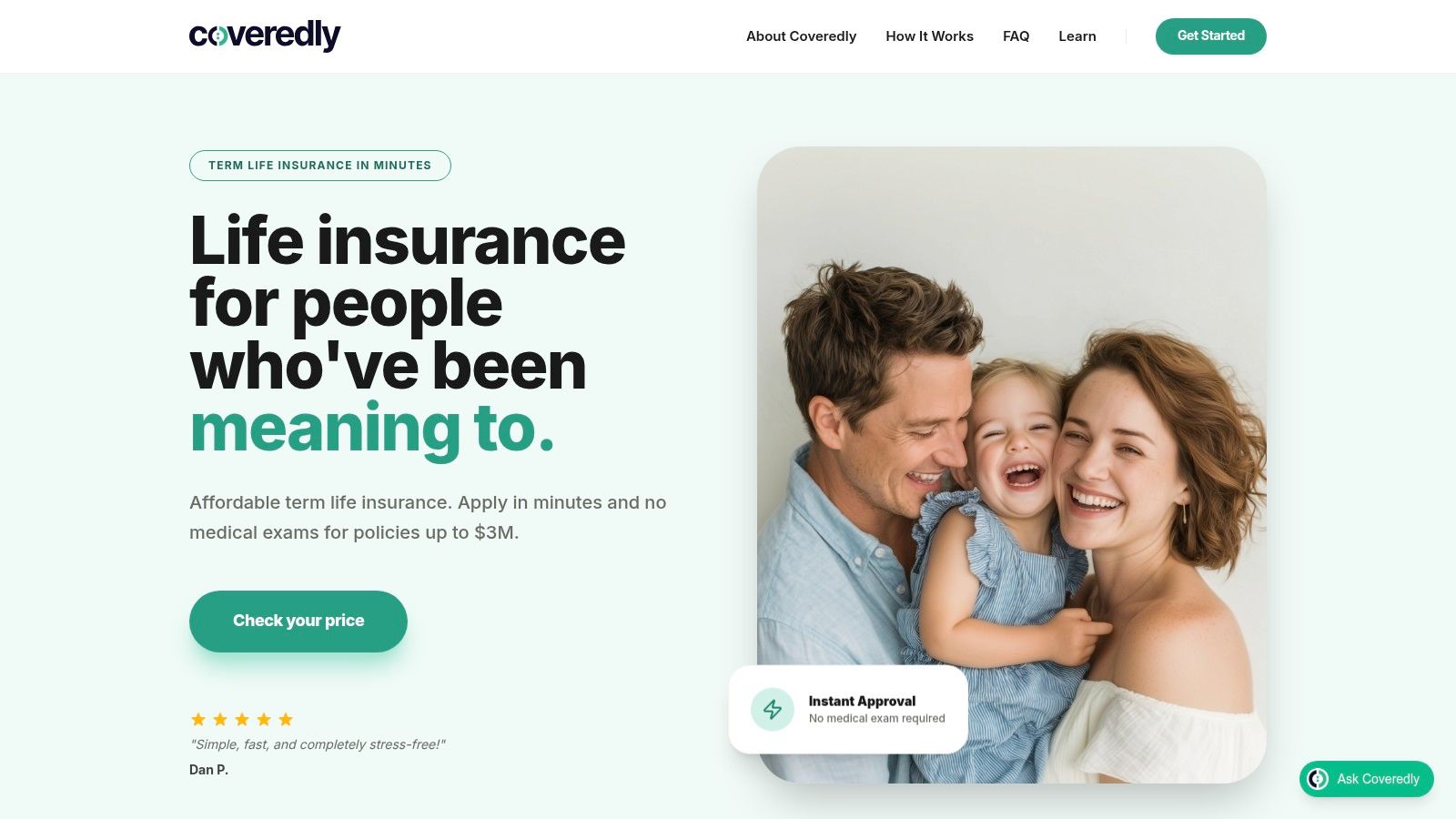
Then run an online quote, review the illustrative premium, and check whether the coverage amount and term match your household plan. Coveredly offers online term life insurance quotes, coverage up to $3 million for qualified applicants, and no-exam options for most applicants. It also provides decision support without requiring every applicant to begin with a phone call.
After submission, the carrier may verify the application, retrieve permitted external data, ask follow-up questions, request medical evidence, or issue a decision. Don't call a quote an approval until the insurer has completed that process.
Use the comparison checklist before accepting an offer. If the application includes a complicated diagnosis, a recent change in health, business ownership, unusual occupation, or uncertainty about beneficiaries, ask for licensed guidance before you finalize.
Here's a practical overview of the online process:
A well-prepared application won't guarantee a particular offer, but it gives the carrier accurate information to evaluate. That's how you get closer to the number you expected instead of discovering the actual price after avoidable surprises.
Coveredly provides a structured online life insurance quote experience, term coverage options, and no-exam pathways for most applicants. Prepare your information, run an accurate quote, and visit Coveredly to compare protection that fits your household.