92% of consumers researched life insurance online in 2025, according to LIMRA's life insurance fact sheet. Searching for coverage is now routine. Knowing whether the policy protects your family is the harder part.
A useful quote needs more than an attractive monthly premium. It needs enough coverage, a suitable term, understandable underwriting, and beneficiary records that match your intentions. Those are the checks to use whether you finish on your phone or get help from a licensed adviser.
Table of Contents
- Online vs Agent vs Employer Coverage at a Glance
- How Online Carriers Like Coveredly Differ
- Who Qualifies for Online Life Insurance
- How Much Coverage and Cost to Plan For
- Term or Whole Life for Online Buyers
- Check Beneficiaries, Carrier and Underwriting Before You Apply
- How to Apply for Life Insurance Online in One Sitting
Online vs Agent vs Employer Coverage at a Glance
Your first decision is whether to buy life insurance online, work with an agent, or rely on benefits through work. In January 2024, 51% of U.S. consumers reported owning life insurance, while 22% of owners believed they didn't have enough, according to LIMRA's 2024 fact sheet, which also reported that among owners, 55% held only individual coverage, 25% only employer-sponsored coverage, and 19% both.
Ownership and adequacy aren't the same thing. Before comparing applications, find your workplace benefit statement and identify the death benefit, eligibility conditions, and rules after employment ends.
Online, agent and employer life insurance compared
These are typical channel characteristics, not promises about a particular policy. An online application can still require medical information, and an agent can use digital tools.
| Factor | Buy online | Through an agent | Employer group coverage |
|---|---|---|---|
| Application | Digital form, usually completed in minutes | Meeting or call with an agent | Enrollment at hiring or during open enrollment |
| Medical exam | Often not required for smaller policies | Often required, sometimes a paramedical exam | Usually none, up to a set benefit cap |
| Decision time | Often immediate or within days | Typically days to several weeks | Set at enrollment |
| Human help | Chat, phone or email support | Personal advice through the whole process | HR or benefits team |
| Portable after a job change | Yes, the policy stays with you | Yes, the policy stays with you | Usually no, coverage ends or must be converted |
Online buying suits someone who knows roughly what protection they need and prefers a digital application. An agent can be especially useful when health history, substantial coverage needs, or policy design requires a more detailed conversation. Neither channel automatically produces a better contract.
Employer-sponsored life insurance is a useful supplement, but don't assume it follows you to another job. Review portability and conversion provisions before counting the benefit toward long-term family financial protection. Our group versus individual life insurance guide explains that distinction in more detail.
Practical rule: Check your workplace policy first, then choose the individual buying channel that fills the coverage gap.
How Online Carriers Like Coveredly Differ
A digital storefront doesn't tell you who issues the insurance. Some websites belong to insurers; others belong to agencies that connect applicants with carriers. We're a licensed insurance agency, and our partner carriers issue the policies, so the issuing insurer's name should be part of your comparison.
Use the same checklist for every provider, including Coveredly. Give each item a clear answer rather than awarding points for polished design or a short application.
- Application path. Can you complete the process on screen from quote through issuance, including signatures and document delivery? Our application process is fully digital, but save the final documents rather than relying on what the quote page displayed.
- Medical requirement. Identify whether a no-exam route is available for your requested amount and profile. Check what happens if the insurer needs additional information.
- Coverage ceiling. Find the maximum available through the online route. If it falls short of your needs, consider a coordinated application rather than reducing protection just to fit the website.
- Decision and support. Separate an initial result from final approval, and identify the available chat, phone, or email assistance. Our team guides applicants through the process and answers questions about their situation.
- Renewal and conversion. Record available term lengths, renewal limits, and conversion rights. Don't treat these as interchangeable features.
Compare the contract, not just the interface
A convenient application is valuable only if it leads to suitable protection. Record the answers in a simple spreadsheet, with a separate column for the issuing insurer and any unresolved questions.
An unanswered question isn't a favorable answer. Resolve underwriting, privacy, and policy questions before submitting sensitive information, and keep written explanations alongside your quote.
Who Qualifies for Online Life Insurance
A healthy adult seeking a manageable amount of term coverage may have a straightforward online route. In many cases, no medical exam is needed because insurers use digital underwriting and health data. That removes an appointment, not the insurer's assessment of the application.
Insurers consider age, health history, tobacco use, requested coverage, and policy term. Applications may also ask about hazardous hobbies, occupation, or travel. Answer the wording presented rather than assuming a question doesn't matter because you feel healthy.
Likely online path by applicant case
These examples describe possible routes, not eligibility guarantees. “Under 50” is an illustrative applicant category, not a universal insurer cutoff.
| Applicant case | Likely online path | What changes the outcome |
|---|---|---|
| Healthy adult under 50 | No-exam term policy, if eligible | Accurate health answers and data checks |
| Adult with a chronic condition | Extra questions or a medical exam | Condition type, stability and medication history |
| Smoker or recent tobacco user | Higher premium rate class | Tobacco use within the carrier lookback period |
| Coverage above one online policy limit | Split across carriers or agent-led application | Total coverage needed and carrier limits |
| Older applicant | Shorter available terms or additional underwriting | Issue-age rules, health and the requested term |
A chronic diagnosis isn't automatically a rejection. Insurers may need to understand whether the condition is controlled, whether treatment has changed, and whether follow-up care is current. Many carriers offer flexible underwriting options for people with pre-existing conditions.
Tobacco questions deserve particular care. Answer according to the carrier's definitions and lookback period, including any products the application names. Don't replace that question with your own definition of being a smoker.
When the simple route doesn't fit
If your required benefit exceeds an online application limit, don't submit overlapping applications without disclosing them. Carriers may assess the total insurance requested and already in force. An adviser can help coordinate the amounts and explain the purpose of each policy.
Older applicants may find fewer term lengths available. Compare the available end dates with the obligation you're protecting rather than selecting the longest option automatically.
An online decline is a decision about that application under that insurer's rules. It isn't proof that every insurer will decline you. Another carrier, a different underwriting route, or a revised coverage structure may be appropriate, without any guarantee of approval.
Before starting, gather:
- Medication details. Include names, dosages, and why you take them.
- Medical history. Have clinician details, recent visits, diagnoses, and pending tests available.
- Existing coverage. Record individual policies, workplace benefits, and pending applications.
- Lifestyle information. Prepare accurate answers about tobacco, work, travel, and hazardous activities.
How Much Coverage and Cost to Plan For
The cheapest quote can be the wrong quote if it leaves your household underinsured. The 2024 Insurance Barometer Study found that 42% of U.S. adults said they needed life insurance or more of it, and about 72% of Americans overestimated the cost of a basic term policy, as reported by LIMRA. Don't reject coverage based on a guess, or accept it based on price alone.
Start with the expenses your household would need to manage without you.

Build a needs estimate
A common planning rule of thumb is 10 to 15 times annual income. That's a starting guideline, not a research finding or a personalized recommendation. We help tailor the estimate to each situation.
A more useful calculation is:
Income support + debts + childcare and future commitments + final expenses − resources available for those needs.
Avoid double-counting. If you plan to pay off the mortgage immediately, don't also include the same mortgage payments throughout the income-support budget. Subtract only savings that survivors could reasonably use, rather than assuming every retirement account or emergency dollar is available.
For a more detailed worksheet, use our guide to calculating life insurance needs.
| Household | Main costs to cover | Coverage check |
|---|---|---|
| Newly married, no children | Shared mortgage share, joint debts | Could the surviving partner keep the home and pay debts? |
| Parents of young children | Childcare, education, mortgage | Does coverage last until the youngest child is independent? |
| Dual-income household | Each partner's income and debts | Is each partner covered separately? |
| Single, no dependents | Debts and final expenses | Does a smaller amount cover them with room to spare? |
Apply the calculation to your household
For newlyweds sharing a mortgage, begin with what the surviving spouse could afford alone. The goal may be paying off the balance, or providing enough support to keep payments manageable.
For parents of young children, add the cost of replacing unpaid care and household work. A parent without employment income can still leave a substantial financial gap. Include education goals separately so they don't disappear inside a broad income estimate.
For dual-income partners, calculate each person's needs separately. Equal salaries don't necessarily mean identical coverage needs if benefits, caregiving duties, or debts differ.
If support may extend into retirement, Prime Journal's guide to retiree expenses can help you identify budget categories to discuss. Use your household's expected spending, not someone else's average.
A low premium answers whether you can afford the payment. Adequate coverage answers whether your family can afford your absence.
Compare coverage amount and term length first, then the premium and differences between carriers. Treat the initial quote as an estimate until underwriting confirms the offer.
Term or Whole Life for Online Buyers
Term life is loosely like renting for a fixed lease; whole life is loosely like owning with a savings component. The comparison helps explain duration, but it isn't an investment recommendation. Insurance cash value doesn't work like home equity.
This illustration captures the basic distinction.

Term life insurance covers a defined period, such as 10 or 20 years, and pays named beneficiaries if the insured dies during that term, as the National Association of Insurance Commissioners explains. It provides pure protection without an investment component and is the most popular and affordable type.
Whole life insurance provides lifetime coverage under the policy's terms and includes cash value that grows over time. Its premiums are significantly higher than term life premiums. Choose it because you need its features and can sustain the payments, not because the renting analogy makes term sound wasteful.
Match the term to the responsibility
Consider a hypothetical 30-year-old with a 25-year mortgage and two young children. A 20-year term might cover the years when the children rely most heavily on that parent's income, but it wouldn't cover the entire mortgage period. The remaining gap needs a deliberate plan, such as longer coverage or sufficient resources by then.
A term policy hasn't failed if you outlive it. You've paid to transfer a financial risk during the period you selected.
For another explanation of how life insurance works, watch this overview.
Before buying, distinguish these options:
- Renewable term. Renewal may remain available after health changes, but premiums can rise and renewal rights may end at a specified age.
- Non-renewable term. Continuing protection after expiry requires applying for new coverage.
- Conversion rights. A qualifying policy may allow a move to permanent coverage within its stated conditions and deadline.
If the obligation has a foreseeable end, start by evaluating term coverage. Then compare renewal and conversion provisions before committing.
Check Beneficiaries, Carrier and Underwriting Before You Apply
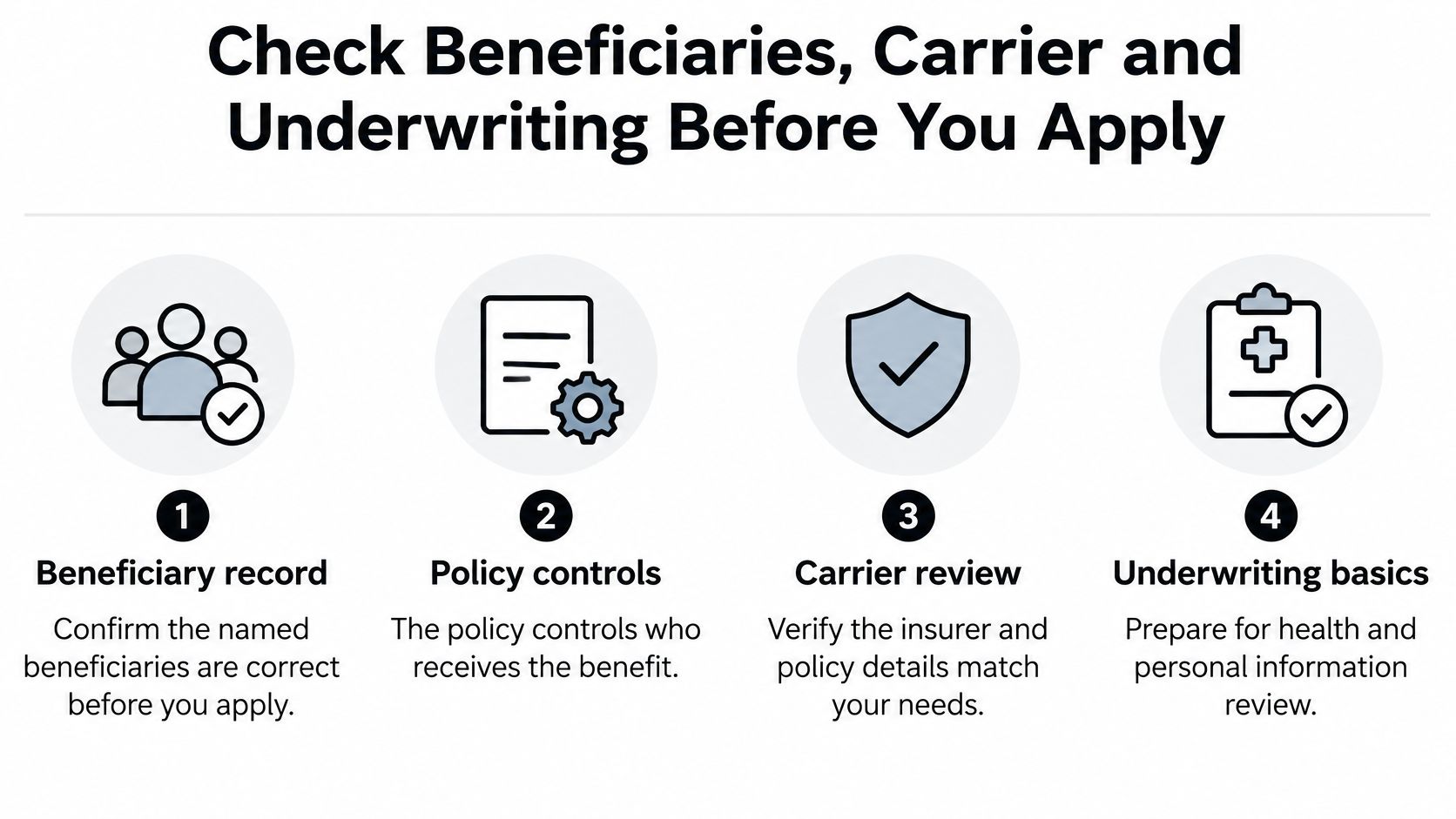
The beneficiary record deserves as much attention as the premium. Life insurance pays the named beneficiaries under the policy's terms, as the NAIC's life insurance consumer guidance explains. Check designations after marriage, divorce, or a child's birth rather than assuming your intentions will be obvious.
Name primary and contingent beneficiaries, confirm full legal names, and check the allocation percentages. If you want to provide for a minor or use a trust, get guidance on the appropriate designation rather than improvising the entry.
Use this checklist before sharing application information.
Understand what no-exam underwriting means
Digital underwriting may review application answers, prescription history, third-party records, and fraud checks. No exam doesn't mean no review. An inaccurate record can contribute to a decline, higher premium, or coverage limit.
Colorado and New York are implementing oversight involving artificial intelligence, algorithms, and third-party data providers, according to Deloitte's insurance regulatory outlook. Speed alone doesn't establish fairness or accuracy; you need understandable explanations and a way to challenge incorrect information.
If an outcome surprises you:
- Request the reason in writing.
- Check the records identified in the decision.
- Request corrections from the organization holding inaccurate information.
- Ask whether a human reviewer can reconsider the file.
Identify the agency and issuing carrier
We're licensed to conduct insurance business in applicable states. We offer term life insurance with no medical exams for policies up to $3 million; eligibility and the issuing policy's terms still matter.
Confirm both the agency's role and the insurer responsible for the contract. Before applying, get clear answers to these questions:
- Data sources. Which records will underwriting use?
- Human review. Does a person review declines?
- Next steps. What options follow an adverse decision?
- Corrections. How can an applicant dispute inaccurate records?
- Renewability. Can the policy continue after the initial term?
- State licensing. Is the issuing carrier licensed in your state?
Many applicants with straightforward profiles can complete the process fully online. Write down your intended coverage amount, term length, and beneficiaries before starting a quote, so convenience doesn't determine those choices for you.
How to Apply for Life Insurance Online in One Sitting
Prepare your records before opening the form, and allow yourself time to read unfamiliar questions. You may complete your part in one sitting even if the insurer needs additional information before making a final decision.
Applying is free and doesn't affect your credit score. A quote, submitted application, and active policy are different milestones, so keep track of which confirmation you've received.
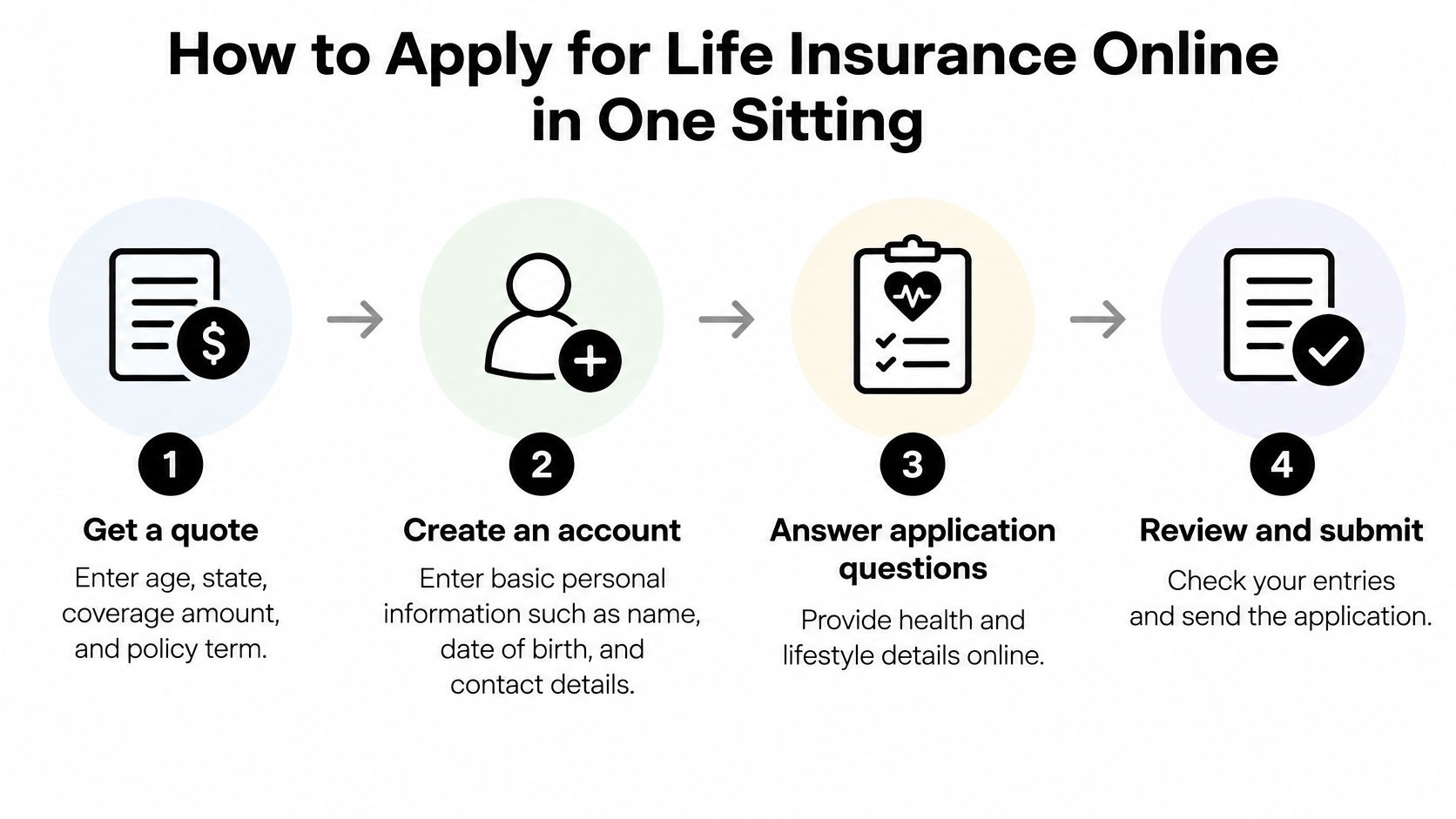
The basic application flow looks like this.
Complete and review the application
Get a quote. Enter your age, state, chosen coverage amount, and policy term so the estimate reflects your intended protection. A common mistake is accepting a default amount without checking it against your household calculation.
Create your account. Enter your legal name, date of birth, and contact details accurately, using an email account you monitor. A typo can prevent you from receiving requests or accessing documents when you need them.
Answer the health and lifestyle questions. A typical application asks for personal information, health history, medications, and lifestyle details, so use your records rather than guessing. Underreporting medications can create inconsistencies and delay approval; if the wording is unclear, get clarification before submitting.
Review the decision. Many applicants receive an immediate result, while others receive a request for more information. Read whether the message is an approval, conditional offer, or pending review, and compare the offered premium and benefit with your original quote.
Confirm the beneficiaries before accepting. Apply the beneficiary checks described earlier to the names and allocations on the actual application. Incorrect entries can complicate a claim, even if you told your family something different.
Pay the first premium. Coverage typically begins once the policy is approved and the first payment is processed. Entering payment details isn't enough if the transaction fails, and an unpaid first premium may mean coverage hasn't started.
Save the documents and payment schedule. Download the policy, set premium reminders, and read the grace-period provision for missed payments. Most policies include a grace period, but don't assume an unsuccessful automatic payment will resolve itself.
Confirm that protection is active
Use our online life insurance application guide if you want to review the process before entering personal details. Pause rather than submit an answer you know is incomplete, particularly when a question concerns pending medical tests or existing coverage.
After acceptance, check the issued contract against the offer you intended to accept. Confirm the insured person, benefit amount, term, premium schedule, and any exclusions or riders. Ask for an explanation if a document doesn't match what you understood.
Completion check: Keep the acceptance confirmation, policy number, and clear coverage start date together.
Tell a trusted person where the policy is stored and how to identify the issuing insurer. You don't need to share account passwords, but your beneficiaries should be able to locate the contract and begin a claim.
We offer a fully digital route to term life insurance, with support to help you choose coverage for your situation. Visit Coveredly with your household needs estimate, preferred term, and beneficiary details ready, then compare the offer against those needs before accepting.