You're likely staring at a growing list of adult responsibilities, a mortgage or rent payment, maybe a new baby on the way, maybe a business partner who depends on you. In moments like that, a life insurance policy stops feeling abstract, because it's really a financial safety net for the people who rely on your income, your planning, and your promises.
For many people, the hardest part is not understanding the words. It's deciding whether coverage belongs in the plan right now, alongside retirement saving, debt payoff, and everything else competing for attention. That decision gets easier when you understand what the policy does, how it's built, and why the details matter.
Table of Contents
- What Is a Life Insurance Policy Really
- How a Life Insurance Policy Works
- Comparing Major Life Insurance Policy Types
- Customizing Your Coverage with Riders
- Choosing the Right Policy for Your Life Stage
- The Modern Application and Claims Process
- Common Mistakes and Frequently Asked Questions
What Is a Life Insurance Policy Really
A couple sitting at the kitchen table often starts with the same question, what are we buying here? The simple answer is that a life insurance policy is a contract that pays money to people you choose after you die. The deeper answer is that it's a way to keep a mortgage paid, a household stable, or a business protected when your income is gone.
The policy is designed around a clear promise. The insurer agrees to pay a death benefit to your beneficiaries, and you agree to pay premiums and follow the contract terms. The Ashby and Graff guide for CA agents is a useful reminder that other financial contracts also rely on careful document review, because the details in the paperwork drive what happens later.
A policy is less like a savings account and more like a financial safety net. That analogy matters because the point is protection first, not just money storage. If you want a practical way to learn how the pieces fit together, this guide on reading a life insurance policy helps make the document itself less intimidating.
Why the promise matters
Life insurance sits inside modern financial planning because families and businesses need continuity. The policy doesn't remove grief, but it can reduce the financial shock that follows it.
That's why people think about coverage at milestones, marriage, a first child, a home purchase, or a partnership agreement. At each of those moments, the question isn't only “What if I'm gone?” It's also “Who absorbs the cost if I'm not there to pay it?”
Practical rule: if someone would struggle to replace your income, your policy deserves a place in the plan.
How a Life Insurance Policy Works
Think of the contract like a rental agreement for financial protection. You pay for access to the coverage, the insurer keeps the promise active, and the contract spells out exactly who gets paid, when, and under what terms.
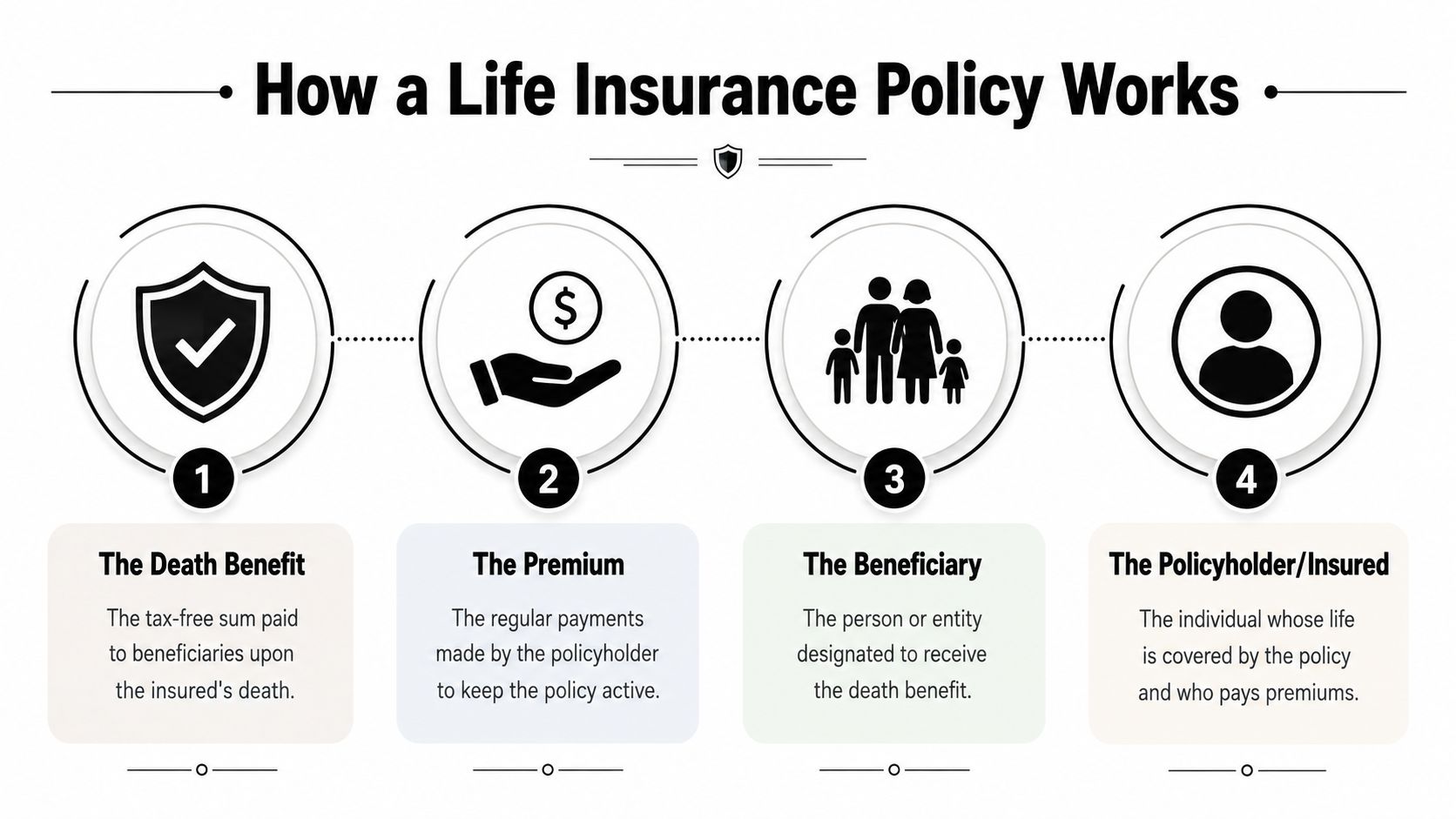
The core structure stays the same across most policies. A policy includes a death benefit, beneficiaries, premiums, and a policy length that can be term or permanent, and permanent policies such as whole life can build cash value that may be borrowed against or cashed out, while term policies have no cash value, according to the South Carolina Department of Insurance's consumer guide on understanding life insurance. That basic architecture is what makes the policy useful, because it turns an emotional concern into a defined legal promise.
The four pillars you need to know
The death benefit is the amount paid when the insured dies. It's the primary focus, because that's the money intended to replace income or cover obligations.
The beneficiary is the person, people, or organization that receives the payment. The NAIC notes that beneficiaries can be one person, multiple people, or even an organization, which is useful if you're covering a spouse, children, or a business entity.
Premiums are the payments you make to keep the policy in force. Miss them long enough and the contract can lapse, which is why affordability and consistency matter as much as the headline benefit.
The policyholder/insured is the person whose life is covered, and the policy term tells you how long the coverage lasts. The South Carolina Department of Insurance explains that term coverage lasts for a specific period, while permanent coverage can last for life if premiums keep getting paid.
Why the contract language matters
The policy isn't only about the promise at death. It also includes the rules for how that promise is administered, which is why the specification page matters so much in practice. In India's policy framework, the schedule can show the sum assured, exclusions, the free-look period, revival provisions, loan options, and claim procedure, while U.S. model disclosure rules use a policy data schedule that includes guaranteed and nonguaranteed values.
That's not paperwork for paperwork's sake. It's the control layer for servicing, claims, and illustrations, and the fields need to line up. If they don't, confusion shows up later when someone tries to update the policy or file a claim.
Comparing Major Life Insurance Policy Types
The biggest choice most buyers face is whether they want coverage that's temporary and lower-cost, or permanent and more expensive, or something that sits between the two. Each type solves a different problem, so the right answer depends on your goals, not on a generic best option.
Term life is the straightforward choice for people who want coverage for a set period. The ACLI reported that of new individual life policies purchased in 2021, 40%, or 4.1 million policies, were term insurance, and those term policies represented 71% of the individual life face amount, totaling $1.4 trillion. That tells you term coverage is often the workhorse of the market, especially when the need is big but the budget is finite.
Whole life and universal life aim at different uses. Whole life usually offers lifelong coverage and a cash value element, while universal life adds more flexibility in premiums and death benefit design. They can make sense for buyers who want permanence, estate planning features, or a policy that behaves more like a long-term financial instrument than a temporary income shield.
Side-by-side comparison
| Feature | Term Life | Whole Life | Universal Life |
|---|---|---|---|
| Duration | Set period | Lifetime, if premiums are paid | Lifetime, if funded properly |
| Cash value | No cash value | Can build cash value | Can build cash value |
| Cost pattern | Usually lower-cost for a given benefit | Usually higher-cost | Varies with structure and funding |
| Best use | Income replacement for a defined window | Long-term permanence | Flexible permanent planning |
| Main trade-off | Coverage ends after the term | Higher premium commitment | More moving parts to monitor |
Who each type fits best
Term life fits buyers who want a large amount of protection for a specific season, like child-raising years, a mortgage period, or a business loan timeline. It's the cleanest answer when the need is practical and time-bound.
Whole life tends to appeal to people who want the policy to stay in place for life and are comfortable paying more for that permanence. The cash value feature adds another layer, but it also adds complexity, so it works best when the buyer desires a permanent contract.
Universal life can suit someone who wants flexibility and is willing to manage it carefully. That flexibility can be useful, but it also means the policy deserves active attention over time.
A useful buyer question is simple, “Do I need protection for a period, or do I need protection that lasts for life?”
Customizing Your Coverage with Riders
Once the main policy type is chosen, riders work like optional features on a car. You don't need every add-on, but the right one can make a standard policy fit your life a lot better.
One common rider is the accelerated death benefit. It can allow part of the death benefit to be accessed earlier under qualifying serious health conditions, which can help a family manage medical or end-of-life costs while the insured is still alive. That matters for people who want the policy to do more than just wait in the background.
Another useful add-on is a waiver of premium rider. If the insured becomes disabled and can't work, the policy can continue without the usual premium payments, depending on the contract. That rider is especially worth asking about if the coverage is meant to protect a household that would already be under stress after an injury or illness.
The internal mechanics of riders are easier to understand when you think of them as customization, not upgrades for status. This explainer on riders in life insurance is a helpful way to see how add-ons change a policy without replacing it.
Riders that come up often
Child riders add coverage for children under the parent's policy. Families sometimes like them because they're simple and can help keep options open later.
Term conversion riders can let a term policy shift to permanent coverage without new medical underwriting, subject to the policy rules. That can matter if your health changes and you still want lifelong protection.
Accelerated death benefit riders and waiver of premium riders serve very different needs, but both are about resilience. One helps when health changes, the other helps when income changes.
Good habit: only add riders that solve a problem you can actually name.
Choosing the Right Policy for Your Life Stage
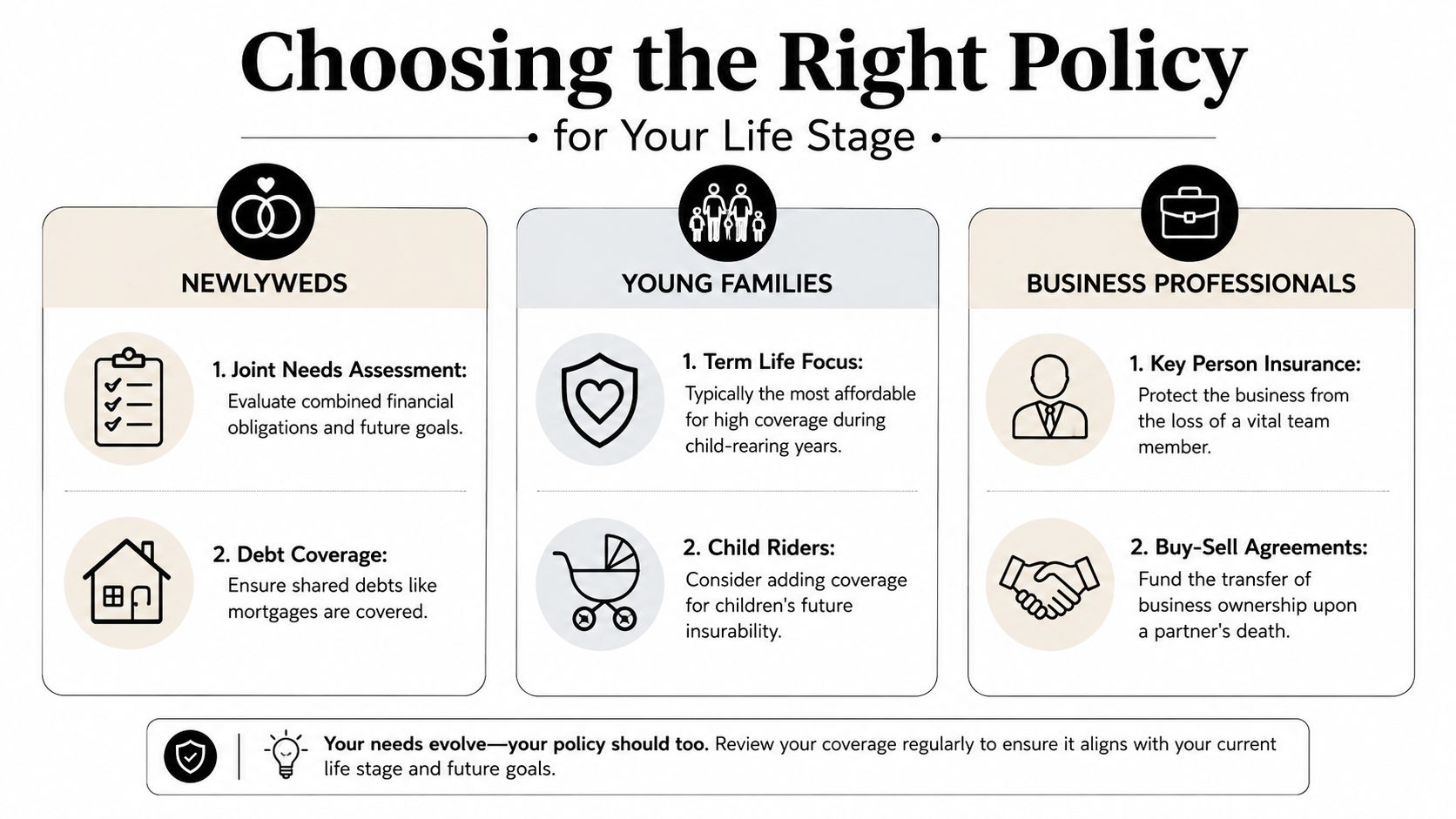
A newly married couple often thinks they need something eventually, not immediately. Then they look at rent, student loans, and shared plans for a home, and the conversation changes fast. For them, the best policy usually starts with a question about what each partner would lose financially if the other died tomorrow, not about abstract theory.
Young families need a different lens. If there are kids in the picture, the policy usually has to do more work, covering income replacement, childcare disruption, and the years when one parent's earnings keep the whole household stable. In that case, term coverage often makes the most sense because it can provide larger protection during the years when financial obligations are highest.
Business professionals face another set of needs. A co-founder may be irreplaceable, not because of ego but because the company's contracts, client relationships, or operating knowledge depend on that person. Life insurance can support a key person need or fund a buy-sell agreement, which gives the business a cleaner path forward if an owner dies.
The modern challenge is not just understanding the policy. Deloitte says many healthy, digitally savvy consumers skip life insurance because they question whether it's worth prioritizing over other financial goals, and that hesitation shows up most clearly when the benefit feels distant. A good first-year resource for any big family transition is Grow With Me's first year guide, because it captures how quickly priorities change once a new chapter begins.
Three real-world decision paths
A newlywed couple often starts by protecting shared debt and making sure neither partner is forced to unwind long-term plans after a death. That usually points toward a simple, affordable policy that can be adjusted later.
A family with young kids usually needs broader income replacement and more years of protection. The policy has to be big enough to keep the household running, not just cover funeral expenses.
A business co-founder may need a policy that supports continuity rather than family spending. In that case, the beneficiary could be the company or the remaining owner, depending on the agreement structure.
A practical way to compare your own situation
- If your obligations are temporary, term coverage often fits better.
- If you need lifetime certainty, permanent coverage may be the better match.
- If your income supports other people or a business, the beneficiary design matters as much as the policy amount.
- If your budget is tight, start with the coverage you can sustain, then revisit it as income and responsibilities change.
The right policy is the one you can keep in force long enough for it to matter.
The Modern Application and Claims Process
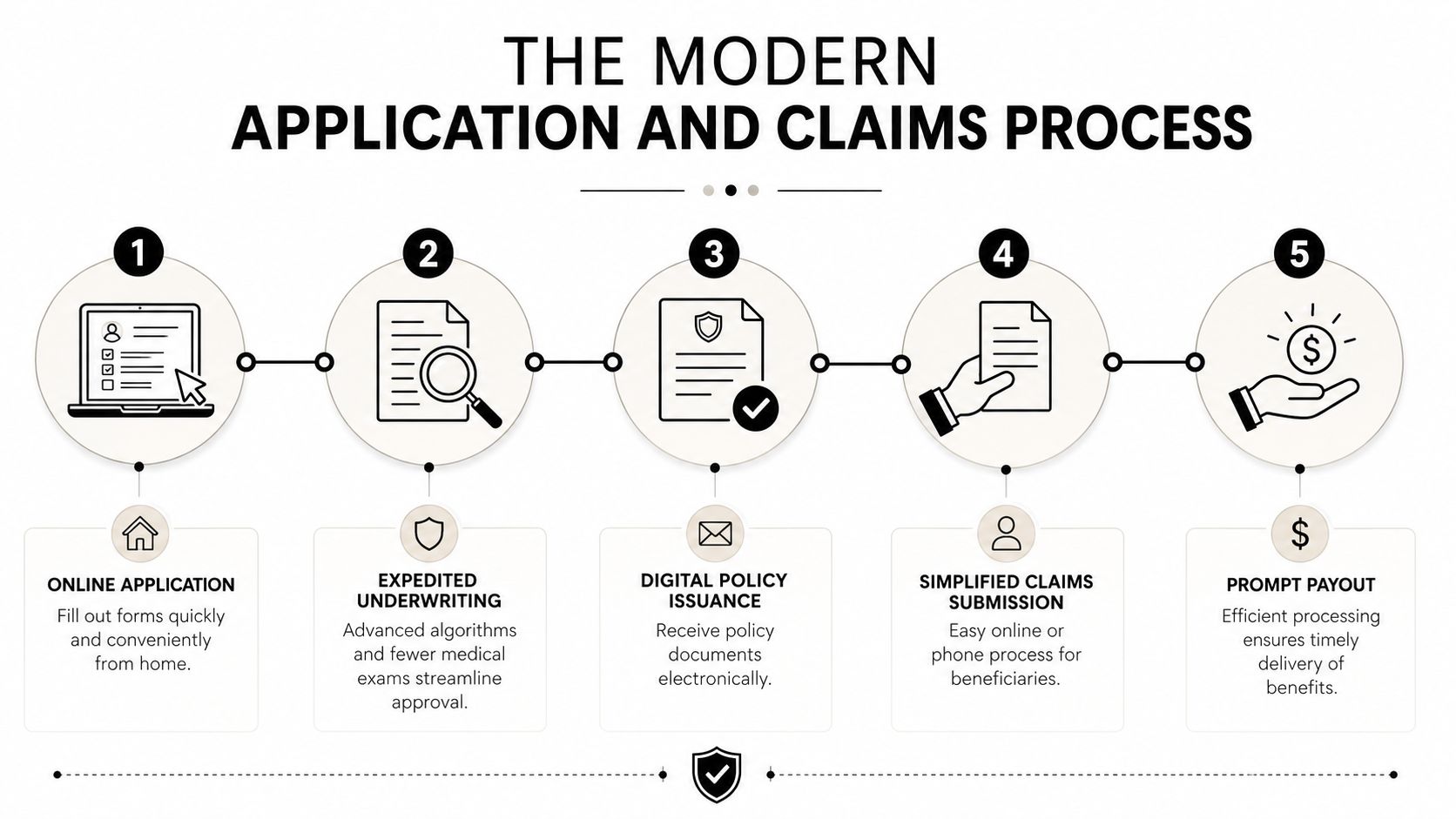
The old image of life insurance application, stacks of forms, long waits, and a nurse visit for everyone, doesn't match the digital tools many buyers use now. A modern application can start online, move through underwriting, and end with policy delivery in a much more efficient way than people expect.
The process usually begins with basic personal and financial information, then moves into underwriting. That's where the insurer checks risk, which can include health history, lifestyle details, and other data relevant to the policy type. For many buyers, especially people looking for a digital-first experience, no-exam or reduced-exam options can make the process feel far less intimidating.
What happens from quote to payout
A typical flow starts with an online quote, then a completed application, then underwriting review, then policy issuance, and finally claims handling when the time comes. The YouTube video below offers a visual overview of that journey.
In the United States, consumers purchased $3.5 trillion of new life insurance coverage in 2024, which shows how much application volume the system handles every year, according to the ACLI fact book. That scale is one reason insurers keep investing in digital processing and simpler workflows.
Claims are usually straightforward for beneficiaries when the paperwork is in order. The insurer needs notice of death, a claim form, and supporting documents, then it reviews the contract and pays according to the policy terms. This guide on how to file a life insurance claim is useful because the family member handling the paperwork is usually already dealing with enough stress.
What digital buyers should expect
A digital-first process doesn't mean the contract is less serious. It means the front end is easier to complete, the documents are easier to store, and the policy is easier to retrieve later.
That's a real benefit for busy households and business owners. When a policy is issued electronically and the beneficiary knows where to find it, the claim process is less likely to stall at the exact moment families need help most.
Common Mistakes and Frequently Asked Questions
The biggest mistake is waiting too long. The second is buying too little because the monthly premium feels easier to swallow than the full need feels to cover. A third mistake is naming beneficiaries once and never checking them again after marriage, divorce, a birth, or a business change.
Perceived cost also keeps people on the sidelines. A major barrier to buying life insurance is perceived cost, with 52% of people citing it as the main reason, yet 72% significantly overestimate the actual price of a basic policy, according to Feather's life insurance statistics page. That gap matters because hesitation often comes from misunderstanding, not from a true lack of fit.
Fast answers to common questions
Can I have multiple policies? Yes, people can own more than one policy if the total coverage fits their need and budget.
Does life insurance pay out for any cause of death? Usually, yes, if the policy is active and the death falls within the contract terms and exclusions. The policy language controls the payout, which is why reading the contract matters.
Can I buy coverage online without a medical exam? In many cases, yes. Digital application paths and no-exam options exist, especially for buyers who want a faster process and whose coverage needs fit the insurer's rules.
Should I choose term or permanent coverage? If you need affordable protection for a set period, term often fits. If you want lifelong coverage and are comfortable with higher cost and more complexity, permanent coverage may be worth reviewing.
When should I review my policy? After marriage, a child's birth, a home purchase, a business change, or any major income shift.
If the people you care about would feel a financial hit without you, the policy deserves a fresh look now, not later.
Coveredly helps people compare and apply for life insurance online, with term coverage built for modern buyers who want a simpler path to protection. If you're ready to see what coverage could look like for your family or business, visit Coveredly and start with the policy that fits your life today.