
You're sitting at the kitchen table after your child has gone to sleep, comparing life insurance quotes for family coverage on a laptop. One result looks affordable, another costs more than expected, and a third offers a large payout with very little explanation. The numbers are easy to find. The hard part is knowing what they're supposed to protect.
A family quote isn't a random monthly price. It's an estimate of what it may cost to transfer a specific financial risk from your household to an insurer. The right starting point is your family's obligations, including income replacement, mortgage debt, childcare, education goals, and household work, not the cheapest premium on the screen.
This guide will help you read quotes with confidence. You'll learn how family coverage differs from individual coverage, how to choose a face amount and term length, why insurers may offer different prices for the same benefit, and how to compare digital, accelerated, and traditional underwriting.

The need is larger than many families realize. In the United States, 56% of households had at least some life insurance coverage in 2022, down from 59.4% in 2019, while the median face value of in-force policies reached $150,000, according to the American Council of Life Insurers household ownership data. That median amount may be modest compared with the income and services a family would need to replace.
If you're also planning for final expenses, a practical resource such as this funeral insurance guide for parents can help you separate immediate end-of-life costs from the larger income-replacement need. Keeping those goals distinct makes your quote easier to evaluate.
Table of Contents
- Introduction to Life Insurance Quotes for Your Family
- What Family Life Insurance Quotes Really Mean
- Family Policy Options and How They Shape Your Quote
- Key Factors That Determine Your Family Quote
- How to Get Accurate Online Quotes and Compare Offers Wisely
- Smart Ways to Lower Your Premium and When Coveredly Fits
- Your Next Steps to Confident Family Protection
Introduction to Life Insurance Quotes for Your Family
Your toddler is asleep, the mortgage payment is due, and one question becomes difficult to ignore: if one parent died, how would the household keep running? A life insurance quote turns that question into a premium, but the premium comes after the more important calculation. First identify the money and services the family would need to replace.
A family quote therefore starts with dependents and responsibilities. A single adult may focus on final expenses or debts. Parents may need to account for mortgage payments, lost earnings, childcare, education goals, and the unpaid work of a stay-at-home parent. In a dual-income household, both adults may need coverage, even when their salaries differ.
Use life stage to estimate the face amount. For a newly married couple, shared debts and future plans may set the starting point. Parents of young children may need enough coverage to replace income while children are dependent and to pay for childcare. Families with older children may give greater weight to mortgage reduction and education costs. This approach treats the benefit like a household budget, with each obligation added before premiums are compared.
A useful quote should clarify three choices:
- Face amount: How much would the policy pay?
- Term length: How long would coverage remain in force?
- Underwriting path: How would the insurer assess health and risk?
The cheapest quote may leave a surviving spouse unable to keep the home, reduce work hours, or pay for care. Compare what each premium buys, not only the number on the screen.
You do not need every financial detail before requesting quotes. Prepare a reasonable estimate of obligations, provide consistent information to each insurer, and separate immediate end-of-life costs from income replacement. A funeral insurance guide for parents can help with that distinction. Then the quote becomes a planning tool rather than a price alone.
What Family Life Insurance Quotes Really Mean
A young family comparing quotes may see two monthly prices that look close, yet protect very different household budgets. A quote becomes useful when you read it from the coverage need outward: first estimate the money your family would need at each life stage, then compare what each premium buys. The insurer's price reflects the size of that promise, how long it lasts, and the risk associated with the applicant.
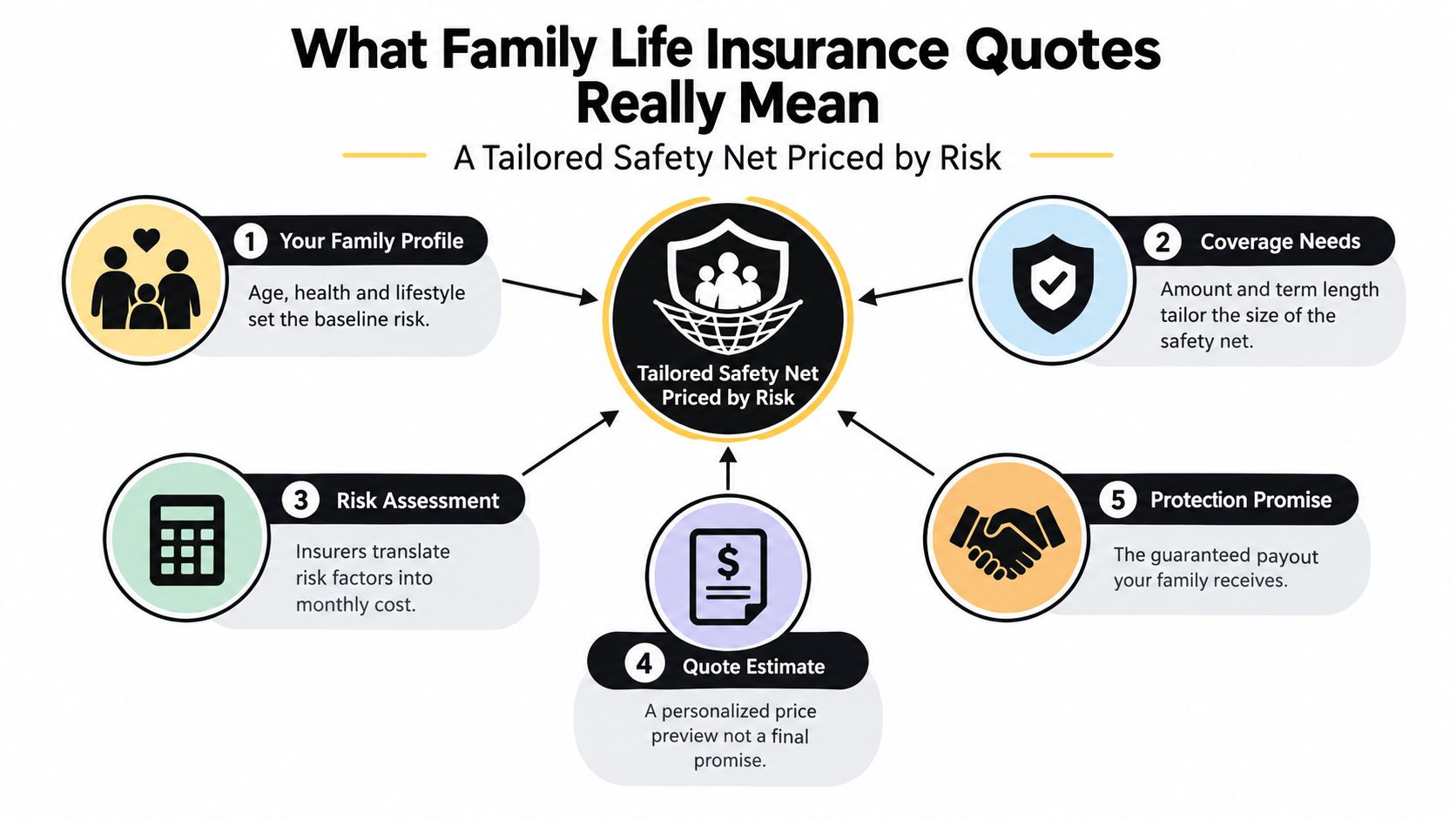
An online quote usually shows a proposed death benefit, policy term, payment estimate, and assumptions about your application. Medical records, prescription history, driving reports, and a full underwriting review may still change the offer. Read the result as a planning preview, not an unconditional promise.
The parts of a quote
Face amount is the death benefit paid to beneficiaries after a covered death. For a family, it should connect to the household math: income replacement, mortgage obligations, childcare, and the years children still depend on you. A larger benefit generally costs more because the insurer accepts greater financial exposure.
Term length states how long the policy is designed to remain in force. Parents may choose a period covering the years of childcare and dependent children, while another household may focus on the mortgage timeline or the point when savings could support the surviving partner.
Premium is the amount paid, commonly monthly or annually. It reflects the face amount, term, policy design, and the insurer's assessment of mortality risk.
Underwriting class is the insurer's risk category. Health, tobacco use, hazardous work, and risky hobbies can affect that category and the resulting price.
Term life is widely used for family protection. ACLI data shows that 45.6% of U.S. households owned a term policy in 2022, compared with 16.9% holding a cash-value policy, illustrating how commonly families use term coverage for protection needs (ACLI ownership data).
Core pricing idea: The medical exam itself is not usually the main price driver. The underwriting class assigned from available risk evidence matters more.
Accelerated underwriting may review prescription history, MIB records, motor vehicle reports, electronic health records, and other external data. For qualified applicants, it can replace a paramedical exam and produce a fully underwritten term decision in minutes or a few days. A Guardian explanation of life insurance underwriting describes this process and gives an example of differing prices for a healthy applicant under age 50 seeking a 20-year, $500,000 policy through no-exam and full underwriting.
Family Policy Options and How They Shape Your Quote
The right family policy starts with a simple calculation: what financial job must the death benefit perform? Add the income the surviving partner may need to replace, the mortgage and other debts, and childcare or household costs that would change after a death. Then choose a policy structure that can deliver that amount during the years your children depend on you. A life insurance needs guide can help organize those figures before you compare premiums.
| Policy Structure | Best For | Quote Impact | Beneficiary Flexibility |
|---|---|---|---|
| Individual term policies for each parent | Couples who want separate protection and independent control | Each person receives a quote based on their own age, health, amount, and term | Usually broad, because each policyholder controls beneficiaries |
| Joint first-to-die policy | Couples seeking one contract that pays after the first covered death | May produce a different combined price, but the policy ends or changes after the first death | Must be reviewed carefully because the surviving partner's future coverage can change |
| Child term rider | Parents seeking limited supplemental protection for children | Often adds a smaller cost to a parent's policy, with limited benefit design | Usually less flexible than a separate child policy |
| Separate child policy | Families with a specific long-term planning objective for a child | Creates an additional application and premium | Can provide more direct beneficiary and ownership choices |
| Employer group or family bundle | Workers who want convenient baseline coverage | May be inexpensive or convenient, but limits and portability can differ | Subject to the group contract and employment arrangement |
For young families, separate term policies for both parents often make the income-replacement math easier to see. Each parent can receive a face amount based on that person's financial contribution and the years of protection needed. A parent who earns less, stays home, or handles much of the childcare still provides economic value. After a death, the survivor might need paid childcare, reduced work hours, or help with household responsibilities.
A joint first-to-die policy can fit couples who want one contract and a benefit payable after the first covered death. Its lower or higher price cannot be judged without examining the tradeoff: coverage may end or change after that payment, leaving the survivor with a different insurance need. Compare the policy's future protection with the amount each partner would need to replace income, housing support, and care work.
A child rider is usually supplemental protection attached to a parent's policy. It may be convenient, but it generally does not replace the larger coverage needed for parental income and childcare. A separate child policy creates another application and premium, while simplified-issue and guaranteed-issue designs may provide lower face amounts and cost more per dollar of benefit. Guardian's no-medical-exam coverage guidance from Guardian explains why limited underwriting can lead insurers to restrict benefits or price for greater uncertainty.
Employer group coverage or a family bundle can provide a convenient starting point. Check its limits and portability before treating it as the household's entire plan. Coverage tied to employment may not follow you if the job changes, and a baseline amount may not cover the mortgage, future childcare, and income gap.
Beneficiaries also shape how the benefit works. A policy can name primary and contingent beneficiaries, and several people can share the proceeds. For example, assigning 50% to a spouse and 25% to each of two children would divide a $500,000 benefit into $250,000 for the spouse and $125,000 for each child, as shown in this beneficiary allocation example for parents.
Ownership and beneficiary choices may need professional advice when a household has substantial assets or a complicated estate. Research into estate tax savings on life insurance can be a reason to consult an estate-planning attorney, rather than treating an online quote as a complete estate plan.
Key Factors That Determine Your Family Quote
A family quote becomes easier to judge once you separate coverage need from insurer pricing. First estimate the money your household would need at each life stage. Then compare how age, health, policy size, and policy length change the premium.

Health and age class
Age and health class often have the strongest effect on a quote. A younger applicant in good health generally receives more favorable pricing than an older applicant with significant health risks. Insurers may review diagnoses, medications, height and weight, blood pressure, tobacco use, and medical history.
Some health details can improve over time. Age and established diagnoses cannot be changed, so accurate disclosure matters. A quote that looks inexpensive only because relevant information was omitted is not a dependable basis for protecting your family.
Amount and term
A larger death benefit creates a larger financial promise, which usually raises the premium. A longer term also keeps the insurer exposed for more years. For the same healthy parent, a 10-year term and a 30-year term can produce different quotes because they cover different periods of family responsibility.
Set the face amount by adding the needs your family would face, such as income replacement, the mortgage, and childcare. Then consider savings and existing coverage that could reduce the gap. The term should last until those needs are likely to shrink, perhaps when the mortgage is paid, children become independent, or savings are sufficient.
Tobacco use
Smoking and other tobacco use can place an applicant in a more expensive risk class. Answer questions about nicotine products precisely and follow the insurer's requested timeframe. A vague or incomplete answer can create underwriting problems later.
Work and recreation
An office-based occupation presents a different risk profile from work involving heights, heavy machinery, or hazardous conditions. Insurers may also ask about aviation, scuba diving, climbing, racing, and other high-risk activities. The effect depends on the activity and the carrier's rules.
Family history and driving
Serious medical conditions among close relatives can affect an underwriting review, particularly when they suggest an inherited risk. Driving violations and major accidents may also influence the final class.
Underwriting uses the information available about an applicant to assess risk. The Guardian underwriting resource explains this process, and the video below provides a visual overview.
Before comparing premiums, mark each factor as fixed, changeable, or under your control. Health habits may change, while the face amount and term are choices you set. This keeps price shopping tied to the coverage your family needs.
How to Get Accurate Online Quotes and Compare Offers Wisely
Online quoting works best when you treat every form as a controlled comparison. If one insurer receives a smaller face amount, a shorter term, or different health information, the prices aren't comparable.

Prepare before opening quote forms
Gather the information you're likely to need. That includes each applicant's age, occupation, tobacco status, major medical details, income, debts, mortgage balance, current coverage, and the people you want to protect. You don't need perfect paperwork for an initial estimate, but you should avoid guessing when the question affects underwriting.
Then set a target face amount and term before visiting multiple sites. If your first result changes your target, record the reason instead of changing the inputs.
Compare identical policy designs
Enter the same information across quote tools. Compare the same death benefit, term length, payment schedule, and policy type. A low quote may reflect a smaller benefit, a shorter term, a temporary introductory price, or an estimate that hasn't included medical evidence.
Look beyond the premium:
- Conversion rights: Check whether you can convert term coverage to permanent insurance and what restrictions apply.
- Renewal terms: Find out whether renewal is available, how the price can change, and when that option ends.
- Exclusions and riders: Review exclusions, accelerated-benefit provisions, child riders, and other additions.
- Insurer strength: Consider the carrier's financial stability and claims-paying reputation.
Understand the underwriting path
Ask whether the figure is an instant estimate, an accelerated-underwriting offer, or a fully underwritten decision. For qualified applicants, accelerated underwriting may use prescription records, MIB information, driving data, and health records instead of an exam. It can reduce friction, but the insurer may still verify the information.
Families who want a broader digital comparison can review instant online life insurance quotes while keeping the face amount and term consistent with their planning worksheet.
Beneficiaries should also be deliberate. A policy can assign primary and contingent beneficiaries, and multiple primary beneficiaries can divide proceeds by percentage. If two children each receive 50% as primary beneficiaries, the benefit is split evenly between them, according to this family beneficiary rules guide.
Don't apply solely because a quote looks unusually low. Confirm that the quote reflects the health information you supplied, the coverage your family needs, and the policy terms you're prepared to keep.
Smart Ways to Lower Your Premium and When Coveredly Fits
A young family may receive a lower quote by shortening the term or reducing the face amount, then discover that the policy ends before the mortgage or childcare burden does. Premium savings should follow the family's timeline, not remove protection that income replacement requires.
Start by matching each term to a responsibility. If childcare costs may end before income support is no longer needed, those needs do not have to share one coverage period. A longer term can address income replacement, while shorter-lived debts may require less coverage later. The policy design should reflect when each financial risk is highest.
Set the face amount with a simple calculation. Add the income survivors would need to replace, the mortgage and other debts, childcare and household services, then subtract dependable resources such as savings, existing individual coverage, and employer benefits. Count workplace coverage only after checking its limits and whether it can continue if the employee changes jobs. Future savings should not replace insurance until they exist.
Health information can affect the price class. Review your records, answer questions accurately, and weigh whether waiting could improve the rate or leave your family uninsured. Applying earlier may help because age is part of underwriting, but a policy is useful only when the household can keep paying for it.
When accelerated digital term may fit
Accelerated underwriting may suit a healthy applicant who wants meaningful term coverage without a routine paramedical exam. It can also fit a busy professional with a straightforward medical history who prefers an online application.
Coverage limits still shape the decision. No-exam term products may reach about $1,000,000 with some insurers and, for qualified applicants in certain market segments, up to $3,000,000. Simplified-issue and guaranteed-issue policies generally offer lower amounts. Typical no-medical-exam limits often fall around $250,000 to $500,000, while guaranteed-issue coverage frequently remains around $25,000 to $50,000 and costs more per dollar of benefit.
That makes accelerated underwriting more suitable for primary family protection than guaranteed issue in many cases. Someone with a complex health history, a need for permanent coverage, or an unusually large estate plan may need traditional underwriting and professional advice.
Families comparing affordable choices can review cheap life insurance policies by total protection, underwriting method, term, exclusions, and renewal features, rather than the smallest displayed monthly figure. Coveredly offers a digital term route with no-exam options for many applicants and coverage of up to $3 million for qualified applicants. It may suit families that value online convenience and a faster application path, provided the coverage amount matches their income, mortgage, and childcare needs.
Your Next Steps to Confident Family Protection
A strong family quote begins with a coverage target. List the income each parent provides, the mortgage and other debts, childcare and household services, education goals, existing assets, and the years when dependents are likely to need support.
Then choose a structure. Many couples start by reviewing separate term policies for both parents, because each policy can protect a different income and give its owner direct beneficiary control. Add riders or supplemental coverage only after the main protection problem is addressed.
Use this short checklist before applying:
- Write the need: Estimate the money and services your family would need to replace.
- Choose the duration: Match the term to major responsibilities rather than selecting a term by habit.
- Set consistent inputs: Use the same face amount, term, health details, and tobacco information across quote tools.
- Read the underwriting label: Know whether the result is an estimate, accelerated decision, or full underwriting offer.
- Review the contract: Check beneficiaries, conversion, renewal, exclusions, riders, and payment terms.
- Protect the policy: Choose a premium your household can maintain through changing circumstances.
The coverage gap remains significant. Deloitte cites estimates that about 102 million Americans, or 40% of the adult population, are uninsured or underinsured, representing an estimated $12 trillion U.S. coverage gap (FinHealth Network's life insurance report). The practical lesson isn't that every family needs the largest policy available. It's that a thoughtful quote should reflect the consequences your household would face.
Start with your family's math, compare equivalent policies, and choose protection you can keep in force. Then explore Coveredly's flexible digital term options if an online application and no-exam path for qualified applicants match your needs.
Coveredly provides online term life insurance quote options, including no-exam coverage for many applicants and amounts up to $3 million for qualified applicants. Visit Coveredly to compare a coverage target built around your family's income, debts, and future responsibilities.