You're shopping for life insurance, comparing quotes, and then the word rating shows up everywhere. One insurer talks about being highly rated. Another says you may qualify for a preferred rating. A no-exam policy promises speed but gives little detail about how your rate was decided.
That confusion is normal. In life insurance, “rating” can mean two very different things, and both affect your outcome. One rating applies to the insurance company. The other applies to you.
If you understand how those two systems work together, you can make a much smarter decision. You won't just chase the lowest premium. You'll look for a company that seems financially dependable and an underwriting path that fits your health, lifestyle, and financial profile.
Table of Contents
- Why Your Life Insurance Rating Matters
- The Two Worlds of Life Insurance Ratings
- Decoding Company Financial Strength Ratings
- How Insurers Determine Your Personal Underwriting Rating
- How Your Rating Drives Premiums and Eligibility
- Actionable Steps to Improve Your Life Insurance Rating
- Choosing a Carrier by Balancing Both Ratings
Why Your Life Insurance Rating Matters
You compare two life insurance quotes for the same coverage amount. One looks cheaper. The other comes from a company with stronger financial marks. Then a third wrinkle shows up. Your rate changes depending on how that insurer classifies your health and risk.
That is the point where "life insurance rating" starts to mean two different things at once.
One rating describes the insurer. The other describes you. A smart buyer reads both layers: one reveals the insurer's staying power, and the other shows how the insurer sees the application. If you only look at price, you can miss a weak carrier. If you only look at company strength, you can miss the fact that one insurer may rate your profile far more favorably than another.
The first scorecard is the insurer's financial strength rating. The second is your personal underwriting rating. They work together, even though many guides discuss them separately. A financially strong company can still offer you an expensive rate class. A company with solid ratings and more flexible underwriting may give your family a better long-term fit.
That connection has become more important as no-exam underwriting has spread. Instead of relying only on a paramed exam, insurers may also review prescription history, motor vehicle records, credit-based insurance data where allowed, medical databases, and other digital signals to estimate risk. In other words, the company's business quality and your personal risk profile meet in the same quote.
Why families and professionals should care
Life insurance is usually bought to protect a paycheck, a mortgage, or a child's future. That makes both kinds of ratings practical, not abstract. You want a company that appears able to pay claims years from now, and you want an underwriting decision that prices your risk fairly today.
Industry demand shows how many households are weighing those tradeoffs. LIMRA reported that 2024 life insurance premium reached a record $15.9 billion, up 3% from 2023, while policy sales remained level. The Zebra has also noted that roughly 60% of Americans have some sort of life insurance policy, while 33% believe they are underinsured.
Practical rule: A cheap policy from a weak carrier is not much comfort, and a highly rated carrier is not automatically the best choice if its underwriting class pushes your premium higher than necessary.
The best outcome usually sits at the intersection of both ratings. You are looking for dependable coverage from a carrier with strong financial footing and an underwriting approach that sees your application in the best reasonable light.
The Two Worlds of Life Insurance Ratings
A common shopping mistake starts with a reasonable question. "Which company has the best rating?" Another starts with a different one. "How do I get Preferred instead of Standard?" Both matter, but they answer different parts of the same decision.
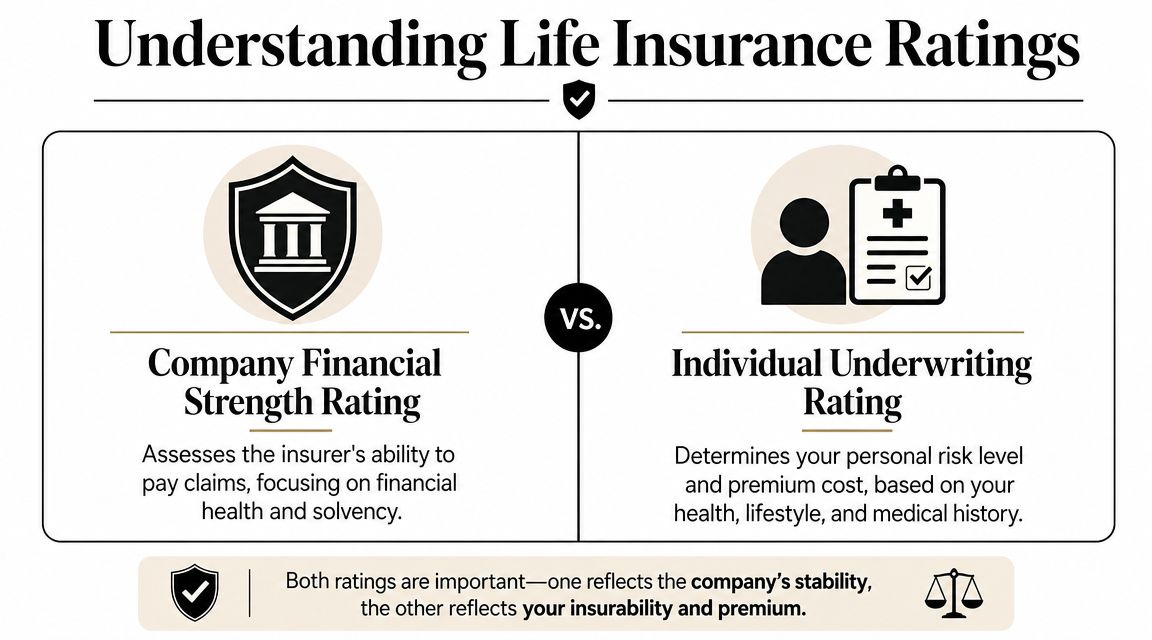
Life insurance has two rating systems operating at once. One rates the insurer. The other rates you.
Company ratings judge the insurer
A company financial strength rating is about the carrier's staying power. Independent agencies review whether an insurer appears able to keep its promises and pay claims over time. They examine factors such as capital strength, investment risk, operating performance, liquidity, and management quality. Western & Southern's explanation of life insurance company ratings notes that AM Best places grades like A++ and A+ in its Superior category.
For you, this functions as a durability check. If a policy is meant to protect your family for 20 or 30 years, the price matters, but so does confidence that the carrier will still be on solid footing when your family needs the benefit.
Personal ratings judge your risk
Your underwriting rating answers a separate question. How risky does the insurer believe you are to insure?
That decision usually turns into labels such as Preferred Plus, Preferred, Standard, or table ratings. The label varies by company, but the idea is consistent. Lower expected risk usually means lower premiums, while higher expected risk can mean a higher price, extra conditions, or even a decline.
This part has changed in recent years. Many no-exam policies use traditional application details plus prescription history, motor vehicle reports, medical records, credit-based insurance data where permitted, and other digital signals to estimate risk without scheduling a paramedical exam. So two companies with similar financial strength can still price the same applicant very differently because they weigh those signals differently. If you have reviewed Globe Life insurance ratings and carrier reputation, that is only half the picture unless you also consider how that carrier's underwriting approach fits your profile.
Why these two ratings connect
The key idea is simple. A life insurance policy is both a financial promise and a personal risk assessment.
That connection is easy to miss because shoppers often compare one side at a time. A parent may pick a financially strong insurer, then get an expensive quote because that carrier's no-exam model reacts harshly to a prescription history or driving issue. Another shopper may chase the cheapest quote and pay little attention to the carrier behind it.
A better approach is to ask two questions together:
- Would I trust this insurer to be financially dependable for the length of this policy?
- Does this insurer's underwriting process seem likely to view my health and history fairly?
That is the intersection savvy buyers care about. You are not only choosing a policy. You are choosing a company to make a long-term promise and a risk model to judge your application.
Decoding Company Financial Strength Ratings
A life insurance quote can look attractive on day one and still leave one big question unanswered. Will this company still be in a strong position to pay a claim years or decades from now?
Company financial strength ratings are meant to help with that question. They are report cards issued by rating agencies that study an insurer's finances, business mix, reserves, and ability to meet long-term obligations. The grades can look like alphabet soup at first, but the basic message is straightforward. Higher ratings signal stronger confidence in the insurer's claims-paying ability. Lower ratings call for closer inspection.
The tricky part is that each agency uses its own scale. AM Best uses A++ at the top. S&P and Fitch use AAA. Moody's uses Aaa. Those labels are similar in spirit, but they are not interchangeable letter for letter.
A quick comparison of the main scales
| Rating Agency | Highest Rating | Meaning |
|---|---|---|
| AM Best | A++ | Superior |
| S&P | AAA | Highest tier on its scale |
| Fitch | AAA | Highest tier on its scale |
| Moody's | Aaa | Highest tier on its scale |
A simple way to read this table is to treat each agency like a teacher with a different grading system. One may use percentages, another letter grades, and another a written assessment. You can still tell who earned high marks, but you should not assume every “A” means the same thing across systems.
That is why careful shoppers check more than one agency when they can.
What the grades actually tell you
A strong financial strength rating does not promise perfect service, the lowest premiums, or the easiest underwriting. It speaks to the insurer's financial capacity. Analysts are asking a narrower question. Does this company appear well-positioned to keep its policy promises under normal conditions and periods of stress?
For a family buying life insurance, that matters because the policy may need to do its job far in the future. Term coverage often protects income during child-raising or mortgage-paying years. Permanent coverage can stay in force much longer. In both cases, you are relying on a company, not just a contract.
This is also where the two rating worlds start to connect.
A financially strong insurer may still be a poor fit for your application if its underwriting model reacts harshly to your prescription history, driving record, or other no-exam data signals. A carrier with solid ratings and a friendlier view of your profile may give you a much better overall result. If you are comparing real carriers, these Globe Life insurance ratings and carrier review examples can show how financial strength discussions appear in the market, but they only become useful when paired with an underwriting fit check.
How to use company ratings wisely
Use financial strength ratings as a filter, not a final answer.
- Start with insurers that have strong ratings from one or more major agencies. This helps you avoid carriers that raise obvious financial concerns.
- Compare across agencies when available. A pattern of strong ratings is more reassuring than a single grade viewed in isolation.
- Keep the rating in its lane. It helps answer whether the company looks dependable. It does not tell you how that company will price your application.
- Pair company strength with underwriting fit. The best choice is often the insurer that combines reliable finances with an evaluation model that treats your health and history fairly.
That combination is what a savvy buyer is really looking for. You want a company strong enough to keep its promise, and a process that gives you a fair chance at a good rate.
How Insurers Determine Your Personal Underwriting Rating
You apply for coverage online at lunch, answer a few health questions, and get a quick offer. Your neighbor applies for the same amount with a different insurer and gets a better rate, even though your health looks similar on paper.
That gap usually comes from underwriting fit.
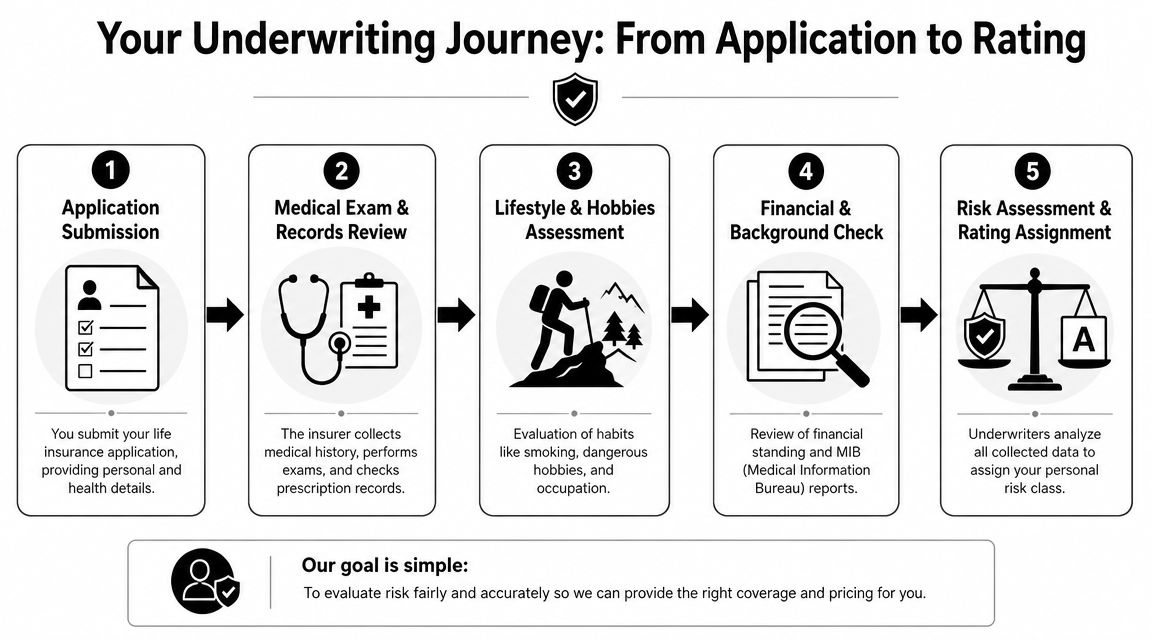
Your personal life insurance rating is the insurer's way of sorting your application into a pricing tier based on expected risk. The important part for a smart shopper is that this process does not happen in a vacuum. The carrier's own underwriting model decides which signals matter most, how much weight each signal gets, and how forgiving or strict the final result will be. That is where the two worlds of ratings start to connect. A financially strong company can still be a poor match if its underwriting approach reacts sharply to details in your record.
What underwriters usually look at
Underwriting works like a screening process with several lenses, not one single test.
One insurer may focus heavily on traditional medical evidence. Another may rely more on prescription history, driving records, past applications, or financial details, especially in no-exam products. For consumers, that means your result is shaped by both your profile and the carrier's method of reviewing it.
Common inputs include:
- Age: Older applicants usually face higher expected claim risk over the life of the policy.
- Medical evidence: This can include blood pressure, lab work, prescription history, physician statements, and prior diagnoses.
- Family history: Some hereditary conditions affect how an insurer views future risk.
- Lifestyle and occupation: Tobacco use, hazardous hobbies, and certain jobs can change the rating class.
- Application consistency: If your answers do not line up with outside records, the insurer may pause, ask more questions, or rate more cautiously.
- Financial context: For larger policies, insurers may review income, assets, debts, and existing coverage to decide whether the requested amount makes sense.
If you want more examples of how carriers review these details, Coveredly's collection of underwriting life insurance topics gives a practical consumer view of the process.
Common rating classes in plain English
Insurers use different labels, but the structure is usually similar.
Preferred Plus or Preferred Best sits near the top. This class usually goes to applicants with very strong health and few risk signals.
Preferred still reflects lower-than-average risk, but with a little more room for minor issues.
Standard means the applicant falls into the insurer's baseline pricing range.
Table-rated or substandard means the insurer sees added risk and charges more, often in step-up levels.
A helpful comparison is airport security lines. Everyone is trying to reach the same gate, but the path depends on what the system finds during screening. In life insurance, the screening rules vary by carrier, which is why the same person can receive different class offers from different companies.
Why healthy people still get unexpected results
A clean annual checkup does not guarantee a top underwriting class.
Insurers often look beyond current health. They may review prescription patterns, past driving incidents, bankruptcy history, existing insurance in force, or whether the amount you requested fits your income and obligations. NerdWallet explains this in its guide to preferred and standard life insurance rating categories.
That is why two applicants with similar lab results can still land in different classes. One may have a prescription history that suggests a chronic condition. Another may be applying for a face amount that looks unusually high compared with income. The insurer is not only asking, “How healthy is this person?” It is also asking, “Does this overall application make sense?”
No-exam underwriting still assigns a real rating
No-exam coverage changes the data sources, not the goal.
Instead of sending a nurse to collect blood and urine, the insurer may rely more on electronic health records, prescription databases, motor vehicle reports, prior application data, credit-related background signals where allowed, and predictive underwriting models. That can make the process faster for you, but it can also make small record issues matter more because the decision is being built from digital clues gathered behind the scenes.
That interplay matters. The same company that looks strong on financial ratings may use a no-exam model that is unusually sensitive to a prescription refill pattern or an old driving violation. Another insurer with similarly solid financial strength may weigh those signals less harshly and offer a better class.
For families shopping carefully, that is the key lesson. Your personal rating is not just about your health. It is about how your full profile meets a specific insurer's underwriting system.
How Your Rating Drives Premiums and Eligibility
Your personal rating affects two outcomes at once. What you pay and whether the insurer is willing to issue the amount you asked for.
A better underwriting class usually means a lower premium band because the insurer estimates lower claim probability over time. A weaker class can push the price up, limit the offer, or move the application into a more restrictive category.

The part many shoppers miss
People tend to think premium pricing is a straight health equation. Better lab work equals lower cost. Worse lab work equals higher cost.
Real underwriting is messier than that. The insurer is asking whether the amount of coverage, the supporting financials, and the applicant's profile all fit together.
NerdWallet explains that insurers may review income, assets, existing coverage, and credit history in addition to health, which means two applicants with nearly identical physical profiles can still receive different rate offers when financial underwriting comes into play.
A simple example without fake math
Suppose two applicants are the same age and both appear healthy. One applies for a moderate amount of coverage that lines up cleanly with income and family obligations. The other applies for a much larger amount but has a more complicated financial picture, more existing coverage, or recent credit issues.
The first applicant may move through underwriting smoothly. The second may face more questions, a less favorable class, or a lower approved amount. Not because the insurer doubts their health, but because the insurer is measuring total risk and policy justification.
Eligibility is part of the rating story
Underwriting doesn't just place you on a price ladder. It also decides whether you fit the company's guidelines in the first place.
That's especially important for:
- Young families seeking a large safety net: The insurer may ask how the coverage amount was chosen.
- Business owners and professionals: Complex income patterns can trigger additional review.
- Applicants stacking multiple policies: Existing coverage affects how a new application is viewed.
Key takeaway: Your life insurance rating is not just a discount mechanism. It's the insurer's gatekeeping system for price, approval, and policy size.
This is why quote shopping can feel inconsistent. One carrier may be comfortable with your overall profile, while another may be more conservative even if the headline premium looked similar at first glance.
Actionable Steps to Improve Your Life Insurance Rating
You can't control every underwriting variable, but you can improve the odds of a better outcome. The key is to prepare for insurance underwriting, not just for a generic doctor visit.

Start with the factors that move the needle most
- Quit nicotine before you apply: Tobacco use can push applicants into higher-risk classes. If you smoke, vape, or use other nicotine products, underwriting will usually care.
- Stay on top of chronic conditions: If you have blood pressure, cholesterol, diabetes, or another ongoing issue, consistent treatment often looks better than poor follow-through.
- Clean up what you can before the application: Weight, sleep, prescriptions, and follow-up visits all shape the record underwriters review.
These steps won't guarantee a top class, but they improve how the file looks when the insurer reviews it.
Prepare your paperwork like a grown-up
A lot of delays and rating disappointments happen because the file is messy, not because the applicant is uninsurable.
Bring order to the process:
- Gather doctor names, medications, and dates of treatment.
- Be ready to explain any condition that's stable and well managed.
- Check that your requested coverage amount makes sense relative to your income and needs.
- Answer questions consistently across the application.
If you want a quick visual walkthrough before applying, this video gives a useful overview of how shoppers can think about better outcomes:
Be strategic about timing
Applying earlier can help because age itself affects risk class and price. Applying when a medical issue is freshly diagnosed or poorly documented may create more friction than applying after treatment has stabilized and records are clear.
That doesn't mean waiting forever for a “perfect” moment. It means avoiding avoidable mistakes.
- If you've recently changed medications, give the treatment plan time to show consistency.
- If your doctor recommended follow-up tests, complete them before applying if practical.
- If your driving record has recent issues, understand that those may influence the application too.
The best application is the one that tells a clean, credible story. Stable health, clear records, and honest answers are easier for underwriters to price well.
Honesty matters more than polish
Don't try to outsmart underwriting. Insurers compare your statements against records and databases, especially in simplified and no-exam pathways.
Being accurate is better than sounding ideal. A fully disclosed, manageable condition is usually easier to work with than an omission that creates trust problems later.
Choosing a Carrier by Balancing Both Ratings
The smartest way to shop for life insurance is to use a two-step filter.
First, narrow your list to insurers with strong financial strength ratings. Those ratings are built to help consumers judge whether a carrier appears equipped to support long-term claims obligations. This protects you from focusing only on price.
Second, compare offers among those stronger carriers to find the one whose underwriting approach fits your profile best. That could mean a company that handles your medical history more favorably, asks fewer questions about your work pattern, or prices no-exam coverage more competitively for your situation.
Why this matters even more with digital and no-exam policies
A no-exam policy may feel simpler, but the risk assessment hasn't disappeared. RGA found that mortality in underserved markets could be more than 2.5 times higher than for fully underwritten policyholders, and carrier differences in the study ranged as high as 1.3x, as reported in RGA's analysis of mortality considerations for underserved markets. That helps explain why simplified-issue pricing can be sensitive to hidden signals instead of a medical exam.
So if a digital quote looks unexpectedly high, the issue may not be random. The insurer may be seeing risk through data proxies you never notice on screen.
A simple buying framework
- Filter for financial strength first
- Shop for underwriting fit second
- Treat no-exam convenience as a feature, not proof of a better value
If you're comparing market options, a term quote comparison tool such as this term life insurance rates page can help you review choices with those two filters in mind.
If you want a faster way to shop online life insurance, Coveredly offers a digital experience built for busy families and professionals, with up to $3 million of term life insurance and no exams for most applicants. It's designed to help you compare practical coverage options without turning the process into a weeks-long project.