You've got a mortgage, children who depend on your income, and a calendar that leaves little room for another appointment. You know life insurance matters, but the traditional process, meetings, paperwork, medical questions, and weeks of waiting, makes it easy to postpone.
An online life insurance application removes much of that friction. You can compare options, answer health questions, sign electronically, and often avoid an exam if you qualify. But digital doesn't mean the insurer stops investigating. Behind the clean form sits a data-verification system that may check medical records, prescriptions, driving history, public records, and the consistency of your answers.
The smartest approach is to use the online route for its convenience while treating the application with the care you'd give any major financial decision.
Table of Contents
- Why Online Life Insurance Applications Are Taking Over
- What You Need Before Starting Your Application
- How Digital Underwriting Actually Works Behind the Scenes
- Practical Tips to Speed Up Your Approval
- Navigating the Application With a Non-Standard Profile
- What to Expect After You Submit Your Application
Why Online Life Insurance Applications Are Taking Over
A busy parent might start an application after the children are asleep, laptop open on the kitchen counter. There's no need to coordinate an agent meeting or search through a filing cabinet for every document. The process feels manageable because the applicant controls the pace.
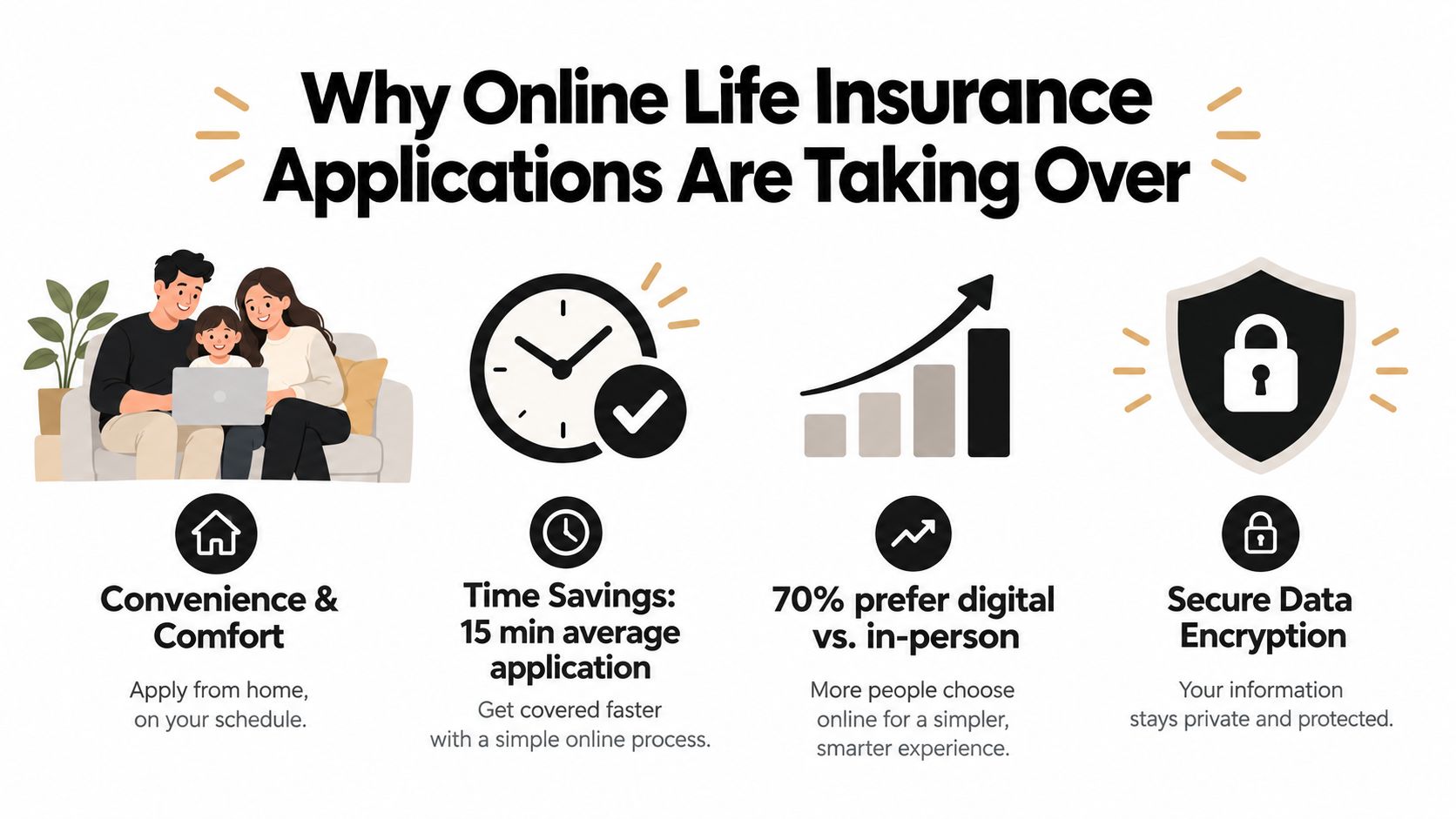
That convenience reflects a broader change in consumer behavior. MIB reported that January 2026 life insurance application volume rose 9.5% year over year, the highest January growth rate on record, and increased 11.7% month over month compared with December 2025. The report also marked the fourth consecutive year of double-digit January monthly growth, with term applications up 26.4%, whole life up 15.6%, and universal life up 34.7% (MIB application activity reporting).
Digital preference now reflects serious coverage needs
Online buying isn't limited to small, simplified policies. MIB reported double-digit year-over-year growth among applicants aged 40 and older, while applications from people aged 0 to 29 declined 7.5% in the same period. The report also recorded strong growth in higher face amounts, including double-digit gains from $100,000 to under $2.5 million and triple-digit growth from $2.5 million to under $5 million (MIB coverage and applicant trends).
Consumer preference has shifted, too. Forbes, citing LIMRA-based research, reported that 32% of consumers preferred buying life insurance online, compared with 29% who preferred buying in person in 2023 research (Forbes reporting on life insurance buying preferences).
The practical conclusion is simple: choosing digital isn't cutting corners. It's choosing a channel that has become relevant for young families, established professionals, and applicants seeking substantial protection. If you need to fill PDF forms on desktop before uploading supporting documents, prepare them carefully rather than rushing through the final submission.
Online life insurance still may not be instant. A clean application can move quickly, while an unusual travel history, incomplete medical record, or conflicting answer can send the file to a human underwriter. Resources about direct-to-consumer life insurance can help you compare the broader digital buying model before you apply.
What You Need Before Starting Your Application
The fastest application is the one you prepare before opening. Applicants often abandon forms because they need to search for an old prescription, confirm a beneficiary's address, or reconstruct a driving history halfway through the process. Gather the information first, then submit once your answers are complete and consistent.
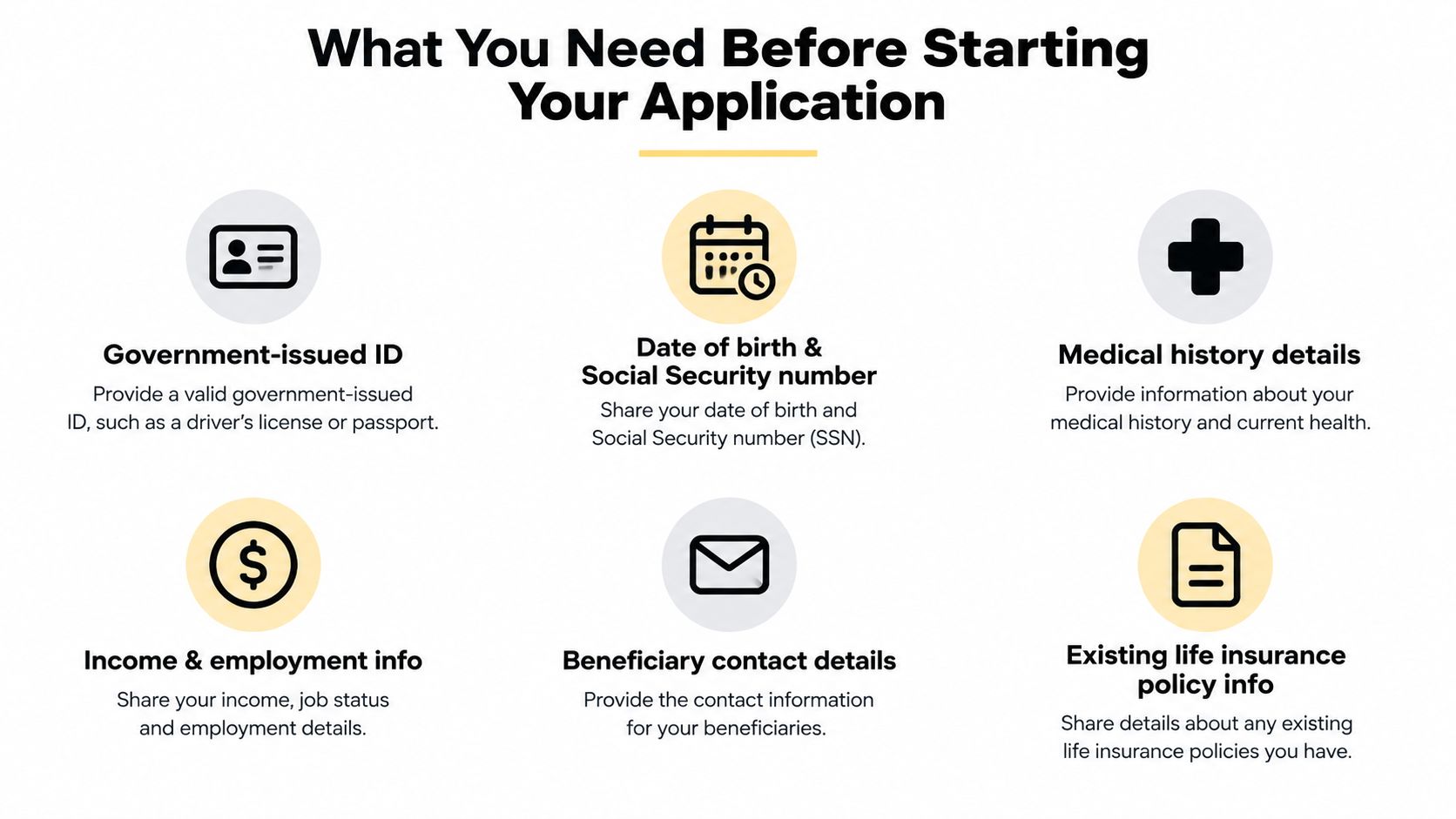
Independent guidance identifies the core information applicants should expect to provide online, including identity details, health history, family history, driving history, and beneficiary information (Aflac guidance on instant life insurance).
Your preparation checklist
- Identity details: Have your legal name, date of birth, current address, and Social Security number available. Enter them exactly as they appear on official records.
- Health history: Write down diagnoses, surgeries, hospitalizations, treatments, and approximate dates. Don't rely on memory if you can verify the details.
- Prescription information: Keep a current medication list nearby, including the reason for each prescription and the prescribing provider when known.
- Family medical history: Review major conditions affecting parents or siblings, especially diagnoses that may appear in the insurer's health questions.
- Driving history: Be ready to disclose serious violations, license suspensions, and accidents. The insurer may verify this independently.
- Lifestyle details: Prepare accurate information about tobacco, marijuana, alcohol, recreational activities, and hazardous hobbies.
- Employment and income: Have your occupation, employer information, duties, and financial details ready if the application requests them.
- Beneficiary information: Record each beneficiary's full name, relationship, address, and contact details.
- Existing coverage: Gather policy numbers, insurer names, coverage amounts, and dates for current life insurance policies.
Accuracy matters more than speed
A rushed answer can create more delay than a careful answer takes to prevent. If you're uncertain about a date, don't guess confidently. Check your records, answer as accurately as possible, and use the application's explanation fields when available.
Save a copy of your submitted answers and any confirmation page. You'll want a reference if an underwriter asks you to clarify a prescription, address, occupation, or previous application.
Preparation rule: Don't begin an online life insurance application until you can complete it without stopping to reconstruct your medical and financial history.
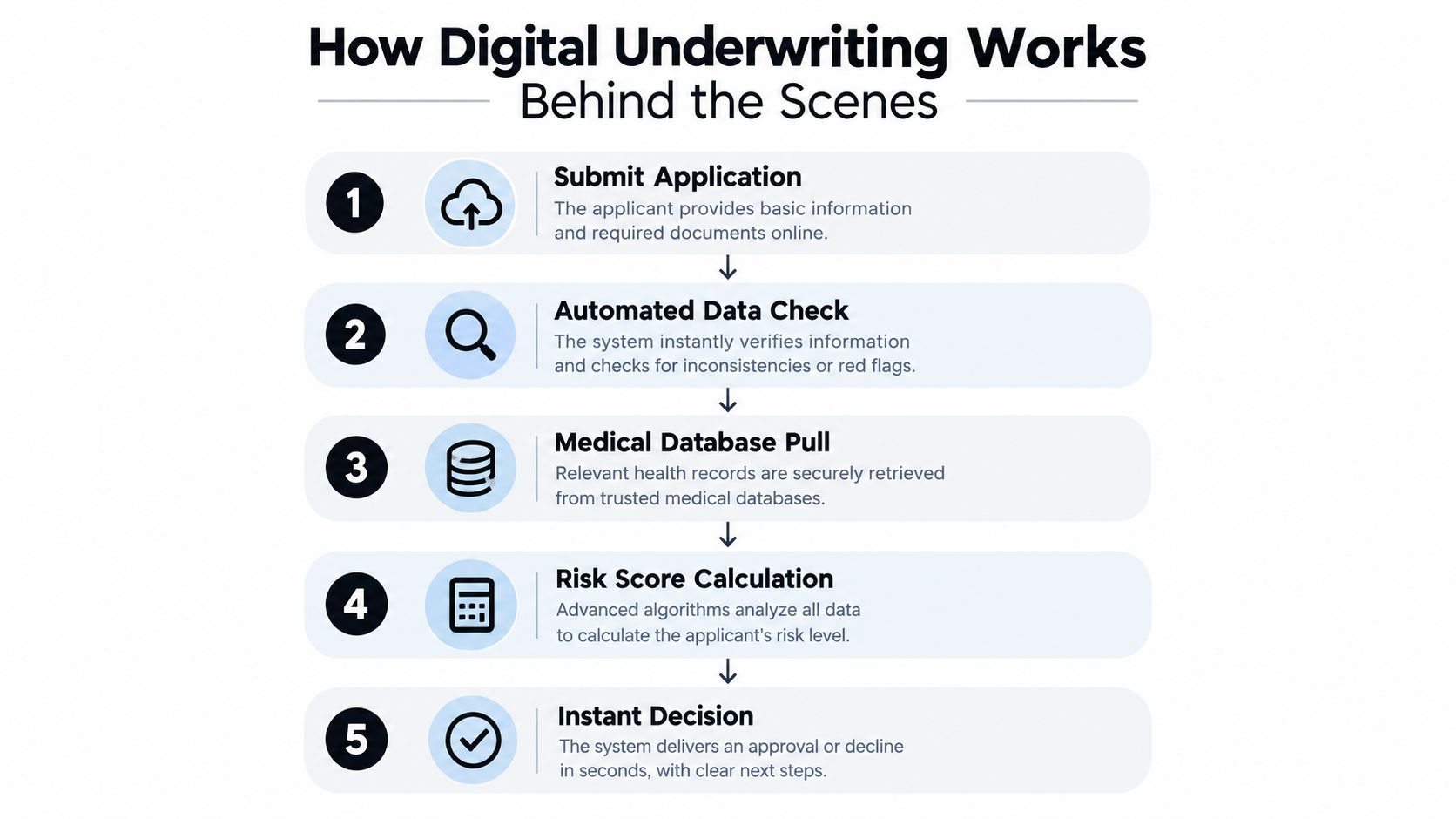
How Digital Underwriting Actually Works Behind the Scenes
Submitting the form doesn't send your application into a black box. The insurer's system compares your answers with information held by outside databases and authorized records. The purpose is to assess whether the application fits the carrier's automated eligibility rules and pricing assumptions.
No-exam coverage still involves underwriting. Reporting on no-exam insurance explains that carriers may use electronic health records, prescription databases, motor vehicle reports, public records, and other third-party data instead of requiring a physical exam. E-applications are used by 96% of insurers in accelerated underwriting programs (Wall Street Journal reporting on no-exam information gathering).
The verification sequence
First, the insurer validates basic identity information and checks whether the application is complete. It may then compare health answers with prescription history, medical claims, electronic records, and other permitted sources. A motor vehicle report can provide context about driving risk, while public records may help verify identity, address, or financial information.
The system then applies underwriting rules. It looks for matches, missing information, contradictions, and risk factors that require judgment rather than a simple automated decision. An applicant who answers “no” to a medication question but appears in a prescription database may receive a follow-up request. That doesn't automatically mean denial. It means the insurer needs the record explained.
The Society of Actuaries found that automated decisioning across surveyed carriers can produce outcomes in seconds to days, with a typical decision rate of 80% of submitted business and best-in-class performance reaching 95% (Society of Actuaries research on automated life underwriting).
This is why two applicants can complete the same online form and receive different experiences. One file may fit every rule and receive an automated outcome. Another may require records, clarification, an exam, or manual review because the available data doesn't tell a complete story.
For a fuller explanation of the stages, review this guide to the life insurance underwriting process.
The most important behavior is complete honesty. Don't omit a diagnosis because it seems minor, and don't assume a prescription won't appear in a database. Insurers verify information because the policy is a long-term contract, and inconsistencies can create more friction than the underlying health issue.
Practical Tips to Speed Up Your Approval
Applicant effort is the main obstacle in digital life insurance, not lack of interest. Seventy-nine percent of applicants cited the amount of required effort as the leading reason for abandoning the process, while 63% of those who abandoned cited time required as a top reason (Nasdaq reporting on electronic life insurance applications).
Treat the application like a short project with a preparation phase. You'll reduce the chance of stopping halfway and give the insurer a cleaner file to evaluate.

Make the first submission clean
- Apply when your life is reasonably stable. Avoid starting during a move, a job change, a major medical workup, or a period when you can't respond to follow-up requests. The application may still be possible, but your attention will be divided.
- Answer every health question completely. A partial answer can trigger additional questions. Include relevant diagnoses, treatments, medications, and dates instead of trying to make your history look simpler.
- Use consistent details. Your name, address, employment, prescription information, and medical answers should align with the records the insurer may access.
- Choose a defensible coverage amount. Don't select an amount casually. Consider income replacement, mortgage obligations, childcare, education goals, debts, and business responsibilities. A coverage request that matches your actual need is easier to explain than an arbitrary figure.
- Respond quickly to requests. If the insurer asks for a physician statement, clarification, or authorization, delay on your side becomes delay in the underwriting queue.
- Review before signing. Read the completed application, disclosures, beneficiary designation, premium details, and consent language. Electronic workflows can catch missing fields, but they can't know whether your answer is truthful.
Electronic workflows have also improved submission quality. Reported NIGO rates, meaning “not in good order,” have fallen from as high as 65% to under 10% in electronic application environments through prefill, validation, and structured health questionnaires (Nasdaq reporting on digital submission quality). That improvement depends partly on the applicant. Use the validation prompts as a final review, not as a substitute for careful reading.
If you want a realistic framework for the waiting period, use this guide to how long it takes to get life insurance.
Navigating the Application With a Non-Standard Profile
“Online” doesn't mean “standard profile only.” Digital systems can handle many ordinary risk factors, but they struggle when answers require context, documentation, or judgment. If your life includes international ties, a complex occupation, or incomplete records, you shouldn't hide those facts. You should prepare to explain them.
Insurers commonly ask about travel, residence outside the country, foreign business or property ownership, tobacco and marijuana use, driving history, occupation, and high-risk activities (industry guidance on life insurance application questions).
Factors that may need context
International travel and residence aren't automatically disqualifying. The insurer may want destinations, frequency, purpose, length of stay, and whether you work or live abroad. A business owner with overseas operations should describe the actual role and travel pattern rather than writing “international business.”
Marijuana use, tobacco, and hazardous hobbies require precise answers. Frequency, method, occupation, and participation level can matter. Someone who occasionally hikes is different from someone who climbs professionally, flies aircraft recreationally, or participates in extreme backcountry sports. The form needs facts, not a label.
Incomplete medical records are more likely to create a delay because automated systems can't reliably evaluate information that isn't available. If you recently changed doctors, moved between countries, or received treatment through multiple health systems, explain where records are held and provide the correct authorization.
Know when to use a human advisor
A fast online path may still work for a non-standard applicant, especially when records are current and answers are straightforward. But human guidance becomes valuable when you have several overlapping factors, such as foreign residence combined with business ownership, a recent diagnosis, or a high-risk occupation.
Ask an advisor to help you identify suitable carriers before submitting multiple applications. Multiple applications can create confusion if the answers differ, and a specialist may know which insurer's underwriting rules are better aligned with your circumstances.
Digital convenience is useful for clean files. Complex lives deserve clear explanations, not optimistic guesses.
If an online application asks for clarification, treat that as a normal underwriting step. Provide documents promptly, keep your answers consistent, and ask what the insurer still needs. A manual review is slower than an automated decision, but it can produce a more appropriate assessment than forcing an unusual profile into a simplified pathway.
What to Expect After You Submit Your Application
The outcome usually falls into one of several paths. The insurer may approve the application automatically, approve it after additional verification, request an exam or laboratory work, offer different terms, or decline it under current underwriting rules.
Automated decisions can arrive in seconds or take days, depending on the carrier's process and the information available. Traditional underwriting, including an exam, can take longer because the insurer may need appointments, laboratory results, medical records, and professional review. No-exam doesn't mean no medical review. Major insurers may authorize access to medical and prescription records and combine those records with health answers and other data sources.
If the insurer requests an exam
An exam-based request isn't a failure. It means the insurer needs evidence that the automated process couldn't obtain or interpret confidently. A medical exam may include basic measurements, health questions, blood or urine testing, and authorization for records, depending on the carrier and policy.
Schedule it promptly and answer the examiner consistently with your original application. Don't cancel existing coverage while waiting for the new policy to become active and confirmed.
How to read the offer
Review four items carefully:
- Coverage amount: Confirm the death benefit matches what you applied for and what your family needs.
- Premium: Check the payment amount, frequency, duration, and whether the premium is guaranteed or subject to change.
- Underwriting class: This rating affects price and reflects how the insurer assessed your risk.
- Policy structure: Verify the term length, exclusions, conversion rights, riders, beneficiary designation, and effective date.
If the insurer offers less coverage or a higher premium than expected, ask for the underwriting reason. You can accept the offer, request reconsideration with additional documentation, compare another carrier, or adjust the coverage amount. Don't reject a workable policy because it isn't perfect, but don't accept unfamiliar terms without understanding them either.
When an illustration is used in the sale, NAIC rules require it to be clearly labeled a “life insurance illustration.” It must identify the insurer, producer, proposed insured's name, age, sex, underwriting class, preparation date, and page position within the complete document (NAIC life insurance illustration framework). NAIC guidance also calls for a narrative summary describing the policy and premiums, followed by a numeric summary of death benefits, values, and premium outlay. The cover overview should generally be limited to no more than 2 pages (NAIC illustration guidance).
Your job after submission is straightforward: monitor requests, verify the final documents, and keep your existing protection until the replacement policy is active. An online life insurance application can save time, but the decision still deserves careful review because it protects the people who can't replace your income themselves.
Coveredly offers an online term life insurance application with digital quoting, health questions, electronic signing, and no-exam options for most eligible applicants, subject to underwriting rules. Visit Coveredly to review your options and start a life insurance application that fits your family's needs.