You bought term life insurance when your life looked very different. Maybe you were newly married, signing a mortgage, or holding a newborn and doing quick math about income replacement. The policy felt distant and simple then. Years later, that end date is closer, your obligations haven't neatly disappeared, and you're wondering what happens when coverage stops. That date isn't a savings milestone or an automatic payout. It's a decision checkpoint, and the term life insurance maturity date deserves attention well before it arrives.
Table of Contents
- Why Your Term Policy's Expiration Date Should Already Be on Your Radar
- What the Maturity Date Actually Means in a Term Life Contract
- What Happens When the Term Ends
- Why the Conversion Deadline Often Arrives Before the Maturity Date
- A Multi-Year Plan for Approaching Maturity
- When Outliving the Term Becomes the Real Problem
- Putting the Maturity Date to Work in Your Financial Plan
Why Your Term Policy's Expiration Date Should Already Be on Your Radar
Sara is 49, works full time, and has a teenager who'll need help with college costs in a few years. Her 20 year term policy expires in six years, but her mortgage will run longer than that. When she bought the policy, she assumed the house would be paid off and the kids would be independent by the end. Life moved more slowly than the spreadsheet did.
That mismatch is common, and it's exactly why early planning matters. A 20-year policy purchased at age 35 normally provides protection through the contract's stated expiration date around age 55, subject to exact policy wording and premium payments, as explained in the National Association of Insurance Commissioners guide to life insurance basics. If Sara waits until age 55 to think about it, her choices may already be narrower and more expensive.

The Mistake That Costs Families Options
Many first time buyers hear the word maturity and picture money coming back to them, like a bond or a savings account reaching its goal. Standard term insurance doesn't work that way. You paid for protection during a specific window, not for an account balance waiting at the finish line.
If renting a safety net for the years your family would struggle most without your income, when the rental period ends, the net goes away unless you renew it, replace it, or convert it under the contract's rules. None of that happens automatically just because you've paid faithfully.
Calendar rule: Treat your maturity date like a mortgage payoff date or a tax deadline. Put it where you'll see it years ahead, not in a folder you'll open after it passes.
Putting that date on your radar now gives you time to compare real paths while you're still covered. You can check whether your health, debts, and dependents still match the original plan. You can also find the separate conversion deadline, which often arrives earlier and surprises people who only tracked expiration.
What the Maturity Date Actually Means in a Term Life Contract
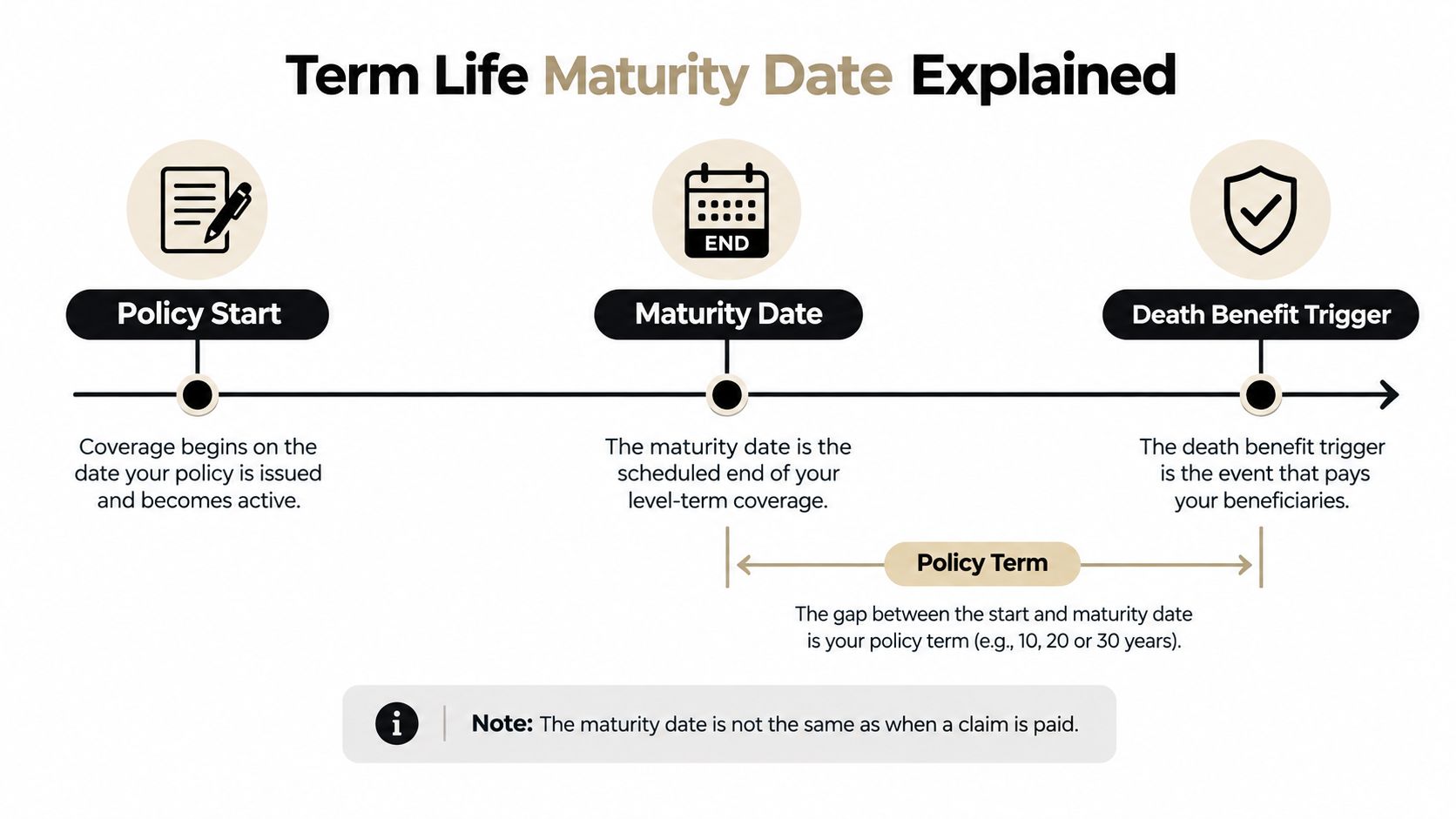
The term life insurance maturity date is generally the scheduled end of your level term coverage period. It's the date when the death benefit protection is set to stop, assuming premiums were paid and the policy stayed in force. It isn't the date a claim gets paid. A claim is triggered by the insured person's death while coverage is active, not by reaching a calendar date alive.
The timeline below shows how those pieces fit together, from policy start through the coverage window to the scheduled end.
Where to Find the Date in Your Paperwork
Start with the policy schedule, usually near the front of your contract. Look for language such as policy expiration date, coverage termination, level-premium period, and the final policy anniversary. Those phrases, along with term insurance maturity date and renewable term, are the keywords that tell you when protection changes and what rights you may still have.
Read the schedule next to the renewal and conversion provisions, not in isolation. One page may show when level premiums end, while another sets a maximum coverage age or an earlier deadline to act. If anything conflicts with what an agent told you years ago, the contract wording controls.
An everyday comparison helps. A home security monitoring contract protects your house for a set term, and the company responds if an alarm event happens during that term. When the contract ends, you don't get your monthly fees back, and monitoring stops unless you sign again. Term life works on similar logic, with far higher stakes.
Why There's Usually No Check at Maturity
Term insurance can offer a large death benefit at a comparatively affordable premium because it's built for a defined risk window and generally builds no cash value. Your premiums buy protection for that window. If you survive it, the insurer kept its promise by standing ready to pay during those years, even though no claim occurred.
Permanent insurance is structured differently. It can accumulate cash value and may mature at an age specified in the contract, so the word maturity carries a different meaning there. Mixing those two meanings up leads many term policyholders to expect a payout that their contract never promised.
If the insured dies while the policy is in force, beneficiaries receive the death benefit. If the insured is alive when the term ends, coverage normally ends without that payment.
The NAIC consumer guidance on term life insurance notes that renewable coverage may continue without new medical underwriting, though premiums typically rise at the older attained age. That's a contract right to check early, not something to assume. Your exact expiration time, grace period, and any automatic renewal language all sit in those pages.
Older permanent policies also explain some of the language confusion you may see in family paperwork. Actuarial tables once treated survival to very advanced ages as statistically insignificant, so maturity ages were set earlier than they often are now. Don't import that history into a modern term contract. For term coverage, keep your eyes on the stated end of the level term and what the contract lets you do before it arrives.
What Happens When the Term Ends
Four paths cover most outcomes at maturity, and they feel very different in practice. Term coverage is widely used for large, temporary obligations. The American Council of Life Insurers 2025 Fact Book data for 2024 shows term insurance represented 39.3% of newly purchased individual life policies but accounted for $1.45 trillion, or 72.1%, of the total individual life face amount issued. That gap tells you families often buy substantial protection for specific years, which makes the end of those years a serious planning moment.
Four Outcomes, Four Different Families
First, if the insured dies before maturity while the policy is in force, the named beneficiaries receive the death benefit. That's the core promise. A parent who dies during the mortgage and child raising years leaves money intended to replace income and keep the household running.
Second, if the insured outlives the term and takes no action, protection ends. Consider a couple whose 30 year term wraps up the same year their mortgage ends and their youngest child is financially independent. Letting coverage lapse may be a deliberate, sensible finish for them. The same inaction would be risky for Sara from the opening example, whose obligations run past expiration.
Third, some policyholders renew. A renewable policy can continue without new medical underwriting, which matters if health has changed. The tradeoff is price, because renewal premiums are typically recalculated at the insured's older attained age and can feel like a shock compared with the original level premium.
Fourth, some policyholders convert to permanent coverage if the contract allows it. Conversion can preserve insurability without a new medical exam under the policy's terms, and it replaces a known end date with longer lasting coverage. It usually costs more on an ongoing basis because permanent insurance includes features term doesn't have, so it's a fit when the need itself has become long term.
There's also a fifth practical move many people consider alongside those contract options, applying for a brand new policy. Replacement can work well if you're still healthy and want a fresh level term matched to your remaining obligations. It also means new underwriting, new pricing based on your current age and health, and careful timing so you don't drop old coverage before new coverage is in force.
Outcomes at Term Maturity
| Path at maturity | What happens | Underwriting required | Typical cost change |
|---|---|---|---|
| Death before maturity | Beneficiaries receive the death benefit if the policy is in force | No new underwriting for a valid claim | Premiums end with the claim |
| Let it lapse | Coverage stops and no death benefit is payable afterward | None | Premium payments stop |
| Renew | Coverage continues under renewal provisions, often year to year | Usually no new medical underwriting if the contract guarantees renewability | Premiums typically rise at attained age |
| Convert | Term coverage changes to permanent coverage under contract rules | Usually no new medical underwriting if converted by the deadline | Ongoing premiums generally higher than term |
| Replace | You apply for a new policy matched to current needs | Yes, current health and age are assessed | Depends on new age, health, amount, and term |
Match the path to the obligation: If the debt or dependency is gone, lapsing may be fine. If it remains, ending coverage by default isn't a plan, it's a gap.
Ask yourself which vignette looks most like your household today, not the household you imagined when you bought the policy. Your answer turns an abstract date into a concrete decision. It also tells you how urgently you need to check deadlines that may arrive before maturity itself.
Why the Conversion Deadline Often Arrives Before the Maturity Date
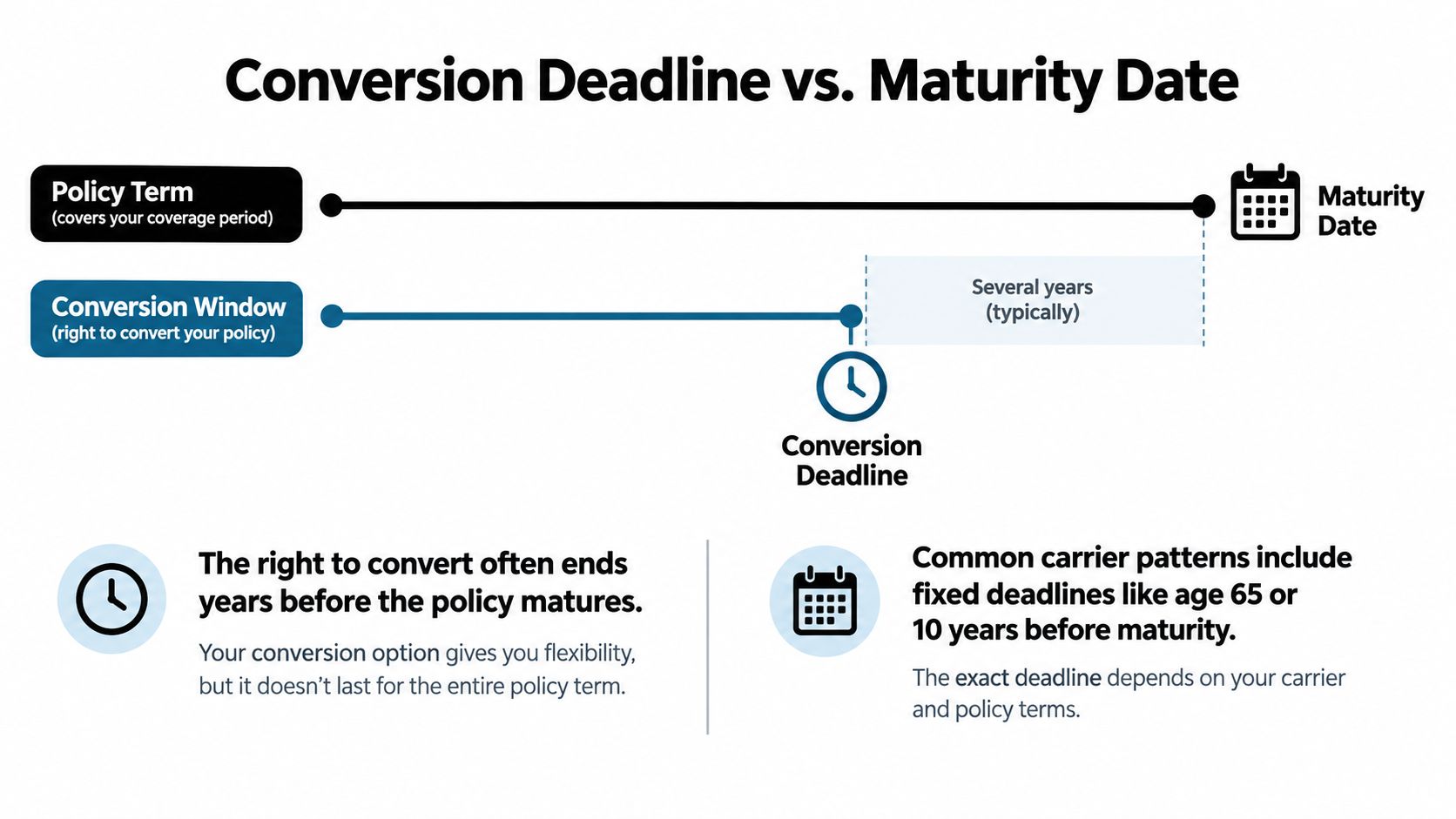
Here's the distinction that catches careful people off guard. Your policy can still be active while your right to convert it has already expired. The maturity date ends the term coverage. The conversion deadline ends a specific option inside that coverage, and it's often earlier.
The comparison below places those two dates on separate tracks so you can see the gap that catches people out.
How Carriers Commonly Set the Cutoff
Many carriers define conversion limits using either a fixed number of policy years, commonly 10 to 20 years, or an age limit commonly around 65 or 70, applying whichever comes first, and conversion windows may end several years before the scheduled policy end date, according to an industry explanation of what happens at the end of a term policy. Those are common patterns, not universal rules. Your contract sets your actual limit.
Follow a sample policy like a flight map. It takes off at issue, cruises through the level premium years, passes a waypoint marked age 65 conversion limit or a specific policy anniversary, then continues flying toward maturity. The plane is still in the air after that waypoint, but one exit door has closed. If you wanted permanent coverage without new underwriting, that waypoint was your last chance to use it.
This short video walkthrough is a helpful companion while you compare those two dates in your own paperwork.
What to Check in Your Contract Today
Search for phrases such as conversion deadline versus maturity date, age 70 conversion limit, and policy anniversary in your policy and any riders. Write both dates down separately, with the earlier one circled. If the language is dense, call the insurer and ask for the last conversion date in writing.
Newly married couples and business owners should pay special attention here. You may not want permanent coverage now, but future health is unpredictable, and conversion can be the bridge if your needs change. Learning how life insurance policy conversion works before that window closes keeps the option real instead of theoretical.
A Multi-Year Plan for Approaching Maturity
A single reminder a month before expiration isn't enough time to weigh health, budget, and family needs calmly. Spread the work across three checkpoints. You'll make better decisions, and you'll avoid discovering a missed conversion deadline when it's too late to use it.
The checklist below turns that runway into calendar entries you can copy into your own planning system.
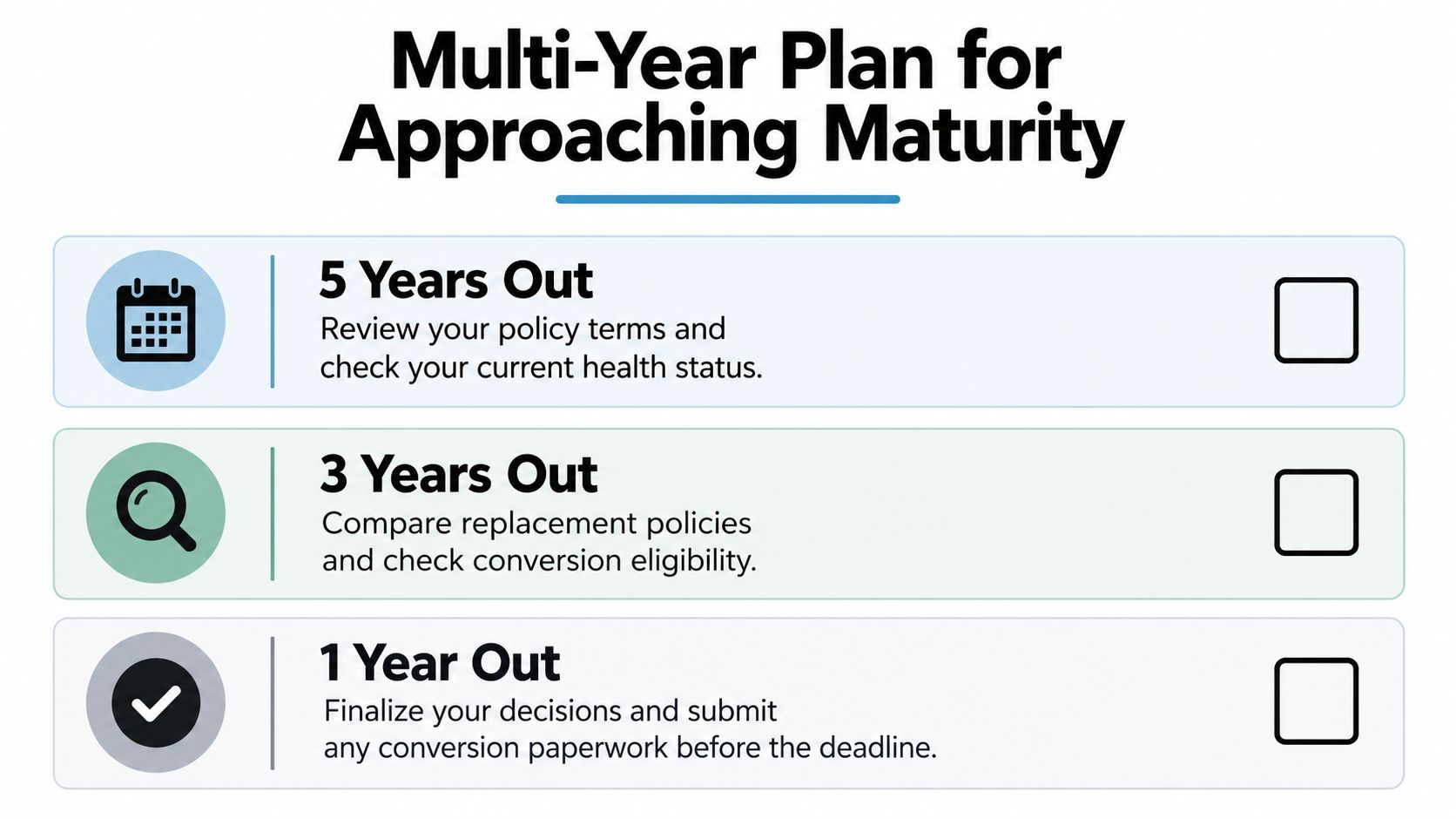
Five Years Out, Revisit the Original Job
Pull out the policy schedule and confirm the maturity date, conversion deadline, maximum coverage age, and renewal provisions. Then list what the policy was hired to do. Mortgage balance, years until children are independent, a business loan, or income replacement for a spouse all belong on that list with their own end dates.
Compare those obligation end dates with your term life insurance maturity date. Where obligations end first, lapsing may eventually make sense. Where they run longer, you've found your gap years. Gather current quotes for replacement coverage while you're healthy enough to have options, even if you don't buy yet.
Three Years Out, Choose Your Direction
This is decision time, not research time. Verify the conversion deadline again, separately from maturity, and ask the insurer what permanent products are eligible and whether partial conversion is allowed. Compare that path with renewal pricing and with a new term application based on your current health.
- Renew: Best explored when health changes make new underwriting difficult and you need coverage for a shorter bridge period
- Convert: Worth pricing when the need now looks lifelong or insurability is the main concern
- Replace: Often attractive when you're still in good health and want a new level term matched to remaining obligations
- Let it lapse: Reasonable when debts are gone, dependents are independent, and other assets can carry the risk
Don't cancel anything during this stage. If you're replacing coverage, keep the existing policy in force until the new one is approved and active. A gap created by tidy paperwork can leave your family unprotected at exactly the wrong moment.
One Year Out, Confirm Every Detail
Now check the literal clock. Confirm the exact expiration date and time provisions in the contract, the grace period for a missed premium, and any automatic-renewal language that could change your premium without a fresh signature. Policy anniversary timing matters too, because deadlines often key off anniversaries rather than calendar year ends.
Update beneficiary names, addresses, and contingent beneficiaries while you're in the paperwork. Marriages, divorces, births, and deaths can make old designations wrong in ways that slow down a claim. Submit conversion or replacement applications with months to spare, not days.
Waiting rarely makes this cheaper, since age is a pricing factor at every checkpoint.
Keep one financial fact in view through all three stages. FINRA's overview of insurance products explains that coverage ends when the term ends unless the policy is renewed, and premiums for most term policies increase as the insured ages or reaches the end of a renewal period. Early action gives you more paths at prices based on a younger age. Late action often leaves renewal at attained age pricing as the only door still open.
When Outliving the Term Becomes the Real Problem
Surviving your term is good news for your health and your family. It can still create a financial problem if people depend on you past the date your protection stops. That gap between term expiration and eventual death is sometimes called the longevity lapse, and it deserves more attention than it usually gets in quick online purchase flows focused on approval speed and price.
Obligations That Refuse to Follow the Original Timeline
A couple who had children later in life may hit maturity with a middle schooler still at home. A homeowner who refinanced may owe on a mortgage years after the original payoff target. A business owner may have signed a loan or lease that assumes several more years of income. An adult child with ongoing support needs, or an aging parent relying on your help, can extend dependency in ways a younger buyer never predicted.
None of these situations means you bought the wrong policy. It means the policy did its job for the years it covered, and life kept going. The planning mismatch appears when fixed term coverage meets longer, messier obligations. Naming that mismatch early is more useful than blaming the original purchase.
Consumer coverage identifies this gap as a distinct phenomenon and recommends reviewing conversion options two to three years before the level premium period ends, as described in MoneyGeek's guide to outliving term life insurance. That timing aligns with the three year checkpoint above. It's late enough to know your remaining obligations clearly and early enough to act before contract windows close.
Weighing the Four Paths Honestly
Each path interacts differently with your health and budget. Renewal may avoid new medical underwriting but can produce much higher premiums, so it often works as a short bridge rather than a long term answer. Conversion may preserve insurability, yet permanent pricing reflects cash value features and longer coverage, so you should convert an amount you can sustain.
Replacement restarts underwriting at your current age and health. Depending on jurisdiction and contract, a new policy can also mean a new contestability period, which is another reason not to drop existing coverage casually. Doing nothing costs nothing in premiums and may be right when the need is gone, but it leaves dependents exposed if the need remains.
If you're torn between temporary and lifelong protection at this stage, comparing term versus whole life insurance side by side can clarify what you'd gain and give up with conversion. Run the comparison against your actual remaining obligations, not a generic rule of thumb. A need with a clear end date usually points one way. A need with no end date points another.
Decision checkpoint: Maturity isn't the insurer ending a file. It's the moment you confirm, on purpose, whether your family still needs this protection.
Putting the Maturity Date to Work in Your Financial Plan
Pull your policy schedule today and write down two dates, the maturity date and the conversion deadline. Set review reminders five, three, and one year before the earlier deadline that affects your plans. That's the whole system, and it turns a confusing contract term into a manageable planning habit.
Then right size what comes next. If obligations remain, estimating how much term life insurance your household still needs keeps you from renewing or replacing an outdated amount by habit. If estate planning is part of your picture, the resource from Law Office of Bryan Fagan on ILITs explains how life insurance trusts can hold a policy outside an estate, which some families explore with legal counsel when permanent coverage enters the plan.
Digital, no exam term products can make the replacement path faster for eligible applicants, which helps when you're healthy and mainly need a new coverage window. They don't remove the need to plan ahead, since a major health change before maturity can still narrow your options. Mark the date now, while you have choices, so the family this policy was built to protect is covered on the day it matters.
If your current term is winding down or your coverage amount no longer fits your life, Coveredly offers digital term life insurance designed to be affordable and flexible, with up to $3mm of coverage and no exams for most applicants. Compare your options before your conversion or maturity deadlines close and find a term that matches your family's next chapter at Coveredly.