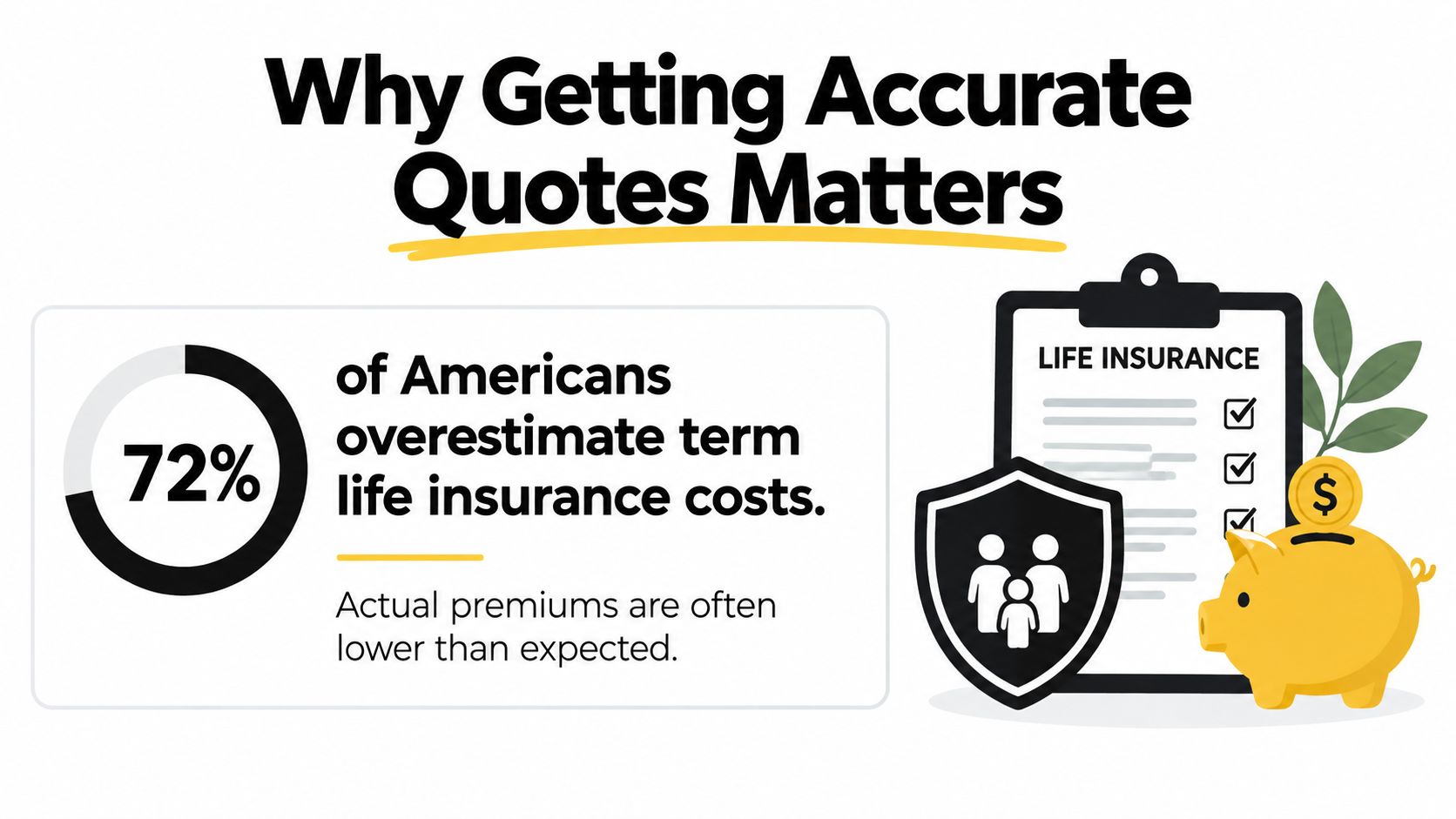
Seventy-two percent of Americans overestimate the cost of a basic term life insurance policy, while adults aged 18 to 30 have estimated the price at a median of 10 to 12 times the actual premium. The practical answer is simple: get personalized term life insurance quotes using identical coverage details, then compare the final policy terms rather than trusting an advertised price or assumption.
That gap between perception and reality can keep families from applying at all. A quote isn't a promise of approval, but it replaces guesswork with a price based on your age, health, tobacco use, coverage amount, term length, and other underwriting factors. For a young family, newly married couple, or business professional, that information is more useful than a generic headline rate.
Table of Contents
- Why Getting Accurate Quotes Matters More Than You Think
- What Information You Need Before Starting Your Quote Search
- How Online Quote Tools Work and What to Expect
- Understanding Term Lengths and Coverage Amounts
- Practical Strategies to Lower Your Premium
- How to Evaluate and Compare Multiple Quotes Effectively
Why Getting Accurate Quotes Matters More Than You Think
The cost assumption is often the first obstacle. LIMRA reported in 2024 that approximately 72% of Americans overestimated the cost of a basic term life insurance policy. Only 10% correctly estimated the cost of a $250,000, 20-year policy for a healthy 30-year-old, while 57% overestimated it and 32% didn't know the cost.
Among adults aged 18 to 30, the median estimate was 10 to 12 times the actual premium, according to recent LIMRA research. That doesn't mean every applicant will receive the same price. It does show why an actual quote can be more valuable than a mental price anchor.
The protection gap behind the price gap
The same LIMRA findings show that 42% of American adults, approximately 102 million people, said they needed life insurance or additional coverage. That was the highest level recorded in the study's 14-year history. Yet inaccurate assumptions about price can stop people before they compare coverage.
Cost isn't the only source of hesitation. LIMRA found that 38% of uninsured Americans cited cost as the main reason for not buying, while almost one-quarter said they didn't know how much coverage they needed or what type to purchase. A quote search addresses both problems when it includes a needs discussion, consistent inputs, and an explanation of why prices differ.
Practical rule: Treat the first quote as a starting point, not as proof that coverage is either affordable or unaffordable.
For broader household planning, families may also benefit from reviewing our business advisory services when insurance needs overlap with asset protection, business ownership, or succession concerns. Life insurance won't solve every financial risk, but it can form one part of a wider protection plan.
What Information You Need Before Starting Your Quote Search
Accurate inputs produce more useful comparisons. Before opening an online quote form, gather the details an insurer is likely to use to assess eligibility, risk class, and price.
Start with the policy design
Write down the death benefit you believe your household needs and the intended term length. Connect those choices to real obligations, such as income replacement, a mortgage, childcare, education costs, or business debt. Don't choose a round coverage amount only because it appears in an advertisement.
Then decide how you'll describe tobacco use and payment preferences. Tobacco status can affect classification, while payment frequency can affect the scheduled premium and policy fees. Use the same answers for every quote so the comparison remains fair.
Prepare your personal and health information
Have your age, sex, occupation, residence, driving history, medical history, medications, and family health background available. Be especially careful with dates, diagnoses, prescriptions, and tobacco disclosures. An incomplete answer may produce a convenient estimate, but it can also lead to more evidence requests or a changed offer later.
Insurers may verify application details with permission-based external data. LIMRA industry research found that approximately 95% of surveyed insurers used MIB application data, while about 60% used prescription databases, laboratory results, or motor-vehicle records.
Use one applicant profile across carriers
Create a short fact sheet and copy the same information into each quote tool. If one form asks about a condition differently, record the wording and answer consistently rather than selecting the answer that produces the lowest displayed premium.
That approach makes later changes easier to understand. If a carrier requests records or assigns a different underwriting class, you'll know the change came from the insurer's review rather than from inconsistent information between applications.
How Online Quote Tools Work and What to Expect
An online quote tool usually follows a straightforward sequence. You provide personal details, choose a coverage amount and term, answer health and lifestyle questions, and receive an initial estimate. The system uses those answers to place you in a preliminary eligibility or underwriting category.
The estimate is useful for shopping, but it isn't a guaranteed offer. The insurer may request medical records, prescription information, driving records, laboratory results, or an examination before deciding whether to issue the policy and at what rate.
From estimate to underwriting decision
Automated underwriting now handles part of the process for many insurers. LIMRA reported that two-thirds of surveyed life insurers in the United States and Canada had implemented automated underwriting in at least part of their business, and another 32% were planning implementation. All surveyed insurers cited reducing issuance time as a goal, while 92% cited cost reduction.
That speed doesn't remove the need for accuracy. A mismatch between your application and external records can trigger additional evidence, a revised risk class, or a decline. The quote interface should show which assumptions produced the estimate and identify the answers most likely to change the final premium.
What to check before applying
Use online tools to compare possibilities, then request written documentation before making a final decision. A sensible workflow looks like this:
- Enter consistent information: Use the same coverage amount, term, tobacco status, and underwriting answers.
- Save the assumptions: Record the date, insurer, payment frequency, and estimate shown.
- Ask what happens next: Find out whether the carrier may request records, an examination, or an amended application.
- Review the written offer: Confirm the risk class, guaranteed premium period, exclusions, and policy provisions.
You can also review instant online life insurance quotes as part of the initial comparison process. The key distinction is that an instant result helps you shop, while an underwritten offer determines the policy you can purchase.
Understanding Term Lengths and Coverage Amounts
A term policy covers a defined period rather than the insured person's entire lifetime. The National Association of Insurance Commissioners explains that term policies cover one or more years and pay a death benefit when the insured dies during the term, provided the policy is in force. Because term insurance generally doesn't build cash value, it can provide a larger amount of temporary protection for each premium dollar than cash-value insurance.
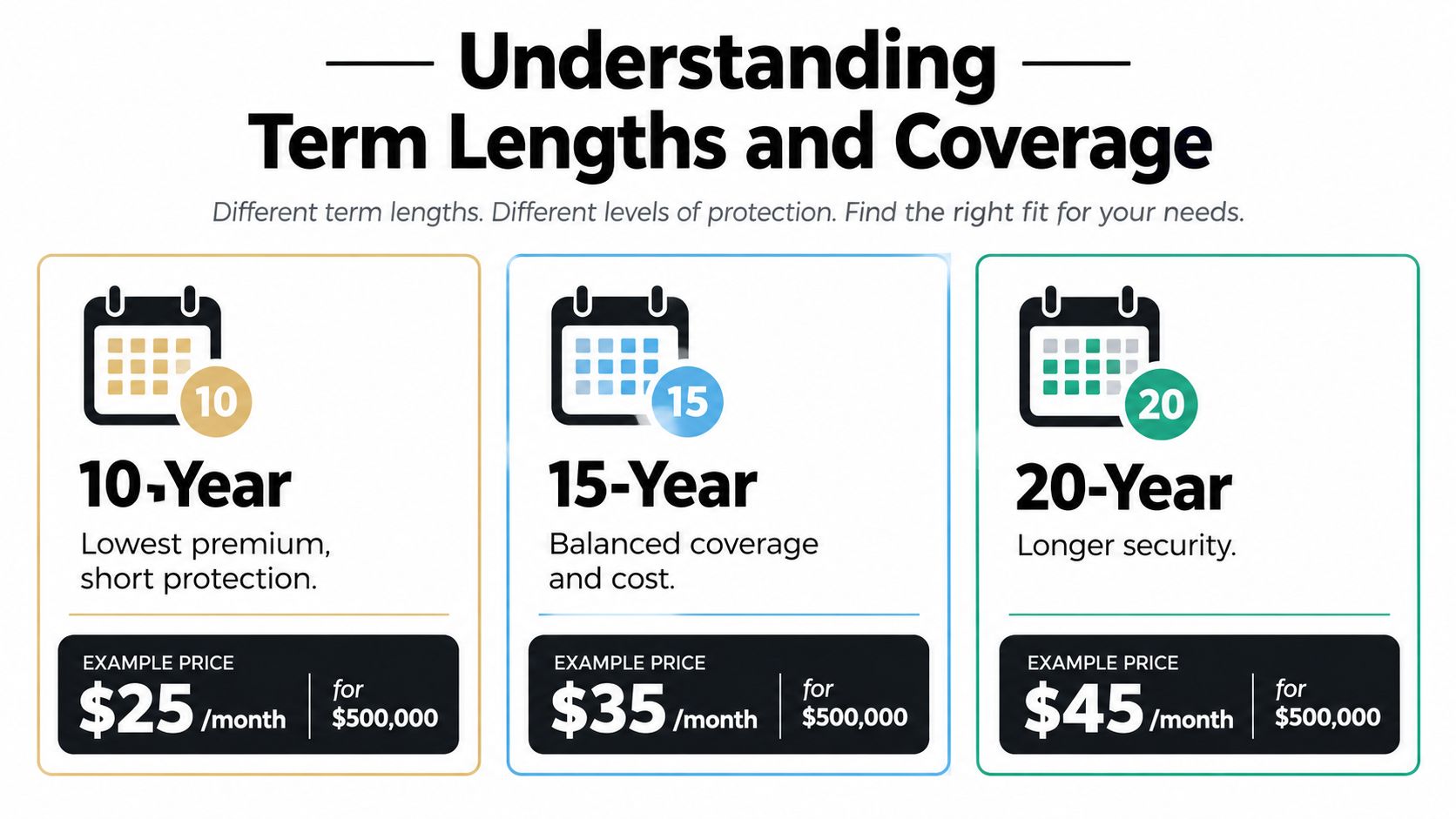
The selected term should follow the liability, not just the lowest quote. A couple with young children might need coverage through the years of childcare and education costs. A household with a mortgage may want the term to extend through the expected repayment period. A shorter policy can cost less initially, but it may expire while dependents still rely on the insured's income.
Compare the structure, not just the first payment
A quote for a longer initial term may differ from a shorter quote because the insurer is accepting risk for a different period. FINRA explains that premiums for most term policies tend to increase as the insured ages or reaches the end of a renewal period.
| Comparison point | Shorter term | Longer term |
|---|---|---|
| Initial cost | Often lower | Often higher |
| Protection period | Ends sooner | Continues longer |
| Main risk | Coverage may end before obligations do | You may pay for protection beyond the period you need |
| Review question | Will dependents still rely on me when it ends? | Can the household sustain the premium throughout the term? |
Coverage amount needs the same discipline. Add income replacement, debts, childcare, education costs, emergency needs, and unpaid household work. Then account for existing savings and employer coverage. The NAIC advises buyers to decide how much coverage they need, how long they need it, and what premium they can afford before selecting a policy.
A useful life insurance coverage needs guide can help organize those obligations before you request comparable quotes. The cheapest quote isn't a good result if it leaves a surviving partner unable to replace childcare, pay debts, or maintain housing.
Practical Strategies to Lower Your Premium
Lowering a premium shouldn't mean reducing the protection your family needs. Start by improving the quality of your application and choosing a policy structure that fits your actual situation.
Apply while your risk profile is favorable
Age and health influence underwriting, so delaying an application can change the available rate class if your circumstances change. You don't need to wait until every financial decision is perfect. You do need to understand the benefit of securing coverage while the policy's underwriting information supports your preferred classification.
Tobacco use deserves honest attention. If you use tobacco, ask each insurer how it defines tobacco status and what evidence it requires for a non-tobacco classification. Don't claim a status you can't substantiate. A later discovery can affect underwriting or policy administration.
Improve the information behind the quote
Manage health conditions with qualified medical care, keep prescription information current, and review your driving record for accuracy. These steps won't guarantee a lower class, but they can prevent avoidable confusion during underwriting.
Ask whether the carrier offers different underwriting paths, including accelerated or simplified processes. Term life insurance premiums can reflect more than the face amount and term. The underwriting route, payment frequency, tobacco classification, and policy charges can all affect the comparison.
Examine payment choices carefully
Ask for the cost under monthly, semiannual, and annual payment schedules. A less frequent schedule may reduce administrative charges, but it must remain practical for your household's cash flow. A payment option that looks cheaper on paper isn't useful if it creates missed-payment risk.
Also ask whether the policy offers conversion rights, how long those rights last, and whether renewal premiums rise after the level period. The NAIC notes that many term policies can renew after the initial term even when health has changed, but the new premiums are higher. A lower opening price can therefore hide a less attractive long-term structure.
How to Evaluate and Compare Multiple Quotes Effectively
One quote tells you what one carrier may charge under one set of assumptions. Multiple quotes become meaningful only when you standardize the inputs. Compare the same face amount, term length, tobacco status, underwriting type, and payment frequency across every carrier.
A simple comparison sheet can prevent the most common error, which is selecting a low monthly figure attached to a different policy design.
| Item to record | Why it matters |
|---|---|
| Guaranteed annual premium | Shows the scheduled cost beyond the monthly headline |
| Total scheduled premiums | Helps compare the full level-term commitment |
| Death benefit | Confirms that the protection amount matches household needs |
| Term duration | Shows when the original protection ends |
| Renewal rates | Reveals the possible cost after the level period |
| Conversion deadline | Identifies how long you can switch to another policy type |
| Policy fees | Captures charges omitted from a simple premium display |
Test each quote against household risk
Calculate whether the premium remains affordable if income falls or expenses rise. Then test the protection amount against a one-income household, childcare replacement, debt repayment, education funding, and support for a partner who performs unpaid domestic work.
Underwriting quality also matters because pricing reflects expected mortality and lapse behavior, not merely your stated budget. Society of Actuaries experience material reported a 2015 Valuation Basic Table actual-to-expected mortality ratio of 95.2% by amount and 110.4% by policy count for 2009 to 2013 individual-life experience. The difference illustrates why aggregate results and policy-count results can tell different stories. For consumers, the practical lesson is to focus on the insurer's underwriting terms and written offer, not on a premium that appears unusually low without context.
Review renewal and conversion provisions as carefully as the initial price. A policy that ends before children become independent or a mortgage is repaid may be inadequate, while a policy with useful conversion rights may provide flexibility if your needs change.
For a similar discipline when reviewing another type of household protection, you can use this guide to compare car insurance quotes. The same habit applies: standardize the inputs, record the exclusions and terms, and compare the complete contract rather than one advertised number.
Ask each carrier or adviser to explain any difference you can't reconcile. Don't submit an application until you understand whether the displayed amount is an estimate, an offer, or a guaranteed premium illustration.
Coveredly lets applicants enter their information through a digital platform and receive multiple term life insurance offers, with options of up to $3 million and no medical exams for most applicants. Visit Coveredly to begin a standardized quote comparison and review which coverage amount and term fit your family's obligations.