You've just welcomed a child, signed a mortgage, or started building a business with someone who depends on your income. Life feels busy and hopeful, but one practical question can sit in the background: if you died unexpectedly, how would your family keep paying for housing, childcare, education, and everyday life?
That's the question behind what does term life insurance cover. Term insurance creates financial protection for a defined period. It's designed to support the people who rely on you during important working and family years, not to operate as a savings account or investment.
Table of Contents
- Understanding Term Life Insurance Basics
- What Term Life Insurance Actually Covers
- Common Exclusions and Limitations to Know
- Real-Life Examples of Term Insurance Coverage
- How to Choose Coverage Amount and Term Length
- Getting Started with Your Term Life Insurance Plan
Understanding Term Life Insurance Basics
A young couple brings home their sleeping daughter after a long day. One parent earns most of the household income, while the other handles childcare and plans to return to work later. Their mortgage, food, transportation, and future education costs all depend on the family continuing to have enough money each month.
Term life insurance addresses the financial risk behind that situation. If the insured person dies while the policy is active, the named beneficiaries receive the policy's death benefit. They can generally use that money for household bills, debt, childcare, education, or other needs rather than following a restricted spending plan.

A safety net with an end date
The word “term” matters. The policy covers a stated period, such as the years when children are dependent, a mortgage remains outstanding, or a business loan needs protection. If the insured outlives that period, the policy ends and no death benefit is payable unless the contract allows renewal or conversion.
That feature makes term life different from lifelong protection. It doesn't try to cover every financial need forever. Instead, it transfers the risk of losing an income during a selected window to an insurer in exchange for premiums.
Practical rule: A term policy should match the years when your family would face the greatest financial disruption if your income disappeared.
The policy only works as intended while it's in force. Missed premiums, an expired term, or a failure to follow the contract can affect whether a claim is payable. Before applying, it helps to understand how term life insurance works and identify the responsibilities attached to keeping coverage active.
For a young family, the purpose usually isn't to predict when death might occur. It's to make sure a spouse, partner, or child has financial breathing room if the unexpected happens during the years of greatest dependence.
What Term Life Insurance Actually Covers
Term life insurance is a pure death-benefit contract. If the insured dies while the policy is in force, beneficiaries receive the face amount stated in the policy. The payout is generally capped at that death benefit, rather than growing through accumulated policy value, as explained by the Texas Department of Insurance.
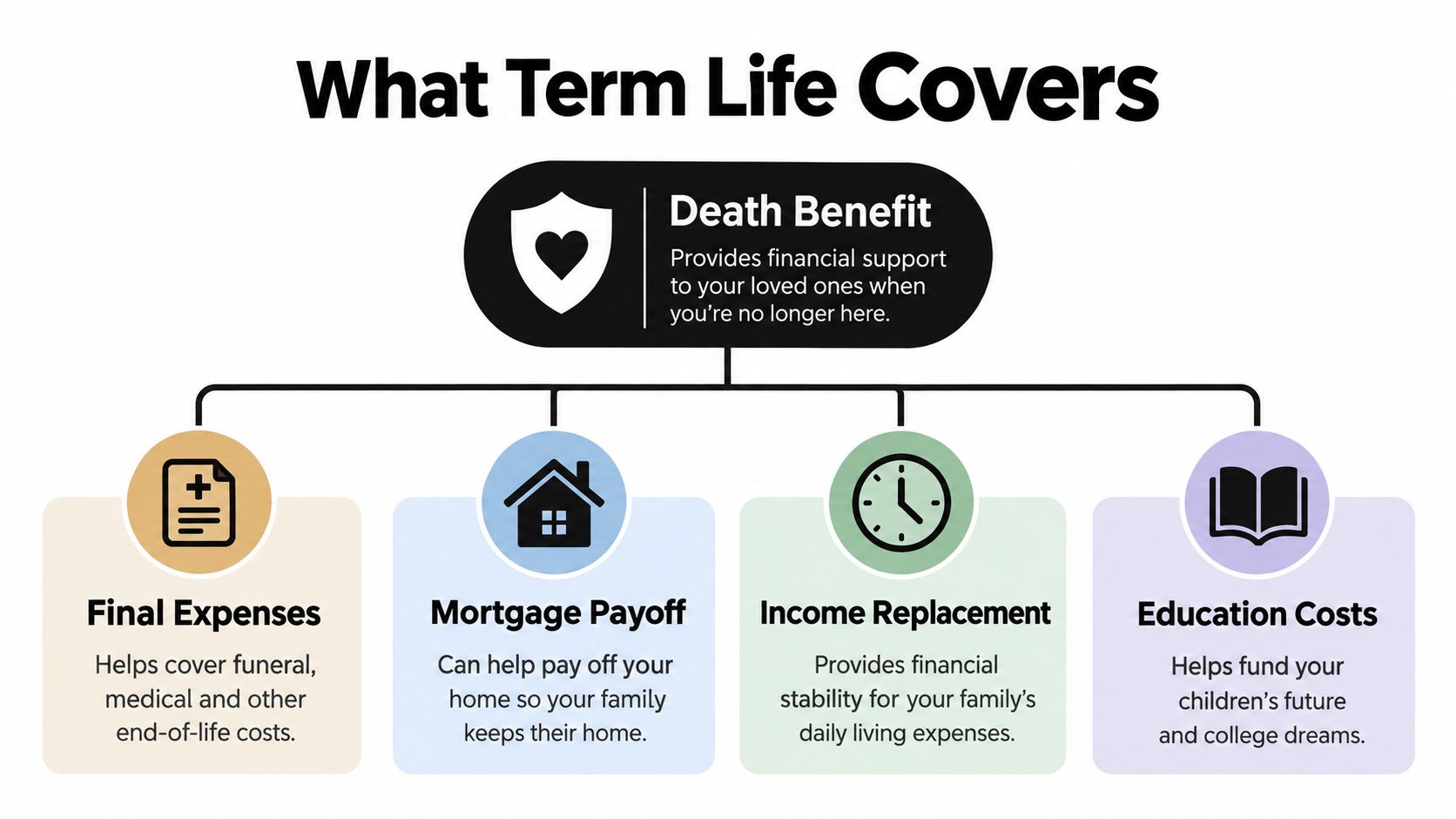
Think of the death benefit as a pool of money that replaces the financial support the insured would have provided. The beneficiaries, rather than the insurer, usually decide how to apply it. Common uses include:
- Income replacement: A surviving spouse may use the benefit to replace lost earnings while adjusting to a new household budget, work schedule, or childcare arrangement. The right amount depends on the family's actual obligations and resources.
- Mortgage and debt protection: A family may apply part of the payout toward a mortgage, student loan, business obligation, or other major debt. This can reduce the risk that survivors must sell a home or make difficult financial decisions immediately after a death.
- Childcare and education: The benefit can help fund childcare while a surviving parent works, or preserve plans for tuition and other education costs. It doesn't guarantee a particular educational outcome, but it can protect the money assigned to that goal.
- Final expenses: Funeral and related costs may be one use, but they're not the only purpose of term coverage. For many families, the larger concern is continuing income and meeting long-term obligations.
What the base contract doesn't provide
A standard term policy doesn't create cash value. It also doesn't normally provide living benefits in the base contract, and it doesn't pay a benefit just because the insured reaches the end of the term.
That boundary separates term insurance from permanent insurance products that may include a cash-value component. Term coverage is focused on transferring death-related income risk for a specified period, not on building an investment balance.
Level term insurance typically keeps both the premium and death benefit fixed for the selected period. Common available periods include 5, 10, 15, 20, or 30 years, according to Guardian Life's explanation of convertible term insurance. This predictable structure can make household budgeting easier, especially when a family is coordinating coverage with a mortgage or children's dependent years.
Common Exclusions and Limitations to Know
A policy's cause-of-death coverage may be broad, but its timing and contract conditions are strict. Many term policies cover death from most causes, yet payment still depends on the policy being active and the claim falling outside an explicit exclusion.
The first issue is the suicide exclusion. Term policies often exclude suicide during the first 1–2 years, although the exact period and treatment depend on the contract and applicable jurisdiction. A policy may also exclude or limit coverage for certain high-risk activities, aviation, foreign travel, or military-related circumstances.
Read the conditions, not just the headline
Consider two different claims. In the first, the insured dies from an illness several years into an active policy, and no stated exclusion applies. The cause of death may fall within the policy's broad coverage. In the second, premiums stopped and the policy lapsed before the death occurred. Even though the death itself may not involve an unusual medical cause, the policy-status problem can prevent payment.
That's why a family shouldn't rely on a summary sentence such as “life insurance covers death.” The contract controls the result.
- Policy status: Confirm that premiums are paid and the policy remains in force on the relevant date.
- Early-period exclusions: Read the suicide provision and understand how the insurer handles the excluded period.
- Risk activities: Disclose aviation, hazardous hobbies, foreign travel, or military service accurately during underwriting.
- Jurisdiction and wording: Exclusions and regulatory limits vary, so review the policy issued for your location rather than relying on a general online description.
This guide to what life insurance may not cover can help frame the questions you should ask before choosing a policy.
Regulatory rules in some markets restrict which exclusions insurers may use. For example, standards may permit suicide exclusions while limiting medical-condition exclusions and allowing only certain hazard-based exclusions. The practical lesson is simple: coverage depends less on guessing whether a medical cause is “normal” and more on checking the term, policy status, and written exclusions. The BMO term life insurance reference provides further context on these boundaries.
Real-Life Examples of Term Insurance Coverage
Families often assume term life insurance is mainly for funeral costs. That view misses the larger financial problem. A death can remove years of earnings, leave a mortgage unpaid, interrupt childcare, and create education costs at the same time.
The Johnson family illustrates a broader use. They purchased a 20-year term policy to address their mortgage and provide income replacement until their children finish college. Their decision isn't based on a belief that the policy will create savings. They chose a period that corresponds to the years when their children and housing obligations place the greatest demand on the household budget.

Different milestones call for different decisions
The Chen family has a different timeline. As newlyweds, they choose a 10-year term to align with their debt payoff plan. Their needs may change later if they have children, buy a home, or take on a business obligation. A shorter initial period can fit a defined responsibility, but the couple needs to understand what happens when that period ends.
The Martinez family uses coverage during a business partnership. Their concern isn't only household income. The business has obligations that could become harder to manage if one partner dies. Term insurance may help address those time-bound responsibilities, subject to the policy structure, beneficiary arrangements, ownership, and applicable business advice.
These examples challenge two common assumptions:
- “Term insurance is only for funerals.” Final expenses may be one use, but families also use the death benefit to address mortgage debt, education plans, income replacement, and business responsibilities.
- “A policy pays whenever death occurs.” The death must occur while the policy is in force and outside the contract's stated exclusions.
- “The longest term is automatically best.” A longer period may be appropriate for some households, while another family may need coverage that follows a shorter debt or business timeline.
Industry coverage reflects continued interest in this product. In the United States, term new premium was up 3% in 2025 and policy count was up 2%, as reported by AAA's coverage of term life insurance myths and facts. Those figures don't determine what any individual needs. They do reinforce that many consumers are still evaluating term insurance while misconceptions remain.
How to Choose Coverage Amount and Term Length
Choosing a policy starts with the financial gap your family would face, not with a number copied from someone else. A household with a mortgage, young children, and one primary earner may need a different structure from newlyweds with limited debt or business partners protecting a company obligation.
Start by writing down what the death benefit would need to address. Include current income that dependents rely on, outstanding debts, childcare, education goals, housing costs, and other commitments. Then consider resources that could reduce the gap, such as existing savings or other insurance. The goal is to connect the benefit to a real responsibility rather than buying an arbitrary amount.
Build the amount around obligations
A practical review can ask:
- What income would disappear? Identify whose earnings support the household and how long replacement income may be needed.
- Which debts would remain? Include a mortgage, student debt, or business obligation that survivors might struggle to service.
- Which future costs matter? Consider childcare and education plans, especially when children are young.
- What resources already exist? Savings and other benefits may offset part of the financial need.
- Who receives the benefit? Confirm that the named beneficiary matches your current family and legal planning.
Term length should follow milestones. A marriage, children's dependent years, mortgage payoff, or business obligation may each suggest a different endpoint. Available level-term periods commonly include 5, 10, 15, 20, and 30 years, so the choice can be tied to the timeline rather than selected at random. The guide to estimating how much life insurance you need can help organize this assessment.
A useful question: If the main financial obligation ends earlier than the policy, would the remaining years still protect a meaningful family need?
Affordability also affects the decision. A recent LIMRA-linked survey found that 52% of people thought life insurance was too expensive, while 78% overestimated the cost of basic term coverage, according to Fidelity's discussion of life insurance myths. Those figures don't mean every policy will fit every budget. They do suggest that assumptions about price can stop people from exploring suitable coverage.
You also need flexibility. Coverage generally ends when the term ends, and continuation may become much more expensive. Renewal or conversion rights can matter if your health, family, or business situation changes, so check those provisions before applying.
Getting Started with Your Term Life Insurance Plan
Once you know the financial purpose of coverage, turn the decision into a short application plan. The insurer will need accurate information about your health, lifestyle, occupation, and other underwriting factors. Clear answers help the company assess the risk and offer terms that match the information provided.
Prepare before requesting quotes
Gather the details that shape the decision:
- Financial obligations: List income needs, debts, housing costs, childcare plans, education goals, and business responsibilities.
- Policy preferences: Decide whether you're comparing a shorter or longer term, level premiums, and a death benefit that fits the identified gap.
- Health and lifestyle information: Prepare medication details, medical history, tobacco information, occupation, travel, and hazardous activities.
- Beneficiary information: Have the legal name and relevant details for each person or entity you want to name.
- Existing coverage: Review current policies so you can identify gaps or unnecessary overlap.
Ask each insurer the same practical questions. When does coverage begin? What happens if a premium is missed? Which activities or travel situations require special underwriting? Is the policy renewable or convertible? What happens when the selected term ends? How does the application handle changes in health or employment before approval?
Digital purchasing and automated underwriting are making online application flows more common. That can help busy professionals compare options without arranging every conversation in person, but convenience doesn't replace careful reading. Review the actual policy terms, exclusions, beneficiary designation, premium schedule, and renewal or conversion provisions before accepting coverage.
A term policy pays the named beneficiary only if the insured dies while the policy is in force. If the insured outlives the term, the coverage ends without a death benefit unless the policy is renewed or converted under its terms, as explained by Allstate's overview of term life insurance. That mechanic is why term insurance works well for time-bound needs such as mortgage protection and income replacement.

Use this final checklist before submitting an application:
- Match the coverage amount to your household's financial gap.
- Match the term to major milestones and obligations.
- Compare quotes using the same benefit and term assumptions.
- Read exclusions, policy-status rules, and renewal or conversion terms.
- Review the beneficiary designation and keep policy records accessible.
Coveredly offers online term life insurance quote and application flows, with coverage choices that include 10-, 20-, and 30-year windows and up to $3 million of term coverage with no exams for most applicants. Visit Coveredly to compare term options and take the next step toward protection that fits your family's timeline.