If you’re like a lot of young couples and professionals, life insurance probably sits in that mental folder labeled “important, but I’ll deal with it later.” Maybe you have a basic policy through work. Maybe you checked a benefits box during onboarding and haven’t looked at it since. Maybe you’re wondering if that’s enough now that you’ve got a mortgage, a baby on the way, or someone else depending on your income.
That’s exactly where basic life insurance comes in. Its purpose is to create a financial cushion for the people you love if you die unexpectedly. The tricky part is that “basic life insurance” can mean two different things in real life: the employer-sponsored coverage that comes with many jobs, or a simple individual term life policy you buy on your own. They sound similar, but they work very differently when your job changes.
Table of Contents
- What Basic Life Insurance Really Means
- Comparing Basic Term Life with Other Insurance Types
- Who Truly Needs Basic Life Insurance Coverage
- How to Choose Your Coverage Amount and Term Length
- Getting Covered A Simple Modern Approach
- Frequently Asked Questions About Basic Life Insurance
What Basic Life Insurance Really Means
When people ask what is basic life insurance, the simplest answer is this: it’s a policy designed to pay money to your chosen beneficiaries if you die while the coverage is active. Think of it as a financial safety net. It’s there to help your spouse, kids, or other loved ones handle bills, debt, and day-to-day life during a very hard time.
In most cases, basic life insurance means term life insurance. Term life covers you for a set period, not forever. If you die during that term, the policy pays the death benefit. If the term ends while you’re still alive, the coverage ends and there’s usually no cash value left behind.
The two versions most people run into
The first version is the one many people get through work. For many employees, basic life insurance is a guaranteed-issue term product offered by an employer, which means underwriting is bypassed and eligible workers can often enroll without a medical exam or health questionnaire. Because it’s part of a group plan, pricing is generally lower, but coverage is often limited to 1 to 2 times annual salary and may not be portable, as explained in this overview of employer basic life insurance and group term coverage.
The second version is an individual term policy that you buy yourself. It’s still simple protection, but you own it directly. That distinction matters because your job can change, but your family’s need for protection usually doesn’t.
Practical rule: If your life insurance disappears when your paycheck changes, it isn’t fully under your control.
A lot of confusion comes from people assuming “basic” means “small” or “bare minimum.” It doesn’t have to. “Basic” usually refers to the structure being straightforward. No investment component. No cash value buildup. Just clear protection.
Here’s the easiest way to understand it:
- Employer basic life insurance is convenient because enrollment is simple and payroll deductions do the work.
- Individual basic term life insurance gives you direct ownership and more control over how long the policy lasts.
- Both are designed for protection, not as savings or investing tools.
If you want a clearer primer on the mechanics, this guide on how term life insurance works is a useful next step.
Comparing Basic Term Life with Other Insurance Types
Basic term life stands out because it does one job well. It provides a death benefit for a specific period. That’s why it’s usually the easiest type of life insurance to understand and often the best fit for people who want protection without extra moving parts.
The simplest way to compare them
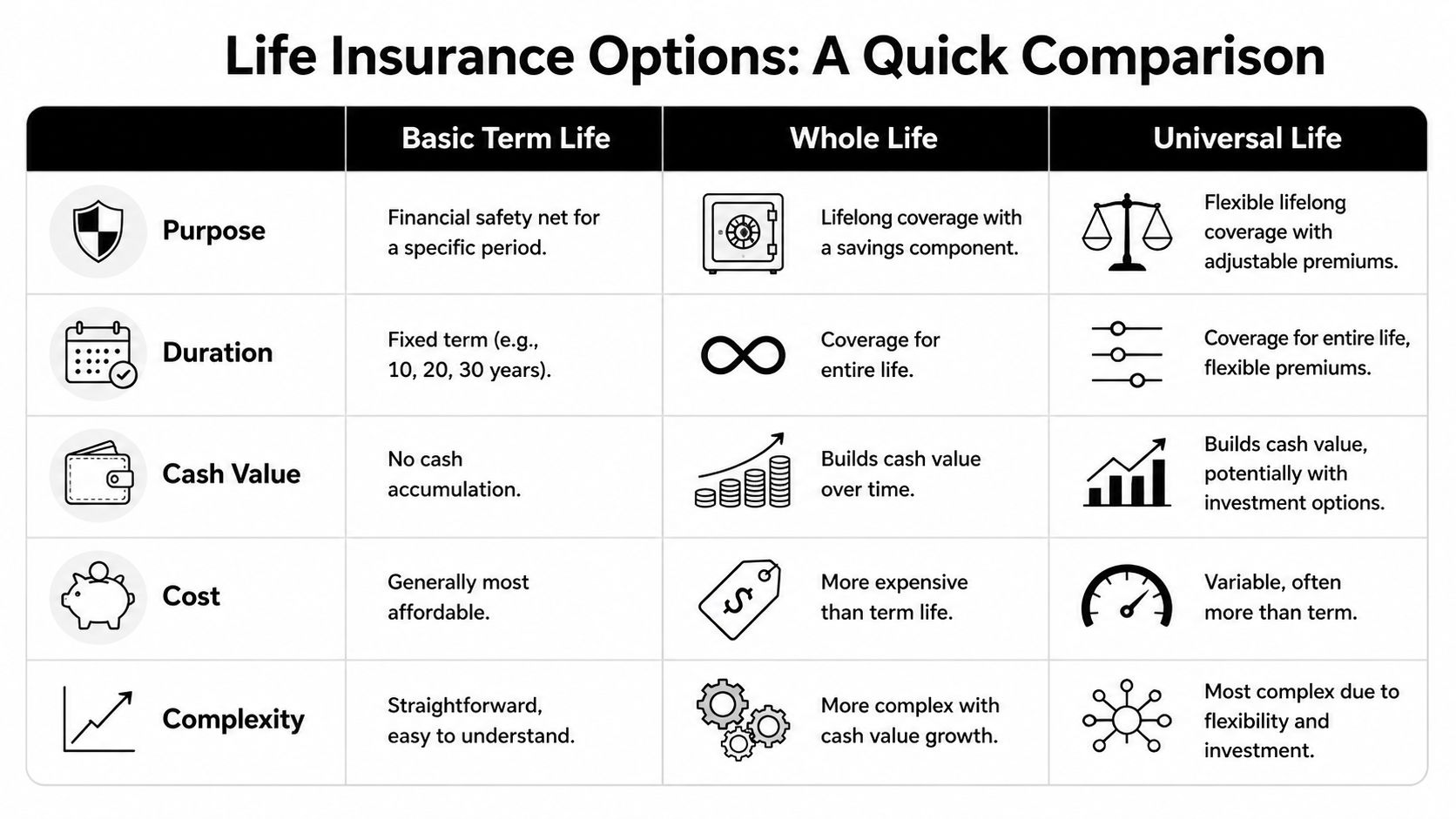
Term life is temporary. Whole life and universal life are forms of permanent insurance. That’s the biggest dividing line.
A basic term policy focuses on pure insurance risk. According to SmartAsset’s explanation of basic life insurance, term premiums can be 50% to 75% lower than whole life because the policy covers a defined period and doesn’t build cash value. That same source notes that the death benefit is typically received income-tax-free by beneficiaries.
Term life is usually the cleanest answer when your goal is protecting income, a mortgage, or your children’s everyday needs during your working years.
Quick comparison table
| Policy type | Coverage length | Cash value | Cost style | Best fit for |
|---|---|---|---|---|
| Basic term life | Fixed period | No | Generally lower | Families and professionals who want straightforward protection |
| Whole life | Lifelong | Yes | Higher | People who want permanent coverage with a savings component |
| Universal life | Lifelong with flexibility | Yes | Often variable | People comfortable with more complexity |
Where people get tripped up
People often hear “permanent” and assume that means “better.” Not always. Better depends on the problem you’re solving.
If your main concern is, “What happens to my partner if I die while we still owe on the house?” then a term policy matches that problem well. The same goes for replacing income while your kids are still young or while you’re in your peak earning years.
If your main concern is lifelong coverage plus a cash value feature, then whole life or universal life may enter the conversation. But they usually require more explanation, more monitoring, and higher premiums.
A simple checklist helps:
- Choose basic term life if you want clear coverage for a set number of years.
- Look at whole life if permanent protection and cash value are both priorities.
- Approach universal life carefully if you want flexibility and understand that flexibility adds complexity.
For a side-by-side explanation in plain English, this resource on term vs whole life insurance can help you compare the tradeoffs.
Who Truly Needs Basic Life Insurance Coverage
A simple way to look at life insurance is this: if your income, unpaid work at home, or shared financial commitments help keep someone else stable, you likely need coverage.
That can apply earlier than people expect. A couple does not need children or a large estate for life insurance to matter. If one person’s paycheck helps cover rent, a mortgage, childcare, groceries, or debt payments, the loss of that person can leave the other scrambling at the worst possible moment.

Three everyday situations where coverage makes sense
A newly married couple buys a home and combines their finances. On paper, everything may look manageable with two incomes. In real life, one loss can turn a comfortable mortgage payment into a monthly crisis. Basic term life can give the surviving spouse time to grieve without having to make rushed decisions about selling the house or draining savings.
A young family has its first child. One parent may step back from work, or both incomes may be tied to the cost of housing and childcare. In that case, life insurance works like a financial shock absorber. It can help replace lost income and keep the household running while the family adjusts.
A young professional is building a career and assumes life insurance can wait. But a partner may rely on their income, parents may need support, or private debts may fall on loved ones. There is also a portability gap that catches people off guard. Employer basic life insurance often stays tied to the job, so coverage can shrink or disappear when someone changes employers, gets laid off, or starts working independently.
That last point matters more than it used to. People switch jobs more often, pick up contract work, and piece together benefits across different employers. Group life insurance at work can be a helpful base, but it is not always a policy you can count on following you through those changes.
Why younger households should pay attention
Cost confusion keeps plenty of families from acting. Industry research from LIMRA has found that consumers often overestimate the price of life insurance, which can cause them to delay buying coverage they can likely afford. Waiting usually means applying at an older age, when rates tend to be higher and health changes can limit options.
For younger families and professionals, an individual no-exam term policy can solve the portability problem directly. You own the policy. It is not tied to your employer, your benefits package, or your next job change. That flexibility can be especially helpful if your career path includes promotions, relocation, freelance work, or time away from a traditional employer.
If you are trying to decide whether your situation calls for a small policy or something larger, this guide on how much life insurance you need can help you estimate a practical amount.
The key question is not your age. It is whether someone would have to pick up the bills, the childcare, or the financial fallout if you were gone. If the answer is yes, basic life insurance deserves a place in your plan.
How to Choose Your Coverage Amount and Term Length
Choosing a life insurance amount can feel like trying to pack for a trip you hope your family never has to take. The goal is not to guess perfectly. The goal is to leave enough behind so the people you love have time, options, and breathing room.

Start with what your income is doing for your household
A simple starting point is income replacement. Ask yourself one practical question: if your paycheck stopped tomorrow, what would your household need covered, and for how long?
For some couples, that means replacing several years of income so the surviving partner can keep up with rent or the mortgage, groceries, childcare, and everyday bills. For others, it also means setting aside money for debts, final expenses, or future costs like college.
A helpful way to estimate it is to look at:
- Who relies on your income: a spouse, children, or even a parent you help support
- What bills would stay behind: housing, loans, utilities, insurance, and childcare
- What one-time costs might show up: funeral costs, moving expenses, or paying down debt
- How long support would be needed: a few years, until the kids are grown, or until a mortgage is manageable on one income
Rules of thumb can get you started, but your household budget gives the clearer answer. If you want help running the numbers, this guide on how much life insurance you need walks through a practical way to estimate your coverage.
Choose a term that lines up with the years that matter most
The term is the length of time the policy stays in force, such as 10, 20, or 30 years. A good choice usually follows the timeline of your biggest financial responsibilities.
If your children are toddlers, a 20-year term may cover the stretch when they need you most. If you just bought a home, you may want a term that overlaps with the years when that payment would be hardest for your family to carry alone. If you are the higher earner in a single-income household, a longer term can give your partner more time to adjust.
Here is a simple way to frame it:
| Financial responsibility | Coverage idea |
|---|---|
| Young children at home | Choose a term that covers the years they will depend on you most |
| Mortgage debt | Match the term to the years when the payment would be hardest to absorb |
| Single-income household | Focus on enough income replacement time for the family to adjust |
Life insurance works best when it has a job to do. When you tie the policy to a specific need and a specific time horizon, the decision gets much easier.
Later in your search, it can help to watch a quick walkthrough before you apply.
Factor in the portability gap before you settle on a number
This is the step many young families skip. They calculate a coverage amount, see a basic life benefit at work, and assume the problem is solved.
But employer coverage often has a portability gap. The amount may be too small, and it may disappear when you change jobs, get laid off, move into freelance work, or take time away from a traditional employer. A policy that only works while you stay at one company is a bit like renting safety instead of owning it.
As noted in this article on the portability gap in employer life insurance, relying only on employer coverage can leave families exposed during career changes. That matters because your need for protection usually does not end when your job changes.
So when you choose your amount and term, ask two questions together:
- How much coverage would my family need?
- Would that coverage stay with me if my job changed next month?
If the answer to the second question is no, an individual no-exam term policy can fill that gap. You choose the amount. You choose the term. And the coverage stays with you, not your employer. For a workforce that changes jobs more often than it used to, that flexibility can be just as important as the dollar amount itself.
Getting Covered A Simple Modern Approach
A lot of people still picture life insurance as paperwork, medical appointments, and weeks of waiting. That can happen, but it’s no longer the only path.
Today, getting basic term life coverage can be much more direct, especially if you’re looking at digital, no-exam options.

What the process looks like now
Most modern applications follow a straightforward flow:
- You choose a coverage amount and term. Your household budget and responsibilities drive this decision.
- You answer health and lifestyle questions. Depending on the insurer and the amount you want, you may not need an exam.
- The insurer reviews your information. In many cases, the process is much faster than people expect.
- You accept the offer and activate coverage. Then you keep the policy as long as you continue paying for it.
This is a big shift from the old assumption that every applicant has to schedule labs and chase paperwork. For people balancing work, kids, and daily life, simplicity matters.
Why buying your own policy can be the cleaner move
If you already have coverage at work, you may wonder whether you should just convert it if you leave. That sounds convenient, but it isn’t always the best financial move.
According to this analysis of supplemental employer coverage and conversion costs, many professionals don’t realize that converting an employer supplemental policy after leaving a job can make premiums 5 to 10 times higher. The same source notes that new individual no-exam policies from digital platforms can be 30% to 50% cheaper and may offer portable coverage up to $3M.
That portability changes the decision. An individual policy belongs to you, not your employer. You don’t need to rebuild your protection every time your career shifts.
A good buying mindset looks like this:
- Use work coverage as a bonus: Treat employer life insurance as useful extra protection, not your only plan.
- Prioritize ownership: A personally owned policy moves with you from job to job.
- Choose simplicity when possible: If no-exam term coverage meets your needs, that can remove a major barrier to getting started.
The best policy isn’t the one that looks good during open enrollment. It’s the one your family can count on even after your job title changes.
Frequently Asked Questions About Basic Life Insurance
Can I have both an employer policy and an individual policy
Yes. Many people do.
That setup often makes sense because the employer policy provides a base layer of coverage, while the individual policy gives you something you control directly. This can be especially useful if your work policy is modest or tied closely to your job status. The key is making sure the total amount matches your responsibilities, not just what your benefits portal happened to offer.
What riders should I ask about
Riders are optional features that can add flexibility to a policy. Availability varies by insurer, so it’s smart to ask what’s offered and what problem each rider is meant to solve.
A few examples to ask about include:
- Accelerated death benefit rider: This may allow access to part of the death benefit under certain serious health circumstances.
- Child rider: Some policies let you add limited coverage for children.
- Waiver of premium rider: This may keep the policy active if you become disabled and can’t work.
You don’t need every rider. Ask whether the rider solves a real need in your household or just adds cost and complexity.
Are life insurance payouts taxable
In many cases, beneficiaries receive the death benefit income-tax-free, as noted earlier from the SmartAsset explanation. That’s one reason term life can be such practical protection. The money is generally intended to preserve the family’s financial stability at a difficult time.
That said, tax treatment can become more nuanced depending on policy structure, ownership, and estate issues. If your situation is more complex, it’s worth checking with a tax professional or estate attorney before making final decisions.
For most young families and professionals, the bigger takeaway is simple:
- The death benefit is there for protection
- Term life keeps the structure straightforward
- Personally owned coverage helps close the portability gap
If you want life insurance that moves with your life, Coveredly offers online term life coverage with up to $3mm and no exams for most applicants. It’s a practical option for young families, newly married couples, and professionals who want flexible protection they can keep, even when work changes.