The face amount is the dollar figure printed on a life insurance policy that the insurer promises to pay when the insured dies or the policy matures, so a $500,000 term policy starts with a $500,000 face amount. That number looks simple on a quote screen, but it's really the starting point for what your family could receive, not a promise that ignores the contract around it.
Table of Contents
- A Quick Story That Puts Face Amount in Context
- What the Face Amount Actually Is in a Life Insurance Contract
- How the Face Amount Turns Into an Actual Payout
- Sizing the Face Amount to Your Household's Real Risks
- Two Real-Style Households Compared
- Choosing Between Term and Permanent Designs
- Common Myths About Face Amount Worth Ignoring
- Key Takeaways and Frequently Asked Questions
A Quick Story That Puts Face Amount in Context
Maya and Jordan signed their first mortgage on a Friday. By Sunday night, they were at the kitchen table with loan papers on one side, a laptop on the other, and a life insurance application asking a question they'd never considered. How much coverage do you want?
The screen offered round numbers. $250,000 sounded large. $500,000 sounded responsible. $1,000,000 sounded like something for wealthier people. None of those reactions told them what the number did, or whether it matched the mortgage they'd just taken on together.

That's the moment most people first ask what is face amount in life insurance. You're not studying insurance for fun. You're trying to protect a partner, a home, maybe children you have now or plan to have, and you don't want to guess at the one number the whole policy is built around.
Here's the plain version. The face amount is the stated amount of insurance in the contract. It's like the capacity printed on a moving truck. It tells you the size of the protection you selected, before you check what's loaded inside, what's been removed, and what extra features you've attached to it.
That analogy matters because two policies can show the same headline number and work differently underneath. One might be straightforward term coverage for the mortgage years. Another might build cash value, allow loans, or include riders that change the final payout.
By the end of this guide, you'll be able to do two things. First, you'll know exactly what the face amount represents on the policy page. Second, you'll know how to size that number to your household's real obligations instead of picking the option that merely feels big enough.
What the Face Amount Actually Is in a Life Insurance Contract
The diagram below maps the three places this term shows up, on the policy document, at death, and at maturity.
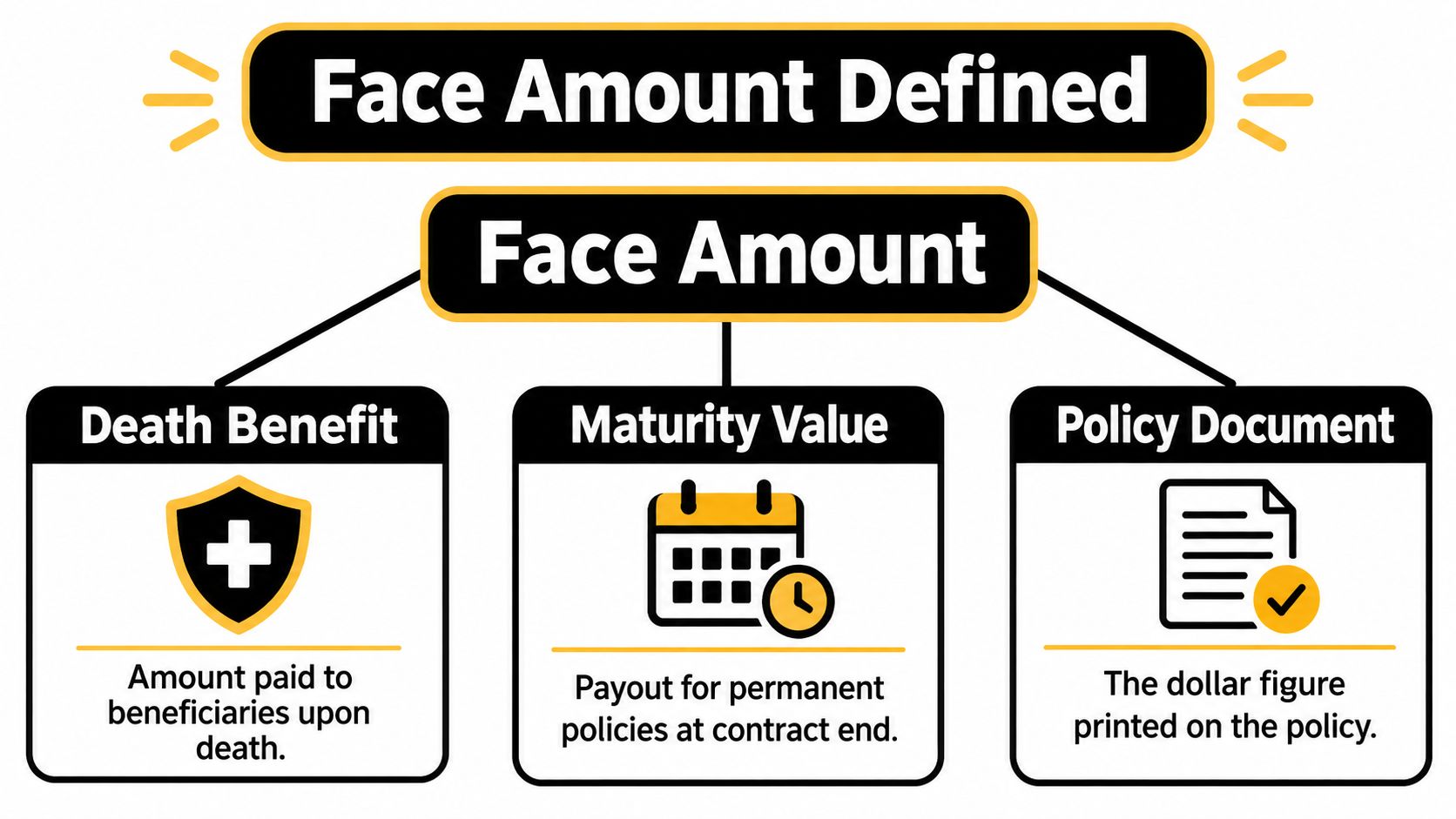
In contract language, the National Association of Insurance Commissioners glossary definition of face amount describes it as the sum of insurance provided by a policy at death or maturity. That reported amount can include the basic policy plus qualifying riders or additional insurance under an increasing-death-benefit policy.
Three nearby terms cause most of the confusion.
- Face amount: The stated coverage value in the contract. It's the insurance base you selected at issue.
- Premium: The price you pay to keep that coverage in force. It's what leaves your bank account, not what your beneficiaries receive.
- Cash value: A separate value that may accumulate inside permanent life insurance. It's not the same bucket as the face amount, and it doesn't automatically stack on top of it.
The face amount is the policy's stated insurance base, while the death benefit is what actually reaches beneficiaries under the contract terms.
A basic example helps. If you buy a level term policy described as a $1 million policy, that $1 million is the face amount. The policy can have a large face amount and no cash value at all, which is typical of term insurance.
For a quick visual walkthrough of how these contract pieces fit together, watch this short explainer before comparing quotes.
Where the policy sits legally can matter too, especially for larger estates. Families exploring whether a policy should be owned personally or through a trust sometimes review resources on ILIT estate planning Florida to understand ownership questions before they finalize beneficiaries. The face amount stays the contract figure either way, but the surrounding structure shapes who controls the policy and how proceeds are handled.
How the Face Amount Turns Into an Actual Payout
The flow from printed figure to paid claim has a few checkpoints, and the infographic below lays them out in order.
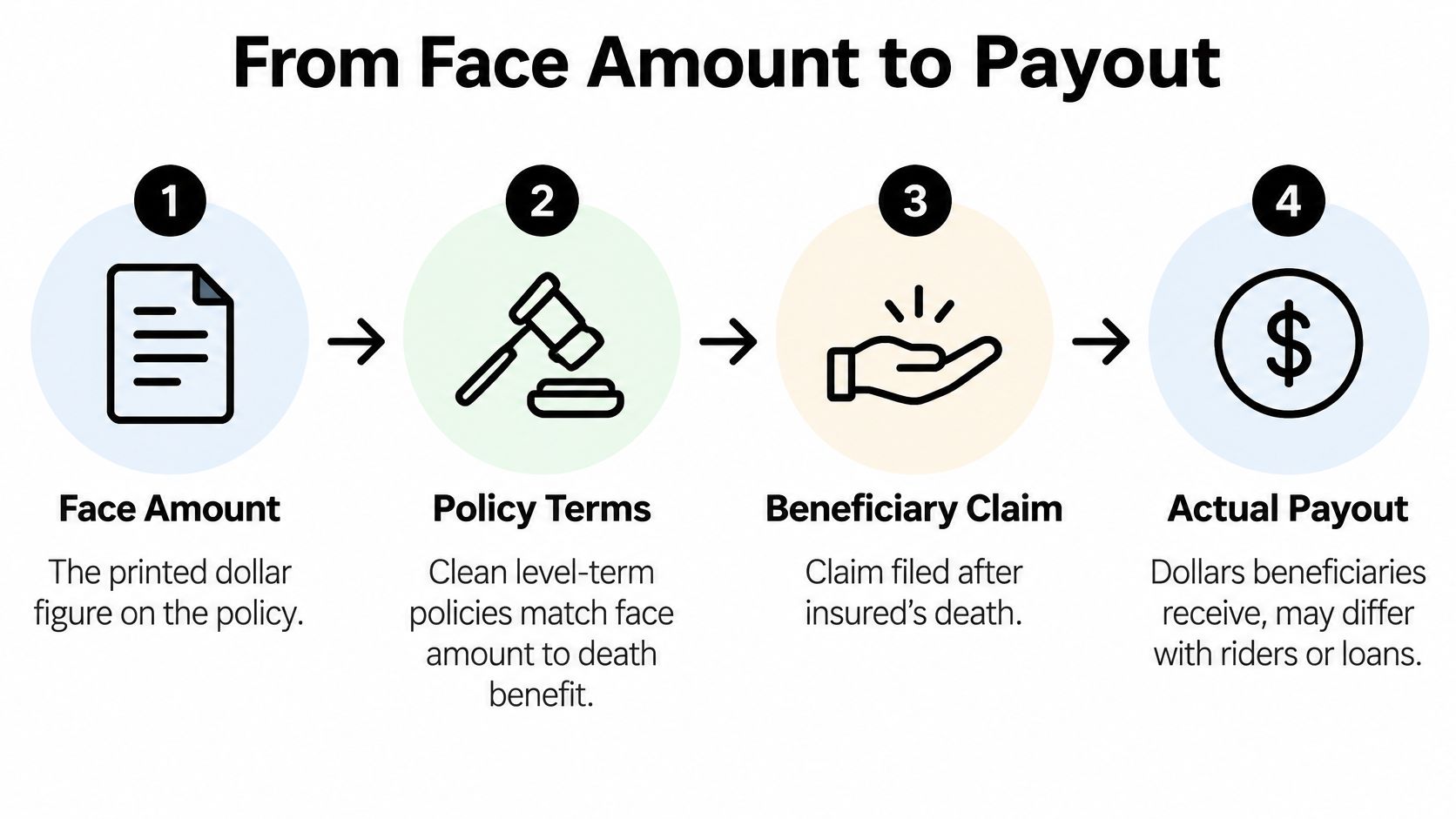
Start with the clean case. In a level-term policy with no deductions, the face amount and the death benefit typically match while the policy is in force. If death occurs during the covered term and premiums are paid, a $500,000 face amount ordinarily produces a $500,000 death benefit. If you want the companion definition, this guide on what a death benefit means in a life insurance policy covers the payout side directly.
Permanent policies add moving parts. The NAIC consumer guide to life insurance payouts and policy loans explains that beneficiaries generally receive no more than the policy's stated death benefit, even if the policy had accumulated cash value, and that unpaid policy loans and accrued interest are deducted from the death benefit.
A Worked Example With a Loan
Take a policy with a $500,000 face amount and $40,000 of outstanding loans. Before other contractual adjustments, beneficiaries could receive approximately $460,000, not the full $500,000. The family didn't lose money to a hidden fee. The policyholder borrowed against the contract during life, and the insurer settles that debt from the proceeds at death.
Policy design can also push the number the other direction or change the formula entirely.
- Riders: An accidental-death rider or other qualifying rider can add amounts beyond the base policy figure.
- Variable life: The death benefit may be structured as the face amount alone, the face amount plus account cash value, or another contract-defined formula.
- Universal life: Some contracts calculate the benefit as the greater of a specified face amount, a face amount plus cash value, or an amount required by tax-law cash-value rules.
- Living benefits: Accelerated payments made during life can reduce what remains payable at death.
So treat a $1 million face amount as the policy's stated insurance base. For simple term coverage, it's usually the planned payout. For permanent designs, check the current in-force benefit, any loans, and the benefit formula before you assume the check size.
Sizing the Face Amount to Your Household's Real Risks
A salary multiple is easy to calculate and easy to get wrong. It doesn't know whether you have a mortgage, young children, a partner who works unpaid at home, or private school tuition ahead. A household-risk calculation starts from the survivor's actual cash-flow gap instead.
The need is widespread. LIMRA's 2025 Insurance Barometer findings on coverage gaps found that 40% of U.S. adults, nearly 100 million people, believe they need more life insurance, while 47% said their household would struggle to pay living expenses within six months after the primary wage earner's death.
Add Up the Exposure First
Work through these categories with your own figures, then subtract what you already have. A step-by-step version of how to calculate how much life insurance your household needs can help you organize the inputs.
- Debts: Add the mortgage, student loans, car loans, and other balances your family would still owe.
- Income replacement: Estimate how many years of earnings your survivors would need to maintain stability.
- Childcare and household services: Count the work a stay-at-home or part-time parent does, because replacing it with paid help costs real money.
- Education funding: Include the schooling goals you'd still want funded.
- Final expenses: Add funeral costs and any final medical bills.
Then subtract existing savings, other reliable assets, and employer coverage you can count on. Be careful with that last item. Employer-sponsored coverage can disappear after a job change, so it's a weaker foundation than a policy you own yourself.
Two Quiet Risks People Miss
Inflation erodes a nominal benefit over a long policy term. A face amount that covers today's expenses may cover less of the same expenses later in a 20- or 30-year term. And the premium is a separate decision, shaped by age, health, term length, and policy type. Don't reverse-engineer the face amount from a monthly price that feels comfortable.
Families often revisit this math alongside broader estate documents, which is why resources from The Law Office of Bryan Fagan on later-life planning can be a useful companion read. The policy number and the legal plan should point at the same household risks.
Two Real-Style Households Compared
Numbers get clearer when you watch two households run the same calculation and land in different places. Both examples below are illustrative, built to show how the inputs drive the face amount rather than to prescribe a figure for your family.
The first household is a newly married couple in their early thirties. They have a $280,000 mortgage, no children yet, and two incomes. If one partner died, the survivor could cover many daily expenses alone, but the mortgage and a few years of lost income would still create a gap. Their face amount is shaped mainly by the mortgage balance, shorter income replacement, and final expenses.
The second household has two young children, a $420,000 mortgage, and one working parent. Losing that income means replacing earnings for many more years, paying for childcare the family currently provides itself, and keeping college savings goals alive. Their exposure is larger in every category.
Household Risk Inputs and Chosen Face Amounts
| Input | Newly Married Couple | Family With Young Children |
|---|---|---|
| Mortgage balance | $280,000 | $420,000 |
| Incomes in household | Two earners | One earner, one parent at home |
| Income replacement need | A few years to stabilize | Many years until children are grown |
| Childcare costs | None yet | Significant, currently unpaid |
| Education funding | Not yet planned | College goals included |
| Final expenses | Included | Included |
| Direction of face amount | Moderate, mortgage-led | Larger, income and childcare-led |
Notice what the comparison is really showing. The second family doesn't need a bigger face amount because they're more cautious. They need it because one income supports more people for more years, and the unpaid labor at home would become a paid expense overnight.
Premium direction follows the face amount. Raising the coverage number raises the price, because the insurer is promising a larger payout. But the first couple can also see their future in the second column. Add children and a bigger mortgage, and yesterday's adequate face amount becomes too small. That's why the calculation is worth redoing at each major life stage, not because the first answer was wrong, but because the household changed underneath it.
Choosing Between Term and Permanent Designs
Once you've sized the number, you still have to choose the structure that carries it. The comparison below shows the basic split.
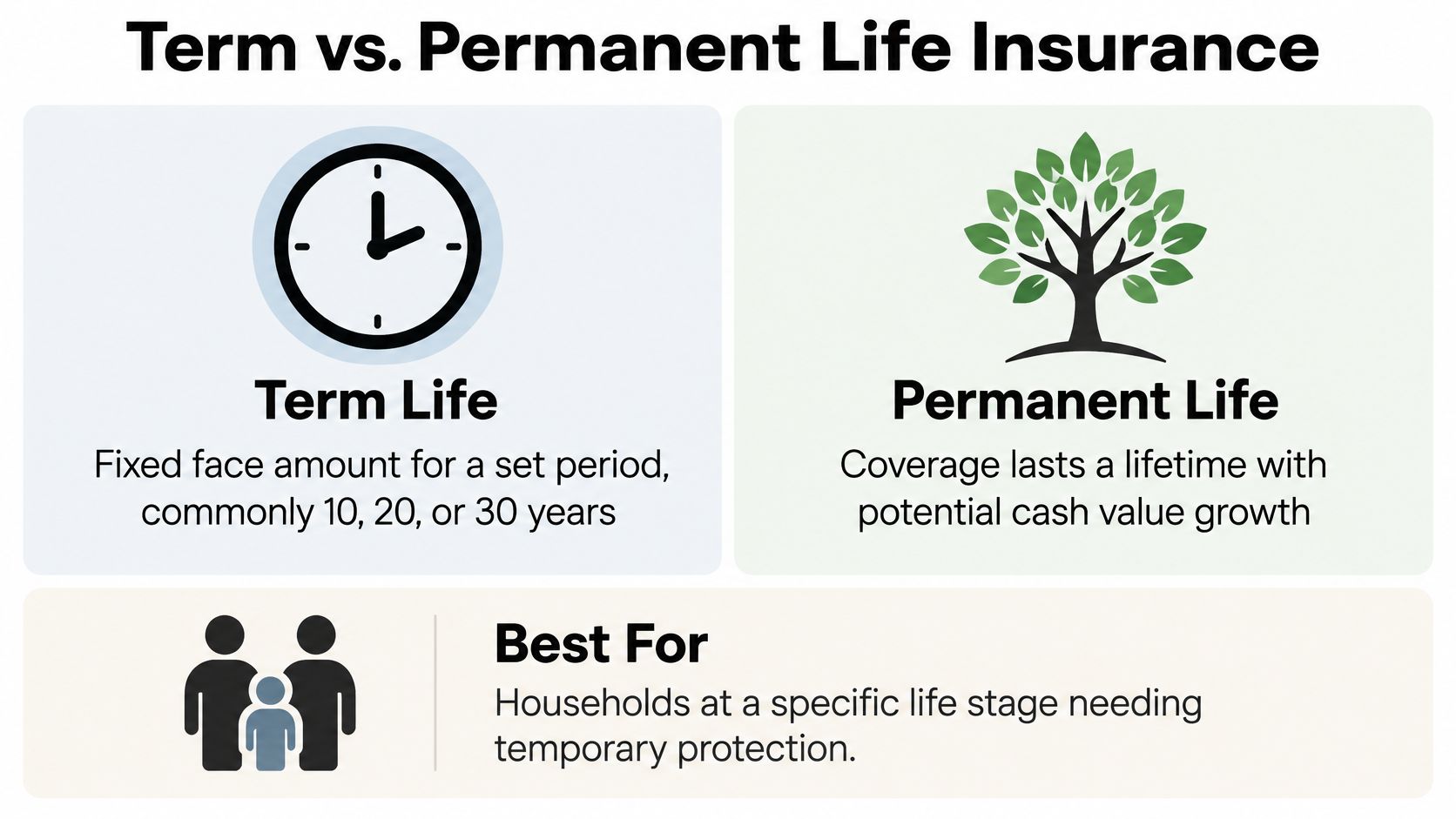
Term life insurance pairs a fixed face amount with a set period, commonly 10, 20, or 30 years. For level-term coverage, the face amount and death benefit typically remain guaranteed and unchanged throughout the term, provided premiums are paid and the policy remains in force. It's renting protection for a defined chapter of life, the mortgage years or the child-raising years, with no cash value building inside.
Permanent life insurance is structured differently. A whole-life policy commonly combines a fixed amount of lifetime insurance with tax-deferred cash-value accumulation, and the policy may permit borrowing against that value. The NAIC overview of whole life premiums and cash value notes that under ordinary level-premium whole life, premiums remain consistent until the insured dies or reaches the policy's terminal age, at which point the cash value may equal the policy's face amount.
That detail proves the core distinction. If cash value only reaches the face amount at the terminal age, then along the way the face amount is the fixed insurance promise, not the current account balance. Borrowing against the cash value can reduce what beneficiaries ultimately receive, which never happens in a plain term policy because there's nothing to borrow against.
If you're weighing the two structures directly, this breakdown of term versus whole life insurance costs and features walks through the trade-offs. For most young families, a straightforward level-term policy locks in a clear face amount at the lowest cost for the years when the financial exposure is highest. Permanent designs fit households with lifetime obligations or specific estate goals that justify the extra features and complexity.
Common Myths About Face Amount Worth Ignoring
Misconceptions about this one term distort coverage decisions. Each myth below sounds reasonable at a kitchen table, and each one breaks down against how contracts really work.
Myth One the Face Amount Is Always the Final Payout
Reality, the face amount is a contractual starting point. Loans, accrued interest, withdrawals, and benefit-option formulas can lower what beneficiaries receive below the stated figure, while certain riders can add to it. In a clean term policy the two numbers usually match, but that match comes from the policy's simplicity, not from a universal rule.
Practical rule: Always ask for the current in-force death benefit, not just the face amount printed at issue.
Myth Two Bigger Is Always Better
Reality, an oversized face amount means higher premiums for coverage your household doesn't need. Money spent insuring risks you don't have is money not going toward savings, debt payments, or other protection that fits better. The goal is a face amount matched to your actual exposure, not the largest number an insurer will approve.
Myth Three the Face Amount Never Changes
Reality, riders, increasing-death-benefit designs, and conversion provisions can all shift the effective amount over time. Your need for coverage also changes when you buy a home, have a child, or change jobs, even if the contract figure sits still. A face amount chosen at one life stage deserves a fresh look at the next one.
Myth Four a Small Face Amount Is Pointless
Reality, even a modest policy can bridge a specific obligation, such as final expenses or a remaining mortgage balance in the later years of a loan. Sized to a defined risk, a smaller face amount does exactly the job it was bought for. The mistake isn't buying a small policy. It's buying any policy without knowing which risk the number is meant to cover.
Key Takeaways and Frequently Asked Questions
The whole topic compresses into three sentences. The face amount is the dollar figure stated on the policy. The death benefit is what beneficiaries receive after the contract's formula, riders, and deductions are applied. The right face amount is the one that matches your household's real financial exposure, and the premium is a separate decision shaped by age, health, term length, and policy type.
One maintenance habit protects that work. NAIC reporting guidance on face amount and in-force benefits indicates that face amount may include the basic policy plus qualifying riders or additional amounts under increasing-death-benefit designs, and that policyholders should compare the current in-force death benefit, not just the original face amount, against outstanding loans and rider amounts.
Frequently Asked Questions
Will a $1 million policy always pay $1 million? Not automatically. In a level-term policy with premiums paid and no adjustments, that's the expected payout. In permanent designs, loans, withdrawals, or a contract formula can change the final amount.
How is the face amount different from the premium? The face amount is the coverage value your beneficiaries are meant to receive. The premium is the price you pay to keep that coverage active.
When should I adjust my coverage? Revisit the face amount after major life events, including a new child, a home purchase, a job change, or a shift to one income. Run the household-risk calculation again with current figures.
Ready to turn your household-risk calculation into an actual coverage amount? Coveredly offers online term life insurance you can size to your mortgage, income, and family goals, with a digital application built for busy households. Get a quote today and choose a face amount based on your real numbers, not a guess.