You're probably looking at two quotes after a major life change. Maybe you've just signed a mortgage, welcomed a child, or realized that your income supports far more than this month's bills. The cheaper quote is attractive, but the longer quote seems safer. The right answer isn't just “buy as much coverage as possible.” It's to match the policy's end date to the years when your family would struggle most without your income.
For most households, 20-year term life insurance is the sensible default. A 30-year policy becomes the better choice when your mortgage, children, business obligations, or retirement timeline extend well beyond the next two decades. The extra decade can be worth paying for, but only when it protects a specific financial milestone.
Table of Contents
- Understanding the Core Mechanics of Term Lengths
- Why the 20-Year Term Dominates the Market
- Breaking Down the Premium Cost Differences
- Aligning Coverage With Your Financial Milestones
- Real-World Scenarios for Families and Professionals
- The Hidden Costs of Waiting and Renewing Later
- Securing Your Coverage in a Digital-First Market
Understanding the Core Mechanics of Term Lengths
Consider a couple in their early 30s. They have a new mortgage, a young child, and one income that currently covers most of the household's expenses. Their quote comparison shows two policies with the same death benefit, but one lasts 20 years and the other lasts 30. The important difference isn't what happens during the first year. Both policies can protect the family during that period. The difference is whether protection remains in place when the child is older, the mortgage is closer to its final payment, and the parents are approaching a different stage of their careers.
A 20-year term policy provides coverage for a fixed 20-year period. The premium generally remains level during that term, and beneficiaries receive the death benefit if the insured dies while the policy is active. If the insured is still living when the policy ends, the policy no longer provides that death benefit, as explained by Guardian Life's overview of 20-year term insurance.
A 30-year term policy follows the same basic structure but keeps the protection in force for an additional decade. Longer terms generally cost more because the insurer accepts mortality risk for a longer period, a point outlined in Allstate's explanation of term life insurance.
What you're buying
Term insurance is designed to protect a defined period of financial dependence. You're not primarily buying an investment account. You're buying a death benefit that can help replace income, support children, address debts, and preserve a household's financial plan if you die during the covered years.
That simplicity is one reason term policies can fit a family budget more easily than permanent coverage. A fixed premium also makes planning easier. Once the policy is issued, you know the scheduled premium for the selected term, subject to the contract's provisions.
Practical rule: Choose the policy end date by looking at the last year your family would need your income, not by choosing the lowest monthly quote.
The 20-year option is often enough when children will be financially independent, major debts will be substantially reduced, and retirement savings will have had time to grow before the policy expires. The 30-year option is more appropriate when those milestones arrive later or when the household has obligations that won't disappear on a neat schedule.
Why the 20-Year Term Dominates the Market
A couple in their 30s may have a large mortgage, young children, and limited room in the budget. They need protection during the years when one lost income could destabilize the household, while still funding childcare, housing, emergencies, and retirement. A 20-year term often fits that timeline without paying for coverage long after the main financial risks have passed.
Per Forbes Advisor's life insurance statistics, 39.3% of new life insurance policies sold in 2022 were term policies, 48% of households reported owning term life insurance, and policies lasting 11 to 30 years accounted for 41.95% of the term insurance market share in 2025. These figures describe a large, established market, not a universal recommendation for a 20-year policy.
The 20-year term earns its popularity by matching common household milestones. For parents with young children, the end date may fall after the children finish school, become financially independent, or reach their early working years. For homeowners, it may cover much of the mortgage period while other assets and retirement savings continue to grow.
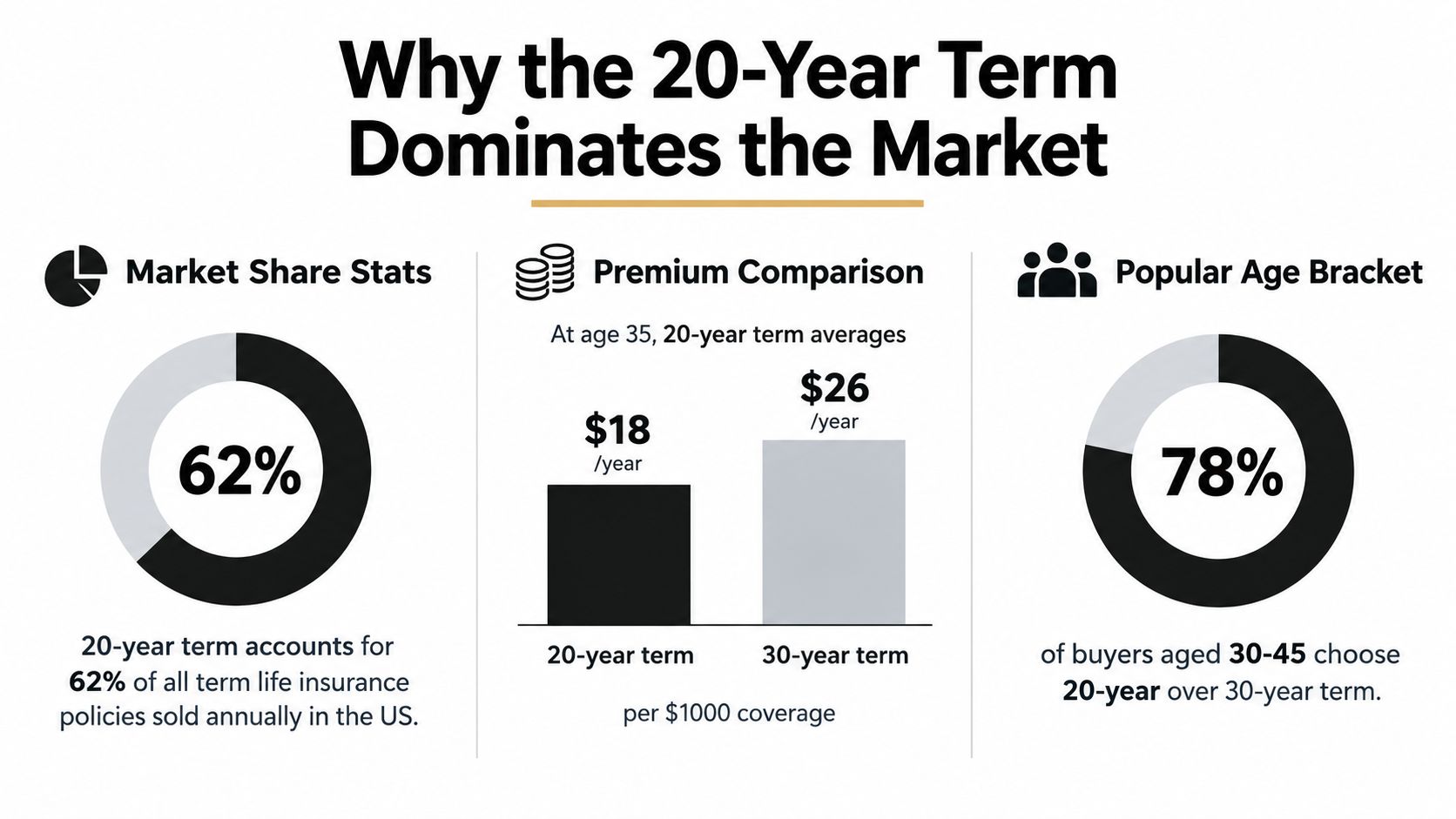
The accompanying infographic reports a 62% market share and 78% popularity among buyers for 20-year term life insurance. Those figures reinforce its market position, but your mortgage balance and children's ages should determine whether the term fits your household.
Why shorter doesn't mean inadequate
A 20-year policy is a sound choice when its end date follows the family's highest-dependence years. Independent market data cited by The Wall Street Journal's guide to 20-year term life insurance indicates that 20-year term accounts for nearly 40% of term policies sold. It remains a practical middle ground for families that need substantial protection without extending the policy beyond their core obligations.
Choose 30 years when the timeline demands it. That includes starting a family later, taking on a mortgage that will run well into later working years, needing income replacement for longer, or owning a business that relies heavily on your continued involvement. A longer term also reduces dependence on qualifying for a new policy after your health or age changes.
Use the policy end date as a planning tool, not a default. For a practical overview, read this guide to 20-year term life insurance, then compare its expiration date with your mortgage schedule, your children's ages, and your expected retirement savings.
Breaking Down the Premium Cost Differences
A 30-year term costs more because it covers an additional decade, when the insured is older and the chance of a claim is higher. The insurer is pricing both the longer protection period and the increased mortality risk during those later years.
For a healthy, nonsmoking 30-year-old seeking $500,000 of coverage, benchmark pricing shows a clear difference between terms. The figures below come from Yahoo Finance's life insurance rate comparison.
| Applicant profile | 20-year term cost | 30-year term cost | Monthly difference |
|---|---|---|---|
| Healthy, nonsmoking 30-year-old woman | $23.10 per month | $34.52 per month | $11.42 |
| Healthy, nonsmoking 30-year-old man | $29.32 per month | $42.45 per month | $13.13 |
For these profiles, the extra decade raises the monthly premium by roughly 40% to 50%. That increase may fit comfortably within one family's budget and strain another's. Do not choose a longer term if its premium forces you to stop building emergency savings or reduce retirement contributions. The policy should protect the household without weakening its other financial foundations.
Age changes the decision
The price difference usually matters more as the applicant gets older. For a healthy 40-year-old buying a $500,000 policy, reported average annual premiums were about $331 for 20-year term and $579 for 30-year term, according to MoneyGeek's analysis of term insurance and longevity.
A 30-year policy bought at 40 can extend protection into an age when replacing coverage may be difficult or expensive. A 20-year policy may end before retirement, which works if the mortgage is nearly paid and the children will be financially independent by then. It creates a problem if the policy expires while those obligations still depend on the insured's income.
Coverage amount also widens the gap. For a healthy 30-year-old nonsmoking woman, one benchmark places $1,000,000 of 20-year coverage at about $48 per month and the same amount of 30-year coverage at about $96 per month, according to Guardian Life's 30-year term insurance guide.
The right question isn't “Can I afford the 30-year premium?” It's “What financial obligation would still exist after the 20-year policy ends?”
Use this guide to term life insurance premiums to examine how insurers price coverage. Then compare the extra premium with your mortgage payoff date, your children's ages, and the point when your income would no longer support dependents. Because life insurance is one line in a larger protection budget, the same discipline applies to property cover. See this guide to managing home insurance costs for how households size those premiums.
Aligning Coverage With Your Financial Milestones
Start with the policy expiration date, then work backward. Don't begin with the term that looks cheapest. Begin by asking what your family would still owe, fund, or replace when the policy ends.
A mortgage is an obvious starting point, but it isn't the only one. Children may remain dependent after the mortgage balance falls. A spouse may need income replacement for longer than expected. A business loan, ownership agreement, or special care obligation can also extend the period when life insurance remains essential.

Build your milestone map
Use a simple household worksheet. Write down the approximate year each obligation should end, then compare those dates with a 20-year and 30-year policy.
Mortgage payoff: Estimate when the home loan should be paid off under the current payment plan. A mortgage with a long contractual schedule may still be eliminated earlier through extra payments, refinancing, or a planned sale.
Children's independence: Consider when each child may stop relying on household income. A newborn creates a much longer protection horizon than a child already approaching adulthood.
Education and training: Decide whether you want the death benefit to help fund college, vocational training, or another transition into independent adulthood. The policy doesn't need to match a school calendar perfectly, but it should remain active through the years when support matters.
Retirement readiness: Ask when your spouse could reasonably maintain the household without your earnings. A policy may need to extend until assets and retirement income can replace part of your contribution.
Business and estate obligations: Business owners should examine debt, ownership transfer, and the financial effect of losing a key operator. Families with substantial estate concerns may also want to understand asset protection with Law Office of Bryan before selecting a long-term structure.
Make the end date intentional
A 20-year term may work for a couple with older children and a mortgage they expect to clear well before the policy expires. A 30-year term deserves serious consideration for parents with a newborn, buyers who start families later, or professionals whose income supports obligations that won't shrink quickly.
Don't assume a 30-year mortgage automatically requires a 30-year policy. The contractual mortgage period and the household's intended payoff date may differ. Conversely, don't assume that a mortgage payoff ends the need for coverage if a spouse or child would still rely on your income.
A policy should expire because the risk has declined, not because the calendar ran out.
Real-World Scenarios for Families and Professionals
A 20-year policy is often right for a young family with limited cash flow. Suppose two parents have recently taken on a mortgage and have a small child. They need meaningful income replacement, but their budget also has to cover childcare, housing, retirement savings, and routine emergencies.
If their child will be financially independent before the policy ends and they expect to reduce the mortgage substantially during that period, 20 years can cover the central dependency window without forcing them to pay for years they may not need. This family should choose a death benefit that addresses income replacement, debt, and immediate family costs, then review the plan as their income and savings change.
The later-starting family
Now consider a professional who becomes a parent later in life. A 20-year term may end while the child is still completing education or while the household is still relying on the parent's peak earnings. In this case, the extra decade is not a luxury. It protects a milestone the shorter policy misses.
A 30-year policy can also make sense when the buyer expects to work well beyond the next two decades, carries business obligations, or has a spouse who would need prolonged income replacement. The premium is higher, but the policy may prevent the family from needing new underwriting at an older age.
The business owner
Business owners should separate personal income replacement from business continuity. A family may need funds to replace earnings, while business partners may need liquidity to handle a transfer or debt. One policy may not solve both problems, and the correct term should reflect the longest obligation being protected.
For professionals comparing the longer option, this overview of 30-year term life insurance can help frame the decision around extended income needs rather than the premium alone.
The practical recommendation is straightforward:
- Choose 20 years when your children, mortgage, and major obligations should be behind you before the term ends, and the shorter premium helps you maintain a sustainable budget.
- Choose 30 years when a newborn, later parenthood, delayed retirement, business risk, or long income-replacement period makes the 20-year expiration date uncomfortable.
- Consider a combination when different obligations have different horizons. A longer policy can cover the core long-term risk, while other savings and shorter-term planning address expenses that should disappear sooner.
The Hidden Costs of Waiting and Renewing Later
A 20-year policy bought at 30 ends at 50. If your mortgage still has years to run, your youngest child still depends on your income, or retirement savings remain incomplete, replacing that policy is not a minor administrative task. It means applying again when your health, income, and insurability may have changed.
That insurability risk is the main hidden cost of waiting. A new application at 50 may require different health underwriting, and a medical diagnosis or treatment history could affect eligibility or the policy available to you. Renewal provisions can keep protection in place, but renewal premiums may rise as the insured gets older. Do not assume you will qualify for the same coverage later.

Price reinforces the case for securing the right term while you are younger. For a $500,000 policy, one pricing series lists monthly premiums of $18.16 at age 30, $28.03 at age 40, $68.99 at age 50, and $199.32 at age 60 for a 20-year term, according to InsuranceGeek's term life insurance rate data. These figures represent one benchmark, not a quote for every applicant, but they show how waiting can raise the financial burden.
The longevity problem
A policy can expire while the insured still has many years ahead. Roughly 4 million Americans turn 65 each year, and life expectancy at 65 is about 17.5 additional years for men and 20 additional years for women, according to MoneyGeek's longevity analysis.
Use the expiration date as a milestone test. Match it against the mortgage payoff, your children's path to financial independence, and the point when retirement assets should support the household without your income. A policy bought at 45 and ending at 65 may leave a working household exposed if dependents remain or savings have not caught up.
Choose 30 years when the extra decade covers an obligation you already expect to have. Paying for that protection can be more disciplined than relying on a future application that your health or finances may make harder to obtain.
Securing Your Coverage in a Digital-First Market
The application process has become less burdensome for many buyers. Online distributors, automated underwriting, simplified issue products, and no-exam options can reduce the paperwork and scheduling friction that causes busy families to delay coverage.
LIMRA reported that in the first quarter of 2026, U.S. term new annualized premium rose 9% year over year, policy count grew 5%, and term held an 18% share of the U.S. individual life market, with growth supported by online distribution and automated underwriting, according to LIMRA's first-quarter 2026 sales release. Those figures don't remove the need to compare policy terms, exclusions, beneficiaries, and conversion provisions. They do show that buyers increasingly have faster ways to begin the process.
A digital application can be useful when you already know the decision you're testing. Get quotes for both terms, enter the same coverage amount, and compare the premium against the milestone gap. For broader property and project-related insurance context, Aureli Construction insurance guidance offers another example of why coverage decisions should be tied to concrete risks rather than vague assumptions.
Don't wait for a perfect financial plan. Pick the term that protects your family's longest important obligation, confirm that the premium fits your budget, and submit the application while coverage is still affordable and available.
Coveredly offers online term life insurance, including 20-year and 30-year options, with up to $3 million of coverage and no exams for most applicants. Compare your term choices and start a quote through Coveredly before a major family milestone makes the decision more expensive.