A healthy 30-year-old non-smoker can often get $1 million of 20-year term coverage for roughly $40 to $55 per month. The actual quote depends on age, health classification, tobacco use, coverage amount, policy design, and the insurer's underwriting rules.
That range is a useful starting point, but it isn't a promise. Guardian's published examples put a healthy, non-smoking 30-year-old male at about $48.89 per month for $1 million of 20-year coverage and a comparable female at about $36.90 per month for the same amount (Guardian's term life rate examples). Another Guardian table shows roughly $53 per month for men and $63 for women at age 30, illustrating why sample tables can differ by underwriting assumptions and product design.
The practical question isn't just, “What are the average 20 year life insurance rates?” It's, “What would someone with my age, health, tobacco history, and financial obligations likely pay?” The guide below turns published figures into a decision framework you can use before requesting a quote.
Table of Contents
- What 20 Year Life Insurance Is and Why People Buy It
- The Five Core Factors That Drive 20 Year Term Rates
- Sample 20 Year Life Insurance Rates by Age and Gender
- How Coverage Amount Changes Your Monthly Premium
- Why Most Buyers Overestimate the Real Cost
- Practical Tips to Lower Your 20 Year Life Insurance Rate
- Next Steps to Lock In Your 20 Year Term Policy
What 20 Year Life Insurance Is and Why People Buy It
A couple in their early thirties sits at the kitchen table, comparing a mortgage statement with a stack of life insurance flyers. Their concern is straightforward. If one income disappeared, could the surviving partner keep the house, care for the children, and maintain the family's plans?
A 20-year term life insurance policy addresses that risk for a defined period. It pays a stated death benefit if the insured dies during the 20-year term. The premium is generally level during that period, and the death benefit remains level as well. If the insured outlives the policy, the contract usually ends without a payout or cash value (MoneyGeek's explanation of 20-year term life insurance).
A healthy 30-year-old non-smoker can often lock in $1 million of coverage for about $40 to $55 per month. The range exists because insurers don't price every applicant alike. Gender, health class, tobacco use, face amount, state, and carrier underwriting can all move the final offer.
The three building blocks
Most buyers need to understand three parts before comparing rates:
- Face amount: This is the death benefit, such as $500,000 or $1 million, paid to beneficiaries if the insured dies during the term.
- Level premium: The scheduled payment stays fixed throughout the initial 20-year period, which makes household budgeting easier.
- Conversion option: Many term policies let the policyholder convert some or all coverage to permanent insurance, subject to the contract's rules. The option can matter if health changes later.
Families often choose this term length because it matches a major financial horizon. A 20-year policy may align with a mortgage payoff, college costs beginning around kindergarten, income replacement until a younger spouse reaches retirement, or repayment of a business loan. The right duration follows the obligation, not just the lowest advertised monthly price.
Practical rule: Choose the term by asking when your dependents or debts should no longer rely on your income.
Life insurance also fits into a broader household plan. Readers building emergency savings, investing, and paying down debt may find Velzee's guide to building wealth useful alongside insurance planning. A 20-year policy won't replace those activities, but it can protect the people who depend on them.
The rest of the pricing decision becomes clearer once you separate the variables. First identify the factors insurers weigh most heavily, then compare age-based examples, test different face amounts, and request quotes from carriers that underwrite your profile favorably.
The Five Core Factors That Drive 20 Year Term Rates
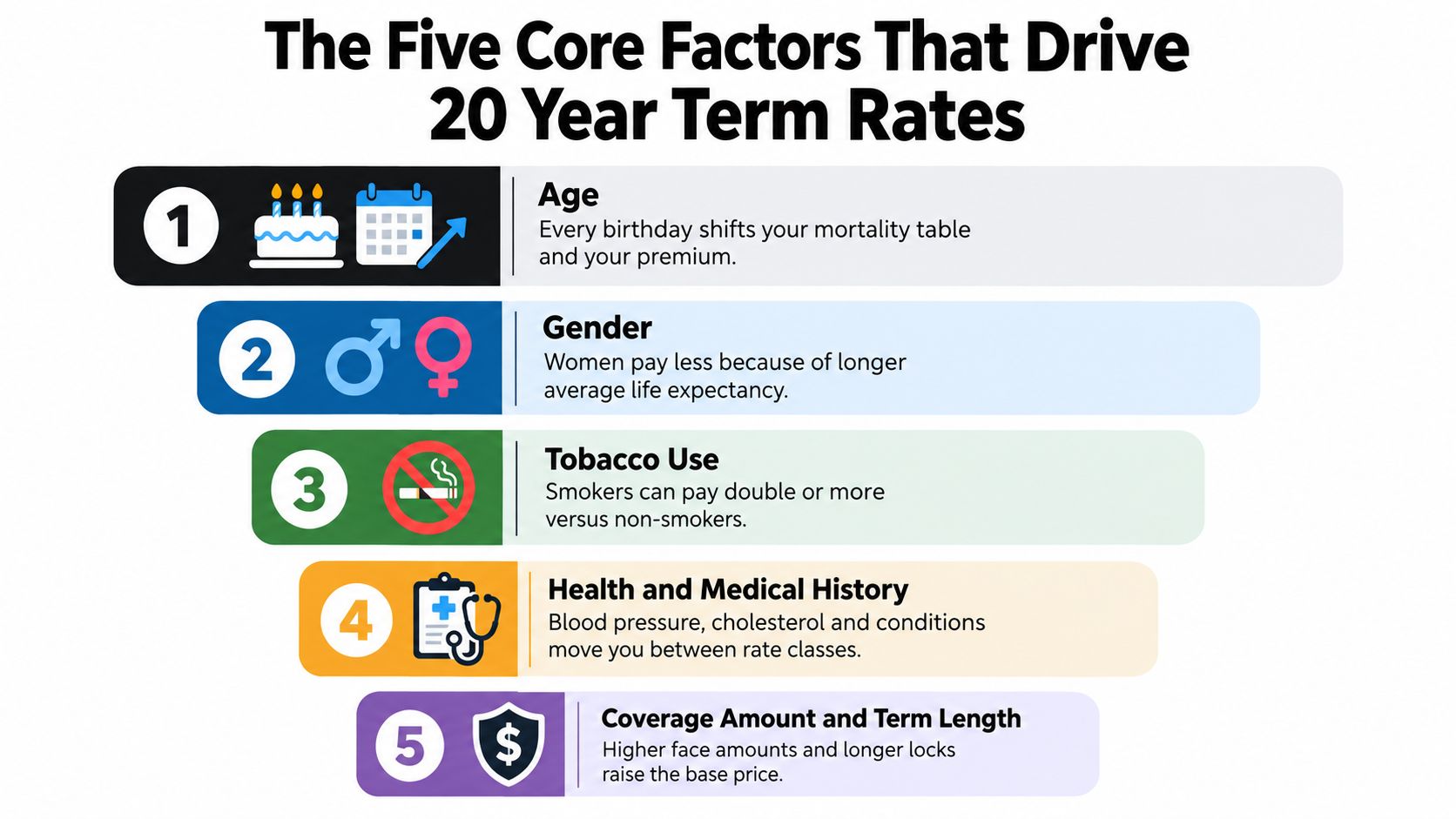
A 20-year term quote is built from five inputs: age, gender, tobacco use, medical history, and coverage amount. Insurers estimate the chance and potential cost of a claim, then place each applicant into a pricing class. Because carriers use different formulas, two healthy applicants can receive different offers.
1. Age
Age usually has the largest effect because insurers use mortality tables, and expected claim risk rises over time. Guardian's examples for $1 million of 20-year coverage show a healthy, non-smoking male paying about $53 per month at age 30, $67 at 40, $180 at 50, and $466 at 60. Comparable examples for women are about $63, $113, $191, and $659 (Guardian's 2025 term rate table).
That pattern works like a rising staircase. Applying earlier can preserve a lower age-based rate, provided the policy remains suitable for the family's needs.
2. Gender
Where insurers use sex-based underwriting, women often receive lower rates at the same age and health class because longer average life expectancy generally lowers expected claim risk. At age 40, the same health class can price a woman roughly 15% to 20% below a man at the same carrier. A couple applying together should request quotes for both profiles rather than assume one policy will cost less.
3. Tobacco and nicotine use
Tobacco use can move an applicant into a substantially more expensive class. One published example for a healthy 35-year-old seeking $500,000 of 20-year coverage lists annual premiums of $290 for a woman and $343 for a man, compared with $934 and $1,127 for smokers (Insure.com's term life rate examples). Nicotine screening may include more than cigarettes, so applicants should answer questions about tobacco and nicotine products accurately.
4. Health and medical history
Underwriters review blood pressure, cholesterol, BMI, medications, diagnoses, and family medical history. They then assign a class such as Preferred Plus, Preferred, Standard Plus, or Standard. Names and thresholds vary by carrier, so a controlled condition may receive different treatment from one insurer to another.
5. Coverage amount, term, and riders
A larger death benefit raises the premium, while a longer level-premium period generally costs more than a shorter one. Riders, including conversion features or additional benefits, can also change the price. This guide to how term life insurance premiums are structured explains how these pieces fit together.
Use the factors as a quote checklist: age and tobacco status set the starting point, health determines the likely class, and coverage amount connects the price to actual family obligations.
Sample 20 Year Life Insurance Rates by Age and Gender
A healthy 30-year-old man may see a published monthly example of $53 for $1 million of 20-year coverage, while a 50-year-old man may see $180. Comparable female examples rise from $63 to $191. These figures show why age belongs at the center of any rate comparison, but they are reference points rather than personal offers. Health class, tobacco history, underwriting, state rules, and carrier selection can all change the result.
Rates below are published examples for healthy non-smokers unless the row identifies tobacco use. Your offer will differ by health class and carrier. The examples use different coverage amounts, so compare the age pattern within each group rather than treating every cell as a direct quote.
Published reference points
| Age | Female | Male | Tobacco User (Male) |
|---|---|---|---|
| 25 | $1 million: $63 per month | $1 million: $57.86 per month | Not listed in the cited examples |
| 30 | $1 million: $63 per month | $1 million: $53 per month | Not listed in the cited examples |
| 35 | $500,000: $290 per year, about $24.17 per month | $500,000: $343 per year, about $28.58 per month | $500,000: $1,127 per year, about $93.92 per month |
| 40 | $500,000: about $25 per month | $500,000: about $30 per month | Not listed in the cited examples |
| 50 | $1 million: $191 per month | $1 million: $180 per month | Not listed in the cited examples |
| 60 | $1 million: $538.97 per month | $1 million: $538.97 per month | Not listed in the cited examples |
The $500,000 age-35 row offers a useful secondary example. For a healthy 35-year-old, the listed annual premium is $290 for a woman and $343 for a man, while the male tobacco-user example is $1,127 per year (Insure.com's term life rate examples). Converting annual figures to monthly amounts makes the comparison easier, but insurers may bill on a different schedule.
The $1 million examples show the same upward curve. Fidelity Life's male examples move from $57.86 per month at age 25 to $202.28 at 50 and $538.97 at 60 (NerdWallet's life insurance rate analysis). Age works like a starting line: applying earlier generally gives the insurer a lower expected risk profile across the term.
A family can use these figures as a decision guide. A parent in their thirties might compare the lower age-based starting point with the cost of delaying coverage until a mortgage or childcare obligation grows. For more context on how age changes premiums, review this guide to life insurance rates by age.
How Coverage Amount Changes Your Monthly Premium
Coverage amount affects the bill, but the premium may not rise in exact proportion. Insurers can spread some policy and administrative costs across a larger face amount, which can lower the cost per dollar of protection.
An age-40 comparison lists monthly premiums of about $25 for women and $30 for men at $500,000, about $42 and $51 at $1 million, and about $77 and $96 at $2 million (The Wall Street Journal's rate comparison). Doubling coverage from $500,000 to $1 million therefore does not automatically double the monthly premium.
The scaling effect
| Coverage Amount | Estimated Monthly Premium | Cost per $1,000 of Coverage |
|---|---|---|
| $500,000 | Women: about $25, men: about $30 | Women: about $0.05, men: about $0.06 |
| $1 million | Women: about $42, men: about $51 | Women: about $0.04, men: about $0.05 |
| $2 million | Women: about $77, men: about $96 | Women: about $0.04, men: about $0.05 |
The cost per $1,000 falls as coverage grows. Moving from $500,000 to $1 million raised the premium by roughly 65% to 70% in this example, so the household receives more protection without paying twice as much.
That difference matters when a family is replacing income, paying a mortgage, and covering childcare. A larger policy may provide better value per dollar than several smaller policies, although the applicant's age, health, tobacco use, and other underwriting factors still affect the final quote.
Use the coverage amount to match the household's obligations, not just to find the lowest monthly payment. For example, a parent may compare the cost of covering a mortgage and years of income against the smaller premium for a policy that would leave surviving family members short. The cheaper policy is only a saving if it provides enough money for the commitments it is meant to protect.
Why Most Buyers Overestimate the Real Cost
Many people assume life insurance costs far more than it does. LIMRA and Life Happens report that about three-quarters of adults overestimate life insurance costs, and healthy adults ages 18 to 30 estimated a $250,000, 20-year level-term policy at roughly 10 to 12 times the actual premium (LIMRA and Life Happens research).
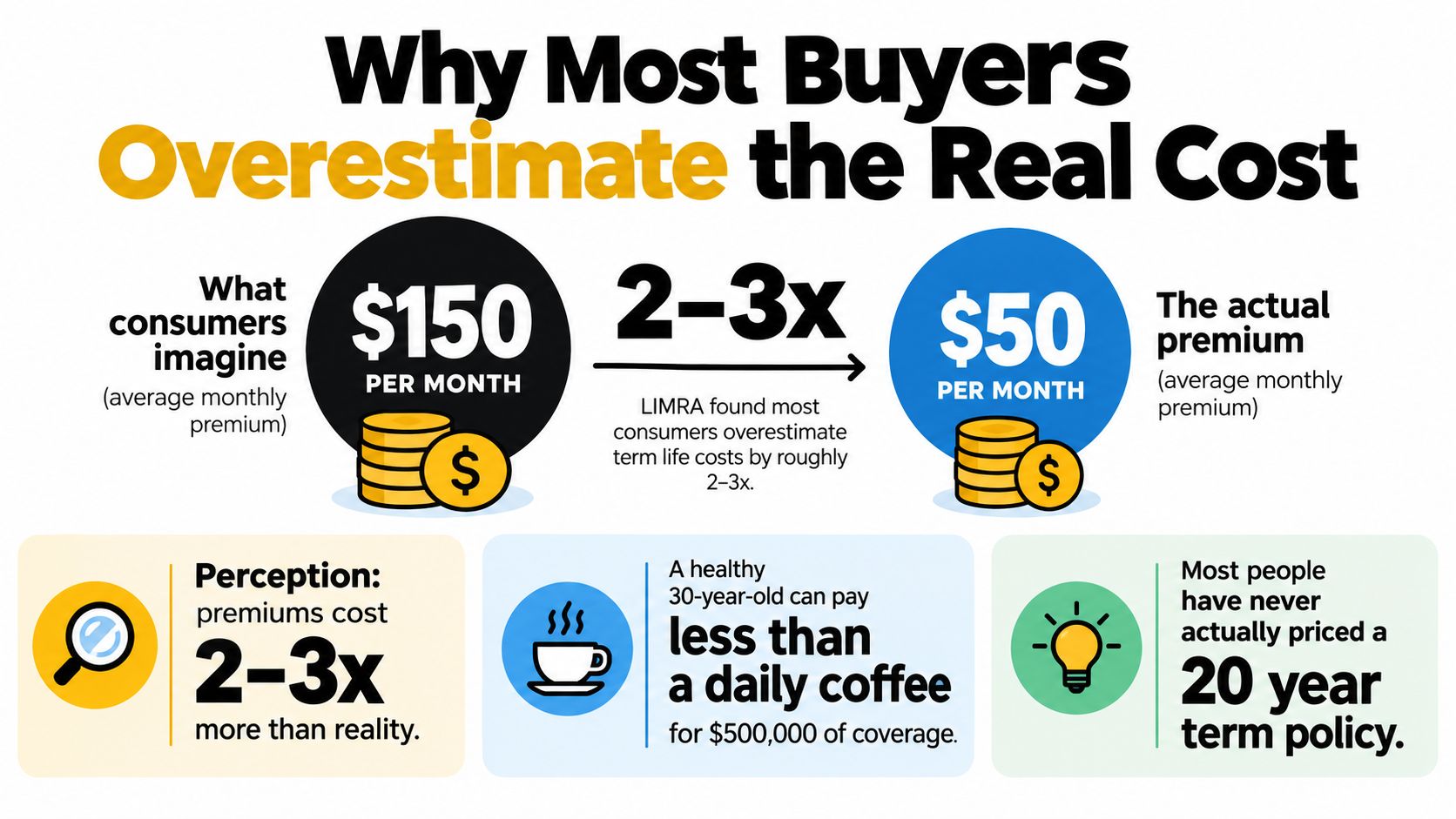
That perception makes the $40 to $55 monthly benchmark for a healthy 30-year-old non-smoker seeking $1 million especially useful. It puts the product into a household-budget category many young families can evaluate, rather than treating coverage as an unknowable financial burden. The exact amount still depends on underwriting, but the starting point is often less intimidating than people expect.
Why the misconception survives
Life insurance is an infrequent purchase. People may remember an older relative discussing expensive permanent insurance, confuse term coverage with lifelong products, or repeat a quote based on a very different age and health profile. Anxiety also pushes people toward worst-case estimates before they have compared actual offers.
A couple might think, “We can't afford enough coverage,” and postpone applying. That delay can move them into an older pricing band or allow a health issue to affect eligibility. The most useful first step is simple: request a real preliminary quote before deciding that coverage is out of reach.
The price you imagine isn't a substitute for the price an insurer can actually offer.
Treat coffee comparisons carefully. A $40 to $55 monthly premium can be manageable for some households, but a family shouldn't buy or reject a policy based on a lifestyle analogy alone. The face amount, policy duration, exclusions, conversion terms, and beneficiaries matter just as much as the payment.
Practical Tips to Lower Your 20 Year Life Insurance Rate
The strongest savings opportunities usually come from the factors that change underwriting risk. Use this checklist to improve your application without hiding information or postponing protection unnecessarily.
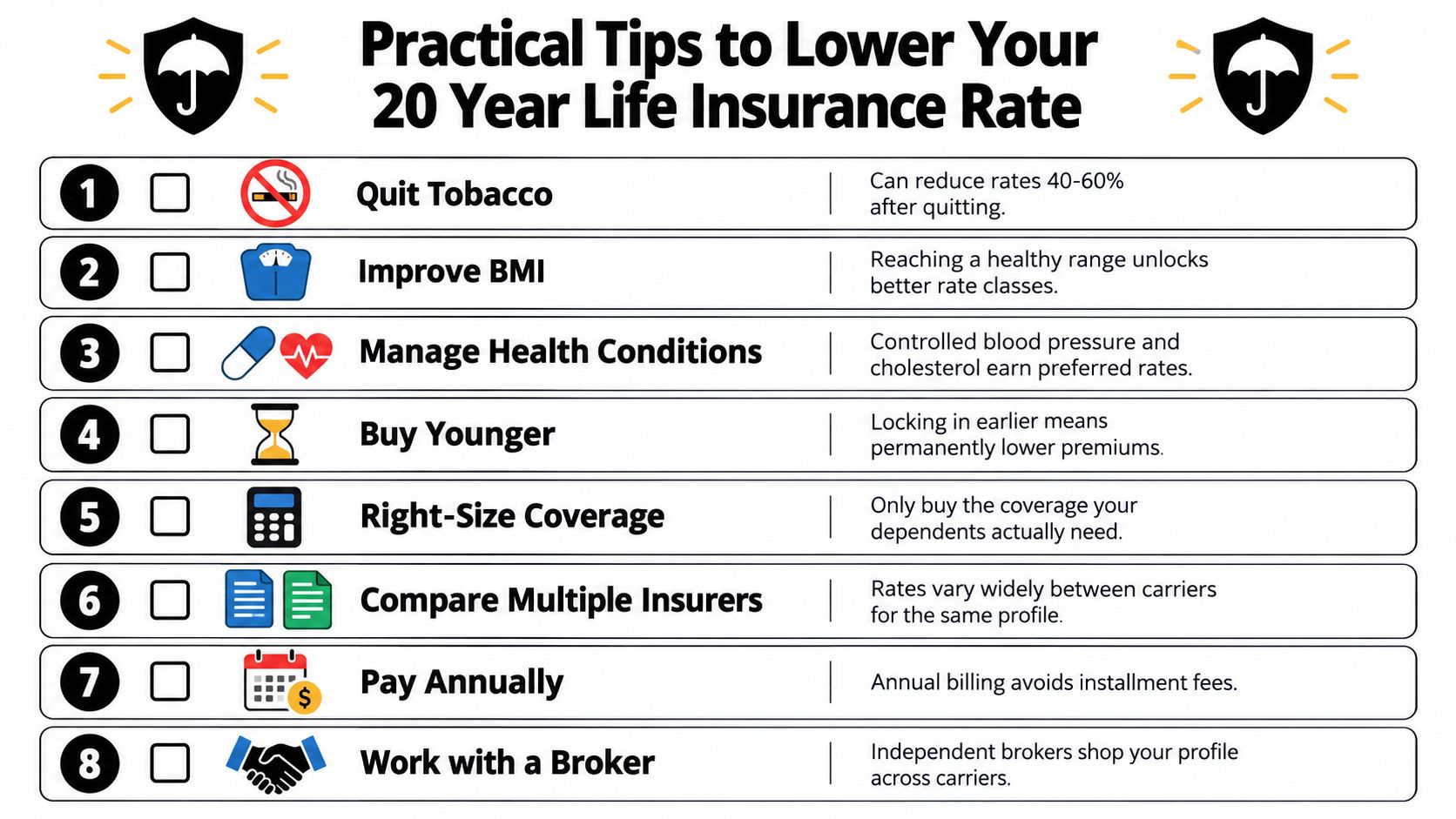
Stop tobacco and nicotine use. Tobacco can push an applicant into a much more expensive category, as the Insure.com examples demonstrate. Tell the insurer the truth about current and past use, then ask how its rules treat cessation.
Apply while you're younger. Age is built into the mortality table, so postponing an application can produce a higher locked-in premium even when no new health issue appears.
Improve documented health. Better-managed blood pressure, cholesterol, weight, and chronic conditions may help an applicant qualify for a stronger class. Insurers generally rely on records, lab results, and medication history, not just self-reported lifestyle changes.
Prepare medical information. Collect physician details, diagnoses, medication names, and relevant dates before applying. Clear documentation can reduce avoidable follow-up and help the underwriter evaluate controlled conditions accurately.
Choose the right face amount. Buy enough to cover the obligations your dependents would inherit, but don't pay for an amount unrelated to your income, debts, and family needs.
Compare carriers. Underwriting rules differ. A carrier that views one medication, occupation, or medical history favorably may not be the carrier that offers the best class to another applicant.
Select level premiums deliberately. Level term keeps the scheduled premium stable during the initial 20-year period. Annual-renewable designs may start differently and can become more expensive as renewal risk changes.
Use an independent comparison process. An independent broker can present your profile to multiple insurers, while a digital provider such as Coveredly offers online term life insurance with coverage options that can reach up to $3 million with no exams for most applicants, according to the publisher's stated product information. You can also compare term life insurance rates across options before submitting a full application.
The key is sequencing. Improve what you can, document it, compare carriers, and don't delay necessary coverage while waiting for a perfect health profile.
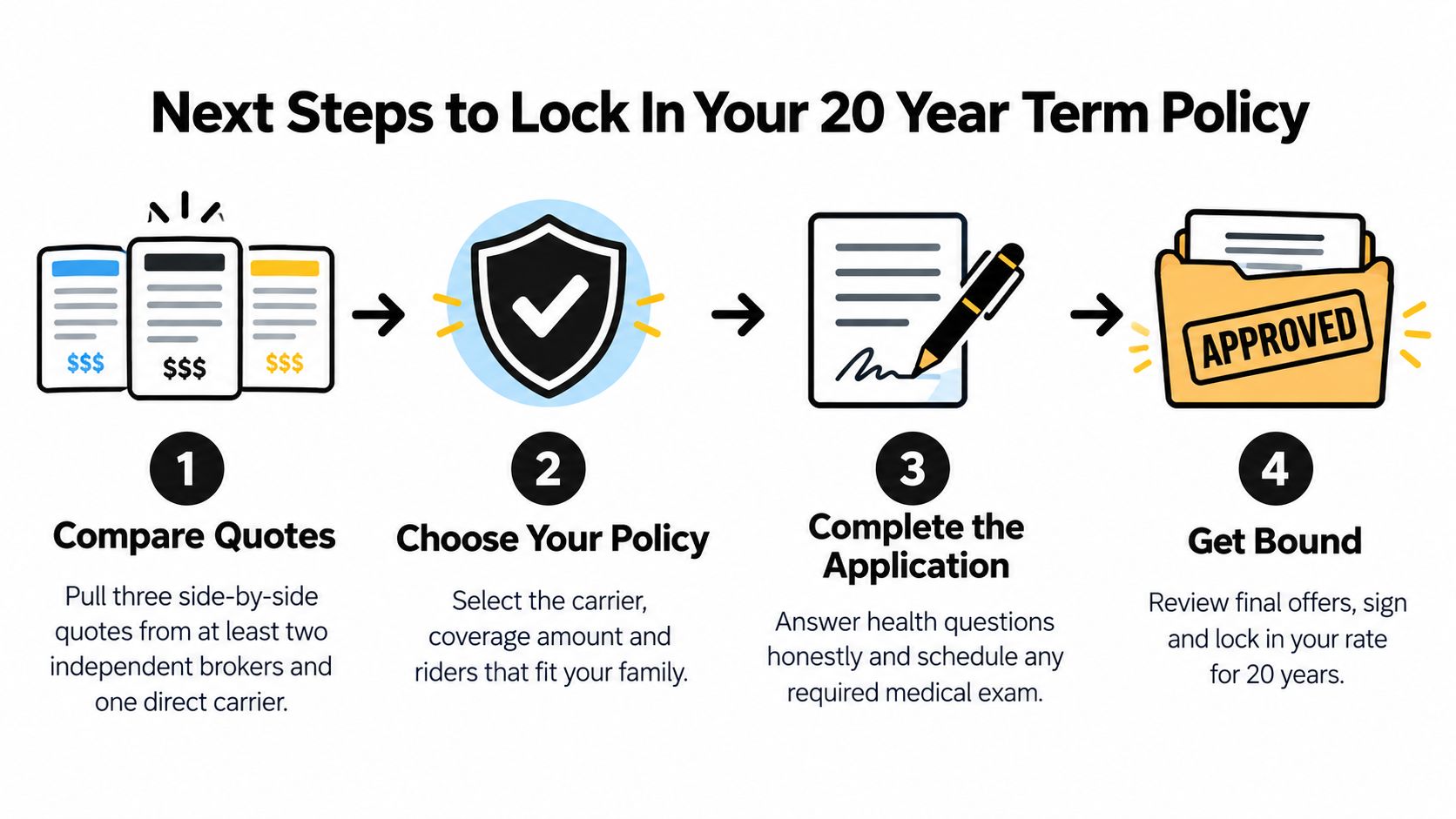
Next Steps to Lock In Your 20 Year Term Policy
Research becomes useful when it leads to a quote and a policy that matches the household's actual risk. Start by comparing offers that use the same face amount, term length, tobacco classification, and payment schedule. Otherwise, a lower premium may only reflect less coverage or a different contract.
Build a comparable quote set
Pull three side-by-side illustrations from at least two independent brokers and one direct carrier. Ask each source to show the premium, underwriting class, exclusions, conversion provisions, renewal terms, riders, and whether the illustration assumes an exam.
Prepare the information an application commonly requests:
- Identity details: Government identification and Social Security information.
- Work and finances: Employment, occupation, and income details.
- Beneficiaries: Names, relationships, and contact information for primary and contingent beneficiaries.
- Medical history: Doctors, diagnoses, prescriptions, procedures, and a recent summary of relevant conditions.
A fully underwritten application may involve a medical exam, laboratory testing, records, or follow-up questions. A no-exam digital path can be faster for eligible applicants, but the insurer still evaluates the information you provide and may request additional evidence.
Review before signing
Don't treat the approval screen as the finish line. Read the final illustration page by page with an advisor if the policy is complex, confirm that the beneficiary designations reflect your wishes, and verify the exact premium and death benefit.
Then set up automatic payments so a missed due date doesn't create an avoidable lapse. Put a policy review on the calendar for the following year, especially if income, debt, children, business ownership, or household responsibilities change.
A 20-year term policy works best when its end date reflects a real financial milestone. If the mortgage, education costs, or business debt will continue beyond the term, reassess the duration before applying. A renewal path may exist, but renewal premiums can rise significantly after the initial level-premium period (Prudential's overview of term life products).
The final choice should balance affordability with adequacy. Get comparable quotes now, verify the contract details, and choose the policy that protects the people and obligations you need to protect.
Coveredly helps shoppers compare and apply for online term life insurance, including 20-year coverage options, with a digital process designed for families and business professionals. Visit Coveredly to review available coverage and request a quote based on your situation.