When you start looking at life insurance rates by age, one piece of advice stands above all else: the younger you are, the less you'll pay. Securing a policy in your 20s or 30s is like locking in a fantastic fixed-rate mortgage when interest rates are at a record low. It's the single most powerful move you can make to guarantee affordable financial protection for your family's future.
Why Age Is the Biggest Factor in Life Insurance Rates
Think about it like this: who pays more for a car warranty? The person with a brand-new car fresh off the lot, or the one with a 15-year-old clunker that has 100,000 miles on the odometer? The answer is obvious, and the exact same logic applies to life insurance.

Insurers price their policies based on risk—specifically, mortality risk. This is simply the statistical chance that they will have to pay out a claim. As we get older, that risk naturally goes up. That’s why your age is the most important variable in the entire life insurance pricing equation.
The Power of Locking in Early
When you buy a term life insurance policy, you lock in a level premium for the entire term, whether it’s 20 or 30 years. This means the rate you get at age 30 will be the exact same rate you pay at age 50, even if your health takes a turn down the road.
By getting a policy early, you're essentially freezing your premium at a low rate based on your younger, healthier self. This predictability is a cornerstone of smart financial planning for young families and professionals.
Putting the decision off gets expensive, fast. For every year you wait, the premium for the same amount of coverage creeps up. That slow creep turns into a steep climb once you hit your 40s and 50s.
The Financial Impact of Waiting
The financial benefit of buying life insurance early isn't just a few bucks here and there—it’s substantial. For instance, a 20-year-old man can often find a $500,000 term policy for around $30 per month, while a 30-year-old still pays just $29. But at age 40, that same policy jumps to $43, and by 50, it balloons to $103. Women see similar savings, with a 20-year-old paying about $23 for the same coverage. Over the life of a 30-year policy, the savings are dramatic.
It all points to one clear principle: the best time to buy life insurance is always now. With modern, digital-first platforms like Coveredly, it’s simple to get a quote and even secure a no-exam term life policy in minutes, so you can protect your loved ones without delay. Of course, the first step is figuring out the right amount of coverage. To get a better handle on this, check out our guide on how much life insurance you might need.
Ever wonder how an insurance company comes up with your specific premium? It’s not a guess. It’s a carefully calculated number based on a field of study called actuarial science.
This whole process is designed to do one thing: predict risk. At the center of it all is a concept called mortality risk—the statistical likelihood that an insurer will have to pay out a death benefit. The higher that risk, the higher the premium needs to be.
The Science Behind the Price
To figure out this risk, insurers use massive datasets to build what are known as actuarial tables, or mortality tables. These tables map out life expectancy across huge groups of people, segmented by factors like age, gender, and health.
It's a lot like forecasting the weather. A meteorologist looks at historical data and current atmospheric conditions to predict the chance of rain. In the same way, an actuary uses population data to predict the likelihood of a claim for someone with your specific profile.
The core logic is straightforward: the older we get, the statistically closer we are to our life expectancy. This rising mortality risk is the fundamental reason why life insurance rates by age always go up.
This isn't a secret formula unique to one company; it's the foundation of the entire industry. The math is the same whether you're buying a personal term policy or getting coverage through work. The risk of insuring a 55-year-old is just fundamentally higher than insuring a 25-year-old, and the price reflects that.
An Easy Analogy: A Car Warranty
A great way to think about this is to compare life insurance to an extended car warranty.
For a brand-new car: The warranty is cheap. The engine is perfect, the parts are new, and the chances of a major breakdown in the first few years are incredibly low.
For a 10-year-old car with 100,000 miles: That warranty is going to be much more expensive. The parts have wear and tear, and the odds of a costly repair are significantly higher.
Life insurance works the same way. A policy for a young, healthy person is like the warranty on a new car—low risk means a low price. A policy for an older person is like the warranty for the used car—the risk is higher, so the premium must be, too.
This is precisely why you get the best life insurance rates by age when you lock them in while you’re young. Once you understand how insurers assess risk, it’s clear that waiting to buy coverage will almost always cost you more down the road.
Seeing the Numbers: How Age and Gender Shape Your Life Insurance Rates
It’s one thing to say life insurance gets more expensive as you age. It’s another thing entirely to see exactly what that means for your wallet. Moving from theory to reality, let's look at how life insurance rates by age play out with real-world numbers.
The rates below are estimates for a standard 20-year term policy for non-smokers in excellent health. This helps us focus purely on how age and gender move the needle on cost.
Why Insurers Focus on Age
Think about it like this: insurers are in the business of managing risk. A younger, healthier person is statistically less likely to pass away than an older individual, making them a lower risk to insure.
It’s a similar logic to how car insurance companies view drivers. A new, inexperienced driver presents a different risk profile than a 45-year-old with a clean driving record.
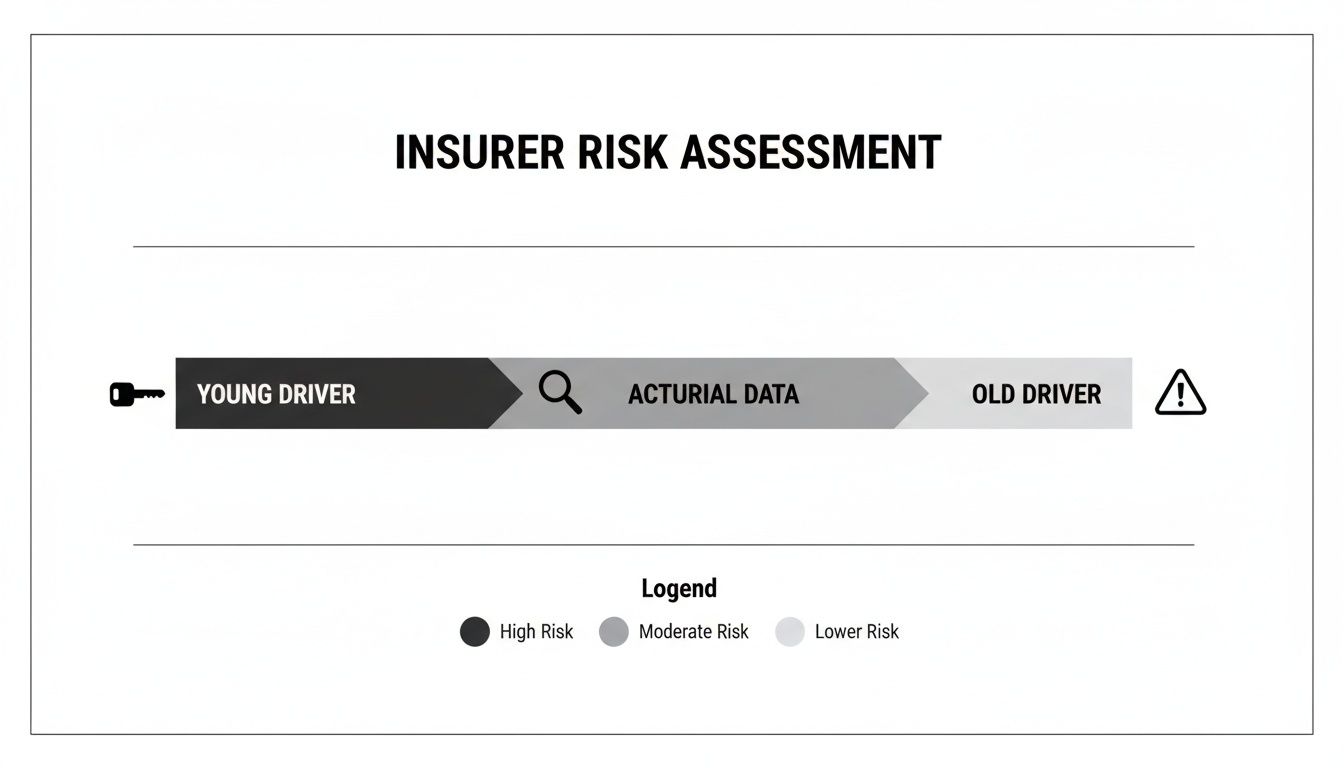
As you can see, the perceived risk climbs steadily with each decade. This statistical reality is the core reason why premiums increase over time.
Estimated Monthly Term Life Insurance Rates for 2026
To make this concrete, here’s a table showing sample monthly premiums for a 20-year term life policy. Notice how quickly the costs can escalate, especially once you pass age 40.
| Age | Male Rate ($500k) | Female Rate ($500k) | Male Rate ($1M) | Female Rate ($1M) |
|---|---|---|---|---|
| 30 | ~$25 | ~$21 | ~$45 | ~$37 |
| 40 | ~$35 | ~$30 | ~$65 | ~$55 |
| 50 | ~$88 | ~$70 | ~$175 | ~$130 |
| 60 | ~$260 | ~$190 | ~$515 | ~$380 |
The takeaway is pretty stark. A 30-year-old male can lock in a $1 million policy for roughly the same monthly cost as a 50-year-old male getting just half that coverage ($500,000).
The decade between your 40s and 50s represents a critical window. Delaying your purchase during these years can result in paying thousands more over the life of your policy for the exact same coverage.
This jump is no accident. The cost to insure a man for $1 million in coverage can leap from around $65 per month at age 40 to $175 at age 50—a 169% increase in just ten years. By age 60, that same policy could cost $515 per month.
These examples are all for term life insurance, which is a fantastic, affordable option for covering temporary needs like a mortgage or raising kids. Of course, there's also whole life insurance, which offers lifelong coverage with a savings component. The pricing works differently, but the same rule applies: the younger you are, the less you'll pay. If you're curious about the difference, you can explore our guide on how much whole life insurance costs.
No matter how you slice it, the data tells one consistent story: every year you wait, the cost of protecting your family goes up.
What Else Influences Your Life Insurance Costs
While life insurance rates by age get all the attention, your age is really just the opening act. A handful of other factors play a huge role in shaping your final premium. Insurers want to see the whole picture of your risk profile, and understanding what they look at helps you know what to expect.
Think of it like applying for a mortgage. The bank looks past your income and considers your credit score, existing debt, and how much you’re putting down. In the same way, an insurance company evaluates your complete health and lifestyle to set an accurate price for your policy.
Your Current Health Status
Right after age, your overall health is the biggest piece of the puzzle. During the underwriting process, insurers look at several key health markers to place you in a risk category, like Preferred Plus, Preferred, or Standard.
It's simple: a healthier profile means a lower premium. The main areas they focus on include:
Smoking and Nicotine Use: This is a big one. A smoker can expect to pay two to three times more than a non-smoker for the exact same coverage. The health risks tied to tobacco use are so well-documented that insurers have a separate, much more expensive pricing tier just for smokers.
Height and Weight: Insurers use a build chart to see if your Body Mass Index (BMI) is in a healthy range. Being significantly overweight can lead to higher rates because of the increased risk of things like heart disease and diabetes.
Medical Conditions: If you have chronic conditions like high blood pressure, high cholesterol, or diabetes, they will affect your rates. The good news? If you're managing them well with medication and regular doctor visits, the impact will be much less severe.
Prescription History: The medications you take give the insurer a clear window into your health history, confirming any conditions you've disclosed on your application.
A medical exam gives the insurer hard data on these points. However, plenty of no-exam policies, like those offered by Coveredly, use health questionnaires and existing data to make a decision. This can get you covered faster, especially if you're in good health.
Lifestyle Choices and Hobbies
What you do for fun can also move the needle on your premium. A quiet homebody who loves to read is a much lower risk than an adrenaline junkie with a passion for extreme sports.
Insurers aren't trying to judge your weekend plans; they are simply pricing the statistical risk that comes with them. Certain hobbies significantly increase the odds of an accident.
If your pastimes include skydiving, rock climbing, or flying private planes, you’ll definitely be asked about them. Depending on how often you do it and how risky it's perceived to be, the insurer might add a flat extra to your premium. This is a fixed additional cost per thousand dollars of coverage that allows them to approve your policy while accounting for the added risk.
Your Driving Record and Family History
Insurers also look at factors that are outside of your immediate control. Your past behavior behind the wheel and your genetic predispositions are both part of your overall risk profile.
Two key areas are:
Your Driving Record: A history of DUIs, reckless driving tickets, or several at-fault accidents signals high-risk behavior to an insurer. This can lead to higher rates or, in some cases, even a denial of coverage.
Family Medical History: Insurers want to know about the health of your immediate biological family (parents and siblings). A pattern of early-onset cancer or heart disease before the age of 60 could point to a genetic predisposition, which might mean a higher premium for you.
Ultimately, your life insurance premium is a combined score based on dozens of different data points. While you can’t change your age or your family history, you can absolutely influence your rates by managing your health and making safe lifestyle choices.
How to Secure Lower Life Insurance Premiums
Knowing why your life insurance premium is what it is can be interesting, but knowing how to lower it is a game-changer. While you can't turn back the clock on your age, you can take control of several other factors to find the most affordable rates possible. Think of it like training for a race; the prep work you do beforehand has a direct impact on your performance on game day.

We've said it before, but it’s the single most effective strategy out there: buy your coverage as early as you can. Locking in a rate in your 20s or 30s is the financial equivalent of buying a hot stock at its IPO price. Every other tip really just builds on this one simple rule.
Focus on Your Health Profile
Before you even fill out an application, a little proactive health management can pay off in a big way. Insurers reward healthy habits with lower premiums, so putting some effort into these areas can lead to serious savings.
The most impactful change you can possibly make is to quit smoking. Insurers usually offer non-smoker rates after you’ve been nicotine-free for at least 12 months. This one decision can literally cut your premium by 50% or more, saving you thousands over the life of the policy.
Beyond that, put your energy into what you can control:
- Improve Your BMI: Work with your doctor to get to a healthier weight. Even small improvements can be enough to bump you into a better health class, unlocking lower rates.
- Manage Chronic Conditions: If you have something like high blood pressure or cholesterol, show the insurer it’s well-managed with medication and regular doctor visits. It proves you're on top of your health.
- Get a Checkup: Take care of any minor, nagging health issues before you apply. A clean bill of health makes your application that much stronger.
Get Smart With Your Policy Structure
More coverage isn't always better, especially if it’s more than you actually need. A common mistake is buying a policy that over-insures you, leading to a premium that’s higher than it needs to be. The real key is to tailor your policy to your specific financial obligations.
For example, don't just pull a number out of thin air. Calculate exactly what you need based on your mortgage, car loans, income replacement for your family, and future costs like college. Choosing $750,000 in coverage that fits your budget is a much smarter move than applying for $2 million only to let the policy lapse later because it's too expensive.
The same goes for the term length. If your mortgage has 22 years left and your kids will be on their own in 18, a 25-year term is probably a much better (and cheaper) fit than a 30-year term.
Use Modern Strategies to Save Even More
Once you’ve got the basics down, a few other approaches can help you find even more savings. These strategies give you a bit more flexibility and take advantage of how insurance works today.
Laddering Policies: This is an advanced strategy where you buy multiple term policies with different lengths instead of one large one. For instance, you could buy a 30-year policy for $500,000 to cover your mortgage and a 20-year policy for another $500,000 to cover childcare and college costs. When the 20-year term ends, you're left with the smaller policy, and your overall premium drops.
Another great modern approach is to look for no-exam life insurance. Digital platforms like Coveredly use data and algorithms to assess your risk without sending a nurse to your house. This streamlined process is faster and often results in very competitive rates for healthy applicants. Since their operational costs are lower, those savings can get passed right on to you.
Ultimately, locking in lower life insurance rates by age comes down to smart preparation and a few strategic choices. By combining good health habits with a well-designed policy, you can find affordable protection that perfectly fits your family's needs. To see how these factors play out in real-time, feel free to use our tools to compare term life insurance rates from some of the top providers in the industry.
Of course. Here is the rewritten section, designed to match the human-written style, tone, and formatting of your examples.
Common Questions About Life Insurance and Age
As you start thinking about life insurance, it’s normal to have a few questions. Getting clear, straightforward answers is the best way to move forward with confidence. Here are some of the most common questions we hear, along with practical answers to help you make sense of it all.
Is It Ever Too Late to Get Life Insurance?
The honest answer is no, it's very rarely "too late" to get some kind of life insurance. But your options do get much more limited—and a lot more expensive—the older you get. Most insurers won't issue a brand-new term life policy to someone over age 70 or 75.
While you can definitely still find great coverage in your 50s and 60s, you'll see that the premiums are quite a bit higher than they would have been just a few years earlier. The key thing to remember is this: the rate you can lock in today will always be better than the one you'll be offered tomorrow. If you know you need it, the best time to apply is always right now.
Will My Rates Increase Every Year on a Term Policy?
Not at all—and that’s one of the biggest benefits of term life insurance. When you buy a policy for a specific time frame, like a 10, 20, or 30-year term, your premium is locked in for that entire period. Your rate won't change, no matter what happens with your health or age during those years.
This is exactly what makes buying a policy when you’re young such a smart financial move. You secure a low, predictable payment for decades, which is a huge relief for budgeting. Your rate would only change if you decided to buy a new policy after your original term ends, since it would be based on your new, older age.
A level premium provides budget stability and peace of mind, allowing you to protect your family without worrying about surprise rate hikes year after year. It's one of the most attractive features of term life insurance for young families and professionals.
For instance, a 30-year-old who buys a 20-year term policy will pay the exact same monthly premium at age 49 as they did on day one. It makes long-term financial planning much, much simpler.
How Does a Medical Exam Impact My Rates?
A medical exam gives the insurance company a verified snapshot of your current health. If you’re in great shape, taking an exam usually gets you the lowest possible rates because it removes all the guesswork for the insurer. They can see exactly what their risk is.
That said, a lot of people prefer to skip the exam for the convenience and speed. No-exam policies work by using a combination of detailed health questions, prescription history checks, and other data to get a clear picture of an applicant's risk.
The upsides of a no-exam process often include:
- Speed: You can get approved in minutes or days, not weeks.
- Convenience: No scheduling appointments or having someone visit your home.
- Competitive Rates: For healthy people, rates on no-exam policies are often very close to what you'd get with a full medical exam.
The choice really comes down to what you prefer. If you’re healthy and just want to get it done quickly and easily, a no-exam policy is a fantastic option.
What if I Quit Smoking After My Policy Starts?
This is a great question, and the answer is even better. If you kick the habit after your policy is active, you can ask your insurance provider for a rate reconsideration. It’s a huge opportunity to lower your monthly payments.
Most insurers require you to be completely nicotine-free for at least one full year before they'll re-evaluate your health class. A few might ask for a two-year period.
To get your rate changed, you'll usually need to:
- Contact your insurer to request a rate change based on your new non-smoker status.
- Fill out a new health questionnaire.
- Possibly provide a new medical sample (like a urine test) to prove you're nicotine-free.
If they approve the change, your premium could drop dramatically as you're moved from smoker to non-smoker rates. This one change can save you thousands of dollars over the life of your policy, making it one of the best financial moves you can make for your health.
Finding the right life insurance shouldn't be complicated. At Coveredly, we’ve made the process digital and straightforward, so you can get the protection you need without the hassle. Explore your options and get a personalized quote in minutes. Learn more at https://coveredly.com.