You just bought a house, your first baby is finally sleeping in a crib, and the monthly budget already feels tighter than you expected. In that moment, life insurance stops being a distant checkbox and starts looking like a long runway problem, because the question isn't only how much coverage you need today, it's how long your family will need that safety net to stay in place. That's where 40 year term life insurance becomes interesting, especially for young parents, newly married couples, and professionals whose biggest obligations stretch far into midlife.
Table of Contents
- Why a 40 Year Term Matters for Long-Horizon Families
- What 40 Year Term Life Insurance Actually Is
- Pricing Factors and Real Cost Examples
- Comparing 40 Year Term to Shorter Terms and Permanent Coverage
- Underwriting and No-Exam Application Paths
- Pros and Cons of Locking in 40 Years
- Riders and Conversion Options Worth Knowing
- Smart Buying Tips and Common Questions for Online Applicants
Why a 40 Year Term Matters for Long-Horizon Families
Maya and Daniel are 32, they just welcomed their first child, and they signed a 30-year mortgage. Their planning horizon is longer than it first looks, because childcare, school years, housing debt, and Daniel's expected retirement at 67 all sit on different clocks. A 40-year term lines up with that kind of layered timeline better than a shorter policy that might expire while the household is still financially exposed.
That's the core appeal. A 40-year contract is a level-term policy that keeps protection in force for a long stretch, instead of forcing a family to revisit the market after 20 or 30 years, when age and health may have changed. In the market, 40-year terms are still rare, and most term life policies are sold in 10-, 15-, 20-, 25-, or 30-year durations, with 40 years usually offered by only a limited number of carriers and often aimed at younger applicants (Choice Mutual).
Who tends to benefit most
Young parents in their late 20s and early 30s often fit this product well, because their dependents won't be financially independent for many years. Newly married couples with a long mortgage can also find the term length useful, since the policy can mirror the debt instead of leaving a gap near the end of the loan.
Practical rule: if your financial obligations still matter when your child is grown and your mortgage is older, a shorter term may not cover the full story.
Professionals with long earning arcs are another natural fit. If your income is meant to support a spouse, children, or a home deep into midlife, a 40-year policy can be a cleaner match than stacking shorter policies and hoping the timing works out.
What 40 Year Term Life Insurance Actually Is
A 40 year term life insurance policy is a pure death-benefit contract that stays in force for 40 years. You pay a fixed premium during that period. If the insured dies while the policy is active, beneficiaries receive the death benefit. If the insured is still alive when the term ends, the policy expires, and there is no default payout at the finish line unless the contract includes a return-of-premium feature (HDFC Life).
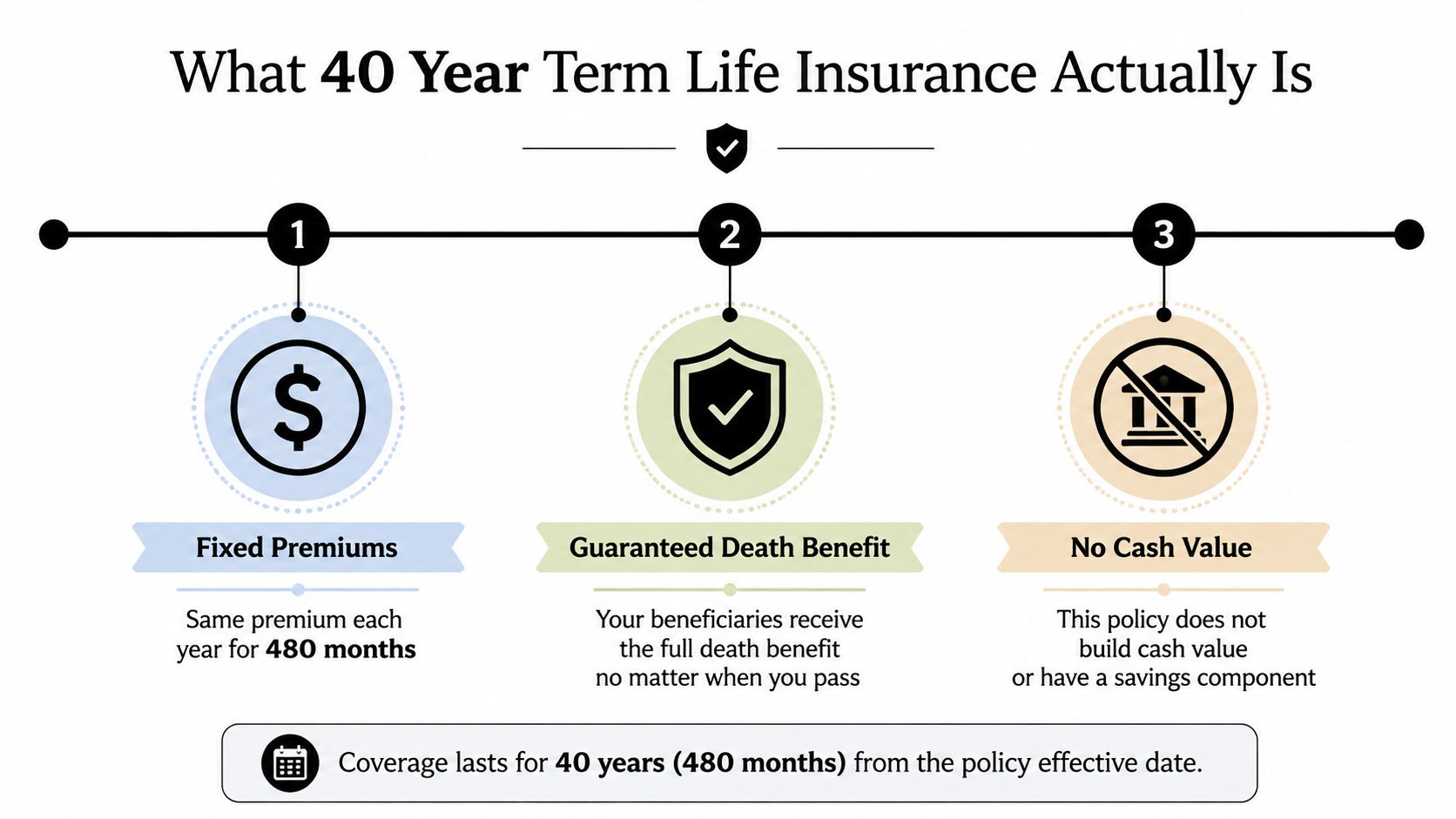
The structure is simple. It works like a long protection window that stays open while the family still faces income risk, then closes when the term ends. It does not act like a savings account, and it does not build cash value, which is the main line separating term insurance from permanent coverage.
The mechanics in plain English
The premium is usually level, meaning the amount is designed to stay the same for the life of the policy once issued. That stability helps families budget around a known insurance cost instead of facing repeated repricing later.
A 40-year policy is also a niche product. Banner Life lists 40-year term among its available term lengths, alongside 10, 15, 20, 25, 30, and 35 years, which shows how limited this market is compared with standard term options (Banner Life). Fewer carriers usually means fewer quotes and fewer design choices, so comparing options carefully matters.
Pricing Factors and Real Cost Examples
A 40-year term quote is usually shaped by five main factors, age at issue, health classification, face amount, gender, and tobacco status. Underwriters may also review occupation, hobbies, and family medical history, but these five do most of the work.
Age usually has the biggest effect. A healthy applicant who buys early is more likely to get a lower rate, and that rate stays fixed after the policy is issued. For young families and professionals, that makes 40-year term less about finding the cheapest label and more about choosing the right moment to lock in insurability before health changes.
A quick way to understand pricing is to compare it to buying long-term disability protection while you are still healthy enough to qualify well. The later you wait, the more uncertainty the insurer has to price in.
Illustrative monthly premiums for a $500,000 20-Year Term Policy, preferred non-smoker
Policygenius shows how fast rates move with age in a healthy applicant pool. In its rate table, a healthy 30-year-old female is listed at $72.78 per month, a healthy 40-year-old female at $134.83 per month, and a healthy 45-year-old female at $197.26 per month for $500,000 of 20-year term coverage. The same table lists a healthy male at $18.16 per month at age 30, $28.03 per month at age 40, and $68.99 per month at age 50 for the same coverage and term length (Policygenius).
| Applicant Age | Female (Monthly) | Male (Monthly) |
|---|---|---|
| 30 | Illustrative planning range, roughly $55 to $70 | Illustrative planning range, roughly $65 to $80 |
| 40 | Illustrative planning range, roughly $130 to $170 | Illustrative planning range, roughly $130 to $170 |
A 40-year term often costs more than shorter coverage because the insurer is carrying more uncertainty across a longer period. That is why a policy bought at 30 can look very different from one bought at 40, even before health details come into play.
For many buyers, the question is not just what the premium is today. It is whether they want to pay for certainty while they are still in strong underwriting shape, or wait and hope their health profile stays the same.
Comparing 40 Year Term to Shorter Terms and Permanent Coverage
A 40-year policy sits at one end of the term-life spectrum. At the other end are 20-year and 30-year policies, plus laddered strategies that combine multiple terms, and then permanent options like whole life or universal life.
| Feature | 20-Year Term | 30-Year Term | 40-Year Term | Permanent (Whole/Universal) |
|---|---|---|---|---|
| Coverage length | Fixed term | Fixed term | Fixed term | Lifetime, as long as the policy stays in force |
| Premium pattern | Level during term | Level during term | Level during term | Usually higher than term, structure depends on policy type |
| Cash value | No | No | No | Yes, in many designs |
| Best fit | Shorter obligations | Mid-length obligations | Long obligations | Lifetime protection and cash accumulation |
A single 40-year policy can beat stacking two shorter terms when the buyer is young, healthy, and wants coverage to run well past age 60 without having to reapply. That can matter for people who expect a long mortgage, late-finishing childcare costs, or a spouse who would still need income replacement after the first policy would have expired.
For a deeper look at the 30-year side of the comparison, this 30-year term guide is a useful companion piece.
Permanent insurance plays a different game. It can last for life and build cash value, but the ongoing cost is usually much higher than term, which is why many families use term for protection and separate savings or investing for long-term accumulation. The decision often comes down to whether your priority is coverage certainty or lifetime accumulation.
Underwriting and No-Exam Application Paths
A 40-year term policy often receives more scrutiny than a shorter policy, because the carrier is pricing mortality risk over four decades instead of one or two. That doesn't mean every application turns into a marathon, but it does mean long-term coverage is less likely to be treated as an instant decision.
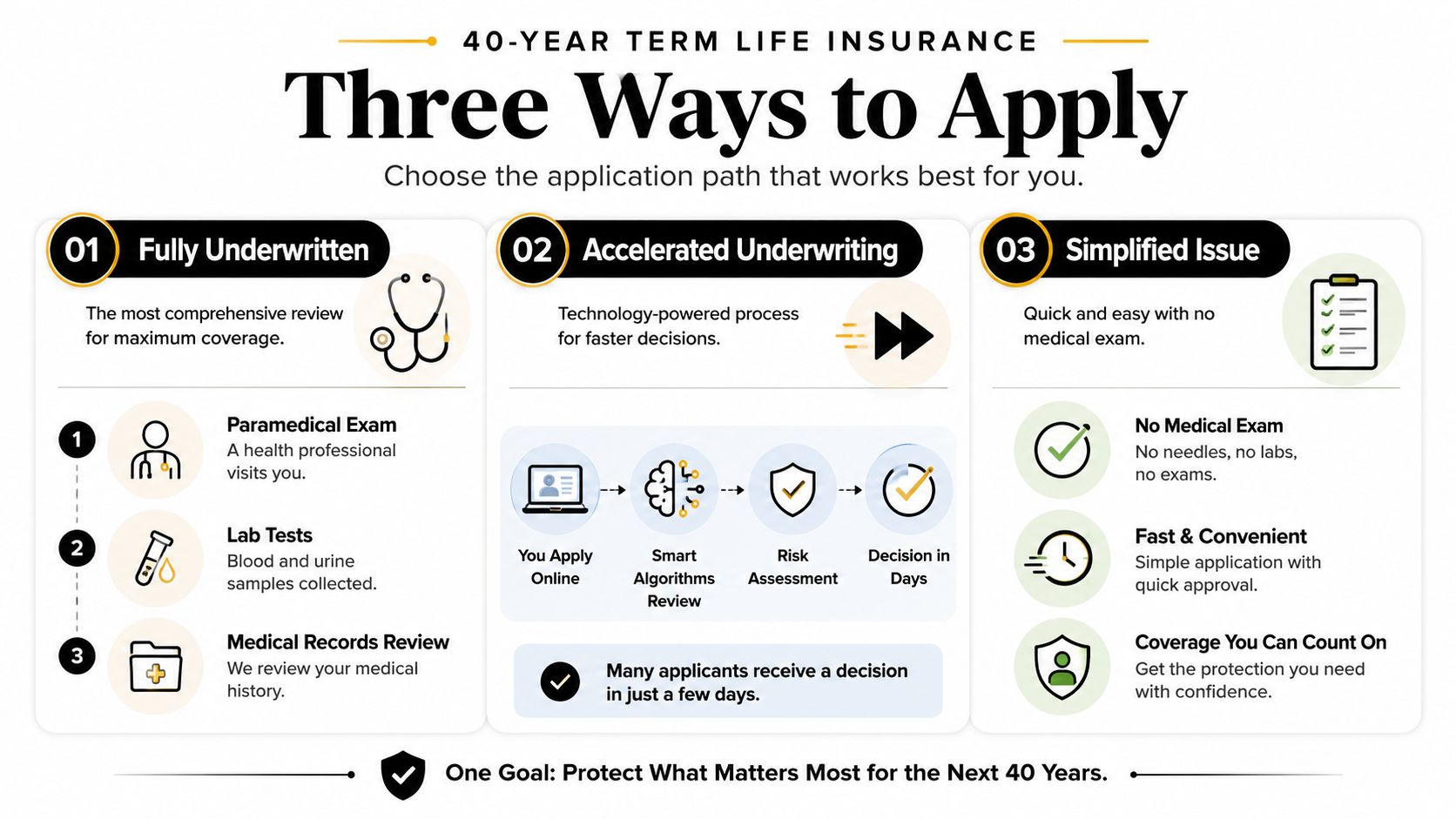
The three common application paths
Fully underwritten applications usually include a paramedical exam, labs, and a review of medical records. Guardian Life's underwriting guidance says full underwriting commonly takes about 2 to 6 weeks, while more extensive cases can stretch to 4 to 6 weeks or longer because insurers may need medical records, lab results, and attending physician statements (Guardian Life).
Accelerated underwriting uses existing data and algorithm-driven review to shorten the process for qualified applicants. That path can move much faster, but the carrier still wants enough information to feel comfortable locking in a long-duration risk.
Simplified issue or no-exam policies rely mainly on health questions. In the market guidance provided, no-exam options often cap at $500,000 of face amount for applicants under 45, while accelerated underwriting can extend to higher amounts, depending on the carrier.
What digital applicants usually see
An online application may begin with basic health and lifestyle questions, then move to identity verification, e-signatures, and carrier placement if the case qualifies. Some applicants get a fast decision, while others are routed into a fuller evidence-gathering process.
Practical rule: the longer the term, the more likely the insurer is to want a clean, well-documented risk picture before issuing the policy.
For more detail on how the process works, Coveredly's underwriting guide explains the path from application to approval in a digital format.
Pros and Cons of Locking in 40 Years
The biggest advantage of a 40-year term is simple, it can lock in coverage when you're young and healthy and leave the premium unchanged for the full term. That gives families predictability, which matters when they're also juggling daycare costs, a mortgage, and career changes.
The upside
If your coverage need lasts for decades, the policy can reduce the risk of being forced back into the market later, when age or health may make new coverage harder to get. It can also match a long mortgage or a long period of income dependence without requiring another application.
The downside is just as real. Fewer carriers offer true 40-year terms, and the longer commitment usually means a higher premium than a 20-year or 30-year policy. That extra cost can also crowd out other goals, especially if the household would rather direct more money toward savings, investing, or retirement accounts.
The trade-off in one glance
- Level premium certainty: You know what you're paying, and it doesn't change during the term.
- Long lock-in: If life changes, you can't shorten the term and recover the extra premium you spent.
- No cash value: The policy protects, but it doesn't accumulate an account value you can tap later.
- Tighter underwriting: Applicants with borderline health may face a tougher approval path or less favorable classification.
A 40-year policy makes the most sense when the need is real, not hypothetical.
That lock-in is powerful, but it's also rigid. If your debts disappear early, or your family becomes financially independent sooner than expected, the policy may have felt more expensive than necessary.
Riders and Conversion Options Worth Knowing
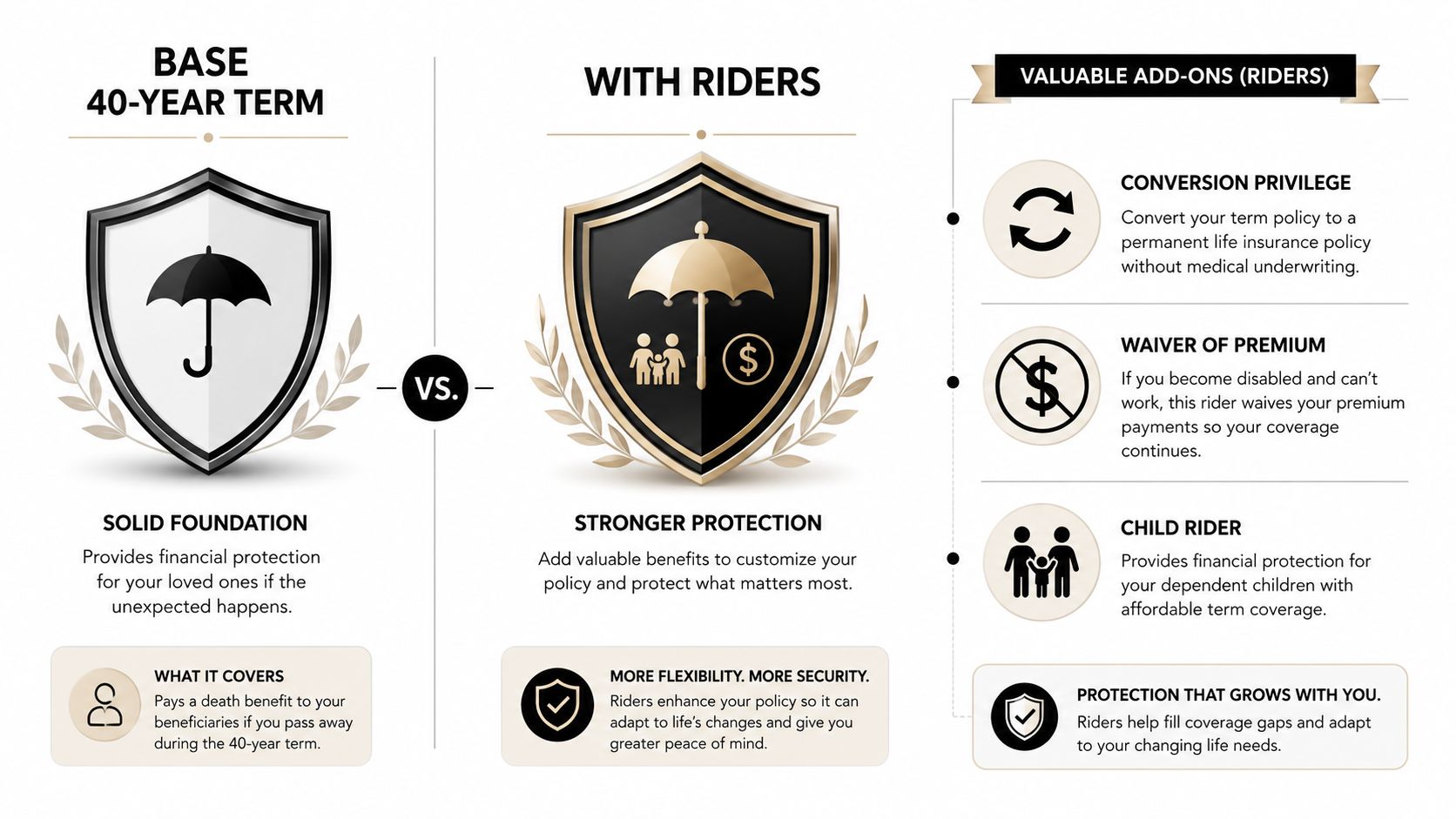
A basic 40-year term policy can be made more flexible with riders, especially if you want the protection to adapt as life changes. The most important one is the conversion privilege, which lets you move from term coverage to a permanent policy without going through new medical underwriting, as long as the contract allows it.
The add-ons that change the policy
Return of premium is the most obvious option for people who hate the idea of “losing” all the paid premiums if they outlive the term. It increases cost, but it changes the end-of-term result from pure protection to a more refund-like structure.
Waiver of premium matters a lot on a 40-year term, because a long policy has a bigger chance of overlapping with disability, and this rider can freeze premiums if the insured becomes totally disabled. That can be a big relief for families whose income depends on one person staying employed.
Child riders and accelerated death benefit riders serve different purposes. A child rider adds protection for dependents, while an accelerated benefit lets a policyholder access part of the death benefit in qualifying terminal illness situations.
For a fuller breakdown of how add-ons work, this riders guide is a useful reference.
How to think about riders
- Young families: Conversion and child protection often deserve the closest look.
- Breadwinner households: Waiver of premium can be especially valuable if income disruption would hurt the budget fast.
- Estate-minded buyers: Return-of-premium or conversion flexibility can matter more if long-term planning is the goal.
Riders change both the price and the claim outcome, so the best ones are the ones that solve a real family problem, not the ones that just sound reassuring.
Smart Buying Tips and Common Questions for Online Applicants
The best way to shop for a 40-year term policy is to start with fit, not price. If you're under 45, have dependents, and expect your obligations to last for decades, a 40-year term can be a strong match, but you still need to compare carriers, underwriting paths, and the premium impact of any rider you add.
A simple buying checklist
- Match the term to the obligation: If your child, mortgage, or business debt will still matter for decades, the term may be appropriate.
- Compare quotes carefully: A niche term length means quote spread can be wider than people expect.
- Choose the right underwriting route: If you want speed, see whether accelerated or simplified issue is available. If you want the broadest carrier review, full underwriting may still be worth it.
- Review at milestones: Marriage, childbirth, home purchase, career change, and retirement planning are all natural times to revisit coverage.
- Don't overbuy face amount: A policy should support the household budget, not strain it.
Quick questions buyers usually ask
Is a 40-year term worth paying more than stacking shorter terms?
Sometimes, yes, especially if you want one contract that spans the full family and mortgage timeline. If your need is shorter or more flexible, laddered terms can be easier to tailor.
What happens if I outlive the policy?
The term ends, and the coverage stops. In the default structure, there's no maturity payout unless the policy has return-of-premium features.
Can I convert later?
If your policy includes conversion rights, you can usually move to a permanent policy without new medical underwriting during the conversion window.
Are death benefits taxed?
In many cases, life insurance death benefits are paid to beneficiaries without federal income tax, but tax treatment can vary by situation, so it's smart to confirm with a qualified tax professional.
A 40-year term is a niche tool, but for applicants under 45 who want long-run protection through family and mortgage obligations, it can be one of the cleanest ways to lock in insurability early.
If you're comparing long-term coverage and want a simpler way to shop online, Coveredly helps people explore term life insurance with a digital process built for busy families and professionals. You can review coverage options, compare paths, and see whether a 40-year term or a shorter alternative fits your life better before health changes make the decision harder.