You and your partner want life insurance that can protect your family for life. One policy promises predictable premiums and guarantees. Another offers room to adjust payments as your income changes. The difficult part is that the lower initial cost of universal life can hide a long-term funding responsibility, while whole life's stability can require a larger commitment from the start.
The difference between whole life and universal life matters because both are permanent cash-value products, but they place risk and responsibility in different places. Whole life generally emphasizes fixed premiums and guaranteed values. Universal life emphasizes flexible premiums and adjustable coverage, but the policy can require regular attention to remain sustainable.
Table of Contents
- Introduction to Permanent Life Insurance Choices
- Understanding Whole Life and Universal Life at a Glance
- How Cash Value Premiums and Guarantees Really Work
- Costs Flexibility and the Hidden UL Subtypes You Must Know
- Risks Sustainability and Why Policies Lapse
- Which Policy Fits Young Families Professionals and Couples
- Decision Checklist and Next Steps to Buy with Confidence
Introduction to Permanent Life Insurance Choices
Consider a newly married couple buying a home and thinking about children. One spouse has a dependable salary, while the other expects income to change as a career develops. They want coverage that won't expire during a mortgage or a child's education years, but they also don't want to commit to a payment that becomes uncomfortable if their priorities change.
That dilemma captures the central choice. Permanent life insurance is designed to last for the insured's lifetime and can build cash value, unlike term insurance, which provides coverage for a selected period. Whole life and universal life both belong to this permanent category, but they aren't interchangeable versions of the same contract. The NAIC's life insurance overview describes whole life as coverage lasting for the insured's entire life, with premiums typically paid on a set schedule. It describes universal life as permanent coverage where premium payments and death benefits can vary based on policyholder choices.
Why the decision has lasting consequences
A policy can look affordable today and still become difficult to maintain later. With whole life, the contract usually gives you a more predictable payment schedule and guaranteed cash-value structure. With universal life, flexibility can help when income fluctuates, but insufficient funding, changing charges, or weaker crediting performance can reduce the account value and create lapse risk.
The danger isn't choosing a product that has a particular label. The danger is choosing a structure that doesn't match how you manage money. A person who wants a policy that runs with minimal intervention may struggle with a universal life design. Someone with irregular income may find whole life's fixed commitment restrictive.
What to compare before buying
A useful comparison should answer practical questions, not just define terms:
- How much certainty do you need? Whole life is associated with stronger guarantees, while universal life gives up some certainty for flexibility.
- Can you maintain funding over time? A flexible premium isn't the same as a permanently lower obligation.
- Will you review the policy regularly? Universal life often needs monitoring of charges, credited interest, and account value.
- Which goal comes first? Family protection, mortgage planning, business continuity, and cash-value accumulation may point toward different designs.
The right choice is less about finding a universally superior policy and more about matching the contract to your budget, risk tolerance, and willingness to manage it. You can also review broader planning considerations in this life insurance policy guide before comparing illustrations.
Understanding Whole Life and Universal Life at a Glance
A young family may want coverage that stays predictable while income, mortgages, and childcare costs change. A business owner may value the ability to adjust funding during uneven years. Both situations can involve permanent insurance, yet the policy design creates different responsibilities.
Whole life insurance and universal life insurance are both permanent cash-value life insurance products. Each can offer lifelong protection and an account value connected to the policy. The meaningful difference lies in how premiums are collected, value is credited, expenses are deducted, and policy changes affect sustainability.
Step one, understand whole life
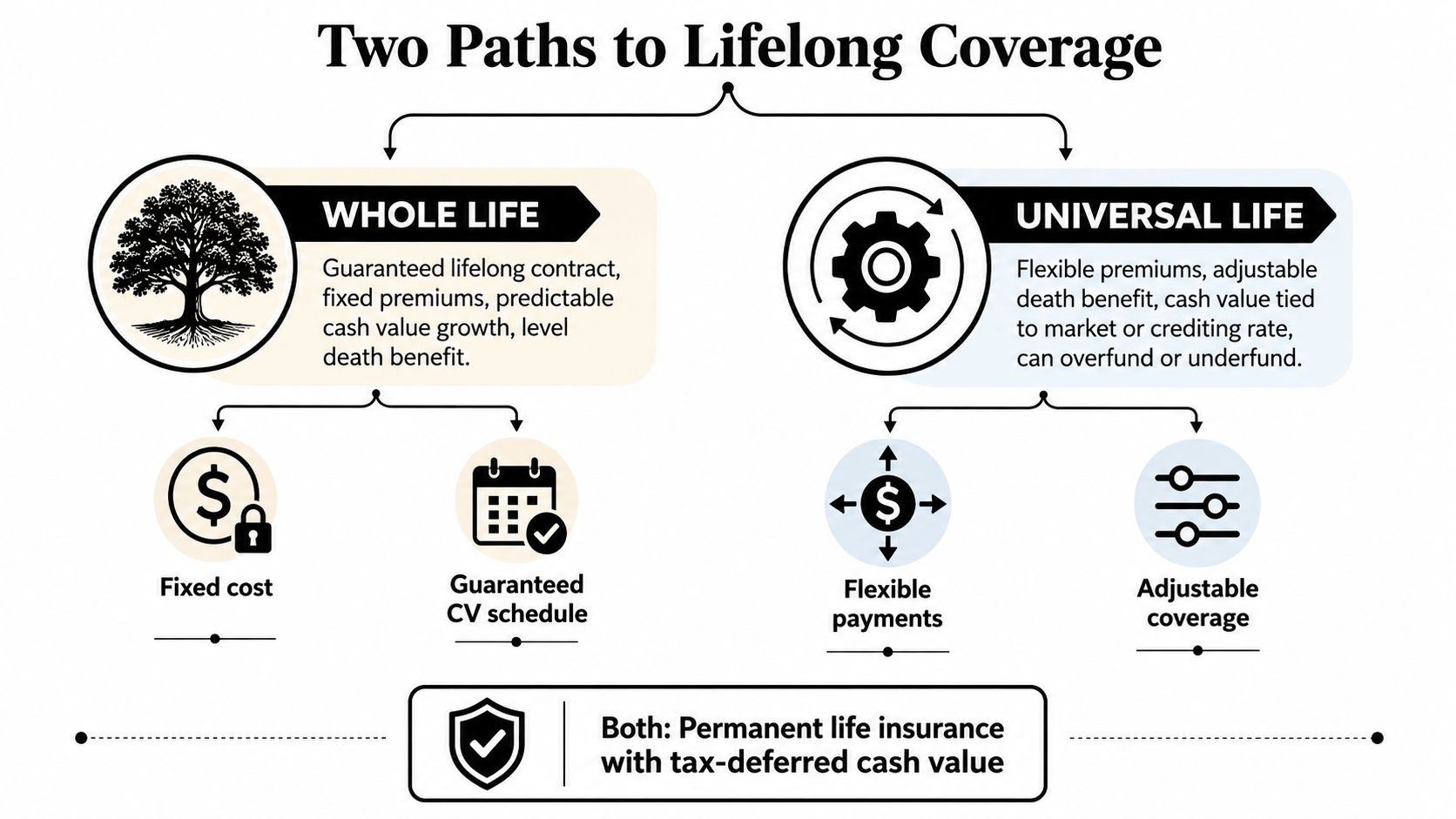
Whole life generally uses a fixed, level premium paid on a set schedule. The policy's core death benefit and cash-value accumulation schedule are contractually guaranteed, subject to the policy's terms and continued payment requirements.
The entire premium does not become cash value. The insurer applies part of it to insurance costs and fees, while the rest supports the policy's cash-value structure. Participating whole life policies may also pay dividends, but dividends are not guaranteed and do not replace the contract's guaranteed values.
That structure can make whole life easier to manage. The basic premium and guarantees are established at issue, so the policy usually demands less ongoing funding judgment than universal life. It still may offer options, and details vary among insurers, but its central funding path is comparatively stable.
Step two, understand universal life
Universal life separates the insurance component from the account value more explicitly. Premiums enter the account, then the insurer deducts items such as monthly cost of insurance, administrative charges, and rider costs. The remaining value receives interest or another form of crediting, depending on the subtype.
Premiums can usually be increased, reduced, or sometimes skipped within the policy's limits. The policy remains in force only if sufficient value or funding covers its ongoing deductions. The death benefit may also be adjustable, subject to contract rules and underwriting for increases. That flexibility can suit changing goals, but it can also create lapse risk if funding or monitoring falls short.
Universal life emerged later than traditional whole life. The Society of Actuaries' discussion identifies rapid market-share growth in the early 1980s, reflecting a shift toward more flexible permanent policies. The category remains significant. A 2024 NAIC presentation referenced roughly $6 trillion in whole life and universal life policy value in the United States, illustrating the scale of these products in the permanent-life market, as noted in the NAIC life insurance material.
The simplest mental model
Whole life builds around certainty. Universal life builds around flexibility and funding discipline. Both can provide lifelong coverage, but universal life requires closer attention to account performance, charges, and premium decisions. Its subtypes, including IUL, VUL, and GUL, can shift that balance further.
How Cash Value Premiums and Guarantees Really Work
The mechanics explain why two policies with the same death benefit can behave very differently over time. Whole life places more structure in the contract. Universal life exposes more of the outcome to funding choices, account performance, and internal deductions.
Whole life follows a defined path
With whole life, the premium is generally level and fixed under the policy contract. The cash value follows a contractually guaranteed accumulation schedule, and the core death benefit terms are generally fixed at issue.
The cash value still reflects the insurer's deductions for insurance costs and fees. What makes whole life different is that the contract establishes guaranteed values after those mechanics are accounted for. Participating policies may provide dividends, but those are additional, non-guaranteed values rather than a replacement for the policy's guarantees.
Practical rule: Treat whole life's guaranteed values as the foundation. Treat dividends, if available, as possible additional value rather than money you must have.
Universal life uses an account-based structure
Universal life is typically unbundled. The policy account receives premiums, while the insurer deducts monthly cost-of-insurance charges, administrative expenses, and rider charges. The remaining amount is credited with interest or index-linked returns, depending on the design.
That distinction matters because the account must remain sufficient to cover ongoing deductions. If the policyholder pays less, the account may carry the cost for a time. If credited interest is weaker than expected or charges consume the account, the policy can move closer to lapse.
Universal life can therefore support meaningful changes in payment timing and coverage, but those changes aren't free from consequences. A skipped payment may preserve short-term cash flow while reducing the account's ability to support future charges.
Use illustrations as planning tools
A policy illustration can show guaranteed and non-guaranteed values, planned premiums, charges, and projected account behavior. It can't remove uncertainty from a policy whose outcome depends on credited interest, market-linked performance, or future funding.
For readers who want to explore how cash value calculations are framed, the thecalcs insurance estimator can provide a starting point for understanding the relationship between premiums, cash value, and coverage. Use any calculator as an educational aid, not as a substitute for an insurer's official illustration.
A policyholder considering participating designs should also understand how dividend treatment and policy terms work. Coveredly's information on participating insurance policies can help clarify why non-guaranteed dividends shouldn't be treated like guaranteed cash value.
Whole life trades funding flexibility for a more predictable contractual structure. Universal life trades some certainty for the ability to adjust premiums and coverage.
Costs Flexibility and the Hidden UL Subtypes You Must Know
A young family may want permanent coverage that protects a mortgage, while a business owner may prioritize a death benefit that lasts without building cash value. “Universal life” covers several designs, so the useful comparison is often whole life versus guaranteed universal life, indexed universal life, or variable universal life, not whole life versus one generic UL policy.
| Feature | Whole Life | Universal Life Family |
|---|---|---|
| Primary structure | Fixed-premium permanent coverage | Permanent coverage with flexible funding and account-based mechanics |
| Premium approach | Fixed premiums under the contract | Flexible premiums, within policy limits |
| Cash-value treatment | Contractually guaranteed accumulation schedule | Interest, index-linked, or market-linked crediting depending on subtype |
| Coverage options | Generally stable core death benefit | Adjustable death benefit, subject to policy rules |
| Main risk | Higher funding commitment | Underfunding, charges, and performance can threaten sustainability |
| Common fit | Predictability and guarantees | Flexibility, customizable guarantees, or cash-value objectives |
The major universal life designs
- Guaranteed universal life, or GUL: GUL emphasizes a death-benefit guarantee when required funding conditions are met. It may fit someone seeking permanent protection without making cash-value growth a priority. The no-lapse guarantee still depends on following the contract.
- Indexed universal life, or IUL: The account's credited interest is linked to an external index formula rather than directly investing in the index. The policy may include a floor, often around 0%, but that floor does not guarantee the policy will remain in force if charges continue and funding is inadequate. Coveredly's guide to indexed universal life insurance pros and cons explains the main trade-offs.
- Variable universal life, or VUL: Cash value is placed in investment subaccounts. The policyholder accepts more direct market-related risk and takes on greater responsibility for investment performance.
- Current assumption universal life, or CAUL: This design uses current assumptions about interest and charges, so changes in those assumptions can alter the account's path.
Every UL review should identify COI charges, administrative expenses, and rider costs. Ask the insurer where each charge appears and how the policy performs under guaranteed and non-guaranteed assumptions.
Cost is only one part of the decision
Whole life often costs about twice as much as universal life for comparable coverage, according to Investopedia's whole life and universal life comparison. A lower starting premium can help a buyer manage current cash flow, but it does not automatically mean a lower lifetime cost or a safer policy. The policy still needs a funding plan that remains realistic as family expenses, mortgage obligations, or business needs change.
The subtype determines what flexibility means. GUL generally emphasizes death-benefit duration, while IUL and VUL introduce account performance into the sustainability question. Whole life offers a more predictable contractual structure, but usually requires a stronger ongoing premium commitment.
Milliman's LIMRA-based analysis reports that UL products, particularly IUL and VUL, represented 42% of U.S. life insurance business in 2024, compared with 30% in 2019. Over the same comparison, fixed and guaranteed UL declined from 12% to 6%. These figures describe a changing product mix, not a recommendation. The right design depends on whether the priority is predictable guarantees, adjustable coverage, cash-value objectives, or a death benefit designed to last under a clearly funded plan.
Risks Sustainability and Why Policies Lapse
Flexibility becomes a risk when a policyholder treats a flexible premium as though it were optional forever. Universal life can tolerate changes in funding within its rules, but the account still has to support monthly deductions and the policy's required conditions.
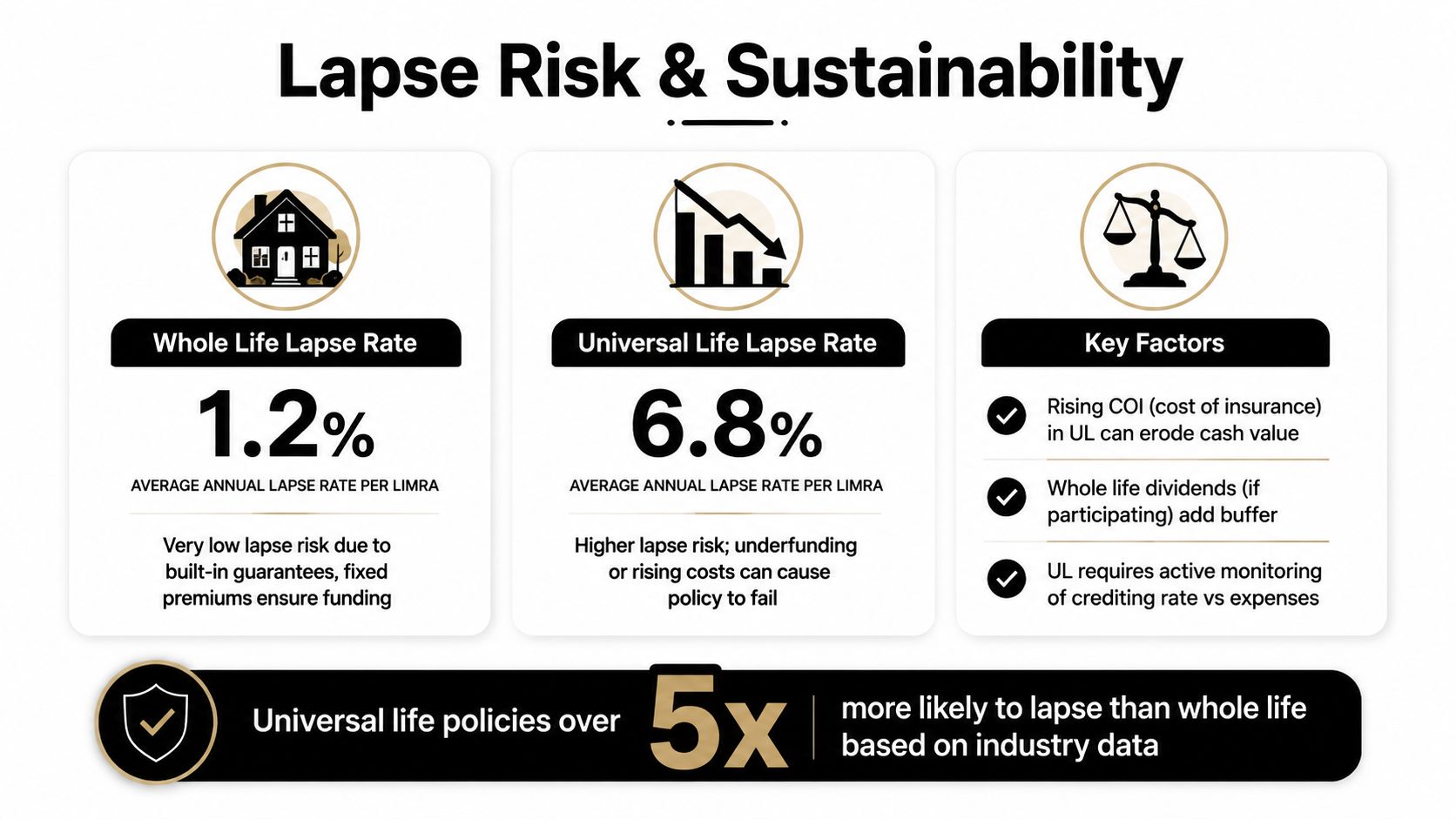
As the insured ages, internal insurance charges can rise. If the account receives insufficient premiums or weaker-than-expected credits, those deductions can consume cash value. Once the account no longer supports the policy, the owner may need to increase funding quickly or face lapse.
What the persistency data signals
A 2026 persistency report cited in the Society of Actuaries conference material reports overall lapse rates of 5.3% for universal life versus 3.9% on a policy basis for whole life. The figures appear in the SEA conference persistency material_2025_06_02.pdf).
These rates don't predict what will happen to a particular policy. They do show why sustainability deserves equal attention with the initial premium. A policy that lapses after years of funding may leave the owner without the intended protection and may create new underwriting challenges if replacement coverage is needed.
Whole life generally places less ongoing responsibility on the policyholder because its core premium and guaranteed values are more stable. Universal life requires a closer relationship with the policy statement, especially when the owner changes premiums, takes withdrawals, adjusts the death benefit, or owns a design tied to current interest or market performance.
A practical UL monitoring routine
- Review the account value: Check whether the actual value is tracking the illustration's assumptions.
- Read the deductions: Identify current COI, administrative, and rider charges rather than looking only at the total premium.
- Test lower-crediting scenarios: Ask how the policy performs if credited interest or index-linked returns are weaker.
- Confirm the no-lapse terms: A guaranteed death benefit may depend on specific premium requirements that differ from the amount needed to keep the account active under ordinary assumptions.
- Revisit major life changes: Marriage, a new child, a mortgage, business ownership, or reduced income can change the appropriate death benefit and funding plan.
A universal life policy isn't sustainable because the first premium is affordable. It's sustainable when the funding plan remains credible after charges, changing needs, and weaker performance are considered.
Which Policy Fits Young Families Professionals and Couples
A young family often needs protection for income, housing, and childcare. If the household wants a permanent policy with a stable premium and predictable guarantees, whole life may fit the family's preference for certainty. The tradeoff is a larger fixed commitment, so the couple should confirm that the payment remains comfortable alongside emergency savings, retirement contributions, and other goals.
If income varies because one parent owns a business or works on commission, universal life may offer useful payment flexibility. That flexibility only works when the family treats the policy as an account that needs funding reviews, not as coverage that can be ignored after a low initial quote.
For family protection: Choose the structure you can maintain through ordinary financial stress, not just the structure with the smallest starting payment.
Professionals and business owners
A business professional may need permanent coverage for estate planning, a buy-sell arrangement, or business continuity. A GUL design can be relevant when the priority is a death-benefit guarantee and cash-value accumulation isn't central. An IUL or VUL may appeal to someone prioritizing cash-value potential and willing to accept more complexity, but those designs require careful review of assumptions and charges.
The business purpose should determine the policy design. A policy meant to protect a company's continuity shouldn't depend on optimistic account performance unless the owners understand how they'll respond if funding needs rise.
Newly married couples
Newly married partners may want lifelong coverage but still be building careers, buying property, or planning for children. Whole life can suit the partner who values fixed premiums and low management effort. Universal life can suit a couple whose income or coverage needs may change, provided they agree on who will monitor the policy and how they'll respond to an underfunding warning.
Some couples may discover that permanent insurance isn't their immediate priority. If the main need is income protection during working years and the budget is limited, term insurance may deserve comparison before either cash-value design.
For couples with changing goals: Decide whether you need permanent cash value now, or whether flexible term protection better matches the household's current stage.
The best recommendation depends on the purpose, the funding discipline, and the couple's comfort with risk. Product labels don't make that decision for you.
Decision Checklist and Next Steps to Buy with Confidence
A sound decision starts with the purpose of the coverage. Don't compare illustrations until you know whether the main goal is a lifelong death benefit, cash-value accumulation, estate or business planning, or a combination of needs.
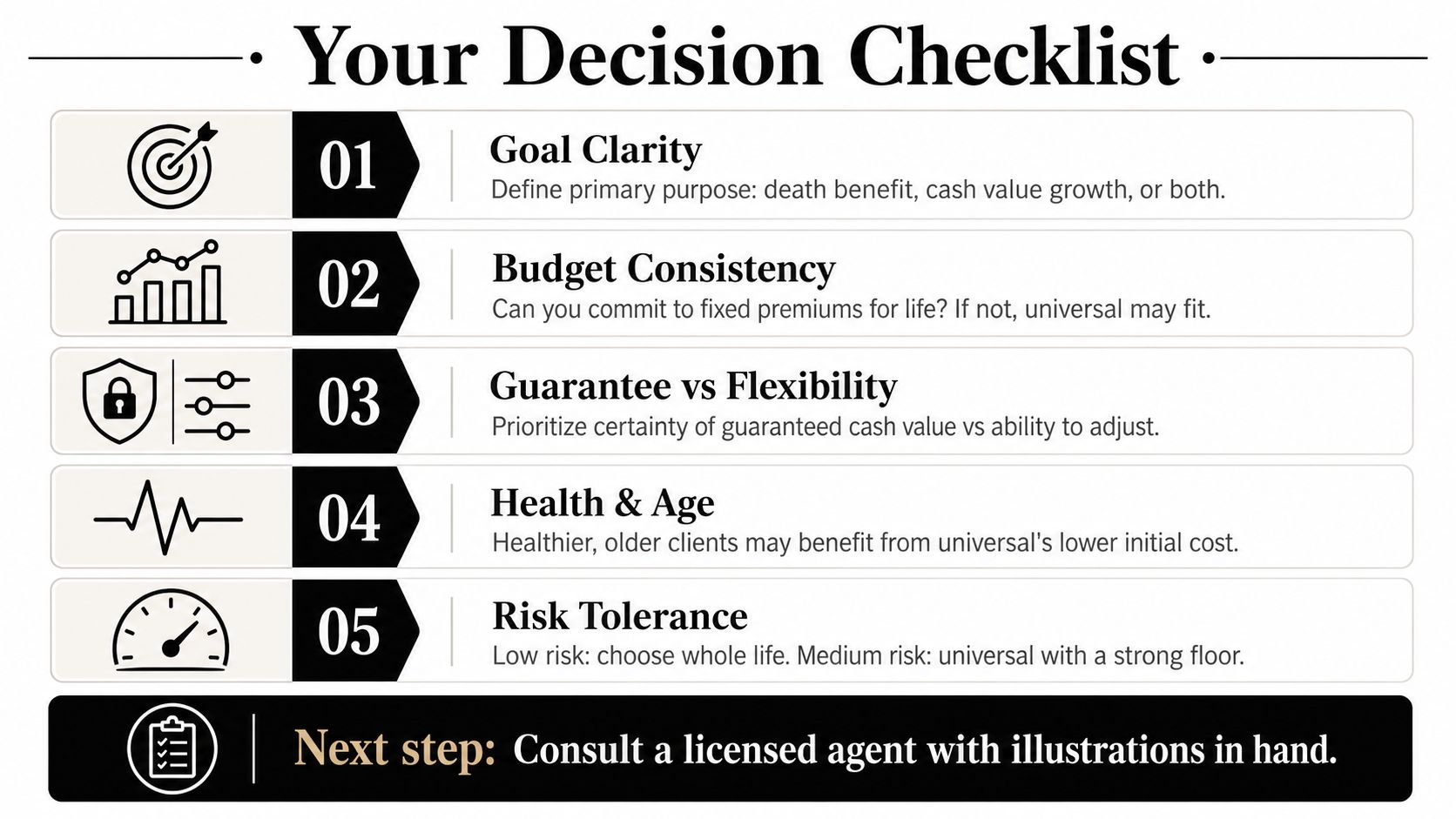
Five questions to answer
- What must the policy accomplish? Write down the people, debt, business interest, or legacy goal the death benefit should address.
- Can you maintain the funding plan? Whole life requires commitment to its scheduled premiums. Universal life permits flexibility, but underfunding can threaten the policy.
- Do guarantees matter more than adjustment? Prefer whole life when predictable contractual values and simpler management matter most. Consider UL when changing premiums or coverage is central to the plan.
- Which UL subtype matches the goal? Ask whether GUL, IUL, VUL, or CAUL is being proposed, then identify the specific risks and guarantees.
- Will you monitor the policy? If you won't review charges, account value, crediting assumptions, and funding, a highly flexible UL design may be a poor fit.
Compare before applying
Request illustrations that separate guaranteed values from non-guaranteed assumptions. Ask what happens under lower crediting performance, increased charges, skipped premiums, withdrawals, and changes to the death benefit.
Tax treatment can also affect the decision. Cash value is generally discussed as growing on a tax-deferred basis, but withdrawals, loans, surrender, and policy lapse can have tax consequences. Ask a licensed insurance professional and a qualified tax adviser to explain how the specific contract applies to your situation.
Term insurance remains a useful alternative when the primary goal is affordable protection for a defined period. Coveredly's digital platform offers term life insurance options, including coverage of up to $3 million with no exams for most applicants, as described by Coveredly's life insurance service. Compare that option with permanent coverage rather than assuming cash value is automatically necessary.
Tomorrow, gather your household budget, mortgage balance, income-replacement goal, and any existing policies. Then request side-by-side illustrations for whole life and the specific UL subtype under consideration, and ask the agent to explain the funding needed to keep each policy sustainable.
Coveredly helps shoppers compare digital life insurance options, including term coverage, while you evaluate whether permanent protection fits your goals. Visit Coveredly to review available coverage and take the next step with a clearer understanding of guarantees, flexibility, and long-term sustainability.