Most advice about participating insurance policies starts in the wrong place. It fixates on dividends as if they're a bonus you'd be foolish to ignore, when the key question for young families is simpler, sharper, and more important: does the extra premium buy enough real value to justify the hit to your budget? If your household is balancing child care, rent or a mortgage, debt, and savings, a policy with a dividend story can be a bad trade if it makes the base coverage harder to afford.
The market data backs up that caution. Participating coverage still matters, but the U.S. life market is dominated by nonparticipating products, and that's a signal buyers should take seriously. The American Council of Life Insurers reported that participating policies accounted for 25.7% of individual life insurance face amount purchased in 2012, then 29.2% in 2021, and 28.9% in 2022, while nonparticipating policies made up 71% of individual life face amount purchased in 2022, about $1.3 trillion (ACLI fact book). Across all channels, participating purchases were 17.7% of total life insurance face amount in 2012 and 16.8% in 2022, which shows only modest share movement over a decade (ACLI fact book).
That's the frame I'd use if I were sitting across from a newly married couple or a young parent. Don't ask whether participating is “better.” Ask whether paying more now for a non-guaranteed dividend later makes sense versus buying stronger protection at a lower price. For a lot of households, the answer is no. For a smaller group with a long horizon, stable income, and a real need for permanent coverage, it can be worth a look.
Table of Contents
- Why Participating Insurance Policies Deserve a Closer Look
- How Participating Life Insurance Actually Works
- Inside the Participating Fund and Dividend Generation
- Comparing Participating Policies to Term and Nonparticipating Options
- Real Scenarios for Young Families and Professionals
- Pros Cons and Tax Implications to Consider
- Questions to Ask Before Buying a Participating Policy
Why Participating Insurance Policies Deserve a Closer Look
Participating insurance policies are often sold with a tidy pitch, you pay premiums, the insurer performs well, and you may receive dividends. That part is true. What matters more for young families is the price you pay for that possibility, because a policy with a dividend feature can still leave you behind if the higher premium takes money away from protection, savings, or day-to-day spending.
The real trade-off is value, not prestige
A participating policy lets the policyholder share in insurer profits through dividends or bonuses, and those payouts depend on investment performance, claim experience, and operating expenses. They are not guaranteed, and in weak years the non-guaranteed portion can be zero (Insurance Authority of Hong Kong). That should change how you judge the product. You are buying a contract with possible upside, not a promised return.
That is why I push back on the idea that participating coverage is automatically the better choice. For many households, especially newlyweds and young parents, the smartest policy is often the one that gives the most death benefit for the lowest premium. If the premium is hard to keep up with, or if it forces you to cut back on emergency savings, retirement contributions, or even ordinary monthly bills, the dividend feature is doing too much of the sales job and not enough for your actual budget.
Practical rule: if the extra premium means you have to weaken essential savings, the participating feature costs too much for you right now.
Who should actually care
Time horizon matters. Participating insurance policies make more sense when you want permanent coverage, can pay the premium difference without strain, and are willing to wait a long time before any dividend pattern becomes meaningful. They fit a narrower group, not the average young family trying to stay flexible.
Ask the harder question. Will you still be glad you paid extra in 10 or 20 years if the payout turns out to be modest or uneven? If the answer is no, you are probably buying the illustration, not the protection. For people watching every dollar, that is the wrong reason to choose a policy.
To understand the terms behind these products, start with this guide to common life insurance policy terms.
How Participating Life Insurance Actually Works
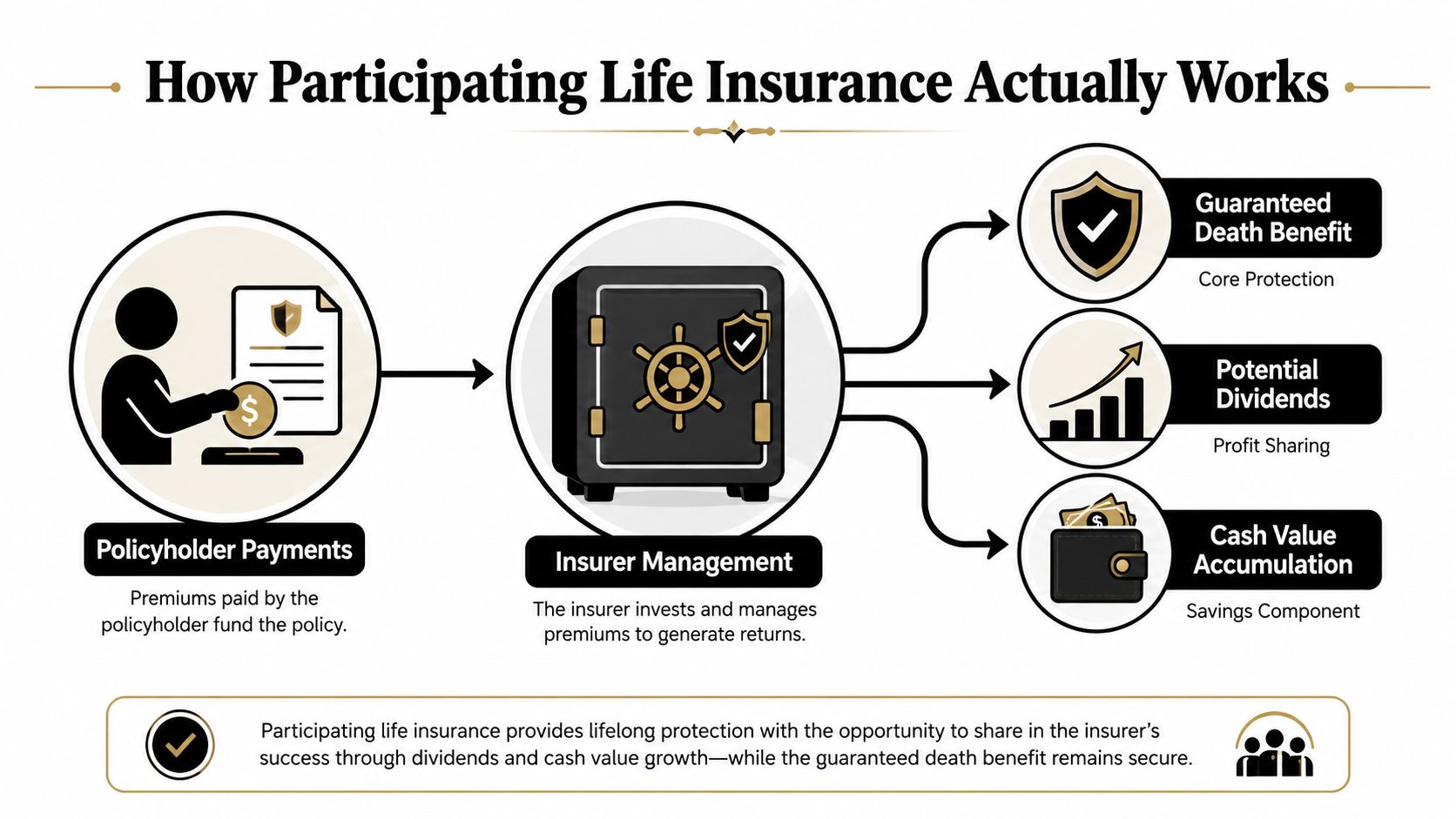
A participating policy gives you a guaranteed base benefit plus a possible share of surplus. That extra share depends on how the insurer performs, so the policy can look attractive on paper without being a sure outcome in real life. For young families and newlyweds, that trade-off matters because every extra dollar in premium has to justify itself over the long run.
What “participating” means in plain English
A participating policy lets policyholders share in an insurer's profits through dividends or bonuses, with payouts influenced by investment performance, claim experience, and operating expenses rather than fixed results (Insurance Authority of Hong Kong). The illustration is built from business performance and actuarial assumptions, so the numbers you see are not the same as a bank deposit rate or a guaranteed return.
The key word is share. You are not buying stock in the insurer, and you are not receiving a shareholder dividend. You are taking part in how surplus may be distributed inside the policy structure. That is why the guaranteed part and the non-guaranteed part need to be kept separate from the start.
How policyholders can receive dividends
Insurers usually give policyholders several ways to handle dividends. The dividend can be taken as cash, used to reduce future premiums, left to accumulate, or used to buy additional paid-up insurance. Those choices affect how the policy behaves over time, but they do not turn the dividend into a guaranteed amount.
A dividend option only helps if the policy already fits your budget. It should not be used to excuse a premium that is too high on day one.
The mistake I see most often is families focusing on the dividend illustration and ignoring the premium bill. If the policy costs more upfront, the dividend has to make up that gap first. That is a steep hurdle, especially when you compare it with simpler term coverage.
If you want a glossary while you sort through policy language, use this guide to common life insurance policy terms. It will not lower the price, but it will make the contract easier to read.
Why dividends can still disappear
The most important thing to remember is that the non-guaranteed portion can be zero in poor conditions (Insurance Authority of Hong Kong). That is the reality of the structure. Buyers who understand that upfront make better decisions because they stop treating the dividend as part of the base policy and start treating it as a possible enhancement.
Inside the Participating Fund and Dividend Generation
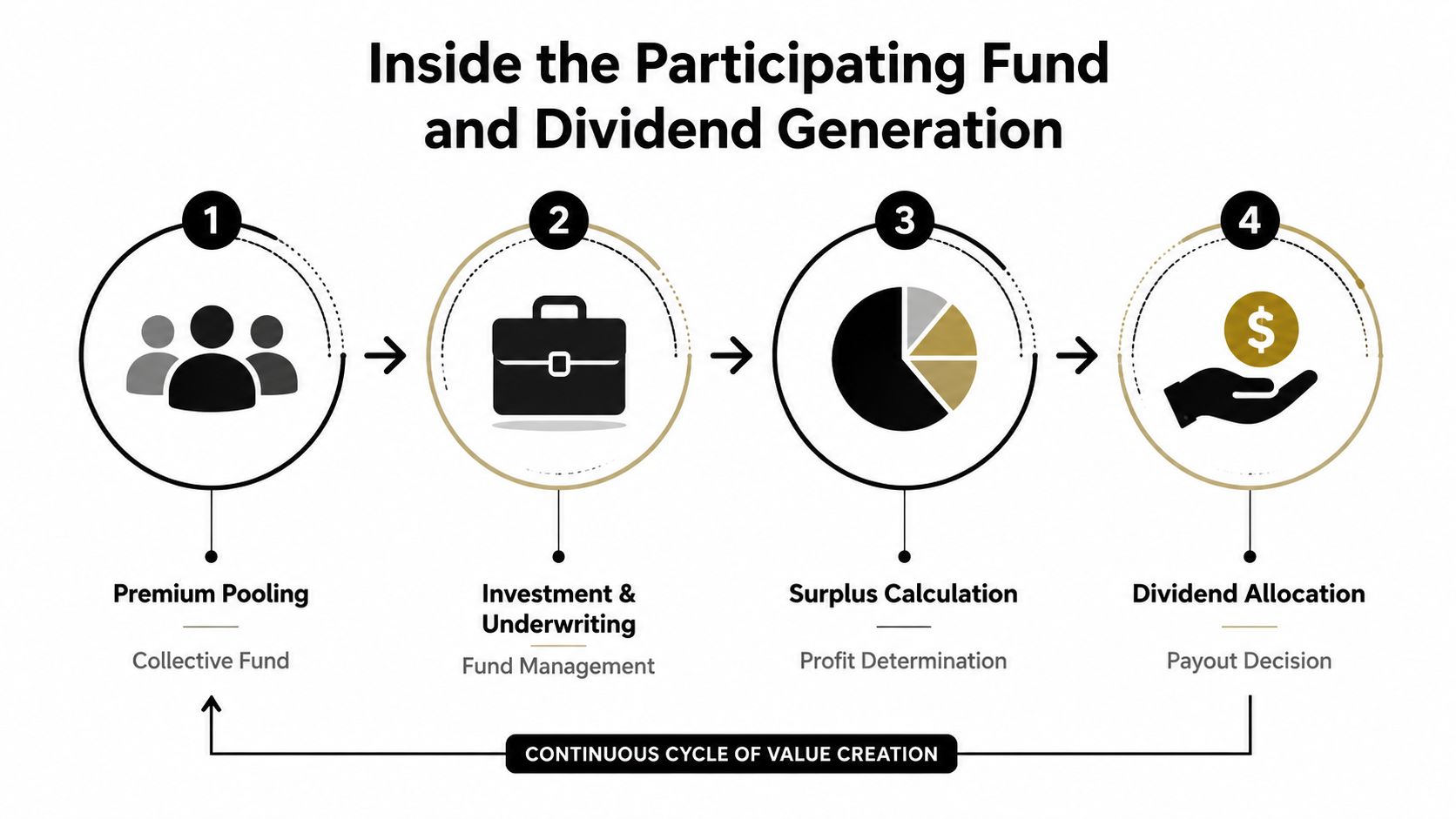
Dividend performance does not come from optimism. It comes from how the insurer manages a dedicated pool of assets, liabilities, and expenses over time. That sounds dry because it is dry, and that is exactly why it matters. If you are trusting an insurer with decades of premiums, boring discipline is what you want.
Where the money sits
In major participating-policy markets, insurers use a dedicated participating account that holds assets supporting these policies and requires disclosure of the asset mix, credit quality, liquidity quality, and investment strategy (OSFI guidance). That disclosure matters because asset management affects how much surplus is available for dividends and how closely the illustration matches reality.
Singapore's Life Insurance Association describes the same basic setup through a participating fund, where premiums are pooled into a specially designated fund that can invest in government and corporate bonds, equities, property, and cash, with the mix changing over time at the insurer's discretion (Life Insurance Association Singapore). That tells you two things. Dividend support depends on real investment policy, not marketing copy. The fund can also shift over time, so the insurer's current strategy matters as much as its reputation from years ago.
Why asset-liability management changes your payout
The practical point is simple. If the insurer matches its assets and obligations well, more surplus can flow into the participating account. If the matching is poor, fewer dollars are left for policyholder dividends. The OSFI guidance ties disclosure to that exact relationship between asset-liability management, the amount available for dividends, and the gap between illustrated and actual payout (OSFI guidance).
That is the variable sales conversations usually skip. A big illustration can look impressive even when the dividend environment behind it is weak. I would take a conservative illustration from a transparent insurer over a glossy projection from a company that will not explain its asset strategy.
The question most buyers should ask
The more useful question is whether the insurer's participating fund has the discipline to support dividends after expenses, claims, and investment swings. Ask for the details, not the sales summary. If the agent cannot explain the participating account in plain language, treat that as a warning sign.
Young families should also ask whether the extra cost is worth it in the first place. A dividend feature only makes sense if the policy already fits the budget, and if you are comparing that premium burden against a simpler option, start with term vs whole life insurance. For a separate example of how dividend-oriented products are discussed outside insurance, the Scotia dividend fund guide is a useful reference. The point is the same in both cases, yield only matters if it can survive fees, structure, and time.
Comparing Participating Policies to Term and Nonparticipating Options
If your main goal is the most protection for the least money, term life is usually the smarter buy. Participating whole life only belongs in the conversation if you already want permanent coverage and you are willing to pay extra for dividend potential that is never guaranteed. That is the trade-off, plain and simple.
Side-by-side trade-offs
| Feature | Participating Whole Life | Nonparticipating Whole Life | Term Life Insurance |
|---|---|---|---|
| Premium cost | Usually higher because of the dividend feature and permanent structure | Usually lower than participating whole life, but still permanent coverage | Usually lowest for pure protection |
| Death benefit | Permanent and may be enhanced by dividends | Permanent and contractually defined | Temporary, for a set term |
| Cash value | Yes, with potential growth | Yes, depending on policy design | Usually no cash value |
| Dividend potential | Possible, but not guaranteed | None | None |
| Flexibility | More choices, but more complexity | Simpler than participating whole life | Highest affordability, least complexity |
| Best fit | Buyers who want long-term permanent coverage and can absorb higher premiums | Buyers who want permanent coverage without dividend uncertainty | Families who need affordable protection now |
The table says what the sales pitch often avoids. You are paying for features, and every feature carries a cost. For many households, especially young families watching every dollar, that extra premium is the deciding issue, because a policy that strains cash flow is usually the wrong policy.
What the market trend means
The broader market points in the same direction. Participating coverage still matters in absolute dollar terms, but nonparticipating products dominate the U.S. life market, with nonparticipating policies making up 71% of individual life face amount purchased in 2022 at about $1.3 trillion (ACLI fact book). That does not make participating policies a mistake. It does show that the simpler structure is where most money goes.
If you are comparing permanent coverage with and without dividends, focus on what the dividend feature really adds after fees and premium differences. In many cases, the long-term lift is modest. For a family that needs every dollar to work harder, a small possible gain is not a good reason to accept a bigger bill each month.
For a cleaner breakdown of the policy choice itself, the term vs whole life insurance guide is the right companion read. For a separate example of how dividend-focused products are discussed outside insurance, the Scotia dividend fund guide shows the same basic lesson. Yield only matters if the costs and structure still leave you ahead.
My recommendation
Choose participating whole life only if you already know you want permanent insurance, can keep paying for it over the long haul, and are comfortable treating dividends as a possible bonus. If your priority is the biggest death benefit for the smallest premium, buy term and keep the budget intact. That is the better move for most young families and newlyweds.
Real Scenarios for Young Families and Professionals
The right policy depends on what you're protecting and what you can afford. That sounds obvious, but it's where most bad decisions happen, because people shop for the story instead of the use case. These three examples show how the same product can be smart in one household and wasteful in another.
Young family with two children
A family with two kids often needs straightforward income replacement first, not a policy that tries to do everything at once. If monthly cash flow is already tight, the case for participating insurance gets weak fast. The reason is simple, the dividend upside is too uncertain to justify sacrificing a larger guaranteed death benefit.
If the household priority is protection, term insurance is the cleaner choice. It gives the family more coverage for less money, which means more breathing room for childcare, food, emergency savings, and debt paydown. That's not a theoretical advantage. It's the difference between a policy that stays in force and one that gets dropped after a financial setback.
If the premium increase would force you to shorten the term of coverage or reduce the face amount, don't buy the dividend feature.
Newlywed couple in their late twenties
Newlyweds usually have more flexibility in time horizon, but not necessarily more spare cash. They may be saving for a home, building an emergency fund, or tackling student debt. In that situation, participating features can be a distraction if they slow down bigger goals.
A helpful way to think about this is to use family budgeting tips from Peaceful Mindful Pocket as the first filter before you even compare policies. If the budget can't comfortably absorb the premium difference, the policy is too fancy for the moment. If the budget is stable and the couple wants permanent coverage for estate or legacy reasons, then a participating policy can be worth comparing, but only after the basic coverage need is solved.
Business professional in the thirties
A business professional with higher income and a stable long-term plan may have a different answer. If they already have term coverage, want permanent protection, and are comfortable with a slower build of policy value, participating insurance can fit as part of a broader planning strategy. The key word is part. It shouldn't be doing the job of emergency savings, retirement investing, or business liquidity.
The mistake in this group is overestimating dividend value because the policy looks conservative. Conservative doesn't mean free, and it doesn't mean efficient. If the main objective is long-term wealth building, the premium difference often works harder in a separate investment account than inside a participating policy.
Pros Cons and Tax Implications to Consider
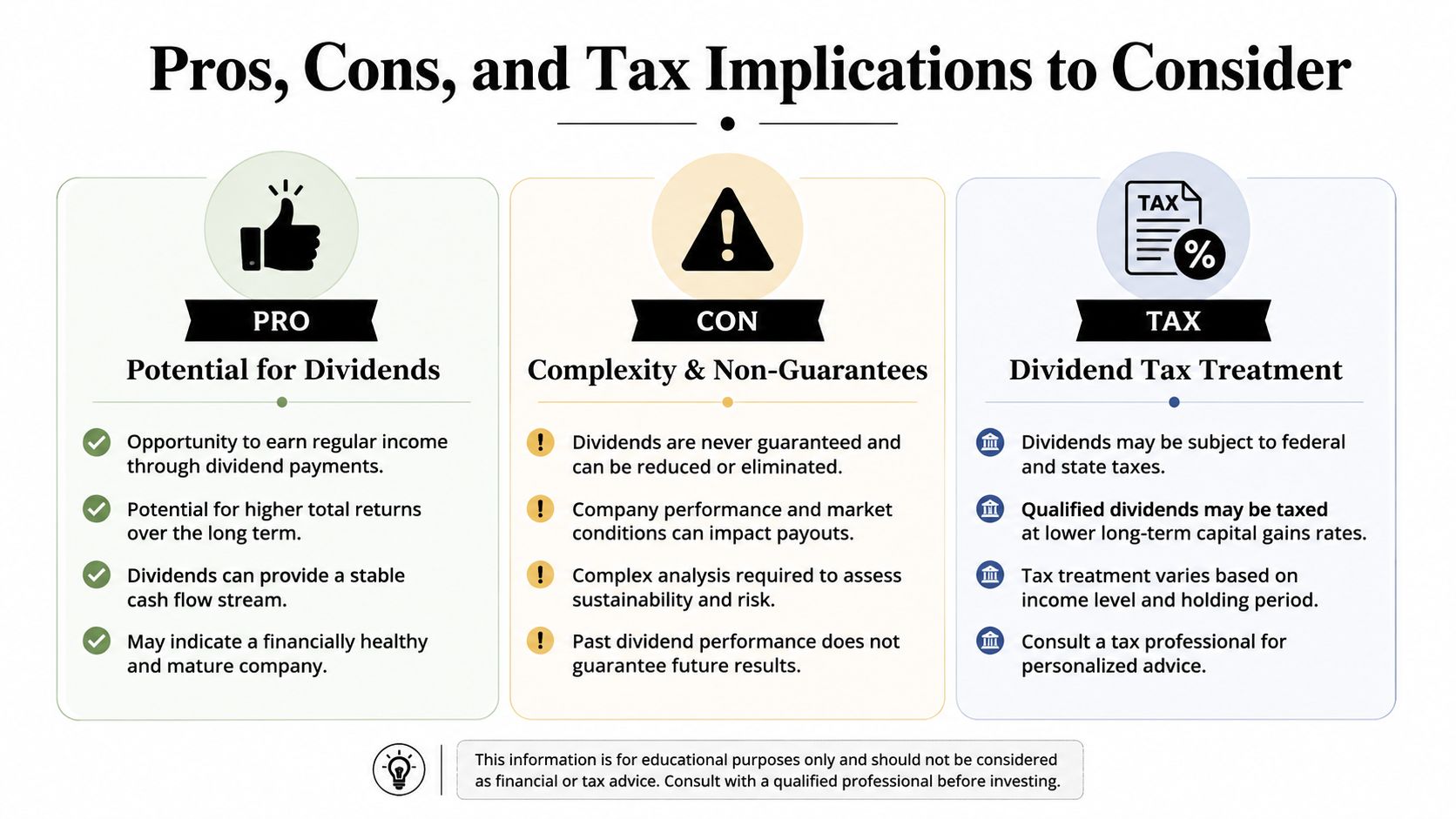
Participating policies are not a scam, and they're not a free lunch. They're a specific tool with real strengths and obvious downsides. If you understand both sides clearly, the decision gets easier.
What you gain and what you give up
The upsides are straightforward. You get possible dividend income, potential cash value growth, and a policy structure that can encourage disciplined, long-term saving. For some buyers, that discipline matters as much as the return itself.
The trade-offs are just as real. Premiums are typically higher, dividends are non-guaranteed, and the policy structure is more complex than term insurance. There's also an opportunity cost. Every extra dollar you pay for the participating feature is a dollar you can't use elsewhere.
Tax treatment to keep in mind
The tax side is generally favorable, but it's not magic. If dividends are treated as a return of premium, they're usually not taxed as income. Problems start when you leave them to accumulate interest, because the interest portion can become taxable. Policy loans and withdrawals also need careful handling, especially if you're using cash value strategically.
For a plain-English overview of that issue, the guide on whether cash value in life insurance is taxable is worth reading before you make assumptions about after-tax results. Don't buy a policy based on a tax idea you haven't verified.
Decision checklist
Use this before you sign anything.
- Can I afford the premium comfortably? If the answer is no, stop.
- Do I need permanent coverage, or just protection for a period of time? If it's temporary, term is usually cleaner.
- Would I still value the policy if dividends were modest or zero? If not, the design is too dependent on upside.
- Am I willing to wait many years for the policy to show value? If not, look elsewhere.
- Do I already have emergency savings and retirement contributions on track? If not, don't let a dividend feature crowd them out.
My opinion is blunt. If affordability is your main concern, participating insurance is usually the wrong first move. Buy the simpler protection first, then consider whether you still have enough room in your budget for a more complex permanent policy.
Questions to Ask Before Buying a Participating Policy
The sales conversation should get uncomfortable fast. That is a good thing. If you are weighing a participating policy, you need answers that are specific enough to compare one insurer with another, not just reassuring talk about “strong dividends” and “long-term value.”
Ask about the numbers behind the story
Start with the history. Ask how long the insurer has paid dividends, how steady those dividends have been, and what happened in weaker economic periods. Then ask for the policy illustration to be split into guaranteed and non-guaranteed parts. That separation matters because the guaranteed part is the only piece you can count on.
Next, ask how the insurer explains the participating account and the way it is managed. You want to know the asset mix, credit quality, liquidity quality, and investment strategy, because those details show how carefully the company handles the pool that supports dividends. If the explanation is vague, treat the dividend forecast the same way.
Ask about exits and flexibility
You should also ask about surrender charges, policy loans, and what happens if you cannot keep up with the premium. A policy that looks fine on paper can become expensive very quickly if your income changes. Young families need to pay close attention here, because a product that strains the budget today can turn into a regret later.
- What is guaranteed, exactly? This tells you the floor.
- How are dividends determined? This exposes the assumptions.
- How have dividends held up in downturns? This shows resilience.
- What are the surrender costs? This tells you how expensive it is to change course.
- How do policy loans affect value? This shows how flexible the policy really is.
- What happens if dividends are lower than illustrated? This is the honesty test.
Ask one more question that matters for families. If dividends stay modest after fees and the higher premium, does the policy still fit your budget and your goals? If the answer is no, the participating feature is not pulling its weight. Simpler coverage usually makes more sense until your cash flow is stronger.
If the agent cannot answer those questions clearly, walk away. A good policy holds up under scrutiny. A weak one depends on you not asking.
Coveredly helps young families, newlyweds, and business professionals compare life insurance in plain English, without the sales fog that makes complex policies harder than they need to be. If you want to focus on affordable protection first and decide later whether permanent coverage makes sense, visit Coveredly and start with a policy that fits your life and your budget.