You're sitting at the kitchen table with a partner, mortgage paperwork nearby, and a few browser tabs open. You type in your age, coverage goal, and health details, expecting term life insurance premiums to look like another large monthly bill. Instead, the quote may be much closer to the cost of an occasional dinner than a four-figure obligation.
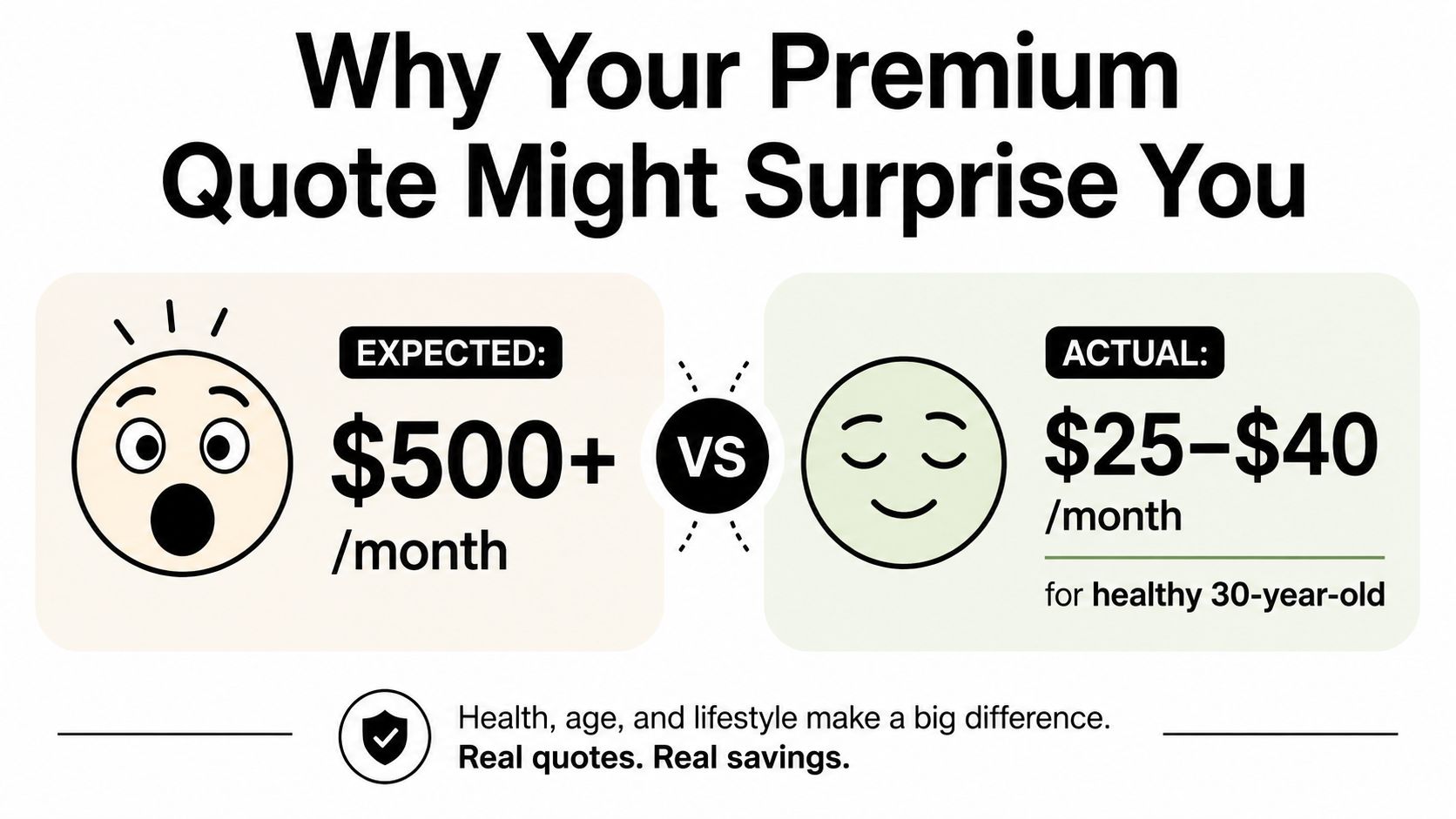
That surprise is common. LIMRA found that adults age 30 and younger estimated the premium for a $250,000, 20-year level term policy at roughly 10 to 12 times the actual median cost. The finding helps explain why some first-time buyers delay coverage before they've even checked a real quote. LIMRA's life insurance insights provide useful context for this pricing-perception gap.
Table of Contents
- Why Your Premium Quote Might Surprise You
- What a Term Life Insurance Premium Actually Is
- How Insurers Build the Base Price
- The Real-World Factors That Move Your Quote
- Sample Rates and Why Cost Rises With Age
- Term vs Permanent and Where Term Saves Money
- Smart Ways to Lower Your Premium and Buy With Confidence
Why Your Premium Quote Might Surprise You
The first online quote usually places three details next to one another: your recurring premium, the coverage period, and the death benefit. The premium is the amount you pay to keep the policy active. The term is how long the stated protection lasts. The death benefit is the amount your beneficiaries may receive if you die while the policy is in force.
That distinction matters because people often treat the death benefit as though it were the price. A $500,000 policy doesn't mean you're paying $500,000. It means the insurer promises that amount, subject to the policy terms, while you pay a smaller recurring premium for the protection.
The quote also isn't a one-time entry fee. A monthly billing option spreads the cost across regular payments, while an annual option collects the premium in a larger payment. Either way, the number represents the cost of maintaining coverage for that period, not a single charge that buys the entire death benefit.
Why similar applicants see different numbers
Two people of the same age can receive very different quotes because insurers don't price age alone. Health history, tobacco use, occupation, hobbies, driving record, family medical history, coverage size, and policy design all affect the expected cost of insuring them. One applicant may qualify for a preferred health class, while another may receive a higher-risk rating after underwriting.
The carrier matters, too. Insurers use their own pricing assumptions, underwriting rules, expenses, and capital strategy. That's why one quote shouldn't be treated as the universal price for your age group.
A useful starting definition is simple: a term life insurance premium is the recurring price of temporary financial protection. The rest of the quote comes from how the insurer estimates risk, funds future claims, and administers the policy.
What a Term Life Insurance Premium Actually Is
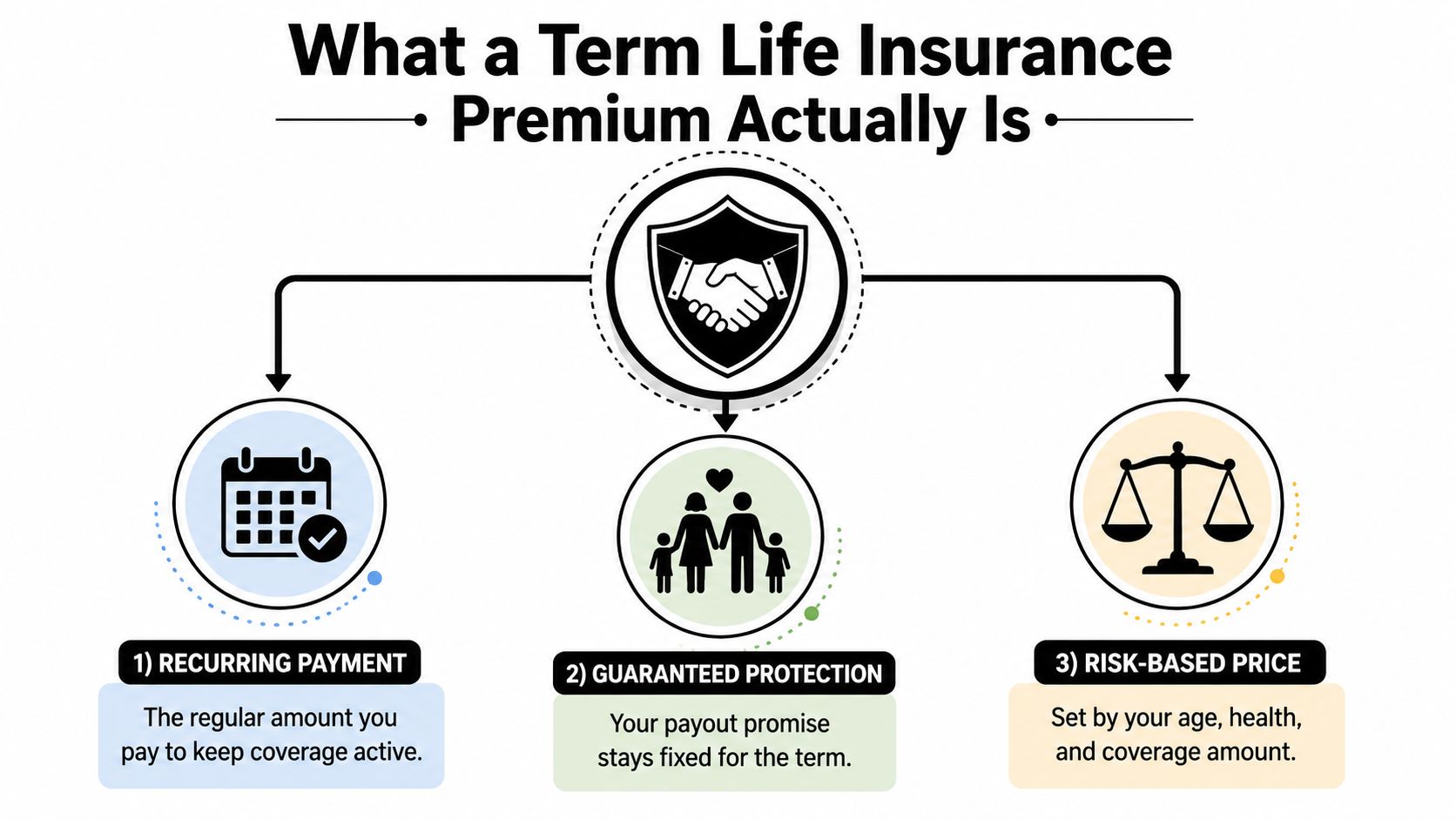
A term life insurance premium is the recurring payment you make in exchange for a policy's promise to pay a stated death benefit if the insured dies during the selected term. You might pay monthly, quarterly, or annually, depending on the carrier and policy. If you stop paying and the policy's grace period expires, coverage can end.
Keep the two core numbers separate:
- Premium: what you pay to keep the policy active.
- Death benefit: what the insurer may pay your beneficiaries after a covered death.
- Term: the period during which the promise applies.
The premium and death benefit don't move in a one-to-one relationship. A larger benefit generally costs more because the insurer would have a larger obligation if a claim occurs, but the price also reflects age, health, term length, and underwriting class.
The rental analogy
Term coverage is similar to renting protection for a defined stage of life. You might want income replacement while children depend on your earnings, or protection while a mortgage remains outstanding. You're paying for a specific financial need rather than building a policy designed to last forever.
That structure helps keep term coverage focused. If you outlive the term, the policy generally ends without a death benefit. Term life also typically has no cash value component, unlike permanent life insurance, which accumulates cash value over time. Guardian's explanation of how term life works describes this structural difference directly.
Level versus annual renewable coverage
With level term insurance, the premium generally remains fixed throughout the selected term, provided you keep the policy active. This makes budgeting easier because the payment doesn't change every year during that period.
With annual renewable term, the policy renews one year at a time, and the premium generally rises as you get older. That design can work for a short or uncertain need, but it may become less predictable over time.
How Insurers Build the Base Price
Before an underwriter reviews your application, an insurer has already built a base pricing model. The model starts with three actuarial building blocks: expected mortality cost, expected investment return on premium float, and expense loading. This overview of term life premium calculation factors explains the same foundation in practical underwriting terms.
Expected mortality cost
Mortality cost is the expected amount the insurer will need to pay for claims across a pool of insured people. Actuaries use mortality assumptions to estimate how likely a person in a particular risk group is to die during the policy term. A younger applicant usually presents a different expected claim pattern from an older applicant, which affects the starting rate.
The insurer doesn't know which individual policyholder will make a claim. It manages that uncertainty across a broad pool, using assumptions and experience to estimate the total cost.
Expected investment return
Insurers receive premiums before they may need to pay claims. They assume those funds can earn investment income during the coverage period. Expected investment return can offset part of the future cost of claims, which influences the premium calculation.
This doesn't mean your premium is an investment account. It's a pricing assumption used by the carrier when estimating how much money it needs to collect today for future obligations.
Expense loading
The third component covers the cost of running the insurance operation. It can include underwriting, policy administration, distribution expenses, commissions, and the insurer's required margin. The carrier has to collect enough to support claims and operate the policy system, not just fund the death benefit.
After combining these elements, the insurer applies personal rating factors. You can review the broader underwriting process in this guide to underwriting for life insurance.
Different carriers may use similar building blocks but choose different assumptions, expenses, and risk appetites. As a result, base prices can differ before an underwriter adds details from your application.
Regulation can affect the result, too. A Milliman analysis found that changing U.S. statutory reserve rules could make 20-year term premiums roughly 15% higher than under the older XXX framework with financing, even when mortality risk stayed unchanged. Milliman's reserve regulation analysis shows why consumer pricing reflects capital and reserve requirements as well as personal risk.
The Real-World Factors That Move Your Quote
The quote becomes personal when the insurer layers underwriting details onto the base price. Some factors tend to have a larger effect than others, but the carrier evaluates them together rather than in isolation.
Age at application is one of the clearest pricing inputs. The insurer is estimating risk over the selected term, so applying later can mean entering a higher age band or receiving a higher starting rate.
Current health also carries substantial weight. The application and medical exam may address height-to-weight measurements, blood pressure, cholesterol, diagnosed conditions, prescriptions, and medical history. The insurer uses those details to assign a risk class.
The policy itself changes the price. A longer term gives the insurer a longer period during which a claim could occur, so a 30-year term generally costs more than a 10-year term for the same applicant and benefit. A larger death benefit also increases the insurer's potential obligation.
Tobacco and nicotine use can raise premiums sharply. So can occupational and recreational risk. A roofer, pilot, or offshore worker may receive different treatment from someone in a lower-risk office role. Skydiving, scuba diving, and competitive racing may prompt additional questions or exclusions.
Driving history matters when it indicates high risk. DUI history, at-fault accidents, and license suspensions can affect underwriting. Gender, geography, policy type, and whether the application is fully underwritten or simplified issue may have a smaller effect in some cases, but they can still appear in the quote.
| Factor | Typical impact | Example effect on monthly premium |
|---|---|---|
| Age at issue | Often significant | Applying at an older age can move you into a higher pricing band |
| Health class | Often significant | A diagnosed condition may lead to a higher rating |
| Term length | Moderate to significant | A longer protection period generally costs more |
| Coverage amount | Direct impact | A larger death benefit generally raises the payment |
| Tobacco or nicotine | Often substantial | Use can produce a much higher quote than non-use |
| Occupation | Varies by risk | Higher-risk work may require additional underwriting |
| Driving record | Varies by history | DUI convictions or serious accidents can raise concern |
| Hobbies | Varies by activity | High-risk activities may affect eligibility or price |
| Policy type | Depends on design | Simplified issue may trade medical detail for different pricing |
Families comparing life protection with mortgage-related coverage may also find it useful to review Allied Tax Advisors' mortgage insurance guidance. Mortgage insurance and term life insurance solve different problems, so compare the beneficiary, benefit structure, and purpose rather than treating them as interchangeable.
Sample Rates and Why Cost Rises With Age
Suppose two applicants request the same $500,000 of coverage, but one applies at age 20 and the other at age 40. Their quotes may look very different before either person changes the coverage amount. A published rate chart lists average monthly premiums for women at age 20 of $22.99, age 30 of $34.52, and age 40 of $54.87 life insurance rates chart. A separate 2026 rate dataset lists $321 at age 40 for a 20-year term, showing how much results can vary with the dataset, product assumptions, applicant profile, and term design. Treat these figures as reference points, not guaranteed quotes.
That spread helps explain the pricing-perception gap. Many young buyers expect term life insurance to cost far more than it usually does, so a rate table can reveal the lower starting band available at younger ages. The exact quote still depends on the policy design and underwriting.
A 20-year policy purchased earlier can secure a lower starting rate than waiting until later. A longer term can cost more because the insurer accepts the risk for more years. A Milliman analysis found that changes to U.S. statutory reserve rules could make 20-year term premiums roughly 15% higher than under the older XXX framework Milliman analysis, even when mortality risk stayed unchanged.
Read the curve carefully
The table below shows the usual direction of pricing across ages and terms. It is a qualitative illustration, not a carrier quote, and it does not supply a verified monthly premium for every combination.
| Age | 10-year term | 20-year term | 30-year term |
|---|---|---|---|
| 25 | Lower starting band | Lower starting band | Higher than shorter terms |
| 30 | Low to moderate band | Moderate starting band | Higher than shorter terms |
| 35 | Moderate band | Moderate to higher band | Higher long-term commitment |
| 40 | Higher band | Higher band | Higher still, subject to availability |
| 45 | Higher than earlier ages | Higher than earlier ages | Higher and more underwriting-sensitive |
| 50 | Higher age-related band | Higher age-related band | May be limited or more expensive |
| 55 | Highest band in this illustration | Higher age-related band | Availability and pricing vary sharply |
At older ages, the curve may steepen because expected mortality risk rises. Insurers also price reserves, expenses, investment assumptions, and the obligation to provide coverage over the selected period.
Gender can influence rates when insurers use different mortality assumptions, but the difference depends on the carrier and product. A chart for one applicant should not be treated as a personal quote.
Practical rule: Use published tables to identify a starting band, then request quotes from at least three carriers before committing.
To compare a monthly premium with annual household costs, multiply it by the number of billing periods in a year. For another age-focused view, review life insurance rates by age.
Term vs Permanent and Where Term Saves Money
Term and permanent life insurance answer different financial questions. Term asks, “How can I protect a defined period of income, debt, or family dependence?” Permanent coverage asks, “How can I create a benefit designed to remain in force for life, with a cash value feature?”
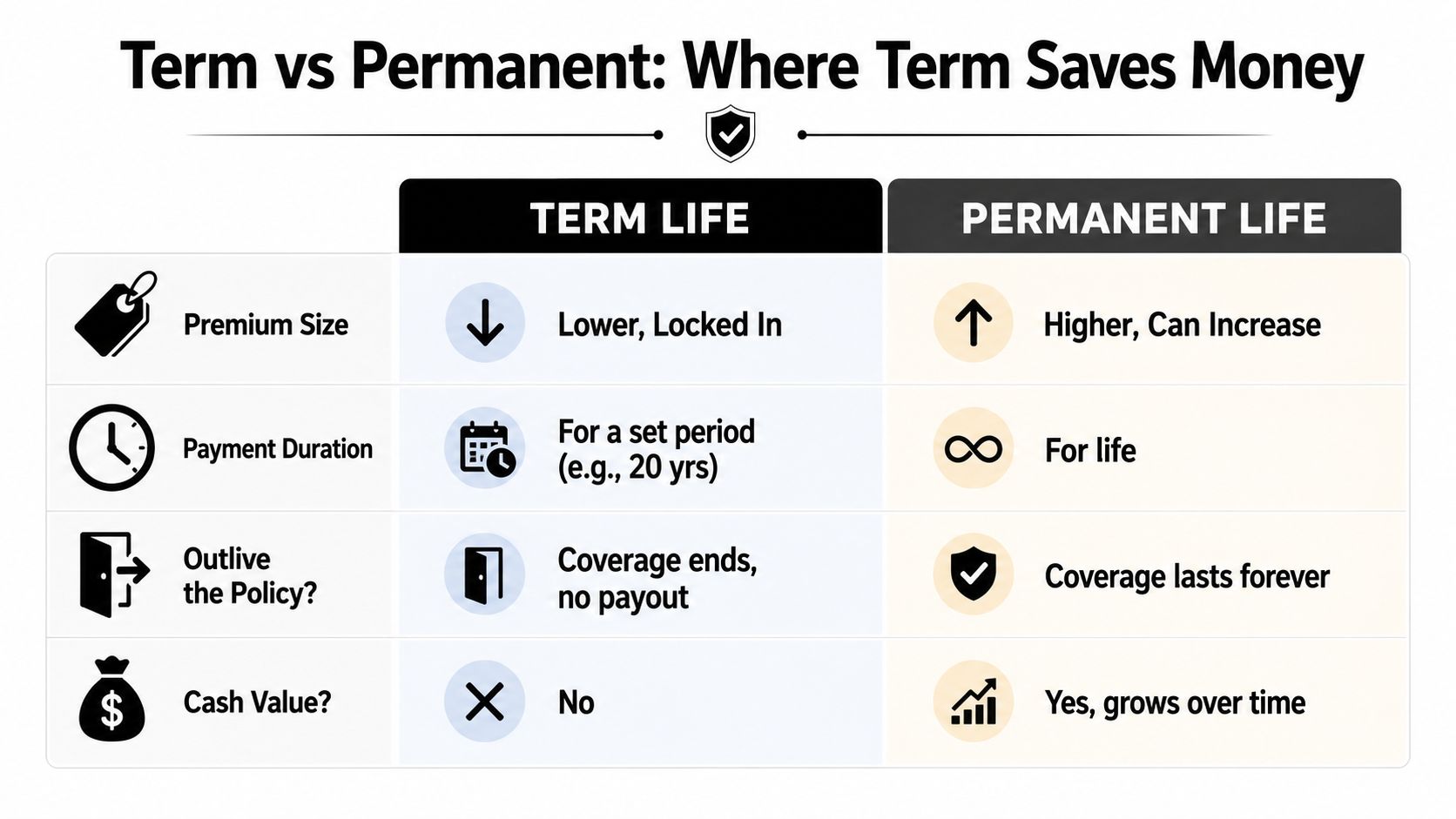
| Question | Term life | Permanent life |
|---|---|---|
| Premium size | Usually lower for pure protection | Usually higher because of added features |
| Payment duration | A selected term | Designed to continue for life |
| If you outlive the policy | Coverage generally ends without a death benefit | Coverage can remain in force if required premiums are paid |
| Cash value | No cash value component | Cash value accumulates under the policy structure |
The price difference can be meaningful. A healthy 35-year-old might pay around $30 a month for a 20-year, $500,000 term policy, while a comparable whole life policy can run $250 to $400 a month for the same coverage. These are illustrative figures, not universal quotes, and the actual premium depends on underwriting and carrier design.
Term costs less because it focuses on temporary protection and doesn't include a cash value account. Whole life combines a death benefit with guaranteed cash value features, so part of the premium supports that additional structure.
Match the policy to the obligation
Term often fits a mortgage, child-raising years, business debt, or income-replacement need with a clear endpoint. Permanent coverage may fit estate planning, lifelong dependents, or someone deliberately seeking lifelong protection and a cash value component.
Employer benefits can add another layer to the decision. If you're reviewing workplace coverage, Professional Insurance Advisors' group life insurance information for Florida can help clarify how group protection differs from an individually owned policy.
The short version is straightforward: term usually wins on pure protection cost, while permanent coverage trades a higher premium for permanence and cash value. Choose based on the financial problem you're solving, not just on the lowest first-year payment.
Smart Ways to Lower Your Premium and Buy With Confidence
You can't control every underwriting decision, but you can control several choices that influence the quote. Start with timing. Buying in your 20s or early 30s may help you apply before the age curve becomes more expensive, especially if you're healthy.
Term selection matters, too. Locking a longer term while you're younger can protect a period such as mortgage repayment or dependent children's schooling. Choose the term because it matches the need, not because the longest option always sounds safer.
Improve the application, not the story
If you have time before a medical exam, focus on sustainable health habits and provide accurate information. Don't hide diagnoses, prescriptions, tobacco use, or risky activities. Incomplete answers can create underwriting problems later, while a complete medical history lets the carrier evaluate the application properly.
Compare carriers because underwriting rules and base pricing differ. An independent broker, online comparison tool, or direct carrier can show different options. You can also consider no-exam or simplified issue coverage when speed matters, but understand that less medical information can affect eligibility, limits, or price.
Use Coveredly's term life insurance rate comparison as one option for comparing available policy designs and quote paths.
Carry this checklist into the quote
- Set the coverage goal: Use a needs calculator and account for income replacement, debts, childcare, and future obligations.
- Gather your records: Have identification, prescription details, diagnoses, and family medical history ready.
- Compare within a short window: Request competing quotes within a two-week window to reduce repeated inquiries on your record.
- Read rider definitions: Check what terminal and chronic illness riders cover, including triggers and limitations.
- Confirm the free-look period: Know how long you have to review the policy and cancel under the applicable rules.
- Check the renewal terms: Confirm whether premiums stay level, rise annually, or change at stated age bands.
The goal isn't to chase the cheapest number on a screen. It's to secure a benefit that matches your family's need, with a premium you can keep paying.
Coveredly offers digital term life insurance shopping, including up to $3 million of coverage with no exams for most applicants. Visit Coveredly to compare a policy path that fits your coverage goal and learn how term life insurance premiums may apply to your situation.