A healthy 30-year-old can often get a 20-year, $2 million term policy for roughly $40 to $55 per month, while the same coverage can climb past $200 per month by the mid-50s. Your exact 2 million life insurance policy cost depends on age, health, term length, sex, tobacco use, and the insurer's underwriting decision.
That range surprises many buyers because the death benefit is so large. A $2 million policy sounds like a luxury product, but term insurance can function more like a temporary income-replacement tool. For a young, healthy applicant, the monthly premium may fit beside ordinary household bills. For an older applicant, the same benefit can become a serious long-term expense.
The reason is actuarial rather than mysterious. Insurers price coverage around the probability of a claim during the selected term. As age increases, projected mortality risk rises, and the premium must reflect that higher expected cost.
This guide turns the pricing logic into practical examples. You'll see what the face amount means, why a 20-year term can cost much less than a longer guarantee, how underwriting changes quotes, and how to estimate your own range before completing an application.
Table of Contents
- What a $2 Million Life Insurance Policy Really Costs
- How a $2 Million Term Policy Actually Works
- The Main Factors That Drive Your Premium
- Sample Premium Ranges by Age and Term Length
- Three Real-World Pricing Examples
- How to Estimate Your Own Price in Minutes
- Getting an Accurate Quote and Next Steps
- Smart Ways to Keep Your Premium Low
What a $2 Million Life Insurance Policy Really Costs
A healthy 30-year-old may pay roughly $45 to $55 per month for a man and about $39 to $45 per month for a woman for a 20-year, $2 million term policy. Those estimates come from published pricing and calculator results in AgentCalc's life insurance premium calculator, alongside the market figures cited earlier.
The premium is a monthly bill, but the benefit addresses a much larger problem. The $2 million face amount could replace years of household income, reduce a mortgage balance, fund future education costs, and pay for childcare or other services after the policyholder dies. It is not a savings balance available for withdrawal during the term. It is a financial backstop for people who rely on the policyholder's income or unpaid work.
The price corridor is wide
Age and term length can move the bill substantially. A published pricing table lists 10-year coverage at $22.91 per month for a 25-year-old woman and $29.91 for a man. For 55-year-old women and men, the same table lists $172.53 and $234.81 per month, respectively, as shown in SelectQuote's $2 million policy pricing overview.
Another market example places a healthy 35-year-old woman's annual premium at about $469 for a 10-year, $2 million policy, compared with about $571 per year for a man. The comparison makes the main point: the face amount sets the size of the protection, while age, term, health, and other risk details shape the price.
For families, term insurance can match a temporary financial obligation to a temporary contract. You pay the premium, keep the policy active, and beneficiaries receive the death benefit if you die during the term.
Practical rule: Choose enough coverage to protect the liability horizon, then choose the shortest term that covers it.
The four pricing forces that matter most are age, underwriting class, term length, and personal risk factors. Sex and tobacco status also affect the quote. For a comparison with a smaller policy, this guide to the cost of a million-dollar life insurance policy shows how changing the face amount changes the coverage discussion.
How a $2 Million Term Policy Actually Works
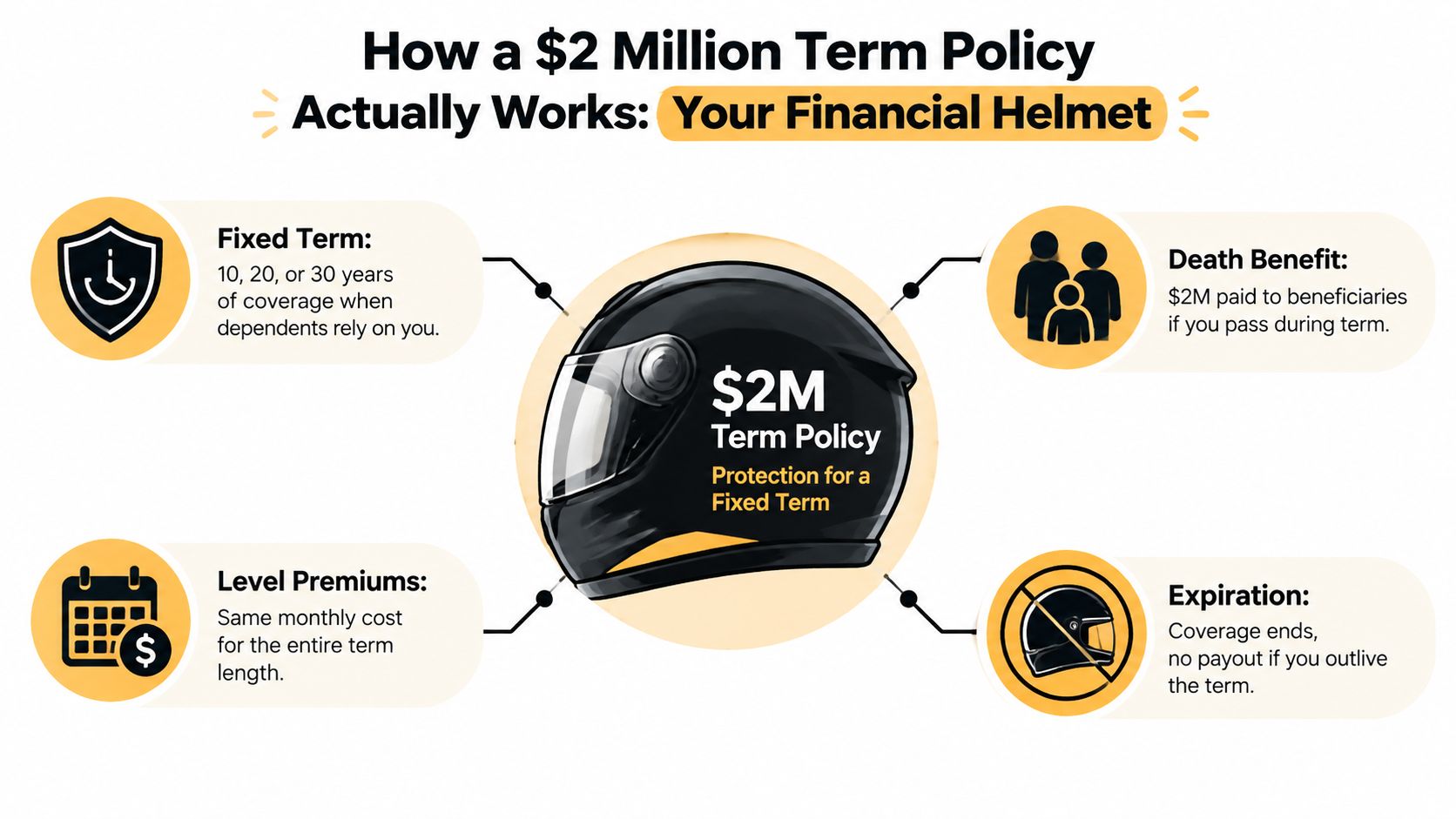
A term policy is like a financial helmet. You wear it during the years when a spouse, children, mortgage, or business obligations depend heavily on you. If you die while the helmet is in place, the insurer pays the agreed protection amount to your beneficiaries. If you outlive the term, the policy normally ends without a death benefit.
Three parts determine what you're buying:
- Face amount: The policy's promised death benefit is $2 million. Your beneficiaries receive it if an eligible claim occurs during the covered term.
- Premium: This is the regular payment that keeps the policy active. A level-term contract generally keeps the scheduled premium stable throughout the selected term.
- Term length: Common choices include 10, 20, or 30 years. The term establishes the period during which the death benefit applies.
Term insurance is pure protection
A standard term policy doesn't build cash value. Each premium dollar pays for insurance protection, administrative expenses, and the insurer's risk. That structure usually makes term coverage less complex than permanent insurance such as whole life, which can combine lifelong protection with a cash-value component.
The distinction matters when you compare policies. A term policy may be well suited to income replacement, a mortgage, or dependent-care years. Permanent insurance serves a different purpose and can carry a substantially different pricing structure.
What happens when the term ends
If you're alive when the term expires, the coverage ends under the original contract. Depending on the policy, you may be able to renew it, convert it to permanent coverage, or let it lapse. Renewal can be more expensive because your age and health profile have changed, so the original term should match the period when your family needs the protection.
The Main Factors That Drive Your Premium
A $2 million policy is not priced by multiplying a smaller policy's premium by a fixed number. Insurers estimate the chance of a claim in each policy year, then adjust that estimate for the applicant's age, health, lifestyle, and coverage period. The face amount sets the scale, but these risk factors determine where your quote falls on the pricing spectrum.
Age changes the starting price
Age usually has the strongest effect. A 30-year-old generally has fewer high-risk years inside the contract than a 50-year-old, so the insurer expects fewer claims during the same term. The increase also follows a curve rather than a perfectly straight line, because each additional year can place more of the guaranteed coverage in later, higher-risk years.
Published examples show how wide that gap can become. For a 20-year term, a healthy applicant in early adulthood may receive a relatively modest annual bill, while a comparable applicant at age 40 can pay more than $2,500 per year for the same $2 million benefit. Treat age as the first filter on your estimate, before comparing carriers or optional features.
Health class sets the risk tier
Underwriters review medical history, prescriptions, height, weight, and tobacco use. They may assign an applicant to a preferred, standard, or rated class. The same controlled condition could have little effect with one insurer and a larger effect with another because underwriting rules differ.
Health therefore works like a multiplier applied after age, face amount, and term establish the base price. A healthier applicant may qualify for a lower tier, while a medical condition or tobacco use can move the quote into a higher one. The final class often matters more than a small difference in the initial online estimate.
Term length extends the guarantee
A longer term protects your family for more years and guarantees coverage deeper into older ages. That added exposure raises the premium. A 30-year term does not automatically cost three times as much as a 10-year term, because insurers price the timing of risk across every policy year rather than charging a simple fee per year.
Match the term to the obligation you are covering. A parent with young children may want protection through the dependency years. Someone focused on a remaining mortgage may choose a shorter period if the debt is scheduled to end sooner.
Sex and lifestyle can shift the quote
Pricing examples commonly show lower premiums for women than for men with the same age and coverage amount. Tobacco use, hazardous hobbies, and high-risk occupations can also raise the quote. These details may change the underwriting class even when the requested death benefit stays the same.
Underwriting is not a judgment about your character. It groups applicants according to expected claim risk.
Sample Premium Ranges by Age and Term Length
A healthy 30-year-old may see a 20-year, $2 million term policy priced in the low double digits to several dozen dollars per month. By age 50, a comparable policy can reach roughly $150 to $202 monthly in calculator estimates. The gap reflects how insurers price mortality risk across the years of coverage.
The table below is an educational comparison framework, not a carrier quote. Available market examples do not provide a complete, consistent grid for every age and term combination, so unsupported figures are left out. The ranges and descriptions show the direction a healthy non-smoker might expect.
| Age | 10-Year Term | 20-Year Term | 30-Year Term |
|---|---|---|---|
| 30 | Lower-cost range, commonly low double digits to several dozen dollars monthly | Roughly $39 to $52 monthly in published healthy-applicant examples | Higher than the 20-year option, with the exact amount depending on carrier and underwriting |
| 40 | Higher than the equivalent policy at age 30 | Published guidance places healthy non-smokers roughly around $110 to $190 monthly | Higher still because the guarantee extends deeper into later ages |
| 50 | Meaningfully above younger-applicant pricing | Roughly $150 to $202 monthly for a healthy applicant in calculator estimates | The most expensive term option in this age band |
| 60 | Age-sensitive pricing can be substantially higher than at 50 | Exact pricing requires an individual quote | Availability and pricing depend heavily on carrier rules and underwriting |
Age changes the starting point, while term length determines how long the insurer carries the risk. A healthy 30-year-old male may obtain a 20-year policy for about $51.63 per month, compared with about $38.97 for a comparable female, according to SelectQuote's published pricing discussion. Those figures are illustrations, not promises for every applicant.
Term length does not multiply the price in a straight line. A 30-year policy costs more than a 20-year policy because it covers additional years, including years when mortality risk is higher. It does not automatically cost three times as much as a 10-year policy, because the insurer evaluates risk year by year.
Use the table to place yourself on the pricing spectrum before requesting quotes. Your state, carrier, health class, tobacco status, occupation, and selected term can shift the result, and only an application establishes an actual offer.
Three Real-World Pricing Examples
The following profiles make the range easier to picture, but they're illustrative examples, not verified case studies or carrier quotes.
Maya, the younger parent
Maya is a 32-year-old teacher who doesn't smoke and has no significant health complications. She wants a 20-year, $2 million policy to protect her family during the years when her children depend on her income.
A preferred underwriting decision could place her around the lower end of the healthy-young-adult pricing spectrum, roughly $45 per month as an educational estimate. Her age, non-smoker status, and favorable health class work together. The 20-year term also aligns with a defined family obligation rather than providing an open-ended guarantee.
James, the business owner
James is 47 and owns a small business. He takes medication for high blood pressure, and the insurer places him in a standard or table-rated class rather than a preferred tier.
A 20-year $2 million quote around $115 per month could be a reasonable planning illustration for his profile, although the actual carrier decision may differ. His age creates a higher base risk than Maya's, while the treated condition affects his underwriting classification. A different insurer might view the same medical history more favorably.
Linda, covering a remaining mortgage
Linda is 58 and wants a 10-year policy for mortgage protection. She doesn't need a long income-replacement term, so she chooses a shorter duration, but her age still carries significant pricing weight.
An educational estimate of roughly $185 to $210 per month in a standard-rate scenario shows the tradeoff. The shorter term helps limit the exposure, yet the older starting age keeps the premium much higher than a young applicant's price.
These examples demonstrate why comparing only the face amount isn't enough. The same $2 million death benefit can produce very different premiums once age, term, and underwriting class change.
How to Estimate Your Own Price in Minutes
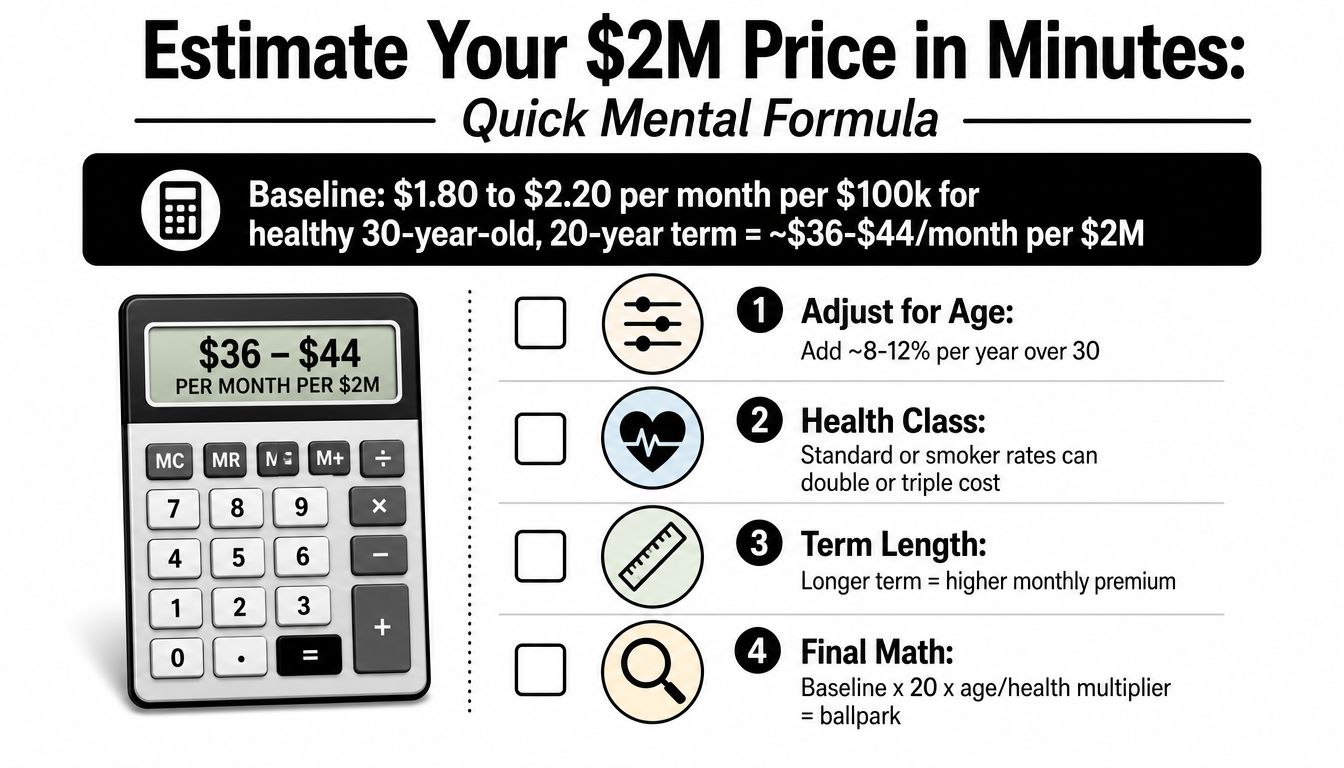
A healthy 30-year-old seeking a 20-year term can use $36 to $44 per month as a rough starting range for $2 million of coverage. That estimate comes from about $1.80 to $2.20 per month for each $100,000 of coverage. It is a planning figure, not a quote.
Treat the estimate like the first mark on a measuring tape. Your final premium moves according to several inputs:
- Age: Applying later generally raises the starting price.
- Health class: Preferred health may lower the rate. Standard, rated, or tobacco underwriting can raise it.
- Term: A longer guarantee usually costs more.
- Lifestyle: Nicotine use, hazardous work, and risky hobbies may affect classification.
- Coverage need: A smaller death benefit or shorter financial obligation may reduce the premium.
Gather these details before requesting a quote:
- Date of birth
- Height and weight
- Smoking or nicotine status
- Recent medical history and current prescriptions
- Desired coverage amount and term
A calculator organizes the inputs, but it cannot determine your underwriting class. If you are also trying to manage debt and build wealth, place the premium inside your household budget instead of judging it alone.
For an initial comparison of term choices, use this free term life insurance calculator, then confirm the result with a formal quote.
Getting an Accurate Quote and Next Steps
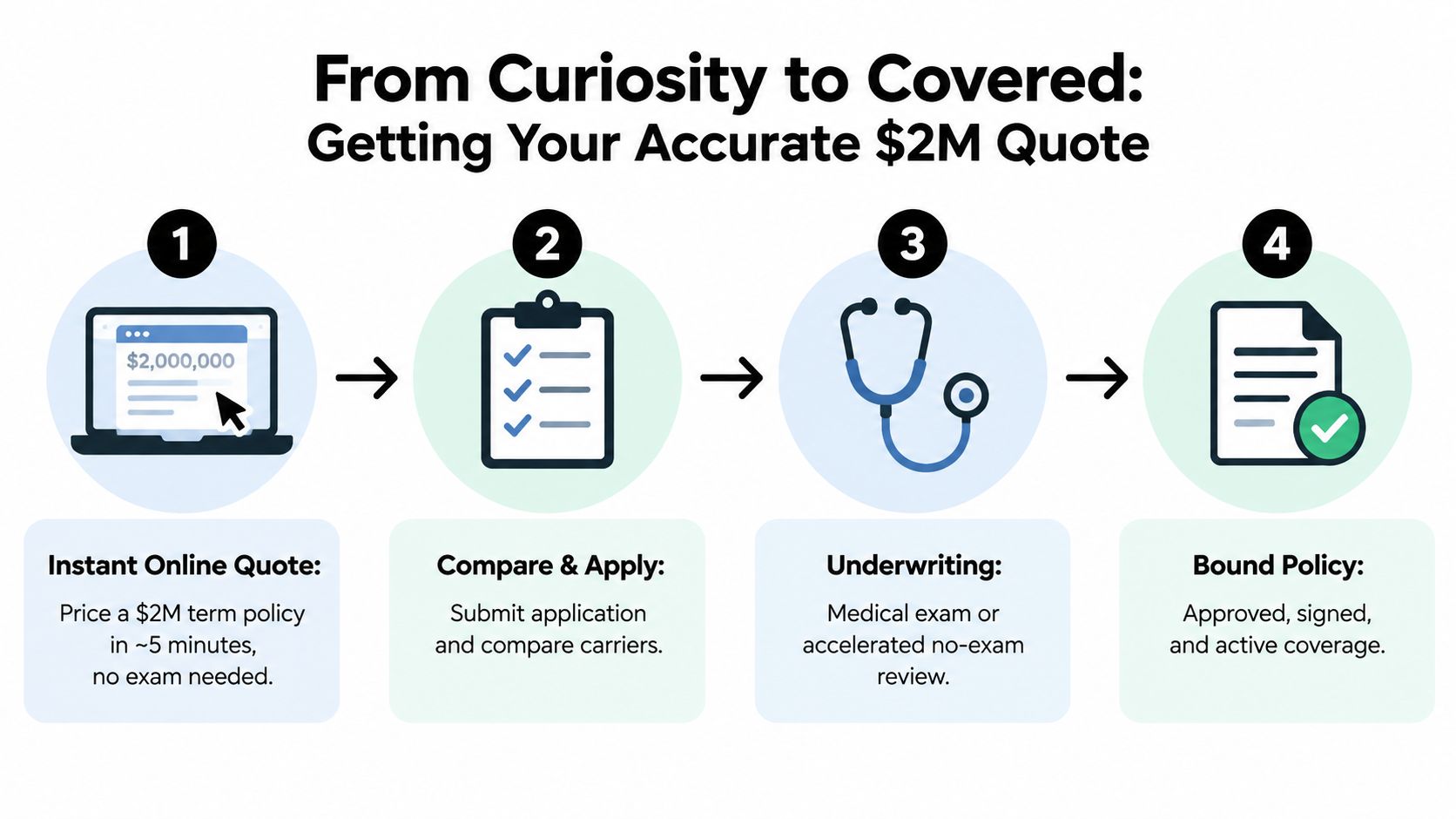
An online quote is the fastest way to turn a planning range into a carrier-specific estimate. Some digital application flows can price substantial term coverage without an exam for eligible applicants, while other cases require an agent-assisted application, accelerated underwriting, or a traditional paramedical exam.
Prepare the information an underwriter will need:
- Identity details: Date of birth, Social Security number, and driver's license information.
- Medical records: Current medications, recent diagnoses, and primary-care physician contact details.
- Beneficiary choices: Full names and relationships of the people or entities you want to receive the benefit.
- Financial context: Recent pay stubs or business details when the insurer evaluates income replacement and policy size.
Choose the application path that fits
An instant-decision process may suit a healthy applicant seeking a standard term length. Accelerated underwriting can be useful when the coverage amount is higher or the insurer wants additional information without automatically ordering a full exam. Traditional paramedical underwriting may fit older applicants, people with complex medical histories, or cases where the insurer needs laboratory results.
The process doesn't end when you see a preliminary price. Follow a deliberate sequence:
- Request three quotes using identical coverage and term details.
- Confirm the projected health class and ask what could change it.
- Match the term to the obligation, such as mortgage payoff, business debt, or dependent-care years.
- Review beneficiaries and ownership before accepting the policy.
- Set the start date only after reading the contract and confirming the first payment.
A quote is an estimate until the insurer approves the application and issues the policy. Read the offer carefully, including exclusions, conversion rights, renewal pricing, and the conditions that apply during the contestability period.
Smart Ways to Keep Your Premium Low
The most effective savings decisions happen before you apply. Use this checklist:
- Buy earlier: Age is a major pricing lever, and delaying can move you into a more expensive risk band.
- Match the term: Don't pay for a 30-year guarantee if the mortgage or dependent obligation ends sooner.
- Improve health first: A stable health profile, healthy weight, controlled blood pressure, and tobacco-free status can support more favorable underwriting.
- Compare carriers: Underwriting appetites differ, so obtain multiple quotes for the same $2 million benefit and term.
- Right-size coverage: If your financial analysis doesn't require the full face amount, reducing it can lower the bill. You can also consider separate policies for obligations that end at different times.
Some insurers may offer payment options that fit your cash flow differently, including monthly or annual bank drafts. Review the total contract cost and payment terms rather than choosing solely by the smallest recurring amount. For more ideas on finding affordable coverage, see this guide to finding a cheap life insurance policy.
Focus first on the two strongest design choices: face amount and term length. Trim coverage only after accounting for income replacement, debts, mortgage obligations, education goals, and the value of unpaid household work.
Coveredly offers an online term life insurance quote experience for coverage amounts up to $3 million, including comparisons relevant to a $2 million policy and different term lengths. Visit Coveredly to enter your details, review available options, and move from a rough premium estimate toward an actual application.