
A mortgage payment is due, daycare costs keep rising, and a toddler depends on two working parents. At the kitchen table, a young couple may agree that life insurance matters but still hesitate over one question: is $500,000 enough, or should they choose $750,000? They don't want to leave their family exposed, but they also don't want to pay for coverage that doesn't fit their budget.
A free term life insurance calculator turns that vague concern into a preliminary coverage amount and premium estimate. Most tools take only a few minutes to use. They help you organize income, debts, dependents, health information, and the number of years your family may need protection.
Term coverage is a common starting point for American households. In 2024, term policies made up 39.3% of new individual life policies, representing 3.8 million policies and 72.1% of the total individual life face amount issued, or $1.45 trillion, according to the ACLI-based term life insurance statistics overview. That makes the calculator question practical, not theoretical.
Table of Contents
- Why People Use a Term Life Insurance Calculator Before They Buy
- The Inputs Behind Every Free Term Life Insurance Calculator
- How the DIME Method Calculates How Much Coverage You Need
- Choosing the Right Term Length for Your Real Risk Window
- Reading the Calculator Results With a Worked Example
- What Free Term Life Insurance Calculators Get Wrong
- Turning Your Estimate Into an Actual Policy
- Quick Answers and Your Next Step
Why People Use a Term Life Insurance Calculator Before They Buy
The couple at the kitchen table isn't really choosing between two numbers. They're trying to protect several separate obligations at once: the mortgage, childcare, groceries, future education, and the surviving partner's ability to keep working or take time away from work. A calculator gives those concerns a place in the same estimate.
It turns household needs into a face amount
The face amount is the death benefit paid if the insured person dies while the policy is active. A calculator helps connect that amount to actual responsibilities instead of relying on a guess or a round number seen in an advertisement.
For example, $500,000 might cover a meaningful portion of a mortgage and debt, but it may not replace many years of income while also supporting children. On the other hand, $750,000 could provide a wider cushion, yet the larger policy may create a monthly premium that competes with savings, housing, or childcare.
The right result depends on the household's obligations, available assets, and intended risk window. A calculator doesn't decide for you. It gives you a transparent starting point for that decision.
It lets you compare before underwriting
A preliminary estimate also lets you compare term length, face amount, and carrier pricing before you share detailed medical information. You can see how the result changes when you choose a shorter term, reduce the coverage, or select a different health classification.
The online model fits a distribution system that has moved toward digital quoting, automated underwriting, and simplified issue applications. LIMRA reported that in the first quarter of 2026, term life new annualized premium plus excess premium rose 9% to $788 million, while policy count grew 5% year over year. Term held about an 18% share of the total U.S. individual life insurance market, with LIMRA connecting growth to online distributors, automated underwriting, competitive pricing, and simplified issue success in its life insurance statistics research.
Practical rule: Treat the calculator as a planning estimate, not an offer or a guaranteed approval.
It tests the premium against your budget
A quote becomes useful only when it fits your current cash flow. Run more than one scenario. Compare the amount you think you need with a lower amount you could comfortably maintain, then decide whether the protection gap justifies the added premium.
The output can also help you prepare for a conversation with an agent or insurer. You'll arrive with a coverage target instead of choosing under pressure during an application. If you work for the federal government, a guide to federal life insurance from Federal Benefits Sherpa can add useful context about employer-sponsored options before you calculate an individual policy.
The Inputs Behind Every Free Term Life Insurance Calculator
A calculator's result is only as useful as the information you enter. The fields may look simple, but each one represents a pricing or underwriting decision that can move the estimate.
Start with age and gender
Age is usually the first input because insurers price risk partly by age. An independent calculator identifies age as the single biggest price driver, and term life insurance calculator mechanics show why an applicant's age band can change the estimated premium. A 35-year-old and a 45-year-old seeking identical coverage won't generally receive the same estimate.
Gender may also appear as an input. Female applicants typically receive lower rates than male applicants because insurers use differences in expected longevity in their pricing models. The exact result still depends on the carrier, jurisdiction, underwriting rules, and the rest of the application.
Report health class honestly
Health class describes how an insurer groups your expected risk. Common labels include Preferred Plus, Preferred, Standard Plus, and Standard. A calculator may ask about height, weight, blood pressure, prescriptions, diagnoses, family history, and other chronic conditions to approximate the class you might receive.
That estimate isn't a diagnosis or a promise. The insurer may verify information through medical records, prescription databases, an examination, or a detailed questionnaire. A healthier classification can lower the estimate, while a less favorable classification can raise it.
Pay close attention to tobacco status
Tobacco questions deserve careful reading. One independent calculator treats tobacco use within the last 12 months as smoker status, a rule that can materially affect the estimate. Don't assume occasional nicotine use, vaping, cigars, or a recent quit date will be treated the same way by every carrier.
Choose term length and face amount
Term length is the number of years the policy remains in force at the selected level premium. Common choices include 10, 15, 20, 25, and 30 years. Face amount is the amount of coverage, such as $500,000 or $1,000,000.
Some calculators also show optional riders. A waiver of premium rider may help keep coverage active if a qualifying disability prevents you from working. An accelerated death benefit rider may allow access to part of the benefit after a qualifying terminal or serious illness. These features can change the cost or policy terms, so check whether the first estimate includes them.
| Input | What the Calculator Asks | Typical Impact on Premium |
|---|---|---|
| Age | Your current age or age at issue | Older age generally produces a higher estimate |
| Gender | The sex classification used by the insurer | Rates may differ under carrier pricing rules |
| Health class | Health history, build, conditions, and medications | Better classes generally receive lower estimates |
| Tobacco status | Nicotine or tobacco use and timing | Recent use can move you into a higher pricing category |
| Term length | How long coverage should last | Longer protection usually costs more |
| Face amount | The death benefit | More coverage generally increases the premium |
| Riders | Optional benefits added to the policy | Added features may increase cost or change eligibility |
For a broader needs check before entering these fields, compare your estimate with this life insurance coverage needs guide. The calculator should reflect your household, not just your preferred monthly price.
How the DIME Method Calculates How Much Coverage You Need
The DIME method gives a calculator a needs-based foundation. The letters stand for Debt, Income, Mortgage, and Education. Instead of focusing only on a multiple of salary, the method adds the obligations your family may face and then considers resources that could reduce the gap.
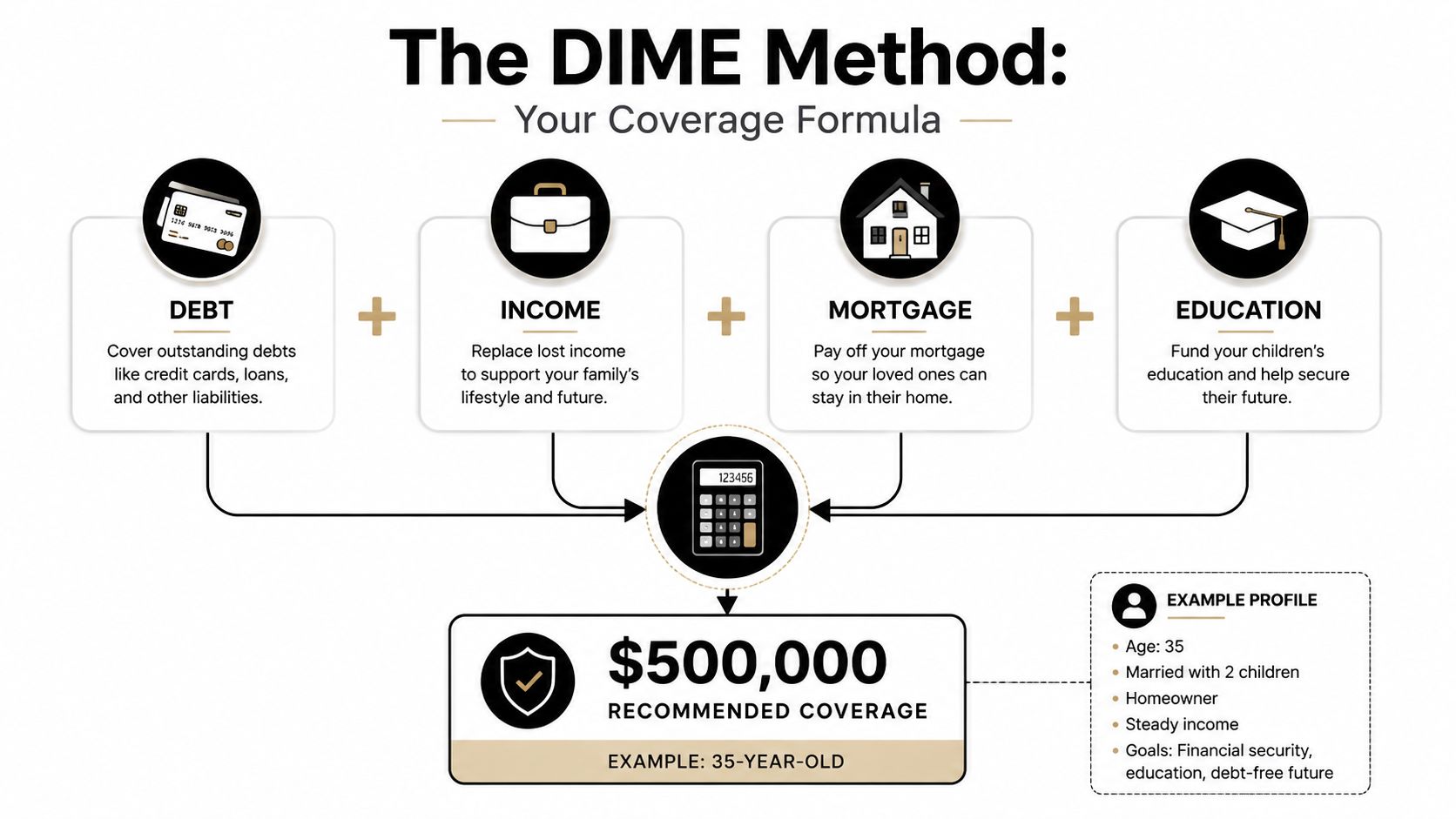
Consider a representative 35-year-old parent earning $75,000 annually. The household has a $250,000 mortgage, $18,000 in remaining student loans and car debt, two children ages 4 and 7, and a spouse who depends on the income.
Debt and income
Begin with the $18,000 in non-mortgage debt. Add an income-replacement amount by multiplying $75,000 by the number of years the family would need support. Using 10 years as the planning period produces $750,000 of income replacement.
That already creates a substantial need, but it doesn't represent the whole household obligation. The actual number of income-replacement years should reflect the surviving spouse's income, childcare needs, savings, and the ages of the children.
Mortgage and education
Add the full $250,000 mortgage balance if the family wants the death benefit to make paying off the home possible. Education costs require a separate assumption. Using roughly $150,000 per child at a public four-year school today creates $300,000 for two children, with the expense projected over the 14 years until the older child reaches the relevant education period.
The illustrative subtotal is therefore:
- Debt: $18,000
- Income: $750,000
- Mortgage: $250,000
- Education: $300,000
- Illustrative total: $1,318,000
That calculation points above the $750,000 to $1,000,000 range often considered during an initial planning conversation. The final target could be lower after subtracting existing life insurance, liquid savings, or other available assets. It could also be higher if the family wants a larger income cushion, childcare funding, or final-expense protection.
The DIME life insurance needs calculator provides the same mechanics-based structure. Enter your own debt, income-replacement period, mortgage, and education assumptions, then subtract resources the family could access quickly.
Choosing the Right Term Length for Your Real Risk Window
The cheapest term isn't automatically the best term. The policy should remain active while the household faces the obligations the death benefit is meant to cover.
For a 35-year-old non-smoker seeking $500,000 of coverage, a 10-year, 20-year, and 30-year quote answers different questions. The premium generally steps upward as the insurer agrees to protect the applicant for a longer period, but the exact dollar amount depends on carrier pricing and underwriting.
| Term Length | Estimated Monthly Premium | Total Premium Paid | Best-Fit Household Situation |
|---|---|---|---|
| 10 years | Use the calculator's carrier-specific estimate | Monthly estimate multiplied across the selected term | A short remaining debt or near-term obligation |
| 20 years | Use the calculator's carrier-specific estimate | Monthly estimate multiplied across the selected term | Raising children through their dependent years |
| 30 years | Use the calculator's carrier-specific estimate | Monthly estimate multiplied across the selected term | Income replacement through much of a working career |
The table intentionally leaves premium fields for the live quote. No generic number can accurately represent every applicant, and a calculator becomes misleading when it presents a universal price without accounting for age, health class, tobacco status, and carrier rules. The guide to choosing a life insurance term can help frame the duration decision around household timing.
Match years to obligations
A 10-year term may fit a small remaining mortgage or a debt scheduled to end soon. A 20-year term may align with raising young children until they reach greater financial independence. A 30-year term may better match a household that wants income protection until a projected retirement date.
Use three dates as a practical check:
- Youngest child's age: How long will dependents likely need substantial support?
- Mortgage end date: When will the balance be paid down or refinanced?
- Retirement date: When might employment income stop being central to the household plan?
Duration check: Choose the term by asking when the financial risk ends, not just which option produces the lowest first estimate.
Outliving the term is possible, and renewing or reapplying at an older age can produce a higher premium. A policy that ends before the mortgage, child-rearing period, or income-replacement need is over may leave the household exposed at the wrong time.
Reading the Calculator Results With a Worked Example
Suppose a 40-year-old non-smoking male enters Preferred health class, $500,000 of coverage, and a 20-year term. The calculator may return a monthly estimate, but that number needs context. Multiply it by 12 to see the annual cost, then multiply the annual cost by 20 to understand the scheduled outlay if the policy remains active for the full term.
The verified information available here doesn't provide a carrier-specific premium for that exact profile. A responsible calculator should display the live estimate it produces, rather than presenting an invented benchmark as if it were universal.
Change one input at a time
Sensitivity testing shows which assumptions deserve the most attention. Keep the applicant, face amount, and term fixed, then change only the health class. Next, run the tobacco scenario. After that, test a larger benefit and a shorter term.
| Scenario | Input Changed | Estimated Monthly Premium | Change vs. Baseline |
|---|---|---|---|
| Baseline | 40-year-old, non-smoking, Preferred, $500,000, 20 years | Calculator-specific estimate | Baseline |
| Health rating change | Preferred to Standard | Calculator-specific estimate | Compare with baseline |
| Tobacco change | Non-smoking to tobacco status | Calculator-specific estimate | Compare with baseline |
| Coverage change | $500,000 to $1,000,000 | Calculator-specific estimate | Compare with baseline |
| Term change | 20 years to 10 years | Calculator-specific estimate | Compare with baseline |
This format teaches an important habit: don't focus only on the first monthly figure. Ask which input caused the largest movement and whether that input is accurate.
Read the result as a range
A calculator may estimate a Preferred class, while the application may produce Standard or another rating after underwriting. The same applicant can also move across pricing bands when health class or tobacco status changes, creating step changes rather than smooth linear variation, as explained in the term life insurance pricing calculator guidance.
Use the result to set a target and a budget. Then compare a slightly lower coverage amount, a different term, and the possibility of an improved health classification only when the application supports it. Never misstate tobacco use or medical history to chase a lower estimate.
What Free Term Life Insurance Calculators Get Wrong
A calculator can be useful and still leave out important pieces of the decision. Its answer often represents a point-in-time snapshot, based on the information you enter today and the assumptions built into that tool.
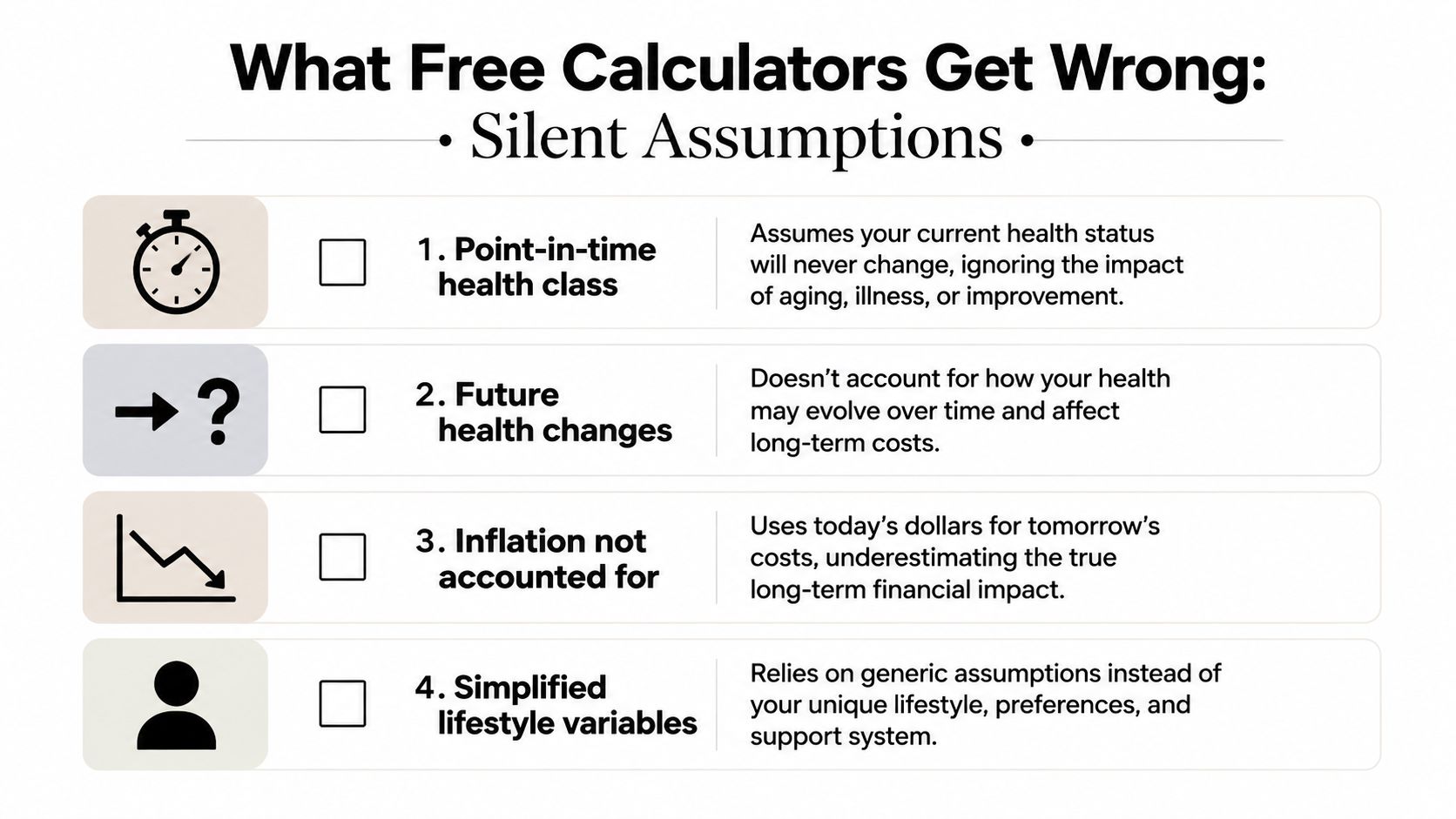
Four silent assumptions to challenge
- Point-in-time health class: The estimate reflects your current reported health and doesn't predict how your health may change later.
- Future obligations: A tool may not know about a planned home purchase, another child, a career change, or a future caregiving responsibility.
- Existing resources: Some calculators subtract savings, current coverage, and debts, but others use a simpler coverage-gap formula.
- Simplified lifestyle information: A short questionnaire can't capture every detail an underwriter may review, from medical records to prescription history.
Employer coverage deserves special attention. A workplace policy can contribute to the household's protection today, but it may not follow you if you change jobs, and a calculator may ignore it unless you enter it manually. Liquid savings and existing individual policies also matter because they can reduce the amount your family would need to replace.
Don't confuse a projection with a promise
A calculator generally applies population-based pricing assumptions. It may not distinguish every relevant lifestyle detail between two applicants who look similar on a short form. Underwriting can also ask questions the tool didn't include.
The coverage checkup and term life calculator highlights a gap that many tools leave unresolved: whether the result is a permanent target or a snapshot that needs updating after a mortgage, child, income change, or other household event.
Treat the estimate as a starting point. Review it when your financial obligations change, and compare it with the coverage already in force. The number should evolve with the household rather than becoming a forgotten figure saved in a browser tab.
Turning Your Estimate Into an Actual Policy
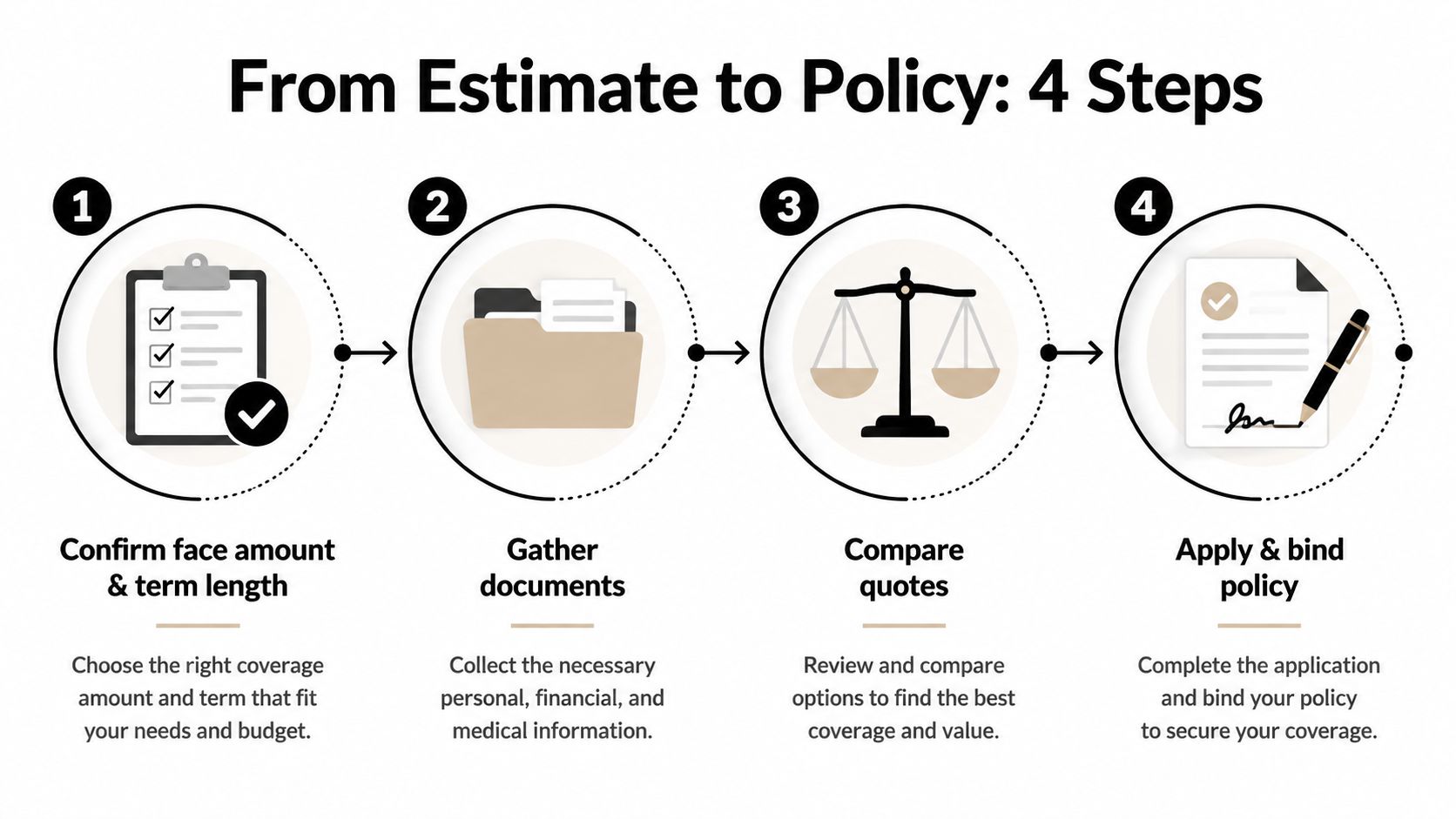
A calculator result becomes useful when you can carry it into an application without losing track of what you intended to buy. The process usually has four practical stages.
Confirm the amount and duration
First, check the face amount against the obligations you included. Confirm that the term reaches the end of the risk window, whether that's the mortgage, the children's dependent years, or the planned retirement date.
Don't automatically choose the highest displayed amount. Choose the amount your family needs and can maintain, then test whether the premium fits your monthly budget.
Gather the application information
Prepare the details an insurer may request:
- Identity information: Government identification and Social Security number.
- Financial details: Employment and income information.
- Beneficiary choices: Names and relevant information for the people or entities receiving the benefit.
- Medical history: Diagnoses, prescriptions, tobacco use, and information needed for underwriting.
A prepared application reduces avoidable delays and makes it easier to keep the final policy consistent with the estimate.
Apply through the insurer's process
Start the online application with the selected coverage and term. Depending on the product, you may complete a simplified-issue questionnaire or proceed through fuller underwriting.
The following video can help first-time buyers understand the path from an estimate to coverage:
Complete underwriting and bind the policy
An instant-decision policy may return a decision in minutes, while a fully underwritten application may take 4 to 6 weeks. The final premium class comes from the insurer's underwriting decision, not the calculator alone.
The guide to getting a life insurance policy can help you organize the transition from estimate to application. Lock in the term length promptly once the household has agreed on its risk window, because age and rate-class changes can affect a later quote.
Quick Answers and Your Next Step
Can I get term life insurance without an exam?
Some policies use simplified underwriting or no-exam processes, while others require more information. The application determines eligibility and pricing, so a calculator can't promise an exam-free approval.
How do pre-existing conditions affect the estimate?
A calculator may place you in a preliminary health class, but the insurer can review medical history, prescriptions, and records. Enter conditions accurately and treat the result as provisional.
What's the difference between guaranteed issue and simplified issue?
Simplified issue typically asks health questions and may use limited underwriting. Guaranteed issue generally uses fewer health requirements but can have different costs, limits, or policy terms. Read the actual offer carefully.
How much do $500,000 and $1,000,000 policies cost for a healthy 30-something?
The price depends on age, gender, health class, tobacco status, term length, and carrier. Run both face amounts through a term life insurance calculator free of charge rather than relying on a generic price.
What's the right age to buy?
Buy when someone depends on your income, services, or debt payments, and when coverage would be difficult to replace later. Younger applicants may receive more favorable estimates, but the right time is tied to the household's actual risk.
Choose a term length, run the free estimate, and compare the result with your debts, income needs, assets, and dependents. Then start an application while your age and health profile still match the assumptions behind the estimate.
Coveredly offers digital term life insurance options designed to make online shopping and application easier, with coverage choices that can fit young families, professionals, and newly married couples. Visit Coveredly to run your estimate and take the next step toward applying for coverage.