You're standing in the kitchen after making the mortgage payment, checking the daycare charge, and realizing how much of your household depends on two paychecks. Your child is healthy, your budget is tight, and life feels busy rather than dangerous. Then a friend mentions a serious diagnosis, or you leave a hospital appointment with a new understanding of how quickly ordinary plans can change.
The question isn't which insurer has the most impressive brochure. It's how much money your family would need, how long that protection should last, and whether you can secure it while coverage is still affordable and available. For most young parents, the answer starts with properly sized term life insurance, not an expensive permanent policy chosen because a salesperson used the word “investment.”
Table of Contents
- A Young Family Moment That Changes the Question
- What Life Insurance Actually Does for a Family
- Term Life vs Permanent Life for Young Parents
- How Much Coverage a Young Family Really Needs
- Why Young Families Overestimate the Cost
- Riders and Features Worth Knowing About
- When to Buy and How a No-Exam Option Fits
- Your Young Family Life Insurance Checklist
A Young Family Moment That Changes the Question
The realization usually arrives during a quiet piece of household accounting. A parent looks at the remaining mortgage, childcare bills, grocery costs, car payments, and the income the surviving partner would lose. Savings might cover immediate expenses, but they probably wouldn't replace years of earnings or the unpaid work that keeps the household functioning.
That's the part many life insurance conversations miss. A stay-at-home parent may not receive a paycheck, but replacing childcare, transportation, meal preparation, household management, and school support can still require substantial money. A working parent's policy has to protect more than salary. It may also need to fund the services that parent provides every day.
A major 2024 U.S. estimate found that 83.5 million households, or 64% of all households, have a life insurance coverage gap totaling $33.2 trillion. Households with children represent $22.0 trillion of that gap, and 82% of households under age 40 are likely to have a gap. Greenwald Research's coverage-gap estimate makes the problem concrete, but the personal calculation is what matters.
The practical question: If one parent died tomorrow, what would the surviving parent have to pay, replace, refinance, or postpone?
Parents often discover that employer coverage is a useful starting point but not a complete plan. A group policy may disappear after a job change, and a small workplace benefit may not cover a mortgage, future childcare, lost income, and education needs together. Independent research found that 34% of households with children report having no life insurance coverage, while 59% of parents of minor children own coverage and 47% say they're underinsured. FinHealth Network's consumer report shows why having a policy isn't the same as having enough protection.
That kitchen-table moment leads to three decisions. First, calculate the death benefit instead of copying a random income multiple. Second, test the actual premium against the household budget. Third, buy before the next mortgage, pregnancy, job change, or health issue makes underwriting more complicated.
What Life Insurance Actually Does for a Family
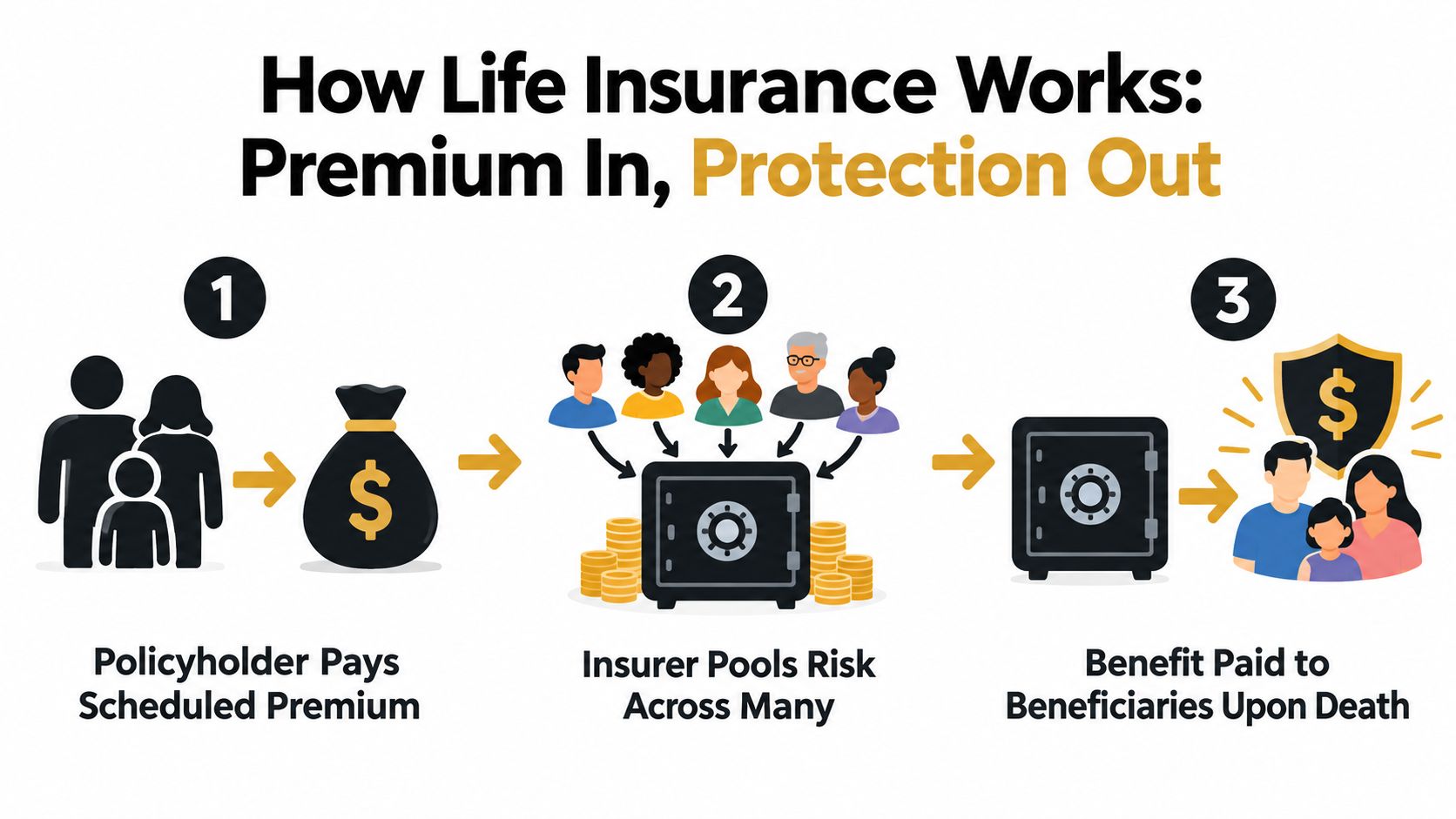
Life insurance is a contract built around a simple exchange: premium in, death benefit out. You pay a scheduled premium, the insurer pools premiums and risk across many policyholders, and the insurer pays the stated benefit to the beneficiaries if the insured dies while the policy is active.
The face amount is the death benefit written into the policy. The premium is what you pay to keep coverage in force. A beneficiary is the person or legal entity designated to receive the benefit. Most parents name a spouse or partner as the primary beneficiary and name a contingent beneficiary as a backup, but the correct arrangement depends on the family's legal and financial circumstances.
Two policy terms deserve attention before you sign anything:
- Contestability period: An early policy period during which the insurer may investigate certain statements made on the application, subject to the policy and applicable law.
- Free-look period: A short review window after delivery during which you can examine the policy and cancel according to its terms.
The death benefit is generally paid to beneficiaries without federal income tax, but families should still ask an attorney or tax professional about ownership, estate planning, and unusual beneficiary arrangements. Life insurance isn't a savings account, a stock portfolio, or a substitute for an emergency fund. Its primary job is to transfer the financial risk of premature death from your household to an insurer.
Term coverage provides a defined safety net
Term life insurance covers a chosen period, such as the years when children depend on parental income and a mortgage remains outstanding. If the insured dies during that period and the policy is in force, the beneficiaries receive the face amount.
Permanent life insurance, including whole, universal, and variable policies, is designed to last for life and usually includes cash value. That structure can serve specialized estate or legacy goals, but it's often more coverage than a young family needs for a temporary income-replacement problem.
Parents also need to account for practical household expenses. A resource such as Nursery Advice's guide to free childcare hours can help families understand available childcare support, which belongs in the broader budget used to judge how much income and caregiving capacity a policy should replace.
Term Life vs Permanent Life for Young Parents
For most young families, term life is the right first purchase. It covers the years when the financial consequences of a death are highest, keeps the contract easier to understand, and usually lets the household buy a larger death benefit without consuming the budget needed for housing, childcare, and retirement savings.
| Feature | Term Life | Permanent Life |
|---|---|---|
| Coverage duration | A defined period selected to match family obligations | Intended to remain in force for life if requirements are met |
| Premium structure | Generally lower for temporary protection | Generally higher because it includes lifetime duration and cash value |
| Main purpose | Income replacement, mortgage protection, and child-rearing years | Lifetime protection, legacy planning, or specialized estate needs |
| Cash value | Usually none | Typically includes a cash-value component |
| Flexibility | Often includes a conversion option, depending on policy terms | May offer premium, death-benefit, or cash-value features depending on policy type |
| Best fit for many young parents | Large protection need during a defined dependency window | Families with a clear permanent insurance objective and budget for it |
Permanent coverage costs more because you're paying for more than a temporary death benefit. Part of the premium supports lifelong coverage and the policy's cash-value structure. That doesn't make permanent insurance bad. It means the product should solve a permanent problem, not be sold as the “more complete” version of term insurance.
The useful comparison is not the first-year premium alone. Compare the coverage amount, payment obligations, guarantees, policy expenses, surrender rules, and the reason you need insurance. If your core risk is losing income before your children become independent, term usually puts more protection in place for the same household budget.
My recommendation: Buy enough term coverage first. Consider permanent insurance only after you can explain the permanent need in one sentence.
A conversion privilege can preserve flexibility. Depending on the contract, a term policy may allow conversion to permanent coverage later without new medical underwriting. That option may matter if your health changes or your estate-planning goals evolve. Review the exact deadlines, eligible products, and conversion rules before treating the feature as a guarantee.
For a plain-English comparison of the policy structures, see this guide to term versus whole life insurance. The decision should follow your family's risk, not a product category's sales pitch.
How Much Coverage a Young Family Really Needs
A coverage estimate should come from the expenses your family would face, not from a number pulled out of the air. The most useful starting point is the DIME framework, which adds Debts, Income replacement, Mortgage, and Education, then subtracts liquid assets and existing employer coverage.
Here's a sample calculation using the assumptions many young families recognize:
| DIME Category | What to Include | Sample Amount |
|---|---|---|
| Debts | Student loans, vehicle loans, credit cards, and other obligations | $80,000 |
| Income replacement | $75,000 of annual income replaced for ten years | $750,000 |
| Mortgage | Remaining mortgage balance | $250,000 |
| Education | Planned contribution for two children's college costs | $200,000 |
| Total before offsets | Add the four categories | $1.28 million |
That calculation produces $1.28 million before subtracting liquid assets and employer coverage. It doesn't require a magic multiplier. It shows exactly why a young parent with a mortgage and children may need much more than a basic workplace benefit.
Use the income shortcut as a test, not a verdict
A commonly cited benchmark is 10 to 15 times annual income, and consumer guidance often places the family term horizon around 20 to 25 years when children are young. Western & Southern's guide for new parents uses those figures as a practical framework, but a shortcut can't see your mortgage, childcare needs, savings, or unpaid labor.
The multiple may overstate the need for a household with substantial liquid assets, a paid-off home, and limited dependents. It may understate the need when children are very young, the mortgage is large, or one parent provides full-time care that would have to be replaced.
The DIME method also helps you choose the term. Match the policy to the longest dependency window. For a newborn or preschool-aged child, 20 to 30 years is a practical planning range because the need usually follows income replacement, mortgage amortization, and childcare or education obligations. Kelly Insurance Group's family planning guidance explains why the child's direct need for coverage isn't the point. The policy protects the household's financial system.
Use Coveredly's life insurance needs guide to organize the calculation, then verify the result against your own budget, debts, savings, and employer benefit. A calculator can structure the decision. It can't make the decision for you.
Why Young Families Overestimate the Cost
Many young parents delay life insurance because they assume it costs hundreds of dollars a month. That belief often comes from older relatives, whole life illustrations, or memories of a medical-exam process that sounds more burdensome than a digital application.
Industry pricing for a healthy 32-year-old non-smoker buying a 20-year, $500,000 term policy is commonly described in the $25 to $35 monthly range, although an individual quote depends on health, tobacco use, occupation, location, coverage design, and underwriting. That concrete example is far different from the common assumption that every life insurance policy carries a large monthly bill.

The larger cost-perception problem is documented in consumer research. Healthy adults ages 18 to 30 overestimated the cost of a basic $250,000, 20-year term policy by 10 to 12 times, and about three in four adults overestimated life insurance costs overall, according to LIMRA and Life Happens research summarized by Policy Review Center. The mistake isn't harmless. If parents assume coverage is impossible, they never request a quote and never learn which policy fits their budget.
Three assumptions distort the decision
Old quotes linger. A parent may remember what an older relative paid decades ago, without knowing the policy type, health class, coverage amount, or age at purchase.
Term and permanent pricing get mixed together. Whole life and universal life include lifetime coverage and cash value, so comparing their premiums with term pricing can make all life insurance look expensive.
Medical exams sound mandatory. Some applicants need full underwriting, while others may qualify for accelerated or no-exam processes. The application route affects speed and convenience, but accurate health information still matters.
A useful household exercise is to calculate the financial consequences of a death before calculating the premium. This guide to finding financial impact can help frame the wider cost discussion, especially when a family is evaluating lost income, caregiving, and ongoing obligations.
Don't ask only, “Can we afford another bill?” Ask whether an unpriced household risk is already sitting in your budget. Younger buyers often have a better chance to lock in term affordability before age and health changes complicate the application.
Riders and Features Worth Knowing About
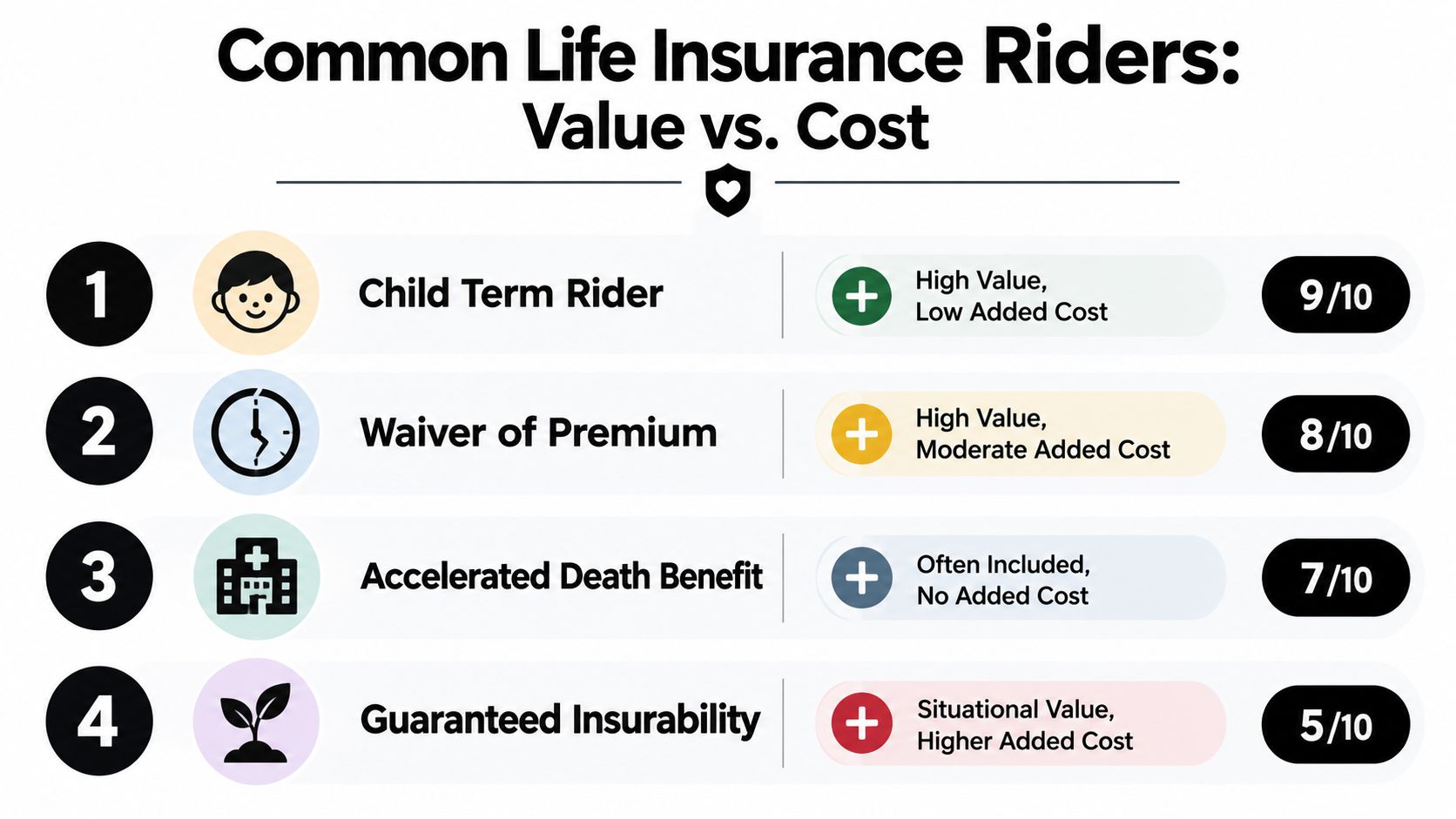
Riders can improve a policy, but they can also turn a simple protection plan into a collection of expensive add-ons. Read each one as a question: Would this materially change what happens to my family if I die or become unable to earn?
The features I'd examine first
- Child term rider: This can provide a modest amount of coverage for children under the parent's policy. It may be convenient and inexpensive, but it shouldn't distract from insuring the parents, whose income and caregiving carry the larger household risk.
- Waiver of premium for disability: If the insured becomes disabled under the rider's definition, the insurer may waive premiums while coverage continues. For a young income earner, protecting the policy itself can be more valuable than adding a small accidental-death benefit.
- Accelerated death benefit for terminal illness: This feature may allow access to part of the death benefit during a qualifying terminal illness. Many policies include it, but the family should understand eligibility rules, payout effects, and whether accessing it reduces what beneficiaries receive.
- Chronic illness rider: This may provide access to benefits after qualifying chronic illness, subject to definitions and restrictions. It can matter for some households, but it deserves a careful policy reading rather than an automatic purchase.
- Conversion privilege: This can allow a term policy to become permanent coverage without new medical underwriting, subject to the contract's limits and deadlines. It's a valuable escape hatch when future health or estate-planning needs change.
- Accidental death benefit: It may increase the payout for a qualifying accidental death, but the added protection is narrow. Read exclusions before paying for a larger benefit.
- Return of premium: This feature can raise the cost substantially to return premiums if the insured survives the term. For many young families, buying more straightforward death benefit coverage is the better use of the budget.
A household that's already trimming expenses can pair the policy review with family budgeting tips for 2026. The objective isn't to eliminate every rider. It's to spend the premium on the risks that would damage the family's future.
When to Buy and How a No-Exam Option Fits
Buy life insurance before the next major responsibility arrives, not after the hospital paperwork, mortgage closing, or new baby has made the urgency obvious. A new child, larger home, job change, or health development can alter the amount you need or make underwriting more involved.
There are two broad application routes. Fully underwritten coverage may involve a medical exam, medical records, prescription history, and a detailed review of health and lifestyle. Accelerated underwriting can use health data, prescription history, and algorithm-based risk models to assess eligible applicants without a paramedical visit.
The digital application path
A no-exam digital term process generally follows a straightforward sequence:
- Complete a short online application.
- Authorize the insurer to review relevant health and prescription information.
- Answer follow-up questions if the automated review identifies them.
- Receive an instant or same-day decision if eligible, or move into additional underwriting.
- Review the issued policy, confirm beneficiaries, and pay the required premium.
A digital term product like Coveredly can fit families who value speed and convenience, particularly when a healthy parent wants to secure a 20-year, $500,000 policy without scheduling an exam. The trade-off is real. No-exam products may cap available coverage, may price slightly higher per thousand than fully underwritten term, and may not accept applicants with complex medical histories.
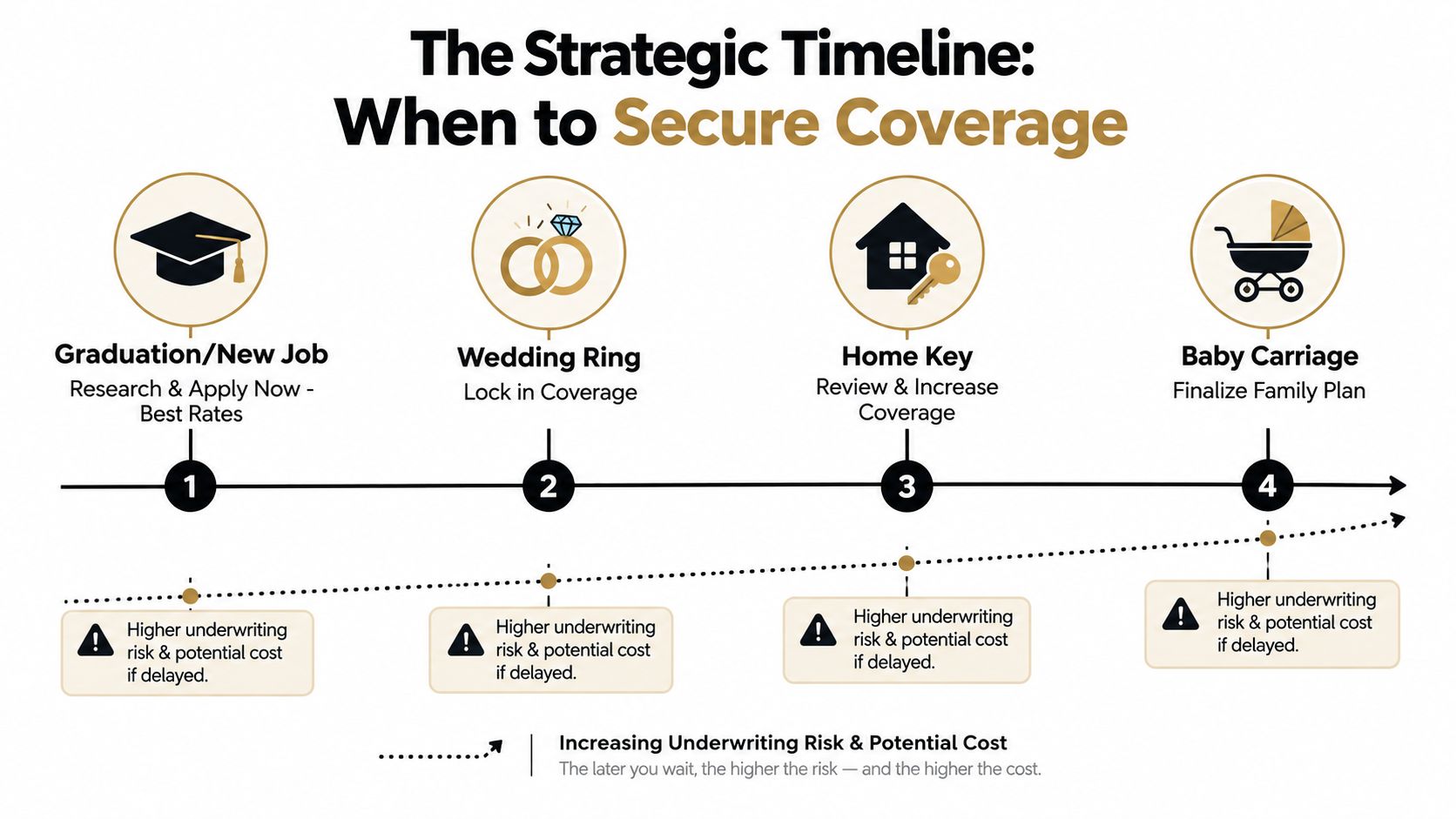
Timing rule: If your family already depends on your income or unpaid labor, waiting for a “better time” leaves the exact risk uninsured.
For many healthy young parents, the no-exam path offers a sensible speed-for-convenience trade. Applicants with medical complexity, a need for unusually high coverage, or time to complete a full review should compare both routes rather than assuming one is automatically cheaper or better. Learn how no-exam term life insurance works before choosing the application path.
Your Young Family Life Insurance Checklist
Treat the decision like a household project you can finish in a week, not a financial task you'll revisit forever.
- List every income earner: Decide whose death would create a financial burden. Include the parent whose unpaid childcare and household work would need replacement.
- Run the DIME calculation: Add debts, income replacement, mortgage, and education costs. Subtract liquid assets and employer coverage, then compare the result with the 10 to 15 times income benchmark.
- Choose the term: Cover the youngest child's dependency period and the mortgage payoff window. For newborns and preschool-aged children, a 20 to 30-year planning range often deserves consideration.
- Compare three quotes: Include one no-exam digital option and one fully underwritten option. Compare the total cost over the selected term, not merely the first premium.
- Review the contract: Focus on conversion rights, exclusions, renewability, beneficiary rules, and riders that affect disability or serious illness.
- Name beneficiaries immediately: Add both primary and contingent beneficiaries when the policy is issued, then confirm the designations reflect your legal and family situation.
- Set review dates: Revisit coverage after a birth, home purchase, job change, major debt change, or significant shift in childcare responsibilities.
The best life insurance for young families is usually the policy that puts enough money in place for the years your household is most dependent on your income, without forcing you to abandon other essential financial goals. Start with the number, test the price, and choose the simplest policy that solves the actual risk.
Coveredly offers online term life insurance quotes and applications, including no-exam options for many eligible applicants, with coverage designed for families evaluating income replacement and major debts. Visit Coveredly to get a quote, compare your options, and take the first practical step toward protecting your household.