You've got a mortgage, a young child, and a household budget built around two incomes. You may also have an emergency fund, employer coverage, and a vague intention to “look into life insurance later.” That plan feels reasonable until one income disappears permanently. Then the question isn't whether your family can cut a few subscriptions. It's whether they can keep the home, replace childcare, manage debt, and preserve the future you were building.
Why buy term life insurance? Because it protects the years when your family depends most heavily on your earnings. It isn't a one-time financial checkbox. The right policy should match your current obligations, change when your family changes, and end when the financial risk it covers has materially declined.
Table of Contents
- A Six-Month Window Most Families Don't See Coming
- What Term Life Insurance Actually Is
- Why Young Buyers Hesitate at the Price
- How Much Coverage You Actually Need
- Two Families, Two Very Different Policies
- When Term Is the Wrong Tool
- Renewal, Conversion, and Portability Explained
- Treat Term Coverage as a Living Financial Tool
A Six-Month Window Most Families Don't See Coming
A young couple sits at the kitchen table after putting their toddler to bed. The mortgage payment is due soon. Childcare is already a major line item. One partner earns more, but both incomes support the household's routine, savings goals, and debt payments.
Then the primary earner dies unexpectedly.
The surviving partner doesn't just lose a paycheck. They may need to maintain housing, arrange childcare, handle outstanding debts, fund education, and keep retirement plans from collapsing. The family's financial problem begins immediately, while grief makes even ordinary decisions harder.

In the United States, nearly half of consumers surveyed in 2024 said their family would experience financial hardship within six months if the primary wage earner died unexpectedly. LIMRA's 2024 findings put a useful boundary around the risk. The danger isn't abstract or decades away. For many households, the financial runway is short.
Savings help, but they don't replace income
An emergency fund can cover immediate bills. It cannot necessarily replace years of earnings, eliminate a mortgage, fund future care, and absorb the cost of a surviving parent leaving work. Life insurance addresses a different problem: the need for a large amount of capital after an income-producing household member dies.
Term life insurance transfers that risk to an insurer for a defined period. You choose a death benefit and a coverage window, then pay premiums while the policy is active. If you die during that term, the insurer pays the benefit to your beneficiaries according to the contract.
Practical rule: Buy coverage for the period when your family would struggle most without your income, not simply because someone told you every adult needs the same policy.
That period might last until children become financially independent, a mortgage is substantially repaid, or retirement assets are large enough to support the surviving household. The decision starts with the income gap, not with a product brochure.
What Term Life Insurance Actually Is
Term life insurance is a straightforward contract. You pay a premium for a selected period, and the insurer pays a death benefit if you die while the policy is in force. If the term ends while you're alive, the coverage generally ends unless the contract offers renewal or conversion options.
Think of it as renting a safety net for a high-risk stage of family life. You don't need the same level of income protection forever. You need it while a partner, children, or lenders depend on your future earnings.
The National Association of Insurance Commissioners explains that term policies cover a defined period, pay a death benefit only if death occurs during that period, and generally provide the largest amount of insurance protection per premium dollar because they don't include a cash-value savings component.
The contract has three decisions
First, select the death benefit, the amount your beneficiaries could receive. Second, select the term length, which should match the period of financial dependence. Third, review the policy mechanics, including renewal rights, conversion provisions, exclusions, and beneficiary designations.
Permanent life insurance works differently. It is designed to remain in force for life when premiums and policy requirements are maintained, and it may include cash value. Term insurance focuses more narrowly on temporary income replacement.
That distinction matters. If your main concern is protecting a spouse and children while they depend on your earnings, term coverage usually fits the shape of the obligation. If your goal is a lifelong legacy, permanent business planning, or a permanent special-needs obligation, you may need a different structure.
Your beneficiary designation also deserves attention. The death benefit generally passes according to the policy contract, but broader estate questions can become complicated. Families dealing with probate, beneficiary disputes, or ownership questions may benefit from reviewing this probate guidance for Texas families with a qualified attorney.
Why Young Buyers Hesitate at the Price
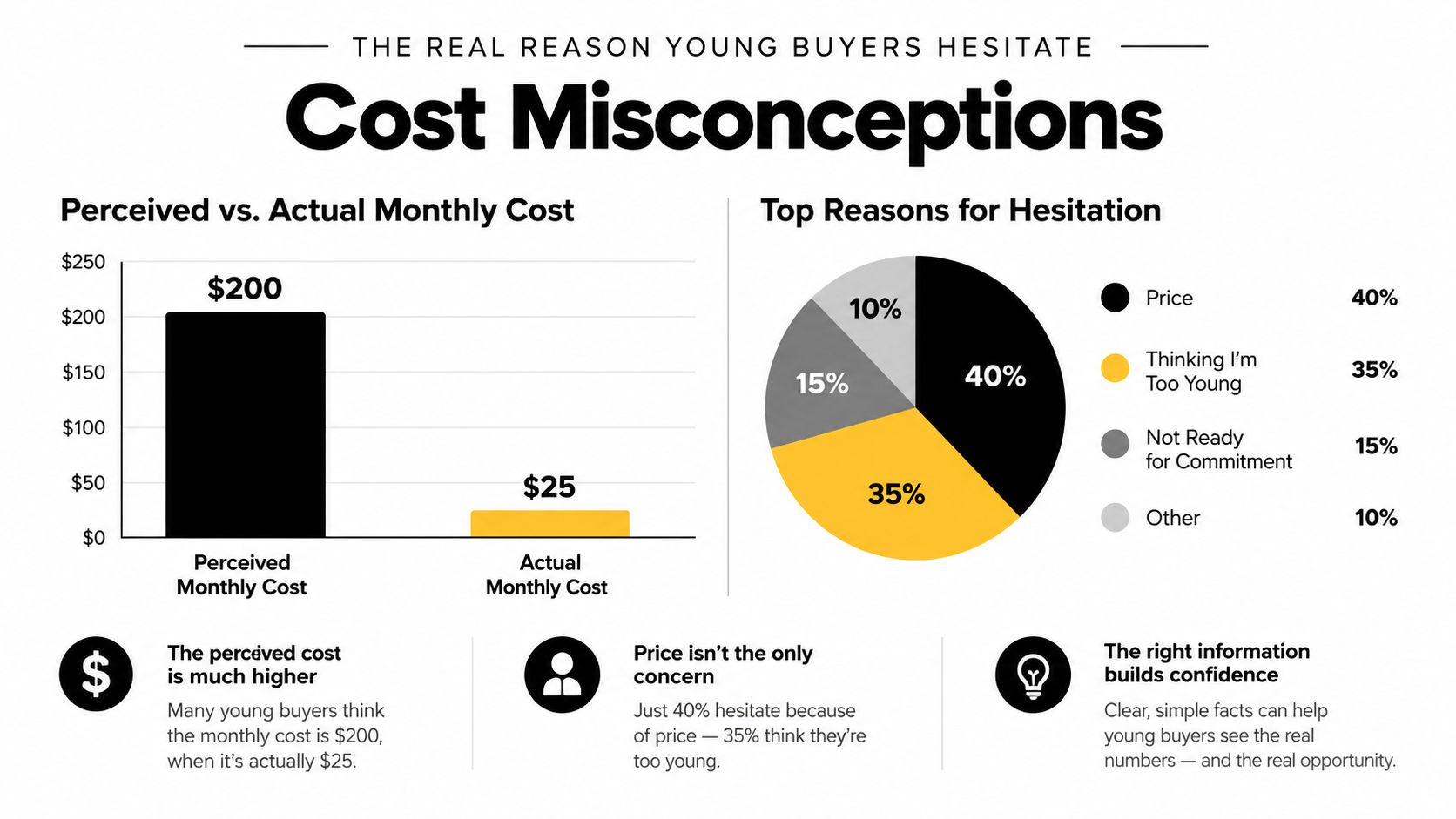
A young couple may hear “life insurance” and assume the premium will strain their budget. That assumption often comes from permanent insurance advertising, stories about older applicants, or a rough estimate made years ago. They postpone requesting a quote, so an untested price becomes the barrier.
In the 2024 U.S. Insurance Barometer Study, approximately 72% of Americans overestimated the cost of a basic term life insurance policy, and 54% said their estimate came from a gut feeling or wild guess rather than a reliable calculation. LIMRA's coverage-gap research shows the practical consequence. A household can delay useful protection because of a premium it never checked.
Request a quote, then compare the premium with the income risk you are transferring. The premium is a recurring household expense. Losing an income without protection can create a much larger crisis.
Price depends on the details
Insurers price coverage according to several underwriting factors:
- Age: Pricing generally changes with the applicant's age.
- Health history: Medical conditions and treatment can affect eligibility and premiums.
- Tobacco use: Tobacco use can materially change underwriting results.
- Coverage amount: A larger death benefit creates a larger obligation for the insurer.
- Term length: A longer coverage period changes the insurer's exposure.
- Occupation and lifestyle: Certain risks can affect underwriting.
No-exam and accelerated underwriting may simplify the application for eligible applicants, but neither removes underwriting. The insurer still reviews the information provided before deciding eligibility and pricing.
Watch the video below for another practical look at the decision.
Stop guessing. Get quotes for the amount and term your family needs, then decide whether the premium belongs in the budget. A smaller policy today may protect your household better than waiting for a future raise or a health change that makes coverage harder to obtain.
How Much Coverage You Actually Need
A round income multiple is a starting shortcut, not a complete answer. The NAIC notes that some experts suggest five to eight times current income, but it also recommends a needs-based calculation. Your household may have substantial debt, existing assets, unpaid caregiving needs, or education obligations that make a generic multiple misleading.
Start with the financial loss your family would face. Estimate the income the deceased person would have provided, then add obligations and subtract resources that would remain available.
| Line Item | What to Enter | Why It Matters |
|---|---|---|
| Lost income | Estimated after-tax income your household would need to replace | This identifies the central cash-flow gap |
| Debts | Mortgage, student loans, personal debts, and other obligations | The surviving household may need to repay or continue servicing them |
| Childcare and caregiving | Replacement care and household support costs | Unpaid work still has financial value when the caregiver dies |
| Education funding | Expected future education costs | This protects a long-term family objective |
| Existing assets | Liquid savings and appropriate existing coverage | These resources reduce the amount of new insurance required |
| Coverage target | Added needs minus available assets | This produces a defensible death-benefit estimate |
The calculation doesn't need to be perfect. It needs to be explicit. If you want a second method, compare your worksheet with this guide on how much life insurance you need, then adjust the result for your household's actual obligations.
Match the term to a deadline
Choose a term that reaches a meaningful financial milestone. That might be the expected mortgage payoff, the point when your youngest child becomes financially independent, or the date when your retirement assets should support the surviving partner.
Don't select a short term just because the premium looks attractive. A policy that expires while children still depend on your income has failed to cover the period that mattered most.
A death benefit also isn't the same as an emergency fund. Federal Reserve data reported through LIMRA's 2024 life insurance fact sheet show that only 55% of adults reported having savings sufficient to cover three months of expenses in 2024. Savings provide liquidity for immediate disruptions. Term insurance can provide a much larger capital reserve after a premature death.
Two Families, Two Very Different Policies
Consider a dual-income professional couple with a toddler and a mortgage. Both adults earn income, but one earns more and the family relies on both salaries for housing, childcare, savings, and debt payments. Their policies shouldn't automatically be identical.
The higher earner may need a larger death benefit because the direct income loss is greater. The other partner may also need meaningful coverage because replacing childcare, household management, and future earning capacity can require substantial money.

Their term length should follow the longest major dependency, not the mortgage alone. If the child will still need support after the loan is repaid, income protection may need to continue beyond the mortgage timeline. Each partner should review beneficiaries, ownership, employer coverage, and personal policies together.
A single-income household has a different exposure
Now consider a family with one primary earner and two young children. The non-earning spouse manages childcare and household work. If the earner dies, the surviving parent may need to increase paid work while paying for childcare, or reduce work and face a serious income shortfall.
This family may need a larger benefit relative to current liquid assets because one policy must address both lost earnings and the cost of replacing unpaid labor. The term should extend through the years when the children require substantial support.
The profiles lead to different recommendations:
- Dual-income couple: Insure both adults, size each policy around income and caregiving exposure, and coordinate terms with the mortgage and children's dependency.
- Single-income family: Give priority to the primary earner's income replacement, but don't treat the caregiving spouse as financially irrelevant.
- Newly married couple without children: Consider joint debts, housing plans, and future dependents. A policy can be adjusted later as obligations grow.
Beneficiaries should be reviewed after marriage, divorce, childbirth, or a major change in family structure. The policy belongs in a broader household plan, not in isolation.
When Term Is the Wrong Tool
Term insurance is not automatically the right answer. It fits a temporary financial obligation. If the obligation is permanent, a policy designed to end may leave the family exposed at the wrong time.
Use three questions to test the fit:
- How long does the need last? A mortgage, child-rearing period, or income-replacement need may have a clear end date. A special-needs trust or lifelong dependent may not.
- What is the purpose? Term generally addresses income replacement and debt protection. Permanent coverage may support a lifelong estate, legacy, or business obligation.
- What premium can you sustain? A permanent policy may require a long-term funding commitment. Term usually concentrates protection during the years of highest financial exposure.
Situations that deserve a permanent-insurance review
A child who will remain financially dependent throughout life may require coverage that doesn't expire when a term ends. A business owner funding a buy-sell arrangement may also need permanent planning, depending on the agreement and the partners' objectives. A permanent obligation connected to a special-needs trust can require a lifelong death benefit.
Business owners should evaluate insurance alongside other financing decisions. The distinction between short term vs long term business loans offers a useful parallel: the duration of the financial need should influence the structure used to fund or protect it.
Decision test: If the financial obligation has a credible end date, compare term first. If the obligation survives your working years, ask whether an insurance policy that can expire is structurally appropriate.
Don't buy permanent insurance just because it sounds more complete. Don't buy term just because it's familiar. Match the product to the liability.
Renewal, Conversion, and Portability Explained
The cheapest-looking term policy can become a poor choice if you ignore what happens after the guaranteed premium period. A policy may allow renewal, but the renewal premium can rise substantially. That matters if you still need coverage when the original term ends and your health has changed.
A conversion provision may allow you to exchange term coverage for permanent insurance without new medical underwriting. The deadline matters. Some contracts permit conversion throughout the term, while others impose an earlier cutoff or restrict the available permanent products.
Review the policy documents before you apply, not after a problem appears. This guide to life insurance policy conversion can help clarify the basic mechanics, but your contract controls.
Ask these questions before signing
- What happens at renewal? Find the renewal schedule and understand how premiums may change after the level-premium period.
- When does conversion end? Record the conversion deadline and identify which permanent policies are available.
- How long are premiums guaranteed? Confirm the exact period rather than assuming the entire term has one fixed price.
- Does coverage follow a job change? Employer coverage may end when employment ends. An individually owned policy generally gives you more control, subject to its contract.
- What underwriting applies? No-exam or accelerated applications may be available to eligible applicants, but approval and pricing still depend on the insurer's review.
Policy mechanics remain poorly understood. Only 29% of policyholders in a recent international report knew about flexible premium-payment options, according to LIMRA's 2026 Insurance Barometer toolkit. Don't assume flexibility exists. Ask whether premiums, coverage, conversion, and portability can change, and under what conditions.
Divorce, a new employer, a business launch, or a second child can all make a review necessary. The policy may still be useful, but the owner, beneficiary, amount, or term could need adjustment.
Treat Term Coverage as a Living Financial Tool
Term insurance should reflect your household as it exists now, not the household you had when you first applied. Review it after four events:
- Marriage: Revisit beneficiaries, debts, housing plans, and the income each partner brings to the household.
- Childbirth or adoption: Add the financial dependency created by another child, including care and future education goals.
- A new mortgage or business loan: Increase or restructure protection if your liabilities become larger or extend further into the future.
- A major income change: Recalculate coverage after a promotion, career change, reduced work schedule, or a spouse's career break.
A review doesn't always mean buying more. You may discover that the original benefit is too large, the term is no longer necessary, or a new debt has created a gap. What matters is comparing the current risk with the current contract.
This week, complete the worksheet, choose a target death benefit, and identify the milestone that should determine your term length. Then request two real quotes from reputable carriers, including a digital option such as Coveredly for eligible applicants, and compare both quotes against your household budget and coverage target.
You don't need a perfect financial plan before taking the first step. You need a defensible number, a suitable term, and a policy whose renewal and conversion rules you understand.
Coveredly offers online term life insurance with application and decision processes designed for digital use, no medical exams for most applicants, and coverage options up to $3 million, subject to eligibility and underwriting. Visit Coveredly to request a quote and compare the available coverage with the needs-based worksheet you completed.