You're reviewing the mortgage payment, childcare bills and next month's budget when you notice the life insurance deduction on your payslip. You know there's a policy, but could your partner explain how much it would pay, who would receive it or whether it would still protect your family after a job change?
A life insurance death benefit is meant to turn that uncertainty into financial support. The amount printed on the policy is the starting point, but the policy's structure, outstanding loans, payment arrangements and beneficiary instructions all help determine what your family ultimately receives.
Table of Contents
- What a Death Benefit Pays and How It Works
- Level, Graded and Decreasing Death Benefits Compared
- How Taxes and Payout Timing Change What Beneficiaries Receive
- Naming Beneficiaries So the Money Arrives Without Delay
- How Much Death Benefit Your Household Needs
- A Worked Example for a Young Family
- Review Your Death Benefit Before Your Next Life Change
What a Death Benefit Pays and How It Works
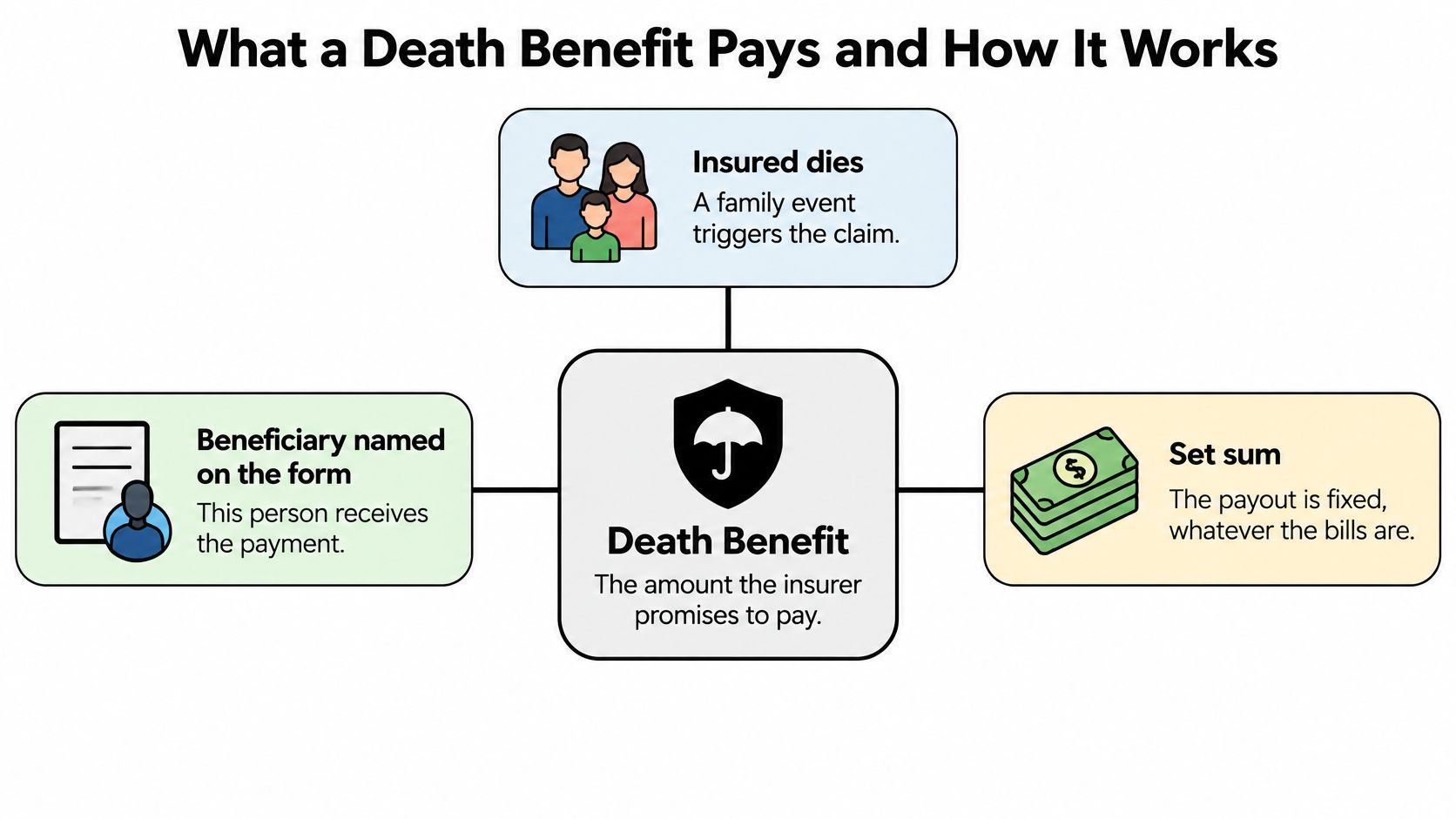
Suppose a parent dies, leaving a partner with children, a mortgage and everyday bills. The insurer doesn't add up those expenses and reimburse them. It pays the benefit promised under the contract to the beneficiary named on the policy, subject to the policy's terms.
The death benefit is the amount the insurer promises to pay when the insured person dies while coverage is in force. Premiums are the payments made to maintain that coverage. They aren't deposits that beneficiaries just collect back.
Think of the contract as a sealed promise: the policyholder pays premiums steadily, and the insurer releases the agreed benefit after a covered death and an approved claim.
The diagram shows how those pieces connect.
Why the printed amount may not be the payment
The face amount is the stated coverage amount, not a guarantee that every claim produces that exact payment. According to the National Association of Insurance Commissioners' life insurance guide, outstanding policy loans and accrued interest reduce proceeds, and accumulated cash value generally isn't paid on top of the stated death benefit.
For example, a policy with a $500,000 face amount can pay less if an unpaid policy loan remains. Don't assume a permanent policy's savings component creates a separate inheritance in addition to its death benefit.
Coverage must also be active when the insured dies. A policy that has lapsed for nonpayment generally pays nothing unless applicable grace-period protections or reinstatement provisions preserve coverage.
From policy to claim
Beneficiaries typically submit a claim form and a certified death certificate. The insurer checks the policy, reviews the claim and confirms the amount payable after any applicable deductions.
- Find the current statement. Check the death benefit rather than relying on an old application.
- Identify the recipient. Confirm who is named and whether a trust needs to receive or manage the proceeds.
- Keep claim information accessible. Your family should know the insurer's name and where the policy documents are stored.
For families considering a trust, David J. Greiner Law Corp.’s life insurance trust guidance for families provides useful estate-planning context to discuss with an attorney.
Understanding the promise matters: LIMRA reported that 51% of U.S. consumers owned life insurance in January 2024, compared with 63% in 2011. Having a policy and having adequate protection aren't the same thing.
First check: Know the current death benefit, who receives it and what could reduce it.
Level, Graded and Decreasing Death Benefits Compared
Death benefit structures compared
| Structure | How the amount changes | Best fit | Main trade-off |
|---|---|---|---|
| Level | Stays the same for the whole term | Income replacement and other obligations lasting the full term | Usually costs more than a decreasing benefit with the same starting face amount |
| Graded | Pays a reduced percentage in the first one to three years, then the full face amount | Applicants using limited-underwriting coverage or weighing tight early budgets | Smaller payout if death occurs in the early years |
| Decreasing | Shrinks on a set schedule, often matching a loan balance | Mortgage or other debt that falls each year | Coverage drops as the debt does, so other needs may go unprotected |
The practical question is which structure matches what your family will owe, not which quote has the lowest premium. A mortgage balance may shrink, but groceries, childcare and a survivor's need for financial support won't necessarily shrink alongside it.
Level benefits preserve a stated amount
A level death benefit stays unchanged throughout the covered term. In a hypothetical policy with a $400,000 level benefit, a covered death in the first year or the tenth year would produce the same stated benefit before applicable adjustments.
That predictability suits income replacement while children remain dependent. The trade-off is that a fixed amount doesn't automatically increase when household costs rise.
Graded benefits limit early protection
A graded death benefit restricts the early payout before full coverage becomes available. These arrangements often appear in policies with limited underwriting, but the exact restriction, covered causes of death and waiting period are contractual details.
Our explanation of graded death benefits can help you identify what to read before accepting this structure. Don't mistake an affordable initial premium for full immediate protection, particularly when your family needs the entire benefit from the start.
Decreasing benefits follow a falling obligation
A decreasing death benefit declines according to a schedule. In a hypothetical policy starting at $400,000, the scheduled benefit could be considerably lower by the tenth year.
That can suit a repayment mortgage, but compare the policy's schedule with the actual loan. Refinancing, borrowing more or changing repayment arrangements can leave the insurance and debt out of alignment.
Benefit structure and policy type are different choices. Term life insurance is the most popular and affordable type, provides pure protection without an investment component and lasts for a set period, such as 20 years. Whole life insurance covers the insured for their entire life and includes a growing cash value savings component, with premiums significantly higher than term life.
Match the structure to your longest financial obligation, not just the cheapest quote.
How Taxes and Payout Timing Change What Beneficiaries Receive
Under U.S. federal tax law, life insurance proceeds paid because of the insured's death are generally excluded from the beneficiary's gross income, as explained in IRS Publication 559. Its guidance means a $1 million policy can generally provide $1 million in income-tax-free proceeds, assuming no reduction or applicable exception.
The distinction is between insurance proceeds and interest. The benefit may be income-tax-free while interest added after death is taxable.
The timeline illustrates where that distinction becomes important.

Payout routes and what the beneficiary keeps
| Payout route | What the beneficiary receives | Tax treatment | Main caution |
|---|---|---|---|
| Lump sum paid promptly | Full face amount, assuming no policy deductions | Generally excluded from gross income | Keeps the full face amount income-tax-free, subject to exceptions |
| Delayed payment | Face amount plus any interest for the delay | Face amount excluded; interest taxable | Interest may be reported separately |
| Installments | Face amount spread across scheduled payments | Original benefit portion excluded; amounts above it taxed as interest | Interest can be taxable even when the benefit is not |
| Retained asset account | Proceeds held by the insurer for the beneficiary | Interest earned is taxable | Keep the insurer statements |
| Transferred policy | Proceeds after a transfer for value | Exclusion may be limited to premiums and qualifying amounts | Ask a tax adviser about the transaction |
Separate the benefit from earnings on it
A prompt lump sum is the simplest arrangement to understand: the insurer pays the approved proceeds, and the beneficiary decides how to hold or use them. Interest subsequently earned in a bank or investment account is separate from the insurance payment.
With installments, each payment may contain both excluded proceeds and taxable interest. IRS Publication 554 explains that the original benefit is allocated across scheduled payments, with amounts above that allocation generally treated as interest.
A retained asset account leaves proceeds with the insurer under the settlement arrangement. Review access terms and statements rather than assuming it functions exactly like your existing bank account.
Check exceptions before choosing
The transfer-for-value rule can limit the exclusion when someone acquires a policy through a purchase or another qualifying transfer. It doesn't mean every ordinary beneficiary change creates taxable proceeds, but a transferred policy deserves individual tax advice.
For broader context, Everglow Prosperity's explanation of when death benefits are taxable is useful when discussing jurisdiction-specific questions. Don't apply another country's treatment to a U.S. policy without advice.
Before selecting a settlement arrangement:
- Request written options. Compare access, interest and payment conditions using the insurer's documents and our explanation of how life insurance is paid out.
- Consider a lump sum first. Choose another route only when it serves a clear financial purpose.
- Keep every statement. Ask whether interest will be reported separately.
- Get tax advice. Review installment, retained-asset or transferred-policy arrangements before committing.
These are U.S. federal income-tax rules, not a promise that estate or inheritance taxes can never apply. Other jurisdictions may impose inheritance, estate or income taxes.
Naming Beneficiaries So the Money Arrives Without Delay
Your will generally doesn't override a valid life insurance beneficiary designation, according to the NAIC's beneficiary guidance. Unless your estate is named, the policy form normally controls who receives the money.
That makes beneficiary administration a financial task, not just paperwork. A generous benefit can still create problems if the recipient has died, the wording is unclear or a child can't legally receive the payment directly.
Give the insurer clear instructions
Your primary beneficiary receives the proceeds if eligible when you die. A contingent beneficiary is the backup if the primary beneficiary dies first.
Use legal names and the identifying information the insurer requests. When several people will share the benefit, specify percentages or clear equal-share instructions instead of relying on informal descriptions.
- Name the primary recipient. Check that the person or entity matches your current intentions.
- Add a contingent recipient. Don't leave the backup field blank just because the primary beneficiary is healthy.
- Make shares explicit. Confirm the insurer has accepted the allocation rather than keeping instructions only in your personal files.
Consider probate and children
Naming an individual directly generally allows proceeds to bypass probate. Naming your estate can send the payment through probate and introduce estate-administration complications or estate-tax questions.
Insurers generally don't pay minor children directly. A properly drafted trust or legally appropriate custodial arrangement may offer a better route, but the wording should match the legal structure an attorney establishes.
The same administrative discipline helps with other assets. Olson & Sons' explanation of how IRA beneficiary designations work offers a useful companion discussion, although retirement accounts have their own rules.
Practical habit: Keep a copy of the insurer's accepted beneficiary designation with your policy, not just a note describing what you intended.
Review the designation at least annually and after marriage, divorce, childbirth, adoption or a named beneficiary's death. Also check it when changing jobs alters your employer coverage.
A review doesn't always require a change. Its purpose is to confirm that your family circumstances, legal arrangements and insurer's records still agree.
How Much Death Benefit Your Household Needs
Methods for sizing a death benefit
| Method | What it adds up | Best for |
|---|---|---|
| Needs analysis | Debts, education costs, childcare, final expenses and years of income replacement, minus savings and existing coverage | Households with several specific obligations |
| Income replacement | Annual household income multiplied by the number of years dependents rely on it | Single-income families with young children |
| Debt payoff | Mortgage balance plus other loans that survivors would have to repay | Couples whose shared debt would be hard to carry alone |
Use actual account balances and your household budget rather than choosing a round number because it sounds substantial. A shared planning session makes assumptions about childcare, employment and education easier to spot.
Start with the documents you already use to manage your finances.

Build a needs figure before using a shortcut
A common guideline is 10 to 15 times annual income, but it's a reasonableness check, not a complete plan. We help tailor the calculation to each household rather than treating that multiple as a prescription.
For a needs analysis, add debts survivors would need to repay, education goals, final expenses, childcare and the income support required over the dependency period. Then subtract savings available for those purposes and existing insurance.
Avoid double-counting. If the calculation pays off the mortgage immediately, don't also include the same mortgage payments throughout the income-replacement budget. Likewise, don't subtract emergency savings that the survivor needs to keep untouched.
Unpaid household work matters too. A parent who doesn't earn a salary may still provide childcare, transport and household management that a survivor would need to replace.
Test portability and purchasing power
Treat employer coverage as temporary support when building the durable plan. It may end when employment ends, and any continuation or conversion rights need checking before you rely on them.
Inflation also changes the answer. A benefit that seems sufficient today may buy less 15 years from now, so test a higher-cost scenario rather than assuming today's budget stays unchanged.
LIMRA's 2025 life insurance fact sheet reports that 53% of young adults who feel only somewhat or not at all knowledgeable about life insurance have a coverage gap. A concrete household calculation is more useful than guessing from a colleague's policy.
Use the video alongside your written budget as you consider your coverage needs.
Run separate scenarios for another child, reduced working hours, a home purchase or a career change. Recalculate after marriage or major new debt, and choose a coverage period that reaches the years when dependents become financially independent.
The deciding question is simple: would the benefit support your household for the years it will need help?
A Worked Example for a Young Family
Consider a hypothetical planning example involving Maya and Daniel, both 34, with two children, a $310,000 mortgage and $140,000 in combined annual income. Maya earns $90,000 and is the person being insured.
Daniel therefore earns $50,000 gross. For this example, assume he has $40,000 available annually after deductions and work-related costs, while the surviving household's adjusted annual budget, including childcare, is $90,000.
Calculate the obligations and available resources
List the lump-sum needs. They want $310,000 to clear the mortgage, $120,000 for both children's education and $15,000 for final expenses. Their running total is $445,000. These are scenario assumptions, not estimates of what another family should spend.
Calculate the annual shortfall. Subtract Daniel's $40,000 available income from the adjusted $90,000 household budget, leaving $50,000 a year to replace. Over 12 years of dependence, that requires $600,000, bringing the running total to $1,045,000. The household budget excludes mortgage payments because the mortgage is already included as a lump-sum payoff.
Subtract existing resources. Assume they have $80,000 in available savings and $100,000 in employer life insurance. Subtracting those $180,000 in resources leaves a current additional-coverage estimate of $865,000.
Compare the quick check. Ten times Maya's $90,000 salary is $900,000, and fifteen times is $1,350,000. Their needs estimate falls just below the lower guideline, so they provisionally round up to a $900,000 level term policy, lasting at least until the younger child is financially independent. Their running additional-policy target is now $900,000.
Test what happens after a job change
The rounded target still relies on Maya keeping her workplace benefit. Without that $100,000 employer coverage, the calculation becomes $965,000, so a $900,000 individual policy would leave a $65,000 gap under these assumptions.
That doesn't make the calculation wrong. It shows why the couple needs both a current estimate and a portable-coverage scenario before deciding.
A raise, new loan, third child or move would require fresh numbers. Changes in childcare or Daniel's working hours could matter just as much as a change in Maya's salary.
Review Your Death Benefit Before Your Next Life Change
- Find the current face amount. Check the policy statement for outstanding loans and unpaid interest that could reduce proceeds.
- Confirm both beneficiary levels. Review primary and contingent recipients, their shares and any minor children named directly.
- Identify the benefit structure. Check whether it's level, graded or decreasing, then compare its schedule with your longest obligation.
- Run the needs calculation. Use current debts, savings, household costs and the dependency period. Calculate a separate result without employer coverage.
- Request quotes for the uncovered need. Compare the proposed benefit and term with the gap, not just the lowest monthly premium.
If that calculation reveals a shortfall, our term life insurance is one option, with no medical exams for policies up to $3 million. Many policies start as low as $15 to $30 per month, depending on age, health and coverage amount; your own quote should guide the budget decision.
We also allow coverage to be raised or lowered as life changes, without starting over. Before changing an existing policy, confirm when replacement or additional coverage becomes effective so you don't create an unintended gap.
Put a review on your calendar this week, then schedule another after marriage, childbirth, a home purchase or a career change.
Coveredly offers online life insurance to help you put a defined death benefit behind your family's financial plan. Visit Coveredly with your needs calculation and beneficiary questions to compare coverage that fits the obligations your household would face.