You're standing outside the hospital with a newborn in your arms, a stack of paperwork under one elbow, and a new question competing with the joy of the moment: Will the life insurance policy we bought before this baby arrived still fit our family later? A second child, a larger mortgage, a career change, or a spouse moving to part-time work could all change the amount of protection your household needs.
That's where adjustable term life insurance can help. Instead of treating the original death benefit, coverage period, and payment pattern as permanent decisions, it may give you ways to respond as your obligations shift. The important point is that “adjustable” isn't one feature. It can refer to several separate contract mechanics, and each one has different limits, costs, and underwriting rules.
Table of Contents
- A Policy That Grows With Your Family
- What Adjustable Term Life Insurance Actually Is
- Level, Decreasing, and Adjustable Term Compared
- How Adjustable Features Behave at Major Life Stages
- The Hidden Math Behind a Fixed Death Benefit
- Riders and Conversion Options Worth Knowing
- Who Adjustable Term Insurance Is Built For
- A Simple Path to Buying the Right Policy
A Policy That Grows With Your Family
A new parent might buy a 20-year policy because the term lines up with the years when a child depends on household income. At the time, the decision feels sensible. Then life moves. The family considers another child, refinances the home, and one parent reduces work hours to handle childcare. The original policy may still be useful, but its benefit and end date may no longer match the household's largest obligations.
Adjustable coverage starts with a simple idea: life insurance should respond to changing financial responsibilities. The history of adjustable life products reflects that principle. Minnesota Mutual introduced an “Adjustable Life” policy in 1971, allowing policyholders to set premium-payment levels that affected policy values. A 1976 Society of Actuaries analysis also documented designs that could provide term insurance to a specified age, permit premium changes during the first policy years, and alter the insurance plan while maintaining selected insurance amounts and premiums. (BenefitsPRO's history of life insurance)

The practical question isn't, “Is flexible coverage better?” It's more specific: Which part of the policy might need to change, and what will the insurer require when it does? A benefit increase may require new health evidence. A reduction may be easier, but could affect the policy's pricing or riders. Renewal may preserve coverage after the initial term, but premiums generally rise with age. Conversion may protect future access to permanent insurance, but it won't preserve the original term premium.
For a family, the value lies in avoiding an all-or-nothing choice. You can design early protection around the years of highest income replacement, childcare, and debt needs, then review whether the policy still makes sense after each major financial transition.
Practical rule: Flexibility only has value when you understand the exact action the contract permits, the deadline for taking it, and the price attached to it.
What Adjustable Term Life Insurance Actually Is
Adjustable term life insurance is a category, not one standardized policy design. Insurers may use the word to describe coverage that lets you alter the death benefit, the duration, the premium pattern, or the path from term insurance to permanent insurance. Two policies can both use “adjustable” in their marketing while offering very different rights.
Start by separating the five adjustment levers.
Face amount
The face amount is the death benefit paid if the insured dies while the policy is active. An adjustable policy may let you reduce coverage as debts decline or increase it after a qualifying life event. An increase can require new underwriting, unless the contract includes a guaranteed-insurability feature or another special provision.
Term length
The term length determines how long the temporary coverage lasts. A household might extend protection when a mortgage is refinanced or when children will remain financially dependent longer than expected. The contract may not allow an extension on the same terms, so check whether the change means renewal, a new application, or a different premium schedule.
Premium structure
A policy can use level premiums, where the scheduled payment stays stable during a stated period, or an annually renewable structure, where the premium typically increases as the insured gets older. Younger buyers sometimes confuse the two. LIMRA reports that 57% of Gen Z respondents incorrectly believe most term policies increase premiums annually. (LIMRA's consumer research on life insurance)
Renewability
A renewable policy can generally continue after the initial term without new evidence of insurability, as long as the policyholder pays the required premiums. The insurer can usually charge more at renewal because the insured has reached an older attained age, and the contract may end renewal rights at a stated maximum age.
Conversion
A conversion privilege lets the policyholder exchange term coverage for eligible permanent insurance, often without new medical evidence. The converted policy usually costs more because it is designed for longer-duration coverage and cash-value accumulation. The conversion deadline, eligible products, and amount that can be converted all come from the contract.
| Lever | What It Lets You Change | Typical Trigger |
|---|---|---|
| Face amount | The amount paid to beneficiaries | Marriage, childbirth, mortgage growth, debt reduction |
| Term length | The period of temporary protection | Extended childcare years, refinancing, delayed retirement |
| Premium structure | How payments are scheduled or priced | Budget changes or preference for payment stability |
| Renewability | Whether coverage can continue after the initial term | Health decline before the term ends |
| Conversion | Whether term coverage can become permanent insurance | Long-term estate, dependent-care, or business needs |
The table is a starting framework, not a promise that every policy offers every option. Before comparing prices, ask the insurer to identify which lever is adjustable and whether the change requires medical evidence.
Level, Decreasing, and Adjustable Term Compared
The easiest way to understand adjustable term insurance is to compare it with two more familiar structures.
Level term keeps the death benefit and scheduled premium stable across the selected period. If a family buys $500,000 of level coverage for 20 years, the intended benefit remains $500,000 during that term, subject to the policy's conditions.
Decreasing term reduces the death benefit over time. It can make sense when the main purpose is matching a debt that should decline, such as a mortgage. The premium may not fall in the same proportion, so the contract matters more than the label.
Adjustable term may combine a temporary coverage period with options to change the benefit, duration, or premium pattern. It's less like choosing one fixed line and more like choosing a policy with permitted settings.
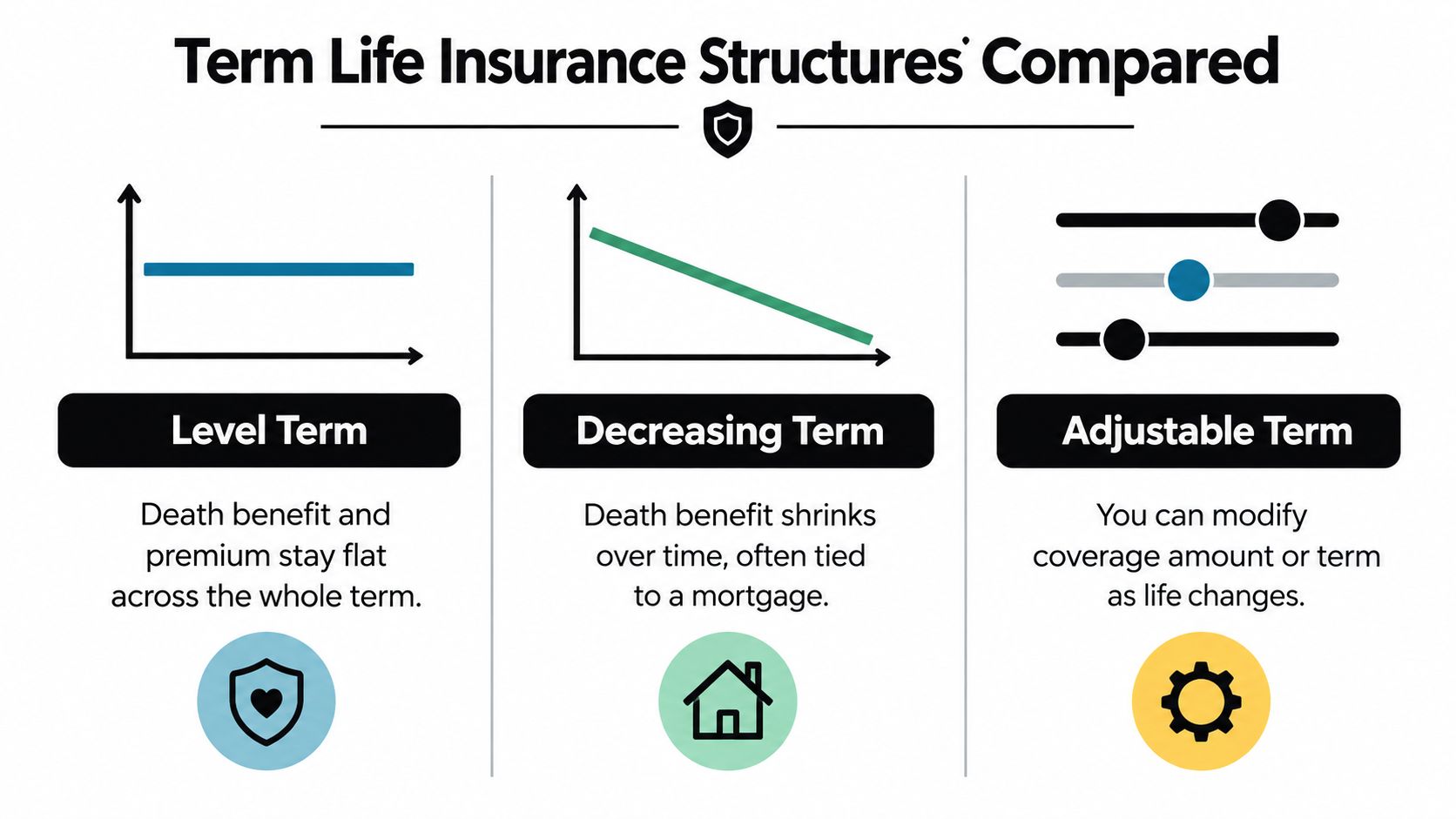
Consider a family whose obligations rise during the early years. A $500,000 level benefit provides the same nominal protection from the beginning to the end of the 20-year term. A $500,000 decreasing benefit starts at that amount but becomes smaller as time passes, which may track a shrinking loan but may not cover growing income-replacement needs. An adjustable policy that begins at $300,000 and can rise toward $700,000 could provide less protection before major obligations arrive and more after a home purchase or a new child, if the contract permits those changes.
The numbers illustrate a structure, not a recommendation. The right benefit depends on income, debts, dependents, assets, and the cost the household can sustain.
For a more traditional option, a level-term life insurance policy may be easier to understand and compare. That simplicity can be valuable when the household expects its needs to remain relatively stable and doesn't want to monitor adjustment deadlines.
When a fixed structure wins
Level term can be the better deal when you know the protection target, want predictable payments, and expect to keep the same benefit throughout the period. Decreasing term may fit a narrow debt-protection purpose, particularly when the household doesn't need the policy to replace a changing income stream.
Adjustable term earns consideration when the family expects meaningful changes and wants contractual tools for responding to them. Its flexibility can also create more decisions, and every permitted change should be reviewed for premium effects, underwriting, and rider eligibility.
How Adjustable Features Behave at Major Life Stages
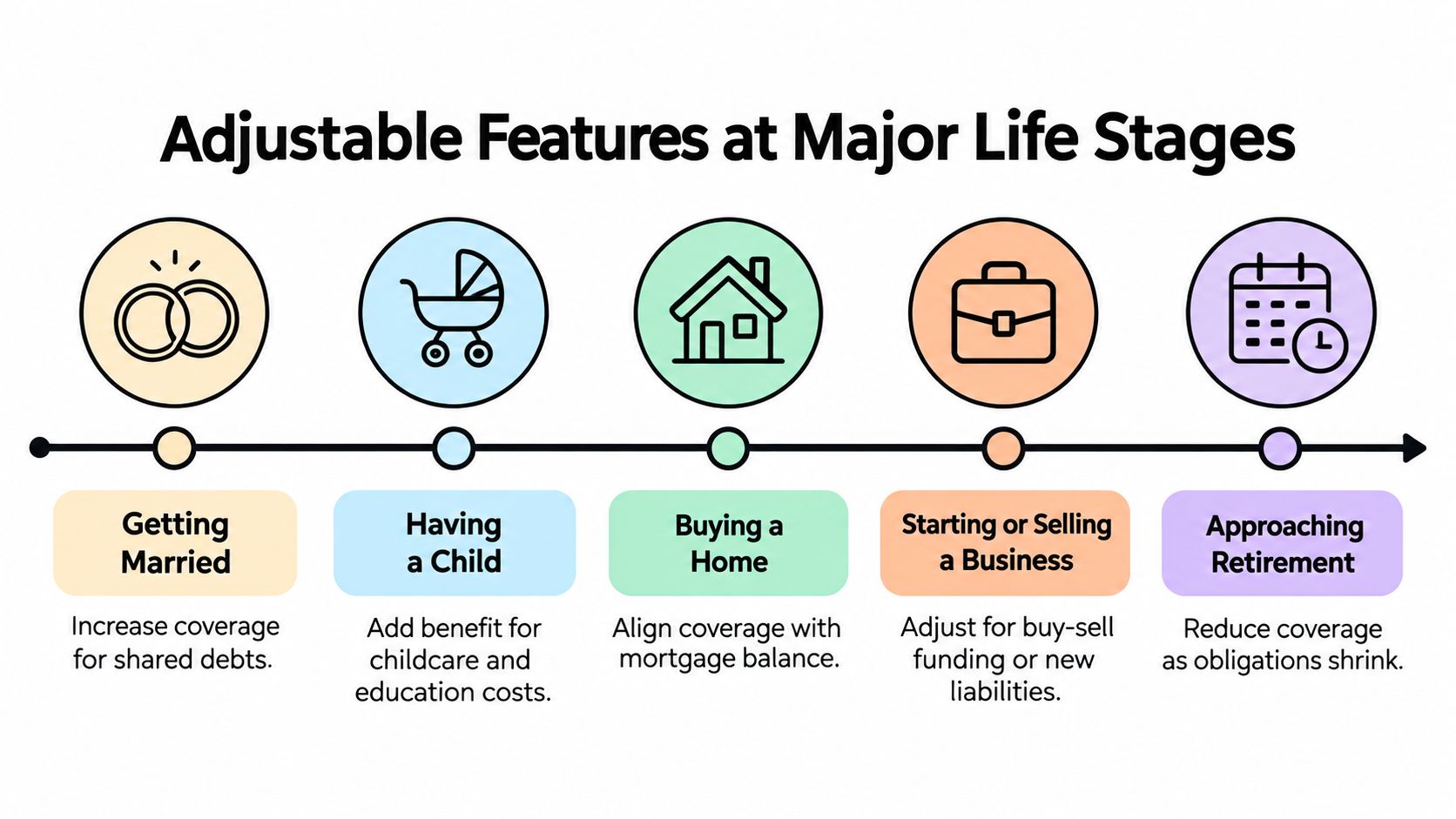
A policy becomes useful when you can connect its features to real decisions. The following milestones are common triggers, but none automatically grants a right to change coverage. The policy language controls.
Marriage
Marriage often combines incomes, debts, and financial plans. A newly married couple may want to increase the face amount so the surviving partner can manage shared obligations, but a benefit increase may require a new application or medical evidence. Ask whether the policy includes a life-event increase, how much it allows, and whether the option expires after a defined period.
A first or second child
A child can create a longer income-replacement need and raise the value of household services such as childcare. The relevant lever is usually the face amount, although extending the term may also matter if financial dependence is expected to last longer. Check whether the policy allows an increase without underwriting, whether the insurer requires proof of the event, and whether the new coverage receives different contestability or suicide-period dates.
A home purchase or upgrade
A larger mortgage can make the existing death benefit insufficient. A family might increase coverage, extend the term, or buy a separate policy rather than alter the original contract. The right choice depends on whether the insurer permits changes, whether the new amount gets priced using current age and health, and whether a decreasing policy better matches a specific debt.
Starting or selling a business
Business owners may need protection for loans, key-person exposure, or a buy-sell arrangement. A term policy that once protected household income may no longer cover the business obligation. Before changing it, identify the beneficiary or ownership requirements, confirm whether assignment is permitted, and ask whether conversion remains available if the business need later becomes permanent.
The empty-nest years
When children become financially independent and major debts decline, reducing coverage may make sense. A lower face amount can reduce cost, but not every policy permits a reduction without changing other terms. Also review whether the remaining benefit is needed for a spouse, final expenses, estate liquidity, or business obligations.
The underwriting question deserves attention at every stage. Conversion often avoids new medical evidence, even if health has deteriorated, but an increase in term coverage may not. The NAIC advises consumers to verify renewal periods, conversion ages, eligible permanent products, and the amount that may be converted in the policy itself. (NAIC consumer guide to life insurance)
Keep a copy of the specifications page with your annual financial records. If a life event occurs, contact the insurer before assuming the change is available.
The Hidden Math Behind a Fixed Death Benefit
A fixed death benefit can look stable while its real purchasing power declines. If inflation averages about 2.5%, $500,000 today would have purchasing power of roughly $300,000 in 20 years, as illustrated by the accompanying calculation. The exact result depends on the inflation path, but the planning lesson is straightforward: a nominally unchanged benefit may support less future spending.
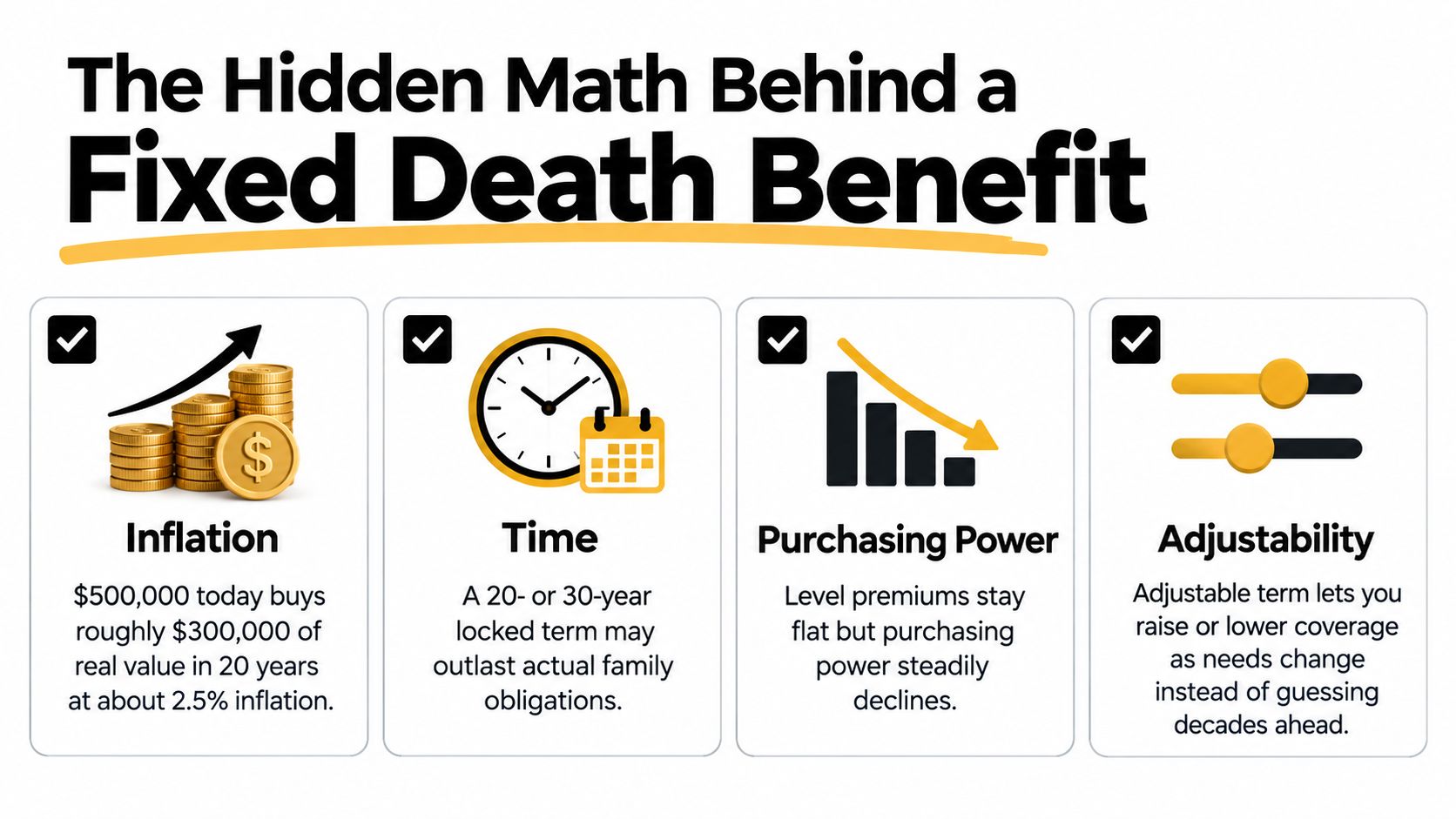
A family's need can move in the opposite direction at first. Childcare, housing, and income replacement may increase after a birth or home purchase. Later, the mortgage balance may fall and children may become independent. A fixed benefit that seemed excessive in the early years could become reasonable later, while a benefit that seemed adequate at issue could become too small after wage growth or prolonged inflation.
The problem isn't solved by always buying more. Larger coverage can strain a household budget, and a policy that becomes unaffordable can lapse. The stronger approach is to match protection to the obligations that would survive the insured's death.
An annual review checklist
Use the same questions each year, and revisit the policy after major events.
- Income: Has either spouse's income changed enough to alter the replacement need?
- Dependents: Has a child been born, become independent, or developed a lifelong support need?
- Debt: Has the household added or repaid a mortgage, student loan, or business liability?
- Coverage: Does the current death benefit still fit the family's likely cash needs?
- Purchasing power: Would the benefit support the same goals if prices continue rising?
- Contract rights: Are renewal and conversion deadlines approaching?
- Budget: Could the household sustain the premium during a job change or leave from work?
Nearly half of U.S. adults, 47%, say they'd have difficulty paying living expenses within six months of the primary wage earner's death, according to the 2025 Insurance Barometer facts. The same source reports that 40% of American adults, nearly 100 million people, believe they need more life insurance. Those figures reinforce the need to review adequacy, but they don't determine the right amount for any one household.
Families handling property, inheritance, or transfer-tax questions may also benefit from a separate guide for San Diego families that distinguishes death taxes from estate taxes. Life insurance can be part of a broader plan, but it shouldn't be evaluated in isolation from ownership, beneficiaries, and estate documents.
Riders and Conversion Options Worth Knowing
Riders modify a base policy. They can solve a specific problem, but each one can add cost or restrictions. Ask for the rider's actual contract language rather than relying on a short label.
Conversion rider
A conversion privilege lets you move from term insurance to eligible permanent insurance, usually without new medical underwriting. It can matter if your health worsens or if your need changes from temporary income replacement to permanent estate liquidity, dependent care, or business succession.
Conversion is not renewal. Renewal continues term coverage, usually at a higher age-based premium. Conversion changes the policy type, often to coverage that builds cash value and costs more. Check the deadline, the permanent products available, the premium basis, whether all or only part of the benefit can convert, and whether riders convert.
The Society of Actuaries and LIMRA's 2009–2023 experience study covers 63.6 million term-policy exposures, $31.4 trillion of term face amount exposure, more than 600,000 term conversions, and 6.2 million converted-policy exposures totaling $955.8 billion of face amount exposure. (The Society of Actuaries term conversion report) The scale of the experience supports treating conversion as a timing decision. Waiting may narrow eligibility, while converting too early may create a permanent premium before the need justifies it.
Guaranteed insurability
This option may allow additional coverage after certain events without new medical evidence. A newly married person or new parent could find it useful, but the contract may limit the amount, event, age, or timing. Ask whether the increase uses current age and whether proof of the event is required.
Return of premium
A return-of-premium feature may refund some or all premiums if the insured outlives the term, depending on the contract. It generally needs a cost comparison against ordinary term coverage. The refund also shouldn't be treated as an investment return without reviewing the policy's actual values and conditions.
Child term
A child-term rider can provide a limited benefit for eligible children under the parent's policy. It may also include a later conversion opportunity, but eligibility, limits, and conversion rules vary. Ask whether the rider covers future children automatically or requires notice.
Waiver of premium
A waiver-of-premium rider can suspend required payments if the insured meets the contract's definition of disability. The definition, waiting period, documentation, and end age matter. This may be especially relevant when a household relies heavily on one income.
Accelerated death benefit
An accelerated death benefit may allow access to part of the death benefit after a qualifying terminal or serious illness. The amount paid during life can reduce what beneficiaries receive, and fees or administrative conditions may apply.
For a broader explanation of how riders work, see what life insurance riders are. Then ask the insurer to show the rider cost and trigger in writing.
Who Adjustable Term Insurance Is Built For
Young families often have the strongest reason to consider adjustable term insurance. Their obligations can change quickly after marriage, childbirth, a second child, childcare changes, or a home purchase. A policy that permits benefit increases, reductions, or conversion can give them more ways to keep protection aligned with those changes.
Business professionals may also benefit when income and responsibilities are less predictable. A promotion, partnership, business loan, or buy-sell obligation can change the required benefit. The policy still needs careful ownership and beneficiary planning, especially when business interests are involved.
Newly married couples usually need a more measured approach. Adjustable coverage can make sense when one partner has variable income, student debt, or plans to leave work temporarily. If both partners have stable finances and expect a predictable protection target, a straightforward level term policy may cost less and require fewer decisions.
Where adjustable coverage has an edge
Adjustable term is worth serious consideration when:
- Obligations are likely to rise: A family expects more children, a larger home, or business borrowing.
- Health may become a concern: A conversion privilege could preserve access to permanent coverage without new medical evidence.
- The budget may change: Reducing coverage later may help keep premiums manageable.
- The household wants options: The policyholder prefers defined contractual choices over relying only on a future new application.
Where simple level term may be better
A level policy may be the cleaner choice when the family knows the desired benefit, expects obligations to remain stable, and values predictable premiums over additional features. Buying a new policy later can sometimes be more economical than paying for flexibility from the start, but a future application may involve new underwriting, a different age-based price, or an unavailable policy.
Flexibility also has limits. Some changes require health evidence, some expire at a stated age, and conversion can be restricted to specific permanent products or dates. For households considering trusts, ownership, or estate liquidity, a qualified professional can help coordinate insurance with broader planning. Brillant Law Firm's estate planning guidance offers context for why ownership and trust structures deserve separate attention from the coverage amount itself.
A Simple Path to Buying the Right Policy
Start with the financial loss your household would face, not with a product label. List income replacement, debts, childcare, education goals, final expenses, and assets that would remain available. Then create a realistic coverage range instead of treating one calculator result as a permanent answer.
Anchor comparisons on three features:
- Face amount: Can you raise or lower it, and does an increase require new underwriting?
- Premium structure: Are payments level during the selected period, or do they rise with renewal?
- Future access: What are the renewal and conversion deadlines, and which products qualify?
Gather current income records, mortgage and loan statements, employer coverage details, beneficiary information, and any existing policy specifications page. Compare quotes only after confirming that the policies use the same benefit, term, underwriting basis, and riders.
A plain level term policy may be appropriate when your needs are stable. Adjustable coverage may be worth the additional complexity when family obligations are likely to shift or when preserving a conversion path matters. Read how to buy term life insurance before applying, and schedule an annual review plus an extra review after marriage, childbirth, a home purchase, a business change, or a major health event.
Coveredly offers digital term life insurance with flexible coverage that can be increased as needed or decreased to reduce cost, with up to $3 million available and no exams for most applicants. Visit Coveredly to compare an option that can adapt as your family, income, and financial obligations change.