Maya and Jordan just bought a house. The mortgage is big, the daycare bill is real, and their toddler doesn't care that the budget already feels tight. They know they should probably buy life insurance. What they don't know is whether to buy a small policy, a big one, a cheap one, a no-exam one, or just keep putting it off.
That's where individuals often get stuck.
If you want to know how to buy term life insurance, stop treating it like a finance trivia question. Treat it like a household cash flow decision. Your job isn't to win at insurance. Your job is to make sure your family can keep paying the mortgage, groceries, childcare, and school costs if one income disappears.
That matters because a lot of households are exposed and know it. LIMRA's 2024 fact sheet says more than 100 million adults believe they're uninsured or underinsured, and 40% of middle-income Americans, or about 50 million adults, say they have a life insurance coverage gap (LIMRA 2024 life insurance fact sheet). This isn't a niche problem. It's a budgeting problem with an insurance wrapper.
Table of Contents
- Why Term Life Insurance Belongs on Your Shortlist
- Sizing Coverage and Picking the Right Term Length
- Comparing Underwriting Paths and Policy Features
- Applying Online Without the Paperwork Headache
- What Happens During Underwriting and Approval
- Paying for Coverage and Activating Your Policy
- Smart Habits and Common Mistakes to Avoid
Why Term Life Insurance Belongs on Your Shortlist
Maya and Jordan don't need a complicated product. They need income protection for the years that matter most. They have a child at home, a new mortgage, and a long stretch of bills that won't pause if one of them dies.
That's exactly where term life insurance fits.
Why term usually fits young families better
Term life insurance typically covers a fixed period of 10 to 30 years, pays a death benefit if the insured dies during that term, and then ends unless you buy new coverage or convert it if the policy allows it (Guardian's term life overview). For a young family, that clean time limit is a strength, not a weakness.
You're trying to cover a temporary risk window:
- The mortgage years
- The child-raising years
- The years when one paycheck still carries the household
Permanent insurance has its place for some buyers, but most first-time shoppers don't need higher premiums and cash value complexity competing with daycare, retirement saving, and emergency-fund building. If your budget is finite, buy the protection first.
Practical rule: Buy term when your biggest need is replacing income for a defined stretch of years.
Term is the plain-language product
A lot of people overcomplicate this. The question isn't whether life insurance sounds responsible. The question is whether someone depends on your income, labor, or both.
If yes, term belongs on your shortlist because it does one job well. It creates a pool of money if you die during the years your family would be financially vulnerable.
Industry structure backs up why term keeps showing up as the default protection product. A 2026 industry statistics summary reports that term life insurance accounts for about 19% of the U.S. life insurance market by premium, even though cash-value products dominate the rest, and it also notes that the top 10 U.S. insurers control 45% of nationwide premium volume (MoneyGeek life insurance statistics summary). For buyers, that means this is a mature, widely available product. You still need to compare policies because pricing and underwriting vary, but you're not shopping in some obscure corner of insurance.
Start with your budget, not a sales pitch
If you're newly married, buying a house, or becoming a parent, term life should be on the table early. Not because it's glamorous. Because it turns a catastrophic income loss into a solvable money problem.
And that's the right frame for the rest of this process. Coverage amount, term length, underwriting path, and payment method should all tie back to your actual household budget.
Sizing Coverage and Picking the Right Term Length
Most bad term life decisions start with lazy math.
People either pick a number that “sounds about right” or buy whatever quote feels cheap enough to tolerate. That's backwards. Size the coverage first. Then shop the policy.
Build coverage from real obligations
I like a simple DIME-style framework because it forces you to count actual financial exposure.
| DIME Component | What's Included | Estimated Amount |
|---|---|---|
| Debt | Credit cards, car loans, student loans, other personal debt | $25,000 |
| Income | Earnings replacement for the years your family depends on that paycheck | $500,000 |
| Mortgage | Remaining home loan balance | $200,000 |
| Education | Future education funding for children | $25,000 |
That sample family lands around $750,000. The exact mix will differ, but the method works because it starts with bills and dependency, not vague rules.
Here's how to think through each part:
- Debt: Count balances that won't disappear when you do.
- Income: Figure out what your spouse or family would need to replace earnings while kids are still at home or until savings catch up.
- Mortgage: Decide whether you want the house paid off entirely or just the payment pressure reduced.
- Education: Add a realistic cushion if you want school funding protected too.
If you want a second pass on the math, use a more detailed life insurance coverage calculator guide.
Buy enough that your family gets breathing room, not just a paid-off funeral.
Don't obsess over a generic multiplier
Generic income multipliers are fine as a rough check. They're not enough on their own. A household with one child, a large mortgage, and one primary earner needs a different answer than a dual-income couple with no debt and strong savings.
That's why I'd rather see a buyer use rough but honest cash-flow math than follow a canned rule.
Pick the term length by dependency, not price
Once you have the death benefit, match the term length to the longest period your family would still be financially exposed.
For most parents, that usually means one of these:
- Youngest child's age plus the years until that child is through school
- Years left on the mortgage
- Years until you expect to be financially independent
Recent independent research found that younger buyers often choose 30-year terms, while $500,000 is the most common coverage amount in Canada (MoneySense PolicyMe 2026 life insurance study). I'm not citing that to tell you what to buy. I'm citing it because it reflects how people shop by life stage. They're trying to cover long family timelines, not just chase the cheapest monthly premium.
When to choose 30 years, 20 years, or 10 years
For a 32-year-old parent, a 30-year term usually makes more sense than a 20-year term. It's a cleaner fit for the years when kids still depend on income and the mortgage still matters.
Choose shorter terms when the timeline is shorter.
- 20-year term: Reasonable if you already save aggressively, debt is manageable, and your kids are older.
- 10-year term: Fine for temporary needs, low debt, or a bridge until a major savings milestone.
- 30-year term: Usually the best fit for new parents, recent homebuyers, and couples still building assets.
Cheap coverage that expires too early is not a bargain. It's a budgeting mistake with a delayed invoice.
Comparing Underwriting Paths and Policy Features
Buyers waste time. They compare logos and monthly quotes when they should be comparing underwriting paths and a few policy features that change the decision.
The four paths buyers actually face
The traditional route is still the benchmark. Independent industry analysis found that in 2018, 73.9% of term sales were fully underwritten, while 19.0% were accelerated underwriting and 7.1% simplified issue (Society of Actuaries product development analysis). That tells you something useful. The standard path still dominates for buyers who want broader access to pricing and can tolerate more disclosure.
| Path | Exam Required | Typical Coverage Limit | Turnaround | Best For |
|---|---|---|---|---|
| Fully underwritten | Usually yes | Often the broadest access, especially for larger coverage | Several weeks | Healthy buyers who want the strongest chance at better pricing |
| Accelerated underwriting | Often no | Often available for healthy applicants under $1,000,000 | Faster than full underwriting | Busy professionals who want speed without giving up too much coverage |
| Simplified issue | No exam | Lower than traditional fully underwritten policies | Fast | Buyers with mild health concerns or buyers who value convenience over price |
| Guaranteed issue | No exam and no health questions | Low face amounts | Fastest | Last resort when health makes other options unlikely |
A couple of boundaries matter here. One source says medical exams are often required above $250,000 to $500,000 depending on insurer and age, while another says accelerated underwriting is often available for healthy applicants under $1,000,000 (MoneyGeek medical exam overview).
Match the lane to your situation
Fully underwritten is still my default recommendation for healthy buyers who want meaningful coverage. You disclose more, you may deal with an exam, and it can take longer. But you're shopping the main market, and that usually gives you the fairest benchmark.
Accelerated underwriting works well for healthy professionals who want a faster path and aren't asking for unusually large coverage. Simplified issue is a trade-off product. Less hassle, but usually less favorable pricing per dollar of coverage. Guaranteed issue is what you use when the other doors are mostly closed.
The policy features worth caring about
Most riders are optional noise. A few matter.
- Convertible term: This is the one I care about most. A convertible term policy lets you switch to permanent coverage without proving insurability or going through underwriting, and some policies allow the conversion window to run as long as the full term, up to 30 years (Investopedia's term life overview).
- Level term: Better than gimmicky declining protection for most families because the death benefit stays steady.
- Waiver of premium: Worth a look if disability risk would make ongoing payments hard.
- Child rider: Usually a niche add-on, not the main event.
If your health changes later, a strong conversion option can rescue a policy that looked ordinary when you bought it.
Applying Online Without the Paperwork Headache
Buying term life used to mean chasing forms, scheduling calls, and repeating the same answers three different ways. The online process is cleaner now, but only if you fill it out carefully.
A digital application is faster. It isn't forgiving.
What the online flow usually looks like
On a modern platform such as Coveredly, the online buying path usually starts with the basics: how much coverage you want, how long you want it, and who the insured person is. Then the application moves into the part that matters, your health, prescriptions, habits, and beneficiary details.

If you want to see how a digital flow is structured before you start, review an online life insurance application walkthrough.
The parts where people create their own delays
Most avoidable problems happen in three places:
- Prescription history: If you forget a medication, the insurer may find it later and pause the file.
- Recent medical visits: Follow-up appointments, testing, and pending results matter more than buyers expect.
- Work and lifestyle details: Hazardous work, nicotine use, and certain hobbies need clear disclosure.
The National Association of Insurance Commissioners notes that insurers typically review health, prescriptions, and lifestyle, and applicants should expect possible follow-ups, medical exams, or phone interviews during underwriting. It also notes that getting the final offer can take weeks rather than days in many cases (NAIC consumer guide to life insurance).
That's why I tell people to pull their own memory together before they click Apply. Don't guess. Don't round down. Don't assume “close enough” is fine.
Slow down before you sign
Digital applications feel casual because they're on a screen. They are still legal documents.
Before e-signing, review these carefully:
- Medical history answers
- Prescription disclosures
- Beneficiary names and percentages
- Coverage amount and term length
- Contact details for follow-up
Accelerated and no-exam paths can reduce friction for qualified applicants, but they don't eliminate the need for accuracy. The fastest approval usually goes to the buyer who answers cleanly the first time.
What Happens During Underwriting and Approval
Underwriting is where the insurer decides whether your application matches reality and what price class you belong in. Buyers tend to imagine this as some mysterious back-office ritual. It's simpler than that.
You answer questions. The carrier checks them.
What insurers compare against your application
Insurers commonly review your medical disclosures, prescription history, and lifestyle details. Depending on the path, they may also request a phone interview, vitals, or a paramed exam.
This visual sums up the main lanes buyers move through:
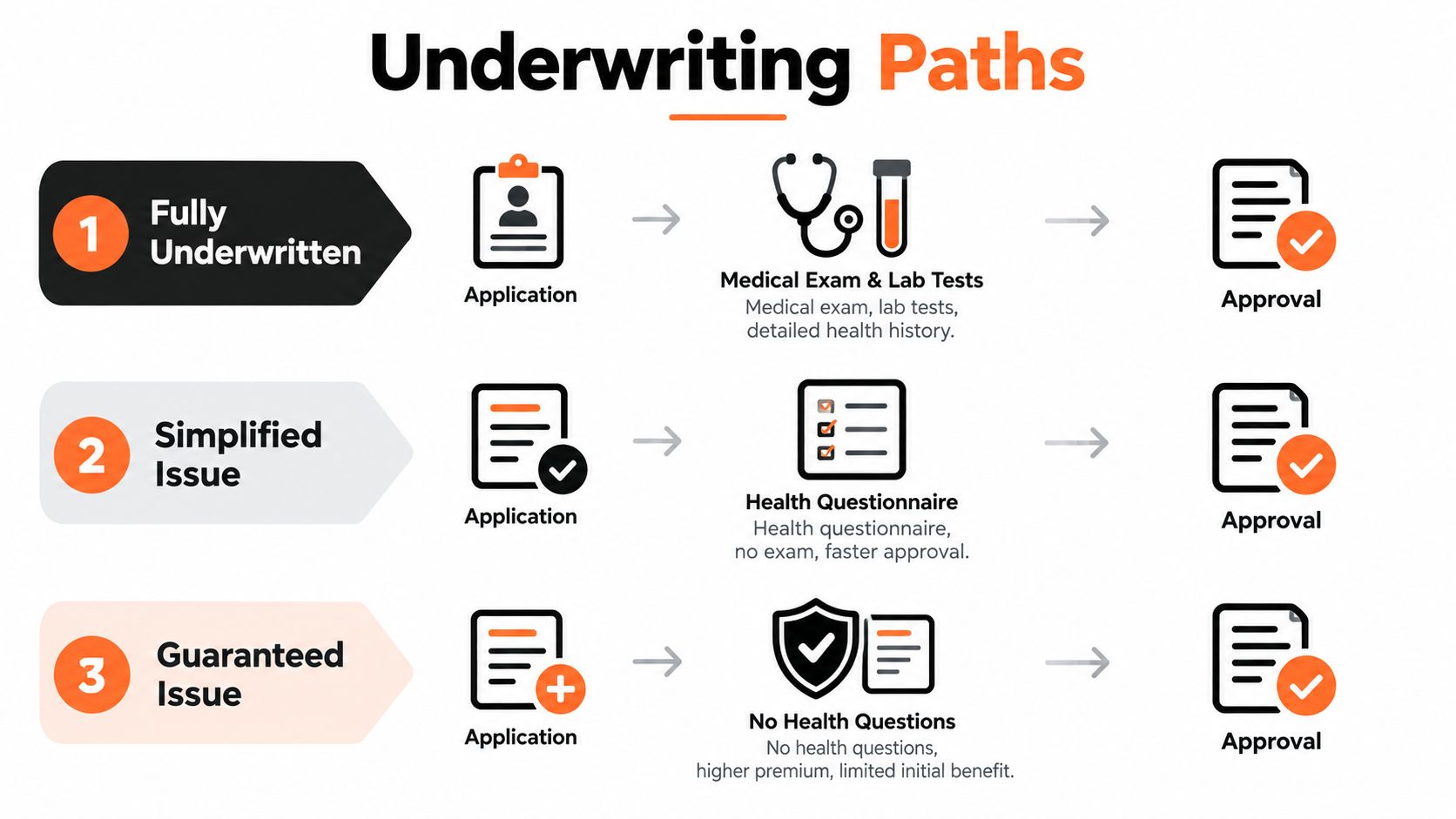
If you want a plain-English breakdown before you apply, read this life insurance underwriting overview.
The problems that trigger delays or worse
The most common issues aren't dramatic. They're sloppy.
- Missing prescriptions: The buyer forgets an anxiety medication, inhaler, or blood pressure refill.
- Undisclosed nicotine use: The buyer thinks occasional use doesn't count.
- Recent diagnoses: The buyer leaves out testing or follow-up because it “wasn't a big deal.”
Those mismatches can lead to delays, revised offers, or outright declines. In serious cases, bad disclosure can create rescission risk. That means the insurer may challenge the policy later because the application wasn't truthful.
Underwriting isn't trying to catch you in a trap. It's trying to see whether your answers line up with your records.
What approval can look like
Approval outcomes usually fall into a few buckets:
- Standard approval: You get the policy at an expected class.
- Rated offer: The carrier offers coverage, but at a higher premium class.
- Decline: The carrier won't issue the policy on that application.
The timeline depends on the path. Accelerated decisions can come very quickly for some applicants. Simplified issue often moves in days. Full underwriting can take several weeks, especially if the insurer needs outside records or more clarification.
Don't panic if the file pauses. Most delays come from records, not doom.
Paying for Coverage and Activating Your Policy
A policy application is not coverage. A policy offer is not coverage. Payment is what activates coverage when the policy is bound.
A lot of first-time buyers miss that.
Why I prefer annual payment when your budget can handle it
If you can afford it, annual payment is usually the cleaner move. It removes one recurring task from the household calendar and often lowers the total cost.
LIMRA reported that in Q1 2026, term life new annualized premium rose 10% and policy count rose 6%, with growth supported by online distributors, automated underwriting, competitive pricing, and simplified issue products (LIMRA Q1 2026 individual life sales release). Buyers clearly like faster, simpler paths. You should bring that same simplicity to payment if you can.
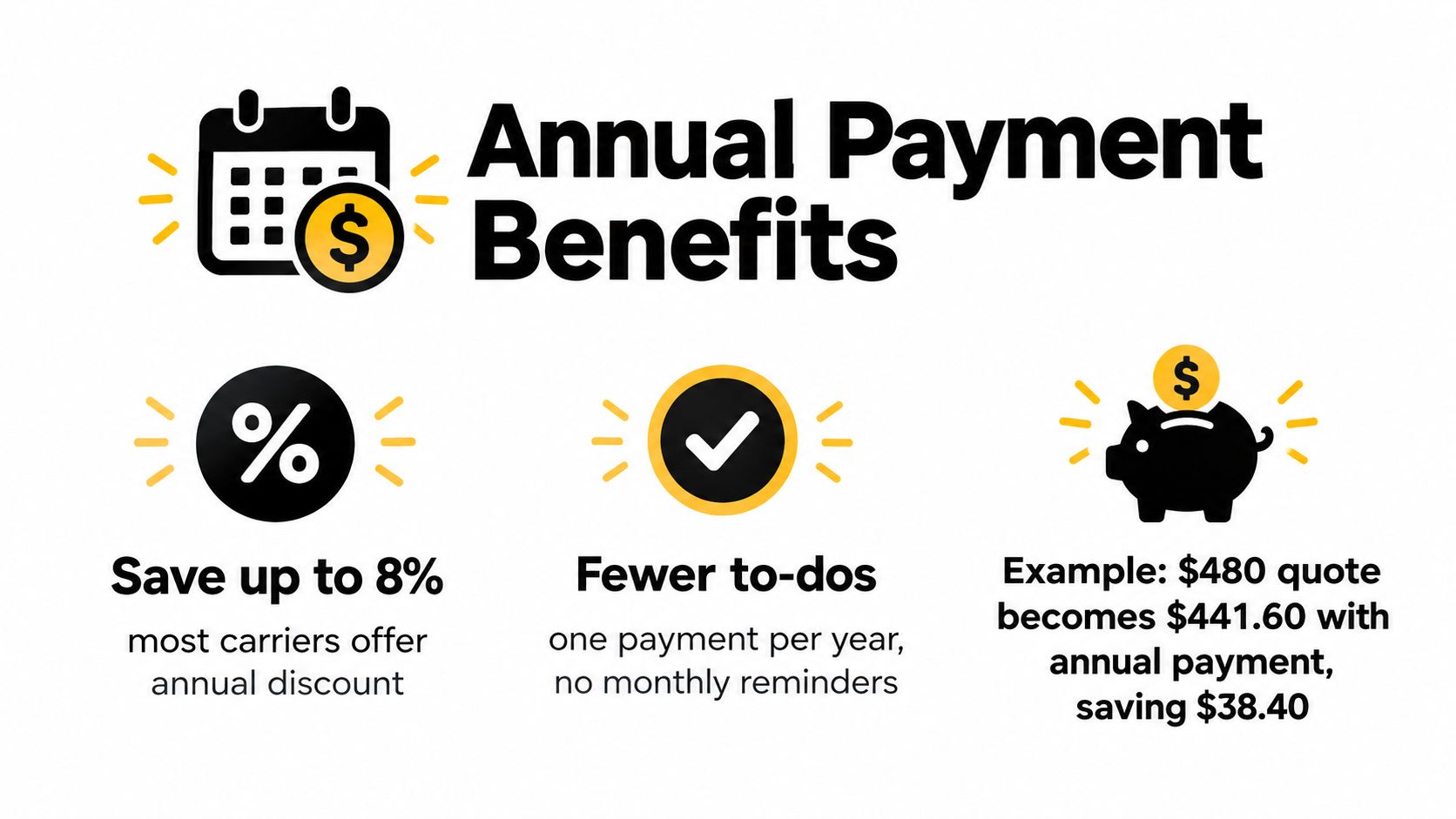
Put the premium into your cash flow on purpose
If a premium is $480 annually, treat it as a $40 monthly line item in your family budget. That framing matters. It stops life insurance from feeling like a random yearly hit and turns it into a standard household cost, like internet or utilities.
You can still pay monthly if that fits better. I'd rather see a policy paid consistently than admired theoretically.
This short video gives a helpful visual overview of the payment decision:
What to check before you assume you're covered
Use this quick activation checklist:
- First premium collected: Coverage usually begins when the policy is bound and payment is taken.
- Delivery confirmed: Make sure you receive the policy documents.
- Free-look period noted: Review the policy during that period, not six months later.
- Payment method set: Direct bill, EFT from checking, or another scheduled method should be confirmed.
Pending is not active. Applied is not active. Approved is not active. Pay the first premium and make sure the policy is in force.
Smart Habits and Common Mistakes to Avoid
A young couple buys a cheap 20-year policy in ten minutes, checks life insurance off the list, and gets back to work. Three years later, they have a second child, higher daycare costs, and one parent cutting back hours. The policy still exists. The plan no longer fits the household budget it was supposed to protect.
That is the mistake I see most often. Buyers treat term life like a one-time product purchase instead of a cash flow decision for the family.
The cheapest quote is only useful if it protects the right bills for the right years. A fast approval is only useful if the policy still works when your income, kids, housing costs, and health change.
Mistake one, shopping by headline premium alone
A low premium can still be a bad buy.
If the coverage amount is too small, the term ends too early, or the conversion option is weak, you did not save money. You bought a policy that leaves your spouse with the same budget problem you were trying to solve in the first place.
Underinsurance is common. As noted earlier, plenty of people own life insurance and still do not have enough of it. That usually happens because they picked a number that sounded affordable instead of starting with the bills their family would face each month.
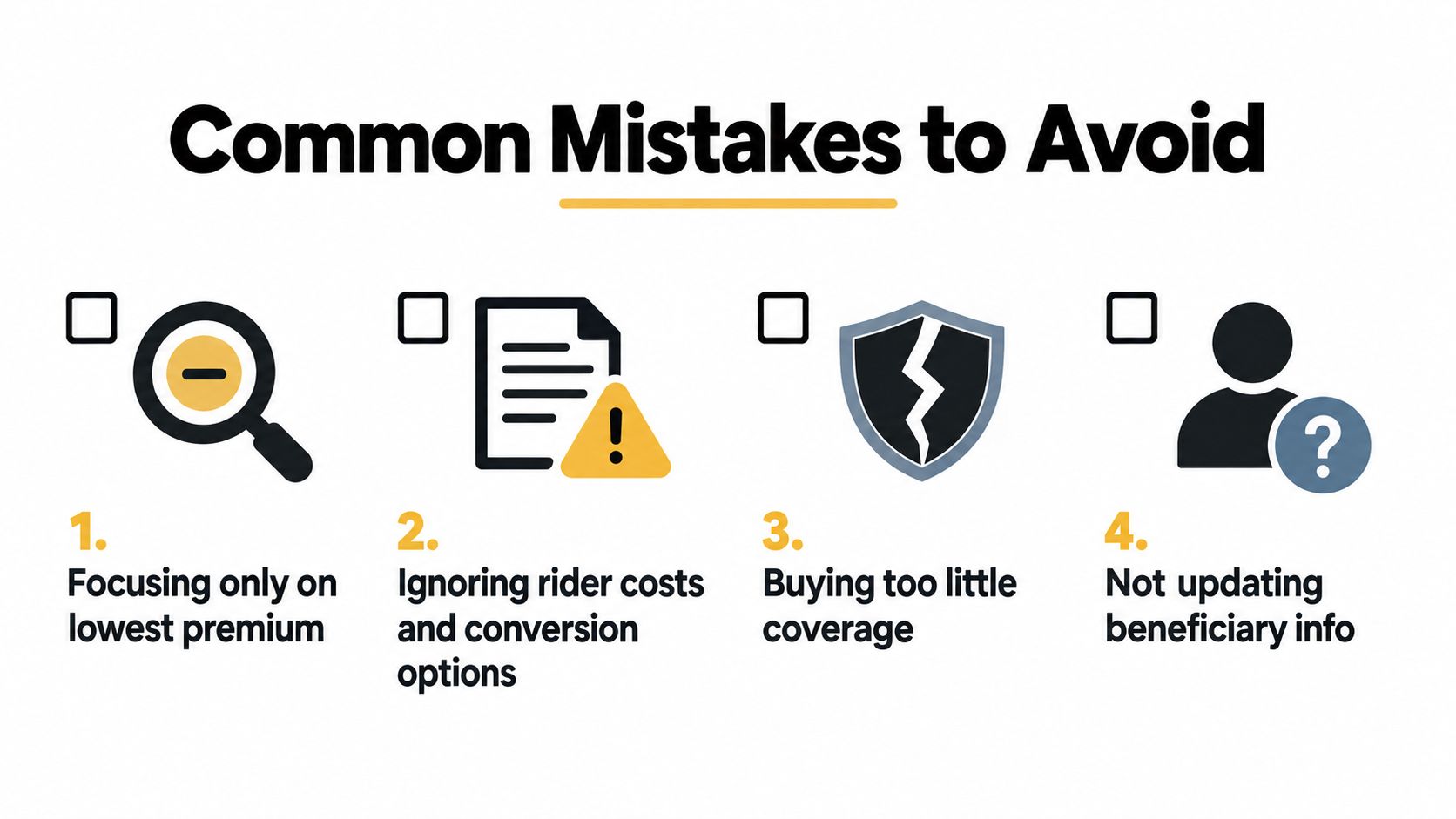
Mistake two, ignoring conversion terms
Convertibility matters more than buyers think.
If your health changes, a policy that allows conversion without new medical underwriting can give you options later. If it does not, you may be stuck buying new coverage at a much higher cost or not qualifying at all.
Ask for the conversion rules in writing. Check the deadline, the products you can convert into, and whether the full face amount is eligible. Do not assume all carriers handle this the same way, because they do not.
Mistake three, covering only the mortgage
A mortgage payoff sounds clean and responsible. It is also incomplete.
Your family does not live on a paid-off house alone. They live on monthly cash flow. Grocery bills keep coming. Childcare often goes up after a death. Retirement contributions usually stop right when the surviving spouse can least afford to lose them.
Start with the budget, not the loan balance. If your household needs income support for twelve years and the mortgage lasts twenty-five, solve for both. If your kids will be financially dependent longer than the house payment lasts, base the term on the kids.
Mistake four, treating the application like admin work
Sloppy applications create expensive problems.
How to buy term life insurance starts with accurate answers, every time. That applies whether you are shopping for no-exam term life insurance, term life insurance for new parents, or life insurance when buying a house. If a medication, diagnosis, tobacco habit, or risky hobby belongs on the application, disclose it.
Read every medical answer like your family will depend on that sentence later. They might.
The pre-sign checklist I'd use in my own house
Before you sign, confirm these five points:
- Coverage matches real household spending. Include income replacement, childcare, debt, and savings goals.
- The term lasts through your longest financial obligation. Usually that is raising children, replacing income, or both.
- Conversion terms are clear. Read the actual policy details, not the sales summary.
- Beneficiaries are correct. Check names, percentages, and backup beneficiaries.
- The issued policy matches the application. Review the final offer the day it arrives.
Do those five things and you avoid the mistakes that cost families the most.
Coveredly offers an online path to shop and apply for term life insurance, including no-exam options for many eligible applicants and coverage designed to fit young families and working professionals. If you want a simpler way to put this advice into action, visit Coveredly and start with a quote that matches your budget, term length, and underwriting lane.