You've just signed a lease with your partner, student-loan payments are arriving, and conversations about starting a family are becoming more practical. Your budget already has rent, groceries, transportation, and emergency savings competing for attention. Life insurance can feel like another bill for a problem that belongs much later.
That assumption can be expensive. Young adults often qualify for lower premiums because age and health strongly influence underwriting, while a policy can protect a partner, children, or anyone who depends on their income. The goal isn't to buy the largest policy available. It's to choose affordable insurance for young adults that fits your responsibilities, budget, and likely life changes.
This guide focuses on the gap between what coverage seems to cost and what a suitable term policy may cost. It also explains how term, whole life, universal life, simplified underwriting, and no-exam applications differ, so you can make a decision without guessing.
Table of Contents
- Introduction with a Realistic Scenario
- Why Young Adults Often Skip Coverage
- Overview of Insurance Types for Young Adults
- Key Premium Drivers and True Cost Examples
- Choosing the Right Coverage Amount
- Concrete Tips to Lower Your Premiums
- How to Compare Quotes and Apply Online
- Common Questions Young Professionals Ask
Introduction with a Realistic Scenario
Maya and Jordan recently married, and their finances now depend partly on two different incomes. Maya earns a steady salary, while Jordan's pay changes from month to month. Rent, student loans, car expenses, wedding bills, and savings all compete for room in the budget. They are also discussing children, which makes one question harder to ignore: how would the household manage if either income stopped?
Neither expects to die young. That expectation makes life insurance easy to delay, especially when they associate it with complicated applications, medical exams, or unaffordable premiums. A short online application may offer a different experience, and some no-exam term policies can provide coverage without a traditional medical exam, although eligibility and pricing still depend on the insurer's review.
Term life insurance works like a temporary financial backstop. It covers a chosen period, and a death benefit could help the surviving spouse replace lost earnings, pay debts, and keep housing stable. If Maya dies, Jordan may face similar costs, including the economic value of unpaid household or caregiving work.
The price may be lower than their first estimate. LIMRA and Life Happens cost-perception findings reported that healthy adults ages 18–30 overestimated the median cost of a $250,000, 20-year level-term policy by about 10–12 times. The actual cost was roughly $192 per year, a useful price anchor when comparing quotes.
Maya and Jordan can start with three questions: who would need money, how much support would they need, and how long would that need last?
Why Young Adults Often Skip Coverage
Young adults frequently delay life insurance because they connect it with old age, children, or substantial wealth. Yet the largest coverage gaps have historically appeared among younger adults. Deloitte summarized LIMRA's findings by reporting that about 102 million American adults, or 40% of the adult population, were uninsured or underinsured, with the largest gaps among the youngest age group and lower-income people. The same analysis estimated a $12 trillion coverage gap. Read the Deloitte analysis of the life insurance coverage gap for that broader context.
The problem isn't only access. It's also price perception. In the 2025 LIMRA and Life Happens research, 37% of Gen Z adults and 46% of Millennials said one main reason they hadn't purchased coverage was that they believed it was too expensive. Those beliefs can prevent people from requesting a quote, even when a modest term policy may fit their budget.

Why waiting changes the decision
Age affects pricing because insurers assess mortality risk over the policy period. Health can also change before you apply. A future diagnosis, medication history, or lifestyle change may make coverage more expensive or reduce the policies available to you.
Young adults also face irregular income, especially in freelance, contract, and gig work. A practical budgeting resource such as Ledgerly's approach to irregular income can help you separate fixed protection costs from variable spending, making a premium easier to evaluate.
Practical rule: Don't ask only whether you can afford life insurance today. Ask whether someone would face a financial crisis if your income or unpaid support disappeared.
Buying early can lock in eligibility while you're healthier, but the policy still needs to match a real obligation. A single person without dependents may need less coverage than a parent with a mortgage. The smart move is to price protection before a crisis creates urgency.
Overview of Insurance Types for Young Adults
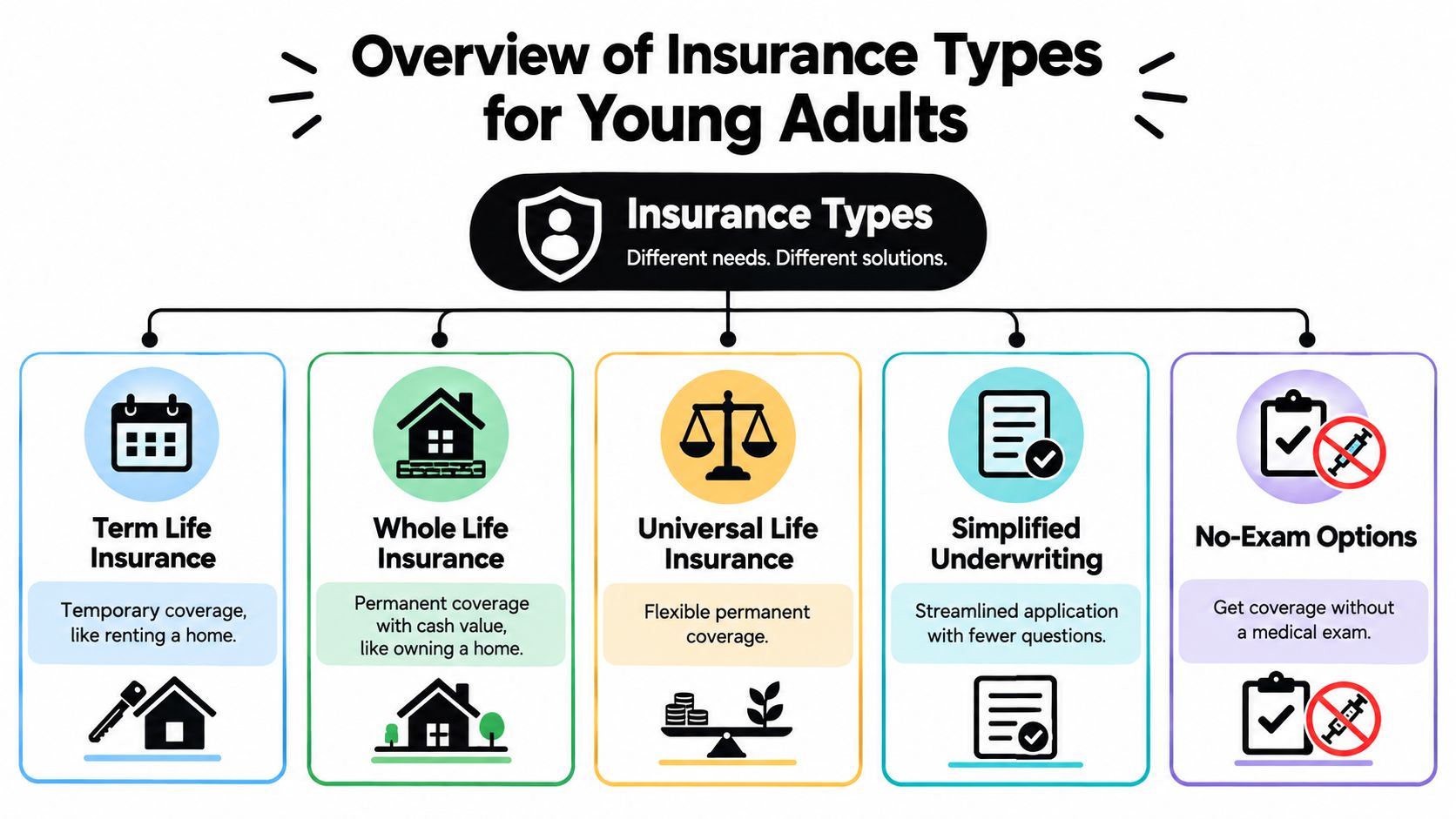
Life insurance policies solve different problems. The easiest way to compare them is to think about what you're paying for: temporary protection, permanent protection, flexibility, or a simpler application.
Term life insurance
Term life insurance provides coverage for a selected period, such as the years when children are dependent, a mortgage is outstanding, or a partner relies on your income. The renting analogy is useful: you pay for protection during a defined period, rather than building ownership value inside the policy.
Level-term coverage generally keeps the death benefit and scheduled premium level during the term. That predictability makes it easier to place the premium in a young adult's monthly budget. A policy can also be large enough to replace income and cover major obligations without requiring permanent coverage.
For a budget-conscious applicant, term life insurance for young adults is often the first structure to compare because it focuses the premium on the death benefit.
Whole life insurance
Whole life insurance is permanent coverage designed to remain in force as long as required premiums are paid. It's more like buying a home than renting one. The policy may build cash value, and its permanent structure can support estate or legacy planning.
That permanence comes with a more complex cost structure. A young adult who mainly needs income protection through working years may pay for features that don't match the immediate goal. Whole life can make sense in specific financial plans, but it shouldn't be treated as the automatic upgrade from term insurance.
Universal life insurance
Universal life insurance is also permanent, but it generally offers more flexibility around premiums and death-benefit design. That flexibility requires ongoing attention. Policy performance, funding, charges, and assumptions can affect whether the coverage remains sustainable.
Someone considering universal life should understand how the policy behaves under different funding choices. “Flexible” doesn't mean risk-free or simpler.
Simplified underwriting and no-exam options
Simplified underwriting uses an efficient application with fewer questions than a traditional fully underwritten process. No-exam term insurance may let eligible applicants obtain coverage without a medical exam, although insurers can still use application answers, health information, age, and coverage amount to assess risk.
The Society of Actuaries reported a combined term-insurance lapse rate of about 10.2% on a policy basis across all policy years. That persistency evidence helps explain why insurers design acquisition and underwriting systems around applicant characteristics and policy behavior. Review the Society of Actuaries persistency report for the cited lapse finding.
For many young adults, term coverage with simplified or no-exam underwriting offers a practical balance: a defined protection period, a clear death benefit, and less application friction.
Key Premium Drivers and True Cost Examples
Premiums reflect the insurer's assessment of risk and the amount of protection you request. Age, health, smoking status, coverage amount, term length, and underwriting details can all affect the quote.
Age is especially important because delaying an application can move you into a more expensive pricing category. One comparison lists a healthy 30-year-old male at around $28 per month for $500,000 of 20-year term coverage, while a healthy 50-year-old male is listed at about $76.50 per month for the same structure. The comparison comes from Insurance Geek's term-life rate examples.
| Age | Male $/mo | Female $/mo |
|---|---|---|
| 30 | $28 | $24 |
| 50 | $76.50 | Not provided |
The female example for the same $500,000, 20-year structure is about $24 per month at age 30. The source doesn't provide a corresponding female figure for age 50, so it shouldn't be inferred.
What changes your quote
- Health: Medical history, current conditions, medications, and overall health can affect underwriting.
- Lifestyle: Smoking and certain high-risk activities may increase the premium.
- Coverage amount: A larger death benefit generally requires a higher premium.
- Term length: A longer protection period can cost more, but it may prevent you from reapplying when older.
- Application method: Simplified or no-exam underwriting can reduce friction, though eligibility and pricing depend on the insurer.
Before applying, decide whether your priority is the lowest initial premium, a longer rate lock, or the least disruptive application process. A clear comparison of life insurance cost per month can help you evaluate quotes using the same coverage amount and term.
Choosing the Right Coverage Amount
A policy amount should match the financial job the death benefit must handle. Begin with income replacement. Add debts, future responsibilities, and final expenses where they apply, then subtract assets survivors could realistically use. Keep funds reserved for another purpose out of that calculation.

Match the policy to your life stage
A single professional with no dependents might start by considering 10–12 times income. Student loans, private debts, or relatives receiving financial support can raise that starting point. The range is a planning guide, not an underwriting requirement.
A newly married couple might consider 7 times income plus debts, particularly if one partner earns much more or provides significant unpaid household support. Calculate each person's need separately. Equal policies may be unnecessary when income, debts, and responsibilities differ.
Young parents should account for childcare, housing, education goals, and the years before their children become financially independent. Estimate the cost of replacing the deceased parent's income and services, then add a defined amount for childcare and other parental duties. A rule of thumb can begin the discussion, but it should not replace the household's own numbers.
Use an example, not a guess
A solo renter with modest debts may need a smaller policy for debt repayment and short-term transition costs. A dual-income couple sharing a home may need enough coverage to keep the surviving partner from selling it or cutting essential spending. A new parent may need a larger death benefit because income replacement and childcare can continue for many years.
Cost assumptions can also distort the decision. As noted earlier, healthy adults ages 18–30 estimated a $250,000, 20-year term policy at about 10–12 times the actual amount. The reported true cost was roughly $192 per year, showing why a real quote is more useful than a guess. Compare the amount, term, and application requirements together, then choose coverage that protects the specific people and obligations your policy would leave behind.
Concrete Tips to Lower Your Premiums
Use this checklist before requesting quotes. Each tactic works differently, and some require a trade-off between price, convenience, and long-term protection.
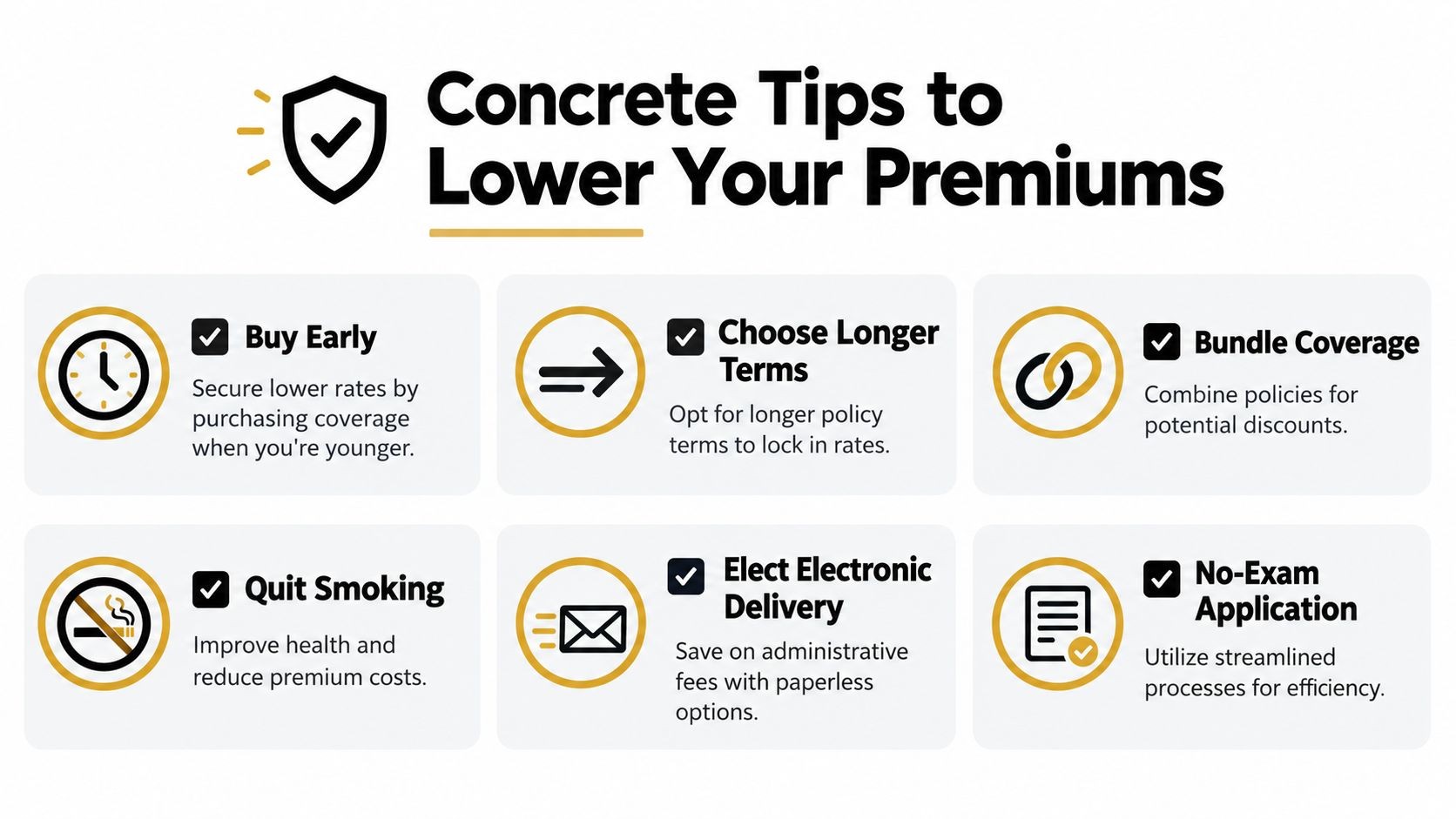
- Buy early: Applying while you're younger and healthier can help you qualify for lower rates and preserve insurability before health changes.
- Choose a suitable longer term: A longer term may cost more initially, but it can lock in protection before you're older and avoid a new application later. Don't choose a term that ends before the obligation you're protecting.
- Compare separate and coordinated coverage: Partners should compare whether separate policies provide better flexibility than relying on one shared arrangement. Bundling may be available, but the actual value depends on the insurer and policy design.
- Quit smoking: Tobacco use can affect underwriting. If your health profile changes, ask how the insurer treats that change rather than assuming an automatic repricing.
- Elect electronic delivery: Paperless documents can simplify administration. Ask whether the insurer attaches any fee or discount to electronic delivery.
- Consider a no-exam application: A no-exam route can reduce scheduling and medical-visit friction. It may be especially useful when a straightforward application fits the insurer's eligibility rules, but it isn't guaranteed for every applicant.
Application habit: Answer health and lifestyle questions accurately. A cheaper-looking application isn't useful if incomplete information creates a claim problem later.
Don't lower the premium by cutting the death benefit below the amount your household needs. Reduce unnecessary policy complexity first, then compare term length, face amount, and underwriting routes side by side.
How to Compare Quotes and Apply Online
Online applications are easiest to evaluate when you control the variables. Start with one coverage amount and one term length, then compare alternatives. Otherwise, a lower quote may represent less protection or a shorter period.
A practical quote workflow
- Gather accurate details: Prepare your age, state, occupation, income, health history, medications, tobacco status, and intended beneficiaries. The insurer uses these answers to assess eligibility and pricing.
- Set the financial target: Decide the face amount and term before focusing on the monthly premium. Use your income, debts, dependents, and household responsibilities.
- Compare equivalent policies: Review the death benefit, premium structure, term length, exclusions, conversion options, and renewal provisions. Put the differences in writing.
- Filter for application friction: Check whether each insurer offers simplified underwriting or a no-exam path. An efficient process can save time, but eligibility depends on the answers and coverage requested.
- Review the quote carefully: Confirm that the displayed premium matches the selected amount and term. Look for temporary introductory pricing or rates that change later.
- Complete the application and e-signature: Digital forms can reduce paperwork and let you submit information from home. Be ready for follow-up questions if the insurer needs clarification.
A platform such as instant online life insurance quotes can help you begin the comparison digitally. Treat the first result as a starting point, not a final recommendation.
Approval timing varies by insurer, applicant, and underwriting outcome. Some applicants may receive a rapid digital decision, while others need additional records or review. Don't cancel existing coverage until the new policy is issued, accepted, and active according to its contract.
Common Questions Young Professionals Ask
Can I qualify with minor health issues?
Possibly. Minor health concerns don't automatically prevent approval, but the insurer may ask about diagnosis, treatment, medications, and recent changes. Answer fully and compare insurers rather than self-rejecting.
What happens if I outgrow my policy?
You can review coverage before the term ends. Depending on the contract, you may be able to convert to permanent insurance or apply for new term coverage, but a new application may reflect your age and health at that time.
Is coverage portable if I change jobs?
An individually owned policy generally isn't tied to an employer, unlike many workplace benefits. Confirm ownership, beneficiary rights, premium responsibility, and portability in the policy documents.
How long does a no-exam application take?
Some eligible applicants receive a quick decision, while others face follow-up questions or additional underwriting. “No exam” means no scheduled medical exam in the relevant application path, not guaranteed approval or instant acceptance.
Coveredly offers digital term life insurance applications, including no-exam options for many eligible applicants, so you can compare protection around your income, debts, and family responsibilities. Visit Coveredly to review an online quote path and take the first concrete step toward affordable coverage.