You're holding a newborn, checking a mortgage payment, and realizing the group life insurance at work won't come close to covering the bills if something happens to you. That's where the search for an affordable life insurance company usually starts, not with a spreadsheet, but with a practical worry about rent, childcare, debt, and who would keep things stable.
The good news is that life insurance doesn't have to feel out of reach. For many young families and working professionals, the challenge isn't finding coverage. It's separating genuine affordability from the common assumption that protection must be complicated, expensive, or tied to a long medical exam.
Table of Contents
- Affordable Life Insurance for Modern Families
- What Makes a Life Insurance Company Affordable
- Key Price Drivers Behind Your Premium
- How to Compare Affordable Life Insurance Companies
- Why Digital Insurers Like Coveredly Cost Less
- Your Checklist and Application Path
- Making the Right Choice for Your Family
Affordable Life Insurance for Modern Families
A couple with a new baby may glance at employer coverage and assume the family is protected. Then the numbers get clearer, and the policy through work starts to look more like a starter layer than full coverage. That is often the moment the phrase affordable life insurance company stops sounding optional and starts sounding practical.
The first surprise is usually the price
Many people expect life insurance to cost like a major household bill. For term coverage, the first quote is often much lower than families assume, especially for younger applicants and shorter policy periods. Industry commentary cites an average representative term policy around $20 per month for a 10-year, $500,000 policy for a healthy 40-year-old male, and sample pricing comparisons show term coverage as low as $28.03 per month for men and $23.78 for women in certain examples from The Zebra's life insurance statistics overview.
That does not mean every quote will be cheap. It does mean many families begin with the wrong price anchor.
Practical rule: If life insurance feels unaffordable before you have compared term length and underwriting method, you may be judging the wrong policy design.
Why young families feel stuck
The pressure is usually not only cost. It is uncertainty. Parents want enough coverage to replace income, keep the mortgage manageable, and protect a partner who is already stretched thin. Newly married couples face the same tension, especially when one income carries most of the household budget.
Term coverage protects a family for a specific window of time, while permanent policies include long-term savings features and are built for a different purpose. That difference matters because it helps explain why many families can get the protection they need now without paying for benefits they do not need yet.
The search gets easier when the question changes. Instead of asking, “Can I afford life insurance?” ask, “What kind of coverage fits my stage of life?” That shift turns affordability into a practical decision, not a guess.
What Makes a Life Insurance Company Affordable
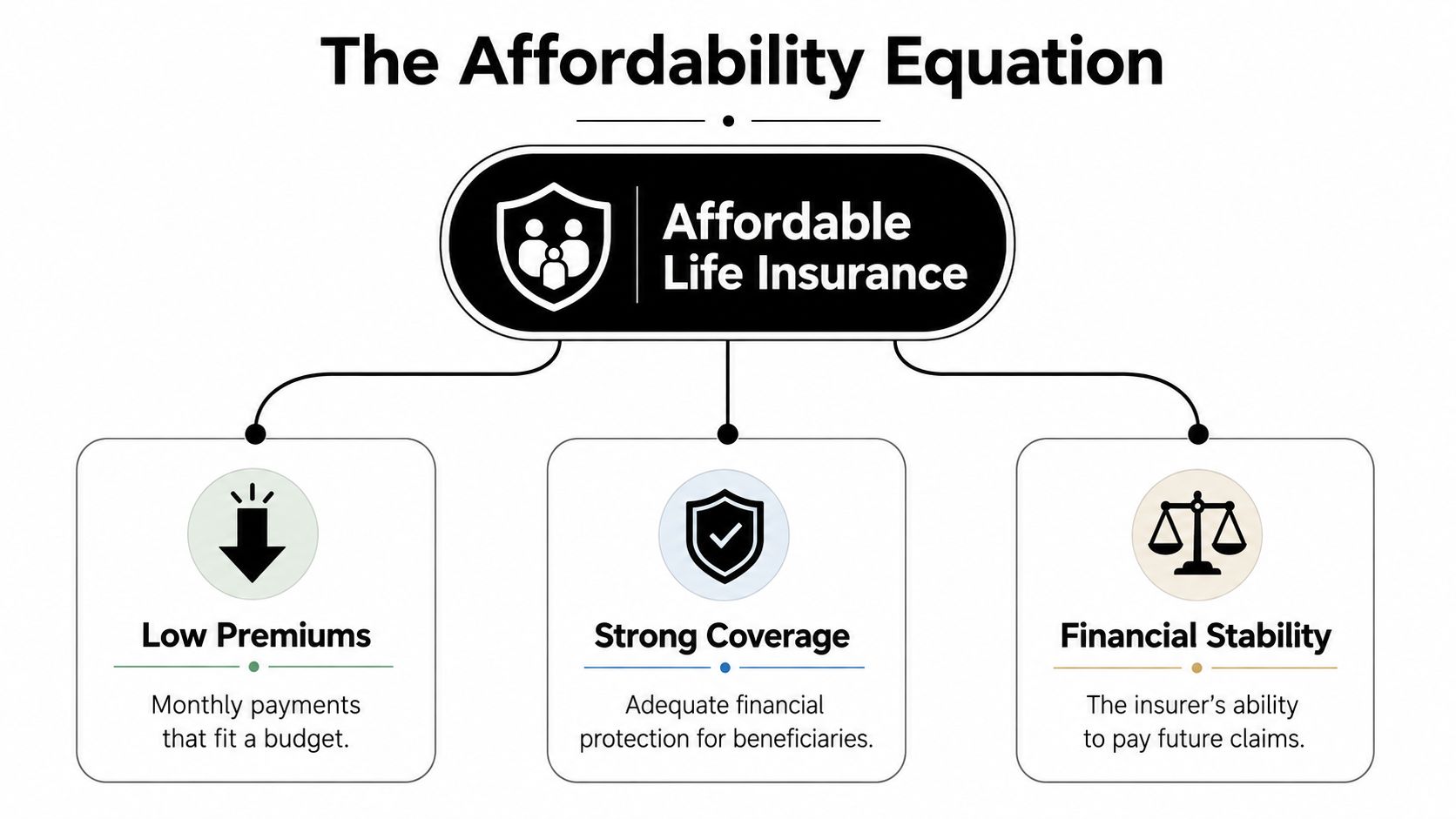
A life insurance quote can look low at first glance and still leave a family with the wrong kind of protection. Affordability is about more than the number on the screen. It depends on whether the premium fits the household budget, whether the coverage solves the family's need, and whether the insurer is built to pay claims over time. A true affordable life insurance company keeps those three parts in balance.
Cheap and affordable are not the same thing
The most common misunderstanding is simple. A lower premium does not automatically make a policy the better choice. Survey results show many people hesitate because life insurance feels expensive, and many also prefer a policy that does not require a medical exam, which points to two separate concerns, cost and friction. The price matters, but the application process matters too.
A quote feels affordable when it works like a well-fitted coat, not a bargain-size jacket. It has to cover the family, fit the monthly budget, and come from a company that can stand behind the policy when it counts. If one of those pieces is missing, the policy may look inexpensive without really serving the household.
For younger families, that distinction matters even more. A term policy can often keep the monthly payment lower because it is built for temporary protection, not lifelong savings. That is why families comparing options should also look at how the policy is structured and how the company underwrites it. A simpler process can reduce hassle and cost, especially when a carrier uses digital underwriting for life insurance instead of sending every applicant through a slower, more manual path.
Why the market can price term coverage lower
The U.S. life insurance market is large, and that scale helps explain why term coverage can be priced more efficiently. The American Council of Life Insurers fact book shows that life insurers hold enormous amounts of coverage in force and write substantial premium volume each year. A market that big can spread risk across many policyholders, which helps support more predictable pricing.
That structure matters for term life. The product is focused on protection for a set period, not on building cash value. When a policy is designed around pure coverage, the insurer is not layering in the extra features that push the cost upward. For many families, that makes term coverage feel more like buying the right tool for one job, instead of paying for a multi-tool when a screwdriver would do.
A useful filter for buyers
The best way to judge an affordable company is to ask what creates the lower premium. Is it a clean policy design, straightforward underwriting, and clear terms, or is it a stripped-down offer that leaves too much out? That question helps families avoid confusing “cheap” with “good value.”
It also helps non-traditional households, like unmarried partners, blended families, and families with one primary earner and one caregiver, choose coverage with more confidence. The right policy should match who depends on the income, how long they need the protection, and how much monthly room the budget really has. When those pieces line up, affordability becomes easier to see, and easier to trust.
Key Price Drivers Behind Your Premium
Life insurance pricing is a lot like airfare. Two people can search the same route and see very different totals, because timing, flexibility, and seat type all change the final number. The same thing happens with term life coverage, especially when age and coverage amount move together.
Age and term length drive the base price
For standardized term coverage, younger buyers usually pay less because the insurer expects less mortality risk over the policy term. In the provided pricing examples, a healthy 25-year-old can see term life rates around $22 per month for a 20-year, $500,000 policy, while the same source shows average monthly cost rising to $47 for a 45-year-old woman and $60.79 for a 45-year-old man from Insurance.com's affordable life insurance pricing examples.
| Term Life Rates by Age and Gender | Male | Female |
|---|---|---|
| Age 25 | $22 per month | $22 per month in the provided example set |
| Age 45 | $60.79 per month | $47 per month |
The pattern is the point. The older the applicant, the higher the quote tends to be. A longer term can also raise the premium because the insurer is promising protection for more years.
Coverage amount changes what “affordable” means
A policy only feels cheap if the benefit amount still makes sense. A smaller benefit can lower the monthly bill, but it may leave the household underinsured. A larger benefit gives more protection, but it can push the quote beyond what the family can sustain.
A good budget target is the one you can keep paying without stress for the full term you choose.
Health, underwriting, and friction matter too
Health information, age, and underwriting method all shape the final premium. That's why one person may qualify quickly while another needs more review. For readers trying to understand how underwriting changes quotes, the basic logic is outlined in Coveredly's underwriting guide, which is useful as a reference point for how digital review can affect the buying process.
Term structure matters because it helps families match cost to a real-life window. Think mortgage years, childcare years, or the stretch before kids are financially independent. If you can line up term length with that window, the policy often feels much more manageable.
How to Compare Affordable Life Insurance Companies
Comparing insurers works best when you look beyond the first price you see. A low monthly quote can hide limited flexibility, slower service, or underwriting that's more frustrating than it needs to be. The goal is to compare coverage design, policy features, and buying experience together.

Use the same yardstick for every quote
Start with the same coverage amount, the same term length, and the same applicant details. If one quote is for a different term or a different health profile, it doesn't tell you much. That's where many shoppers get confused and think one company is cheaper when they're really comparing different products.
No-exam underwriting also changes the comparison. Forbes notes that no-exam life insurance policies can be available for amounts up to $3 million for healthy applicants under 60 in its cheap life insurance guide. That matters because skipping the exam doesn't automatically mean tiny coverage. For many healthy buyers, the better question is how much coverage they can get without slowing down the process.
Look at riders, service, and payout discipline
A quote should be read like a menu, not a headline. Ask which riders are available, how the insurer handles beneficiary claims, and whether the company's service model matches your preference. Some families want human support. Others want a fast digital path and simple policy management.
The right comparison is usually more personal than mathematical. A slightly higher premium can be worth it if the application is easier, the policy is more flexible, and the contract is clearer. If you're comparing term quotes side by side, this rate comparison resource can help you stay focused on the same inputs.
Watch for the real warning signs
- Quotes that skip too much context: A low number without term length, benefit size, or underwriting detail is hard to trust.
- Policies that feel hard to understand: If the contract language is dense, the cost can be hidden in confusion.
- Service that doesn't fit your life: Families with tight schedules often value a faster digital process more than a small difference in premium.
Later in the buying process, the question becomes simple. Does the company make it easier to get a policy that fits your family, or does it just advertise a cheap starting point?
The comparison video below can be useful if you want a visual way to think about premiums, riders, and evaluation criteria.
Why Digital Insurers Like Coveredly Cost Less
A low quote can feel surprising at first, especially if you assume the price must include a lot of hand-holding, office overhead, and long review cycles. Digital life insurers often come in cheaper because they trim the costs that sit behind the scenes, while still keeping the protection itself intact. A direct-to-consumer model can compress those expenses and let more of the savings show up in the premium.
Lower overhead changes what the buyer pays
The main idea is simple. Every extra step in distribution, every manual handoff, and every layer of servicing adds cost somewhere, and that cost usually ends up inside the price a family sees. Publicly filed life-insurance financials show that for one major insurer, premium and policy charges were about $3.26 billion and the insurance underwriting margin was about 41% of premium and charges in 2024, from the SEC filing for insurer financials. That filing shows why expense control matters so much. If a company can keep its operating costs in check, it has more room to offer coverage at a friendlier price.
Digital underwriting helps because it reduces friction during the application and review process. E-applications, cleaner data capture, and automated decisioning can lower acquisition and servicing costs without changing the basic promise of the policy. The insurer still has to choose risks carefully. The difference is that the policy is handled with less manual work.
Simpler processes help families move faster
Families with kids usually do not want an insurance project that drags on. They want to understand the coverage, answer the questions, and move on with their day. When underwriting happens online, the experience can feel closer to opening a bank account than sorting through a stack of paper forms.
That lower effort matters because confusion often gets mistaken for value. A policy that is hard to apply for, or hard to manage later, can feel more expensive than it looks on paper. A smoother process gives families a clearer path from quote to coverage, and that can be especially helpful for parents who are already balancing school, work, and childcare.
Practical rule: If a company makes the application easier without making the coverage weaker, that convenience can translate into real monthly savings.
Flexible digital coverage can still be substantial
A lot of buyers still assume digital or no-exam coverage has to mean a small benefit. That assumption is easy to make because older insurance models often came with more paperwork, more delays, and more limited options. But digital-first underwriting can still support meaningful coverage, even for applicants who do not want a medical exam. That matters for young families, because speed and clarity often matter as much as the quote itself.
A screenshot of the digital experience makes the point visually.

For buyers comparing options, a company like Coveredly is relevant because the model is built around online life insurance, flexible term coverage, and fewer unnecessary steps. That kind of setup can fit the way many families shop. It also helps parents, blended households, and other non-traditional family structures compare coverage without having to sort through a process designed around an older, more paperwork-heavy approach.
Your Checklist and Application Path
The easiest way to buy affordable life insurance is to work in order. Start with the need, then the quote, then the application. If you reverse that sequence, you can end up chasing a cheap number that doesn't fit your family.
Step 1, define the amount you actually need
Think about the bills your family would have to carry if your income disappeared. That usually includes the mortgage or rent, childcare, debt, and a little room for final expenses. The point isn't to guess the perfect number. It's to avoid buying too little because the monthly premium looked friendly.
A simple test helps. If your partner had to absorb the loss alone, what obligations would feel impossible to keep? That answer gives you a starting coverage target.
Step 2, choose the term around a real milestone
Many families choose a term that lines up with the years they're most financially exposed. That might be until the mortgage shrinks, until the youngest child is independent, or until a business becomes stable enough to stand on its own. The cleaner the milestone, the easier it is to avoid overpaying for extra years you may not need.
Step 3, gather the basics before you quote
- Identity details: Name, date of birth, and contact information.
- Health and lifestyle facts: Be accurate about your medical history, medications, and tobacco use.
- Coverage goals: Decide the benefit amount and term length before you compare companies.
- Beneficiary choices: Know who you want to protect and how the benefit should be directed.
Step 4, compare at least three quotes on the same terms
Use the exact same age, coverage amount, and term length for every quote. Then compare more than price. Look at rider availability, underwriting speed, and how clear the contract feels when you read it.
If two policies cost about the same, the one with the clearer application and cleaner terms is usually the better everyday fit.
Step 5, complete the e-application carefully
Answer every question truthfully and consistently. Small mismatches between your application and your medical or financial details can slow underwriting. Digital applications move fastest when your information is clean from the start.
Step 6, review the approval against your budget
Once you get an offer, check whether the premium still fits your monthly life. A policy is only affordable if you can keep paying it comfortably. The right decision is the one you'll still feel good about a year from now, not just the one that looked cheapest in the first five minutes.
Making the Right Choice for Your Family
The best affordable policy isn't always the cheapest one. It's the one that fits your life stage, your income, and the people who rely on you. That matters even more for households that don't fit the old insurance mold, including women, LGBTQ+ customers, disabled customers, and families with non-standard income patterns, since access can still be uneven in traditional channels, as noted in Swiss Re's discussion of underserved Americans.
That's why affordability and accessibility belong together. A family can't use a cheap policy if it's hard to apply for, hard to understand, or hard to keep in force. If you want another practical comparison point outside insurance, this guide on compare costs with Ocodile shows how families often evaluate value by balancing price, fit, and long-term usefulness.
The simplest decision path is still the strongest one. Define what you need, compare term quotes on equal terms, and choose the company that gives you clarity without extra friction.
If you're ready to look at a policy that fits the way you live, visit Coveredly. Coveredly offers online life insurance built for young families, newly married couples, and professionals who want flexible term coverage without unnecessary hassle.