
You're probably here because you saw child rider life insurance on an application and paused. The premium looked small, the wording felt technical, and the question was simple, does this little add-on deserve a place in a family budget that's already stretched by diapers, daycare, and everything else that shows up after a baby arrives?
For many parents, the child rider is one of those insurance terms that sounds more serious than it is. It's usually a small, temporary financial tool, not a full policy for a child, and that distinction matters. If you misunderstand it, you can either buy something you don't need or skip something that would've given you a useful layer of protection.
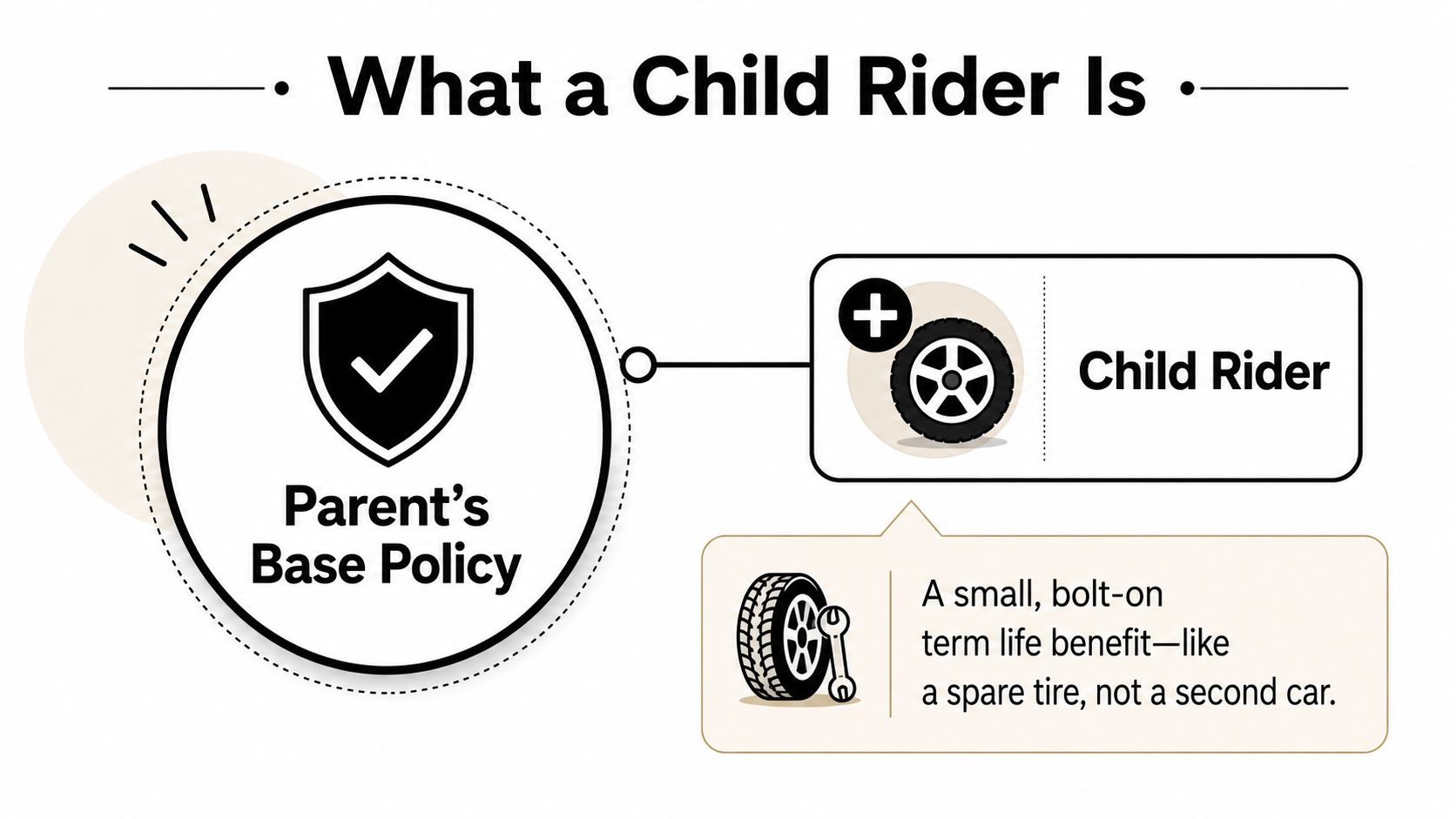
Table of Contents
- Why Parents See a Child Rider on Their Application
- What a Child Rider Actually Is
- Coverage Amounts, Age Limits, and What It Costs
- Rider vs Separate Policy vs Other Alternatives
- Two Real Scenarios to Make the Numbers Concrete
- How to Add a Rider to Your Existing Policy
- Putting the Rider in Your Bigger Family Plan
Why Parents See a Child Rider on Their Application
A young couple sits at the kitchen table with a laptop open, trying to finish a life insurance application before bedtime. They've already answered the hard questions about income, debts, and the mortgage, then they hit a page full of optional add-ons. One line says child rider, and the price is low enough to make them wonder if they're missing something obvious.
That moment is common because the rider sits in a strange place. It's not the main event, but it isn't meaningless either. Policy pages often make it look like a tiny checkbox, even though it's really a decision about whether you want a small layer of protection attached to the parent's policy. Coveredly's family life insurance guidance for new parents fits that same practical mindset, start with the family's real needs, then decide what belongs in the policy.
Practical rule: if an add-on feels cheap enough to ignore, read the terms anyway. Low cost doesn't always mean low value, and it doesn't always mean a good fit either.
The reason this line item deserves attention is simple. A child rider is built to cover a specific emotional and financial gap, the kind that shows up when a family wants help with immediate costs, but doesn't want to buy a separate policy for every child. That's why it appears so often in family applications, especially for people who are already thinking about how to keep life insurance manageable.
The confusion usually comes from expecting the rider to behave like a full policy. It doesn't. It's a small, attached benefit, and the trade-off is deliberate. Once you understand that, the rest of the decision gets much easier.
What a Child Rider Actually Is
A child rider life insurance benefit is best understood as a bolt-on term benefit attached to a parent's base policy. Think of it like a spare tire bolted into the family car, useful, compact, and there when you need it, but not a second vehicle. Colonial Penn describes the structure the same way, a low-face-amount term benefit riding on the parent's policy, with one rider often covering all eligible children under a single premium. That guide also notes that the design keeps administration simple and usually avoids separate medical exams for each child.
The parent's policy is the foundation. The rider is just an attached layer. That matters because the rider is not usually underwritten like a standalone child policy, it's pooled under the parent's contract. The practical effect is simpler paperwork and fewer moving parts, which is one reason families like it.
The rider is usually a temporary liquidity tool, not a wealth-transfer tool.
How the structure works
The basic idea is straightforward.
- Parent policy first: the parent owns the main policy.
- Rider second: the child rider gets added as an extra feature.
- One rider, multiple children: one rider often covers current and future eligible children in the household.
- No separate child exam in most cases: the child usually doesn't go through the kind of underwriting a separate policy would require.
That last point is the biggest conceptual difference. A separate child policy would stand on its own. A rider doesn't. It depends on the parent's policy, which is why the parent's coverage should always come first in the family plan.
If you're comparing policy language, the phrase to watch for is conversion privilege. That's the option to turn the rider into a permanent policy later, usually without starting over with child-level underwriting. Coveredly's overview of life insurance riders is useful if you want to understand how this feature fits into the wider rider category.
And if you're weighing the child's immediate needs against the family's overall protection picture, a helpful outside comparison is compare top in-home pediatric nurses, which can give you a sense of how families think about short-term care needs alongside long-term planning.
Coverage Amounts, Age Limits, and What It Costs
The appeal of a child rider is in the numbers. The face amount is intentionally modest, usually about $5,000 to $25,000 per child, according to major-market guidance from Policygenius, Forbes Advisor, Colonial Penn, and Aflac. Policygenius also describes a common pricing example where a $10,000 child rider costs about $4.20 per month, or roughly $50 per year, and notes that broader pricing is often estimated at $5 to $7 per $1,000 of coverage per year.
That price structure tells you what the product is designed to do. It's there for temporary protection and immediate expenses, not to replace a long stream of income. If a family wanted meaningful independent coverage for a child's adult life, this wouldn't be the right tool. The small amount is the point.
Age rules and timing
Age windows are also fairly standardized. Policygenius says eligibility commonly starts at 15 days to 18 years old, and coverage can last until age 25, age 65, or age 75, depending on the insurer. Aflac says many policies cover children from 15 days old to 18 years old and stay in force until the child's 25th birthday or the policyholder's 65th birthday, whichever comes first. Forbes Advisor adds that some policies run until about 22 to 25 years old, or until marriage in some cases.
The feature many parents overlook
The most underappreciated part is the conversion option. Several of the cited guides say the rider can often be converted later into permanent insurance without new underwriting. That matters because the child's health, habits, and circumstances can change over time, and the conversion right can preserve access to coverage without starting from scratch.
Good fit, not perfect fit: the rider makes sense when you want low-cost final-expense protection now, plus a possible path to future coverage later.
The age rules, the limited face amount, and the low premium all point in the same direction. This is a narrow tool with a narrow job, and that's what makes it useful.
Rider vs Separate Policy vs Other Alternatives
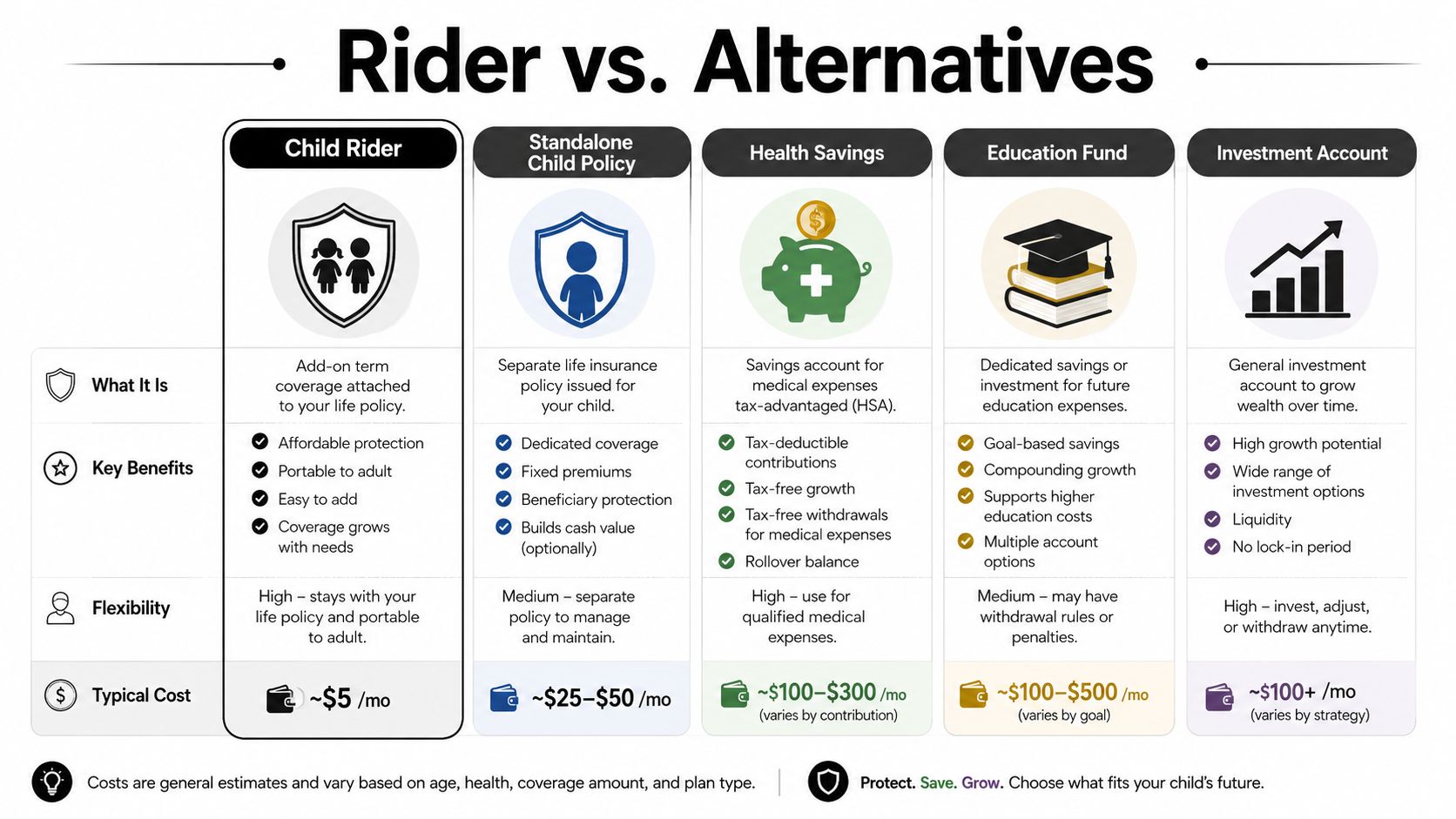
Parents usually compare a child rider against a handful of practical options, not against abstract theory. The core question is which tool matches the job in front of them. If you line up the choices, the trade-offs become much easier to see.
| Option | What it does best | What it's best for |
|---|---|---|
| Child rider | Low-cost, attached coverage with a possible future conversion path | Families who want modest final-expense protection and simple administration |
| Standalone child policy | Separate coverage that can stand on its own | Families who want the child to own meaningful coverage into adulthood |
| Parent-only term life | Focuses dollars on the person whose income supports the household | Families deciding where the real insurance priority belongs |
| Dedicated savings vehicle | Keeps money available for future goals or flexibility | Families who'd rather self-fund than insure every small risk |
| Doing nothing | Costs nothing today | Families with enough savings and a clear comfort level with that choice |
A child rider usually costs less than a separate child policy because it's attached to the parent's contract and built around limited, temporary coverage. A standalone child policy costs more because it stands alone and is designed for broader use. That doesn't make one “better” in every case, it just means they solve different problems.
The parent-only term policy deserves a separate thought. Texas consumer guidance reminds families that life insurance is most useful when others depend on your income, and that coverage decisions should start with debts, income replacement, and the bills a family would still face. The Texas Department of Insurance consumer guide makes that order of operations very clear. If the parent's coverage is thin, that's usually the first place to fix.
A dedicated savings account or education fund can also play a role, but savings are not insurance. They can cover expenses if money is available, yet they don't create a payout at the exact moment a family needs one. Doing nothing is a legitimate choice too, especially when a family already has enough cash to absorb a small shock without changing its broader plan.
The clean decision rule is this. A child rider fits when you want small, inexpensive final-expense protection and you value the chance to convert later. A separate child policy fits when you want coverage that can travel into adulthood as its own policy. Everything else is about whether you'd rather reserve your dollars for savings, the parent's coverage, or no extra coverage at all.
Two Real Scenarios to Make the Numbers Concrete
A rider makes more sense when you can see how it behaves in real life. The same product can look generous for one family and barely relevant for another, depending on the child's age and what you're trying to protect.
Newborn at 30 days old
A family adds a $10,000 child rider when their baby is 30 days old. Using the Policygenius pricing example, that rider would cost about $4.20 per month, or roughly $50 per year. If the family ever had to use it for funeral or burial costs, the payout would be the rider's face amount, not an open-ended sum.
At this age, the rider has a long runway before it expires under many policies. That matters because the conversion privilege, if available, would give the child a possible path to permanent coverage later without new underwriting. For parents who want a tiny layer of protection now and a future option later, the product feels most natural in this scenario.
Teenager at 16 years old
Now shift the same rider to a child who's already 16. The coverage window is much shorter, because many policies stop the rider around 22 to 25 years old, or at another contract age depending on the insurer. The premium might still be low, but the time left to use the rider is noticeably shorter.
In this case, the conversion privilege matters more. The rider is no longer just about short-term protection, it becomes a bridge to whatever the child may want once they're an adult. That's useful if the family wants to lock in an option before health or life changes make the future less predictable.
Rule of thumb: the younger the child, the more the rider acts like a small temporary cushion. The older the child, the more it starts to resemble a limited bridge to future coverage.
The takeaway is simple. A newborn can make a rider feel like a small, budget-friendly safeguard. A teenager can make the same rider feel like a short-lived placeholder with a conversion option attached.
How to Add a Rider to Your Existing Policy
If you already have a policy, adding a child rider is usually more practical than people expect. Many parents think they missed their chance at the original application, but some insurers let you add it later, depending on the contract and the insurer's rules.
Three ways it usually happens
- During the original application. This is the easiest route because the rider can be added while the parent policy is being issued.
- After the policy is in force. Some insurers let you request the rider later through the carrier portal or by contacting the company directly.
- When you buy a new policy. Digital-first providers sometimes bundle the rider as part of the new-policy setup.
Before you say yes, ask a few specific questions. Not all riders behave the same way, and the details matter more than the label.
- Exact expiration age: ask when each child's rider ends, not just the general rule.
- Future children: confirm whether later-born or adopted children are automatically included.
- Conversion terms: find out how conversion works and what kind of policy the child could move into.
- Removal rules: ask whether you can drop the rider later without changing the parent's coverage.
- Coverage amount: make sure the face amount is the amount you think you're buying.
For a broader overview of how riders fit inside a policy, Coveredly's term rider guidance is a helpful reference point.
The best call to an insurer is short and direct: “Can I add a child rider to my current policy, what age does it stop, and what happens if I want to convert it later?” If the answer is unclear, ask for the terms in writing before you sign.
Putting the Rider in Your Bigger Family Plan
A child rider is only useful inside a plan that already takes the parent's coverage seriously. The parent's policy is doing the heavy lifting. The rider is the small, affordable layer that can help with final expenses or preserve a future option, but it should never distract from the bigger job of protecting the household.
The right order usually looks like this. First, make sure the parent's coverage is strong enough for the family's actual obligations. Then decide whether the child rider's low premium and conversion feature are worth adding on. After that, revisit the decision every few years, because children age out of the rider and family priorities change.
A quick checklist can keep the decision grounded:
- Do you already have enough parent coverage?
- Would a small payout help with final expenses if the worst happened?
- Do you care about the future conversion option?
- Is the added monthly cost comfortable in your budget?
If the answer to most of those is yes, the rider may fit neatly into your plan. If the parent coverage is still thin, fix that first. If you already have enough savings to cover the kind of expense the rider is meant for, it may be unnecessary.
The best family protection plans are flexible and honest about trade-offs. A child rider works when you treat it as a modest tool with a narrow purpose, not as a substitute for real household coverage.
If you're reviewing a policy now, compare the parent's coverage, the rider's expiration age, and the conversion terms side by side before you choose. If you want a fast, family-focused starting point, explore Coveredly and see how a digital life insurance application can fit into a real parent's budget today.