A lot of people buy life insurance once, file the paperwork away, and assume the job is done. Then life speeds up. You buy a home, welcome a baby, take on a business loan, or realize your partner now depends on your income more than before.
That’s usually when the question shows up: Do I need more coverage, or just a smarter version of what I already have?
Term rider life insurance offers a practical solution. It operates as a booster pack attached to your main policy. It can add temporary protection for the years when your financial responsibilities are heaviest, without forcing you to rebuild your whole plan from scratch.
If you’ve felt intimidated by terms like rider, base policy, conversion, or guaranteed insurability, you’re not alone. The good news is that the core idea is simpler than it sounds. You’re matching insurance to a season of life.
Table of Contents
- Why Your Life Insurance Might Need a Boost
- What Exactly Is a Term Rider
- Exploring Common Life Insurance Rider Options
- Rider vs Separate Policy Which Is Right For You
- How to Add a Rider to Your Policy
- Frequently Asked Questions About Term Riders
Why Your Life Insurance Might Need a Boost
A common real-life scenario looks like this. A couple buys life insurance before marriage because it seems responsible. A few years later, they have a mortgage, one child, another on the way, and a monthly budget that depends on both incomes. Suddenly, that old policy doesn’t feel as reassuring as it used to.

That feeling is normal. Insurance needs rarely stay fixed. They rise and fall with big obligations like childcare, debt, college planning, and the years when your household would be most exposed if your income disappeared.
The appeal of term coverage is straightforward. The global term life insurance market was valued at $1.1 trillion in 2023 and is projected to reach $2.4 trillion by 2032, and one reason is affordability. A healthy 30-year-old can often get a $500,000 policy for around $30 per month, according to Allied Market Research on the term life insurance market.
Why people start looking at riders
Sometimes you don’t need a totally new insurance strategy. You just need extra coverage for a limited stretch of time.
A rider can help when your needs are tied to a specific window, such as:
- A new mortgage: You want extra protection while the house payment is at its highest.
- Young children at home: Your family needs more income replacement until the kids are older.
- A growing business: You’ve taken on debt, payroll responsibility, or key-person risk.
- A recent marriage: Your partner now depends on your earnings or shared financial plan.
Practical rule: If the need is temporary, your solution may need to be temporary too.
That’s why many people look at riders instead of jumping straight to a much larger permanent policy. The goal isn’t to buy the fanciest contract. It’s to make sure your coverage matches the life you’re living right now.
What Exactly Is a Term Rider
A term rider is extra temporary life insurance attached to a main policy. Most often, the main policy is a permanent one, such as whole life or universal life. The rider adds more death benefit for a set period, then expires.
A simple way to picture it
Think of your base policy like a car you plan to keep for the long haul. A term rider is the roof box you add for a family road trip. It gives you more carrying capacity for a while, but it doesn’t change the car itself.
That’s the heart of term rider life insurance. You keep the original policy, and you add temporary coverage for the years when you need more protection.
A concrete example helps. A $200,000 whole life policy with a $100,000 10-year term rider pays out $300,000 if death occurs within 10 years. After the rider period ends, the benefit drops back to the base policy amount. According to Western & Southern’s explanation of term insurance riders, this setup can save 20% to 50% in premiums compared with buying two separate policies, because the rider uses the base policy’s underwriting.
If you want a plain-English primer on rider basics, this guide on what riders are in life insurance is a useful companion read.
What happens when the rider ends
Readers frequently misunderstand this. A term rider is not extra permanent insurance. It doesn’t usually build cash value, and it doesn’t stay forever just because it sits on a permanent policy.
When the rider term ends, one of a few things usually happens:
- The extra coverage disappears. Your policy continues, but only at the base amount.
- You may have a conversion option. Some policies let you convert under the insurer’s rules.
- Your need may already be gone. That’s often the point. The mortgage is smaller, the kids are grown, or the business is more stable.
A rider is best when you can clearly name the job it’s supposed to do and the years it needs to do it.
Before adding one, ask a simple question: “What expense or responsibility am I trying to cover, and when will that responsibility likely shrink?” If you can answer that clearly, you’re already thinking about this the right way.
Exploring Common Life Insurance Rider Options
Not all riders do the same job. Some add more death benefit. Others help if you get sick, become disabled, or want the option to buy more coverage later.
Riders that protect your family now
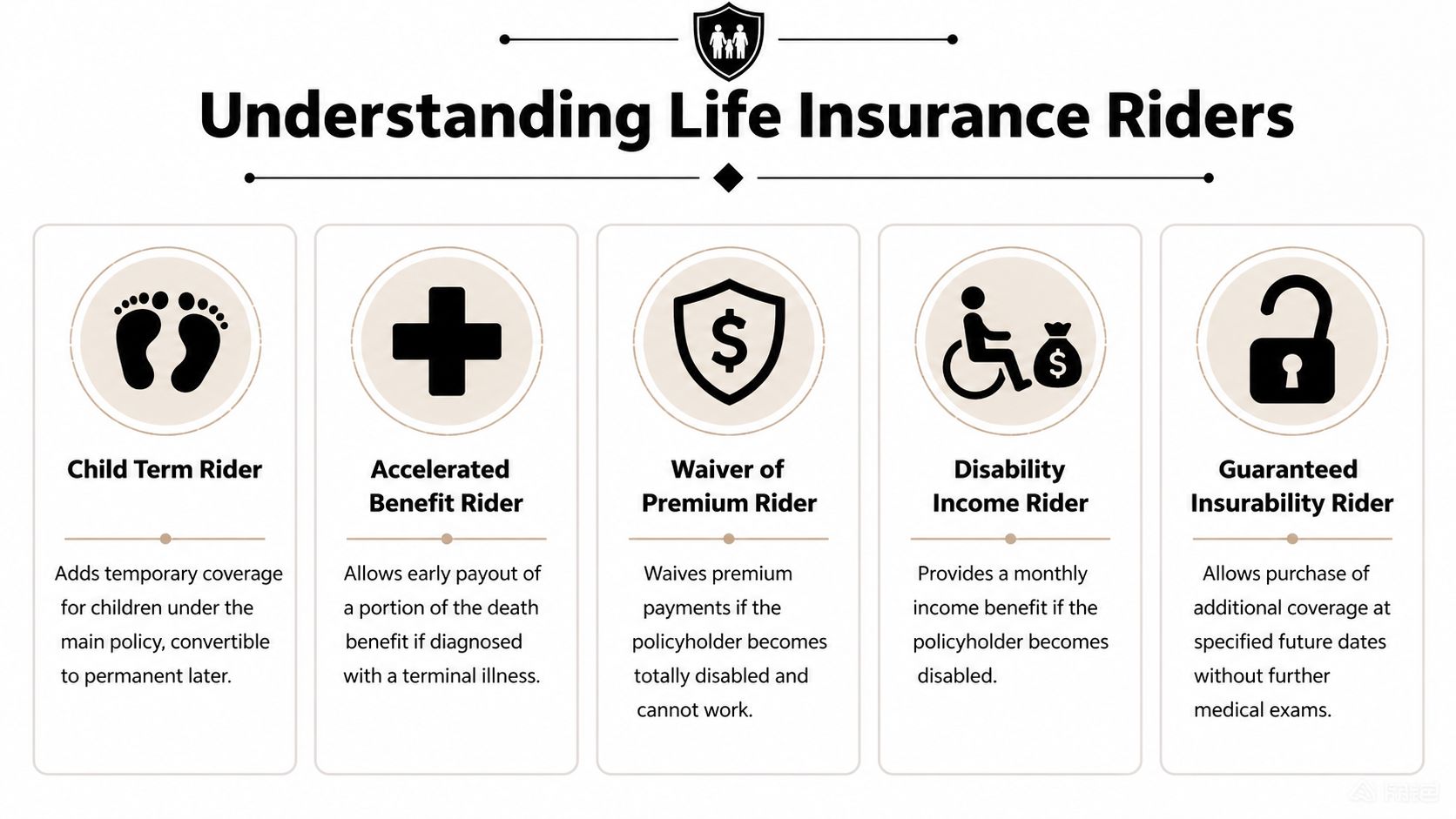
A child term rider adds temporary coverage for children under the main policy. This can appeal to parents who want a small amount of protection under one contract, often with the possibility to convert later depending on the insurer.
A spouse rider works in a similar way. Instead of buying a separate policy right away, one spouse adds a limited amount of coverage for the other under the primary contract. It can be convenient, though the trade-off is that the coverage is tied to the main policy.
An accelerated death benefit rider is different. It doesn’t add more coverage. It lets the insured access part of the death benefit early if a qualifying serious illness occurs. That matters because life insurance can become useful while you’re alive, not only after death.
For example, Agent Link’s discussion of riders and exchanges notes that riders such as accelerated death benefit and long-term care options have helped drive growth, and some policies allow access to up to $2,000 per month of the death benefit if the insured can no longer perform two activities of daily living. If you want a deeper look at this feature, this page on the accelerated benefit rider gives a clear overview.
Riders that protect your policy and future choices
A waiver of premium rider acts like insurance for your insurance. If you become disabled and meet the policy’s definition, the insurer may waive premium payments while keeping coverage in force. For a family that depends on one main earner, this can matter just as much as extra death benefit.
A guaranteed insurability rider gives you the right to buy more coverage later without going through a new medical exam, subject to policy rules. This can be valuable if you expect life changes such as marriage, children, or higher income, but you’re worried your health may not stay the same.
Here’s a fast way to think about these choices:
| Rider | Main job | Often useful for |
|---|---|---|
| Child term rider | Adds temporary child coverage | Parents with young children |
| Spouse rider | Adds limited spouse coverage | Couples who want convenience |
| Accelerated death benefit rider | Allows early access to benefit after qualifying illness | Families worried about medical and care costs |
| Waiver of premium rider | Keeps policy active during disability | Main earners and self-employed workers |
| Guaranteed insurability rider | Preserves the right to add future coverage | People expecting major life changes |
Some riders protect people. Others protect your options. Both can matter.
A good rider isn’t “best” in the abstract. It earns its place when it solves a real problem in your household.
Rider vs Separate Policy Which Is Right For You
This is the decision most guides skip past too quickly. You may be able to add a rider to an existing permanent policy, or you may be better off buying a separate term policy. The right answer depends less on jargon and more on how you want cost, convenience, and flexibility to line up.

The biggest misunderstanding is assuming that “add-on” automatically means “cheaper.” Sometimes it does. Sometimes it doesn’t.
According to Progressive’s overview of term life insurance riders, adding a term rider to a permanent policy can be significantly more expensive than buying a standalone term policy for the same total coverage. Their example notes that a healthy 35-year-old might pay $300 to $500 per year for a $300,000 standalone term policy, while a permanent policy with a rider to reach that same total coverage could easily exceed $2,000 per year.
When a rider often fits better
A rider often makes sense when you already own a permanent policy you want to keep and you only need a moderate temporary boost.
It can work well if you value:
- Convenience: One policy, one insurer, one billing relationship.
- A defined short-term need: Coverage tied to a debt, a child-rearing window, or a business transition.
- Integration with your existing plan: You want to build around the policy you already own instead of managing separate contracts.
This short explainer may help as you weigh the trade-offs:
When a separate term policy may be the smarter buy
A separate term policy often wins when you need a larger amount of temporary coverage and you want the lowest cost path for that need.
Choose a fresh policy when these points matter more:
- Price discipline: You want to avoid paying permanent-policy costs just to get temporary protection.
- More flexibility: A separate policy stands on its own and isn’t tied to the limits or design of another contract.
- Clear purpose: You need coverage for a distinct obligation, such as a long mortgage or income replacement during your highest earning years.
Here’s a simple comparison:
| Question | Term rider | Separate term policy |
|---|---|---|
| Already have a permanent policy you like? | Often a strong fit | May still work, but adds another contract |
| Need the lowest-cost temporary coverage? | Not always | Often stronger |
| Want simple administration? | Usually easier | Slightly more paperwork |
| Need a large coverage amount for a specific period? | Can be limiting | Often more flexible |
Buy the structure that matches the need. Don’t force a temporary problem into a permanent solution if cost matters.
How to Add a Rider to Your Policy
If you’re interested in term rider life insurance, the next step is practical. You need to find out whether your current insurer allows the rider, what rules apply, and whether adding it now still makes sense.

What the traditional process usually looks like
With many insurers, adding a rider starts by contacting the company or your agent and asking three direct questions:
- Is this rider available on my current policy form?
- Can I add it now, or was it only available at issue?
- Will I need new underwriting or updated health information?
Some riders can be added only when you first buy the policy. Others may be available later, but the insurer may review your age, health, and the base policy details before approving the change.
You’ll also want a copy of the policy contract, as rider language can be very specific about term length, eligibility, conversion rights, and when benefits end. If you need help decoding policy language, this guide on how to read a life insurance policy can make the fine print less intimidating.
What to review before you say yes
Don’t focus only on the monthly premium. Review the shape of the coverage.
Check these details carefully:
- End date: The rider may end sooner than you expect.
- Coverage amount: Make sure the added benefit matches the need you’re trying to cover.
- Conversion rules: If conversion is available, understand when and how it works.
- Interaction with the base policy: Ask whether the rider affects other benefits or future flexibility.
Digital insurance buying has also changed the experience. Banner Life’s guide to term life insurance riders and add-ons notes that a 2025 Insurtech Report found only 15% of digital policies currently offer these add-ons, but they’re tied to a 40% higher satisfaction rate in flexible digital policies. That doesn’t mean every online option has every rider. It means you should compare process and flexibility, not just price.
If adding a rider feels confusing, slow down and ask the insurer to show you exactly how the death benefit changes over time.
That one request can clear up most of the confusion.
Frequently Asked Questions About Term Riders
Can I add a term rider if I already have term life insurance
Usually, a term rider is added to a permanent base policy, not to another term policy. Some insurers offer add-ons on term coverage, but the options are often narrower and more product-specific. The best first step is checking your policy form and asking the insurer what riders are still available after issue.
Does a term rider build cash value
No. A term rider is generally temporary death benefit coverage only. It’s there to increase protection for a set period, not to build savings inside the policy. If your base policy is permanent, the base policy may build cash value, but the term rider itself typically doesn’t.
Is a rider better for a new parent than a separate policy
It depends on the job the coverage needs to do. If the goal is a modest boost tied to early child-rearing years, a rider can be convenient. If the new parent needs a larger amount of affordable protection for a clearly defined period, a separate term policy may be easier on the budget and simpler to compare across insurers.
| Question | Answer |
|---|---|
| Can I add a term rider later? | Sometimes. It depends on your insurer, policy form, and whether the rider was available only when the policy was issued. |
| Does it last forever? | No. A term rider is temporary and usually ends after a set number of years. |
| Should I choose a rider just because it’s attached to my current policy? | Not automatically. Compare cost, flexibility, and how well the coverage matches your actual need. |
If you want a digital-first option for affordable coverage, Coveredly offers online life insurance designed for busy families and professionals, with up to $3 million of term life insurance and no exams for most. It’s built to be flexible, simple to apply for, and easier to fit into real life.