Buying a home changes the way you think about money. Before the mortgage, life insurance can feel like a vague “someday” task. After the mortgage, it feels much more concrete. If something happened to you, could your partner keep the house? Could your family stay in the life you just built?
That’s where decreasing term life insurance enters the conversation. It’s a specific kind of term coverage built to track a debt that should get smaller over time, most often a mortgage. The idea is simple. Your loan balance drops as you make payments, so the insurance payout drops too.
For some families, that makes practical sense. For others, it creates a hidden problem: the part of your financial life that needs protection doesn’t always shrink just because your mortgage does. Kids get older. Expenses change. Income still matters. And in the current market, this type of policy is also becoming harder to find.
This guide is written for the person who wants clarity, not insurance jargon. If you’re comparing mortgage protection options, wondering whether decreasing term life insurance is smart or outdated, or trying to understand if a level term policy would serve your family better, you’re in the right place.
Table of Contents
- Introduction Protecting Your Biggest Investment
- What Exactly Is Decreasing Term Life Insurance
- How It Works to Protect a Mortgage A Real-World Example
- Decreasing Term vs Level Term Insurance
- The Unspoken Pros and Cons of Decreasing Term
- Who Should Actually Consider This Policy in 2026
- How to Evaluate Quotes and Find Modern Alternatives
Introduction Protecting Your Biggest Investment
A home is more than a line item on your budget. It’s the place where your routines settle in, where your kids may grow up, and where your family expects stability. The mortgage that makes that home possible is also one of the biggest financial obligations an individual will ever take on.
That’s why many young families look for insurance that matches the debt itself. They don’t necessarily want a policy built for every possible need. They want something that could help wipe out the mortgage if the worst happens during those early, high-pressure years.
Decreasing term life insurance was built for that exact job. It’s not meant to build cash value, and it isn’t designed as a broad wealth tool. It’s temporary protection for a debt that should steadily shrink.
That sounds clean and efficient, and sometimes it is.
But a mortgage isn’t the only thing happening in your life. A spouse may depend on your income. A child may arrive after you buy the policy. You may take on new responsibilities that don’t decline on schedule. That’s where many people get tripped up. They hear “more affordable” and assume “better fit,” when those are not the same thing.
Practical rule: If the insurance is meant to protect a specific debt, decreasing term can be worth a look. If it’s meant to protect your family’s whole financial life, you need a wider lens.
What Exactly Is Decreasing Term Life Insurance

The core idea in plain English
Decreasing term life insurance is a term policy with a fixed premium and a death benefit that gets smaller over time. Consider it a safety net tied to a mortgage balance. At the start, the debt is large, so the protection is large. As the debt is paid down, the protection steps down too.
That’s the key difference from level term. With level term, the payout stays the same for the full policy term. With decreasing term, the payout follows a pre-set decline schedule.
A simple example from Corporate Finance Institute’s explanation of decreasing term insurance shows how this works: a $500,000, 20-year decreasing term policy pays the full $500,000 in year one, then may drop to $375,000 by year five, and continues declining after that. A level term policy with the same starting face amount would still pay $500,000 throughout the term.
That shrinking payout is not a flaw in the product. It’s the design.
Why premiums can stay fixed
Readers often get confused here. If coverage is falling, why doesn’t the premium fall too? Because the policy is priced at the start based on the whole term and the planned reduction in risk. You usually pay the same premium each month or year, even while the death benefit declines on schedule.
One way to picture it is this:
- Premium line: flat
- Coverage line: downward sloping
- Purpose: match a debt that should also slope downward
That structure can make decreasing term life insurance more affordable than level term for a narrow use case, especially when the main goal is debt protection rather than long-term income replacement.
The product works best when your insurance need and your debt schedule move in the same direction.
Another important point: this is still pure term insurance. There’s no cash value accumulation, and the coverage is typically temporary, often over terms that line up with a loan period.
How It Works to Protect a Mortgage A Real-World Example
If you’re trying to picture this in real life, don’t start with insurance jargon. Start with the house payment.

A simple mortgage-style example
Say a couple buys a home and wants insurance tied mainly to the mortgage. They choose a decreasing term policy that starts high and then declines each year in a way intended to mirror the loan payoff.
One concrete illustration comes from Progressive’s overview of decreasing term life insurance. In its example, a $300,000, 30-year policy with a 3.33% annual reduction falls to around $210,000 after 10 years. The point is not the exact math for every lender. The point is that the policy is designed to track a standard amortizing debt.
That’s why people often connect decreasing term with mortgage protection. In the early years, when the outstanding principal is still heavy, the policy pays close to the original amount. Later, when the loan balance has been reduced, the payout is smaller because the debt is smaller too.
If you’ve heard of using life insurance as part of a loan strategy, collateral assignment of life insurance is a related concept, though it works differently from decreasing term and is usually used in more specific lending situations.
What happens to the payout over time
Here’s the practical effect for a family:
- Early years: the death benefit is high enough to closely match the larger mortgage balance.
- Middle years: both the loan and the available insurance payout have come down.
- Late years: the remaining payout may be modest because the policy assumes most of the debt has already been repaid.
That alignment is the whole selling point. If the insured person dies while the mortgage is still substantial, the payout can help the surviving spouse or children keep the home rather than sell under pressure.
A short explainer can make the structure easier to visualize:
The confusion usually starts when buyers expect this policy to do more than it was built to do. It can be a good debt tool. It is not automatically a complete family protection plan. If your partner would still need money for childcare, bills, or income replacement after the mortgage is handled, decreasing term may solve only one part of the problem.
Decreasing Term vs Level Term Insurance
The cleanest way to compare these policies is to stop thinking about “cheap versus expensive” and start thinking about job description. These products solve different problems.
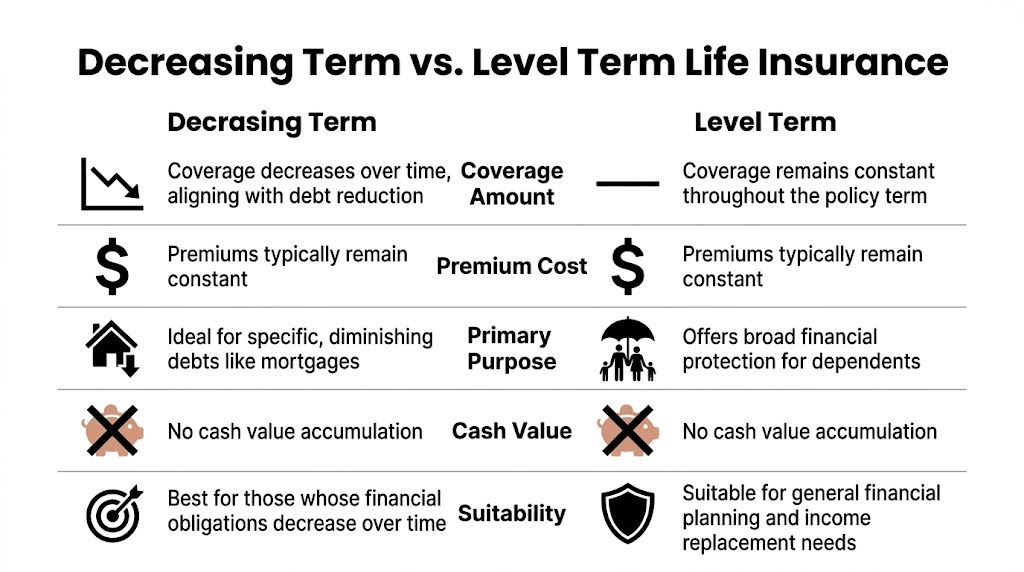
Decreasing Term vs. Level Term at a Glance
| Feature | Decreasing Term Life Insurance | Level Term Life Insurance |
|---|---|---|
| Coverage amount | Declines over time | Stays constant during the term |
| Premium structure | Typically fixed | Typically fixed |
| Primary use | Specific shrinking debt, such as a mortgage | Broader family protection and income replacement |
| Cash value | None | None |
| Flexibility | Narrower | Broader |
If you want a fuller primer on the constant-coverage option, this guide to level term life insurance explains how that structure works.
The real difference is purpose
A decreasing term policy is like buying exactly enough winter salt for the driveway and only the driveway. It’s efficient if that’s your whole concern. A level term policy is closer to stocking the whole garage with supplies because you know several kinds of storms could hit.
Here’s why that matters.
With decreasing term, the insurer knows the potential payout is shrinking every year. That’s why the policy can be priced more efficiently for debt coverage. But your family’s actual need for money may not fall in the same tidy line. Mortgage debt may go down while daycare, school costs, or the need to replace your income stay the same or even rise.
Level term keeps the death benefit steady. That makes it easier to use one policy for multiple goals, such as:
- Income replacement: helping a spouse keep up with monthly expenses
- Child-related costs: covering years when dependents still rely on you
- Debt payoff: handling a mortgage or other obligation without using all the benefit
- Financial flexibility: allowing survivors to choose what matters most at the time
A decreasing term policy is more rigid. Once the schedule is set, the shrinking benefit is built into the contract. If your life changes, the policy doesn’t adapt just because your needs do.
A mortgage balance can be plotted on a chart. Family life usually can’t.
For that reason, many advisors think of decreasing term life insurance as a niche tool. It can be sensible when you already have other protection in place and want an affordable way to cover one clearly defined debt. But if you’re trying to protect a spouse, children, or business obligations along with a mortgage, level term usually gives you more usable coverage throughout the years that matter.
The Unspoken Pros and Cons of Decreasing Term
Most basic guides stop at “it’s cheaper and it matches your mortgage.” That’s only half the story. The other half is about what you give up.
Where decreasing term does its job well
This policy has one strong argument in its favor: focus.
If your only concern is a specific debt that should shrink over time, decreasing term life insurance can be a neat fit. It doesn’t ask you to pay for a level death benefit that may be larger than the remaining loan years later. For disciplined borrowers who want targeted protection and already have other insurance for income replacement, that efficiency can be appealing.
It can also feel emotionally simpler. Some families like the idea that the policy mirrors the mortgage. The debt gets smaller. The coverage gets smaller. The planning feels tidy.
Where the trade-offs start to matter
The hidden issue is value over time. As noted in Thrivent’s discussion of decreasing term life insurance, despite lower initial premiums, decreasing term can offer poorer long-term value because the effective cost per $1,000 of coverage can rise significantly by the end of the term as the death benefit keeps shrinking.
That’s an important concept, even without getting lost in formulas.
If you pay the same premium while the benefit gets smaller each year, the coverage becomes less powerful when your family might still need protection. By the later years, the policy may still be active but no longer strong enough to solve anything beyond a limited remaining debt.
That creates several practical downsides:
- Life doesn’t always shrink on schedule: your mortgage may be lower, but your family may still depend on your earnings.
- New needs can appear: another child, a business loan, or a spouse stepping back from work can change the picture.
- The policy is narrow by design: it’s built for one problem, not for changing responsibilities.
- Late-term protection can feel thin: coverage may remain in force while becoming much less useful.
Bottom line: Lower premium doesn’t automatically mean better value. It may just mean you’re buying less and less protection each year.
That doesn’t make decreasing term “bad.” It makes it specialized. The mistake is treating it as a full solution when it’s really a debt-matching tool with built-in limits.
Who Should Actually Consider This Policy in 2026

A narrow but real fit
There is still a real audience for decreasing term life insurance. It’s just smaller than many people assume.
The best fit is usually someone who wants coverage for one large, declining obligation and who already has the rest of the family’s protection handled elsewhere. That could be a homeowner focused on the mortgage, or a business professional covering a loan with a predictable payoff path. For this buyer, the appeal is precision rather than flexibility.
This conversation matters because younger buyers are actively shopping for life insurance. According to the AFA article citing the 2023 LIMRA Insurance Barometer Study, 50% of millennials intend to buy life insurance. That group often includes people with new mortgages, growing families, and busy budgets.
Who should probably look elsewhere
The catch is that millennials and other younger households often have lives that are still changing. A rigid policy can become a mismatch quickly.
You should be cautious about decreasing term if any of these describe you:
- You need income replacement: your family depends on your paycheck, not just your ability to cover the mortgage.
- Your responsibilities are still growing: newly married couples, new parents, and expanding households often need room to adapt.
- You want one policy to do more than one job: debt coverage plus everyday protection usually calls for a steadier benefit.
- You value flexibility: if you expect your financial picture to change, a shrinking death benefit can feel restrictive.
A lot of buyers assume a mortgage-focused policy is the obvious answer because the mortgage is the largest bill. But the surviving family doesn’t live on a paid-off house alone. They still need cash flow, options, and time to recover.
How to Evaluate Quotes and Find Modern Alternatives
If you decide to shop for decreasing term life insurance, read the quote carefully. Don’t just compare the premium. Compare the decline schedule.
Questions worth asking before you buy
Ask direct questions such as:
- How does the benefit decline? Is it yearly, monthly, by percentage, or by fixed dollar amount?
- What is the payout in the years that matter most to me? Early years and middle years are especially important for families with young children.
- Does the policy match my actual loan path? Some mortgages don’t reduce in a perfectly simple line.
- What problem am I solving beyond the debt? If the answer includes income replacement, the quote may be too narrow.
These questions help separate a policy that merely sounds affordable from one that actually fits your household.
Why many shoppers end up choosing a different path
There’s another wrinkle now: availability. According to Prudential’s discussion of level vs. decreasing term life insurance, an emerging 2025 to 2026 projection is that only an estimated 15% to 20% of top carriers may actively offer decreasing term policies. That limited availability is one reason more shoppers are comparing flexible digital options instead.
If you want to see how standard term options stack up, comparing term life insurance rates across policy types can give you a clearer sense of what you’re paying for.
For many families, the modern alternative is straightforward: choose a level term policy and decide later how the benefit should be used. That keeps the door open. If the mortgage still needs attention, the benefit can help with that. If your family needs income support instead, the policy hasn’t already shrunk out from under you.
If you want life insurance that fits a real family budget without boxing you into a rigid declining benefit, Coveredly is worth a look. Coveredly offers a digital, flexible approach to term life insurance, with up to $3 million in term coverage and no exams for most applicants. For young families, newly married couples, and business professionals who want protection that can adapt as life changes, that broader flexibility can be a smarter long-term move than a policy designed for only one shrinking debt.