A free look period is a post-delivery cancellation window, usually 10 to 30 days depending on the state, during which you can return a newly issued life insurance policy for a full premium refund. It gives you time to check the actual contract before deciding whether to keep it.
You've finished an online application, received your policy, and told your spouse that the insurance is sorted. Then you open the document and wonder whether the premium, beneficiaries, and coverage really match what you intended. That moment isn't a sign you made a mistake. It's the right time to use the protection built into the purchase.
Table of Contents
- What Happens Right After You Buy a Life Insurance Policy
- Understanding the Free Look Period
- How State Rules and Delivery Methods Change the Timeline
- How to Cancel and Get a Full Refund Step by Step
- What the Free Look Period Actually Lets You Verify
- Common Misconceptions That Trip Up New Policyholders
- A Practical Free Look Checklist for New Policyholders
What Happens Right After You Buy a Life Insurance Policy
Consider a newly married professional buying term life insurance online. The application feels manageable, the confirmation arrives, and the policy document appears in an inbox alongside work messages and household bills.
It's tempting to save the attachment and move on. But receiving the contract deserves more attention than receiving an order confirmation. You now have the document you'll use to judge whether the insurance fits your family.

Separate the buying decision from the review decision
At application time, you're deciding whether to pursue coverage. After delivery, you're checking what the insurer issued. The free look period exists alongside that second decision, rather than making approval the end of your opportunity to reconsider.
The NAIC's life insurance disclosure framework describes a policy-examination safeguard with cancellation, a full premium refund, and no charge or penalty. That protection addresses a practical problem: buyers need an opportunity to inspect the delivered contract, not simply the sales information.
For our hypothetical newlywed, the immediate task isn't to become an insurance expert. It's to gather the issued policy, the application, and the original quote in one place. A shared folder can help both spouses review the same documents rather than relying on separate memories of the purchase.
- Save the complete contract. Keep the attachments and any separate rider documents together.
- Preserve the delivery message. Retain the email or other record accompanying the policy.
- Set aside review time. Choose a quiet moment when you can compare documents without rushing.
Practical rule: Treat the policy arriving in your inbox as something to review, not something to archive unread.
You don't need to find a problem to justify reading the policy. Confirming that everything is right is a useful outcome too. The aim is a deliberate decision, whether that means keeping the coverage or using the cancellation right.
Understanding the Free Look Period
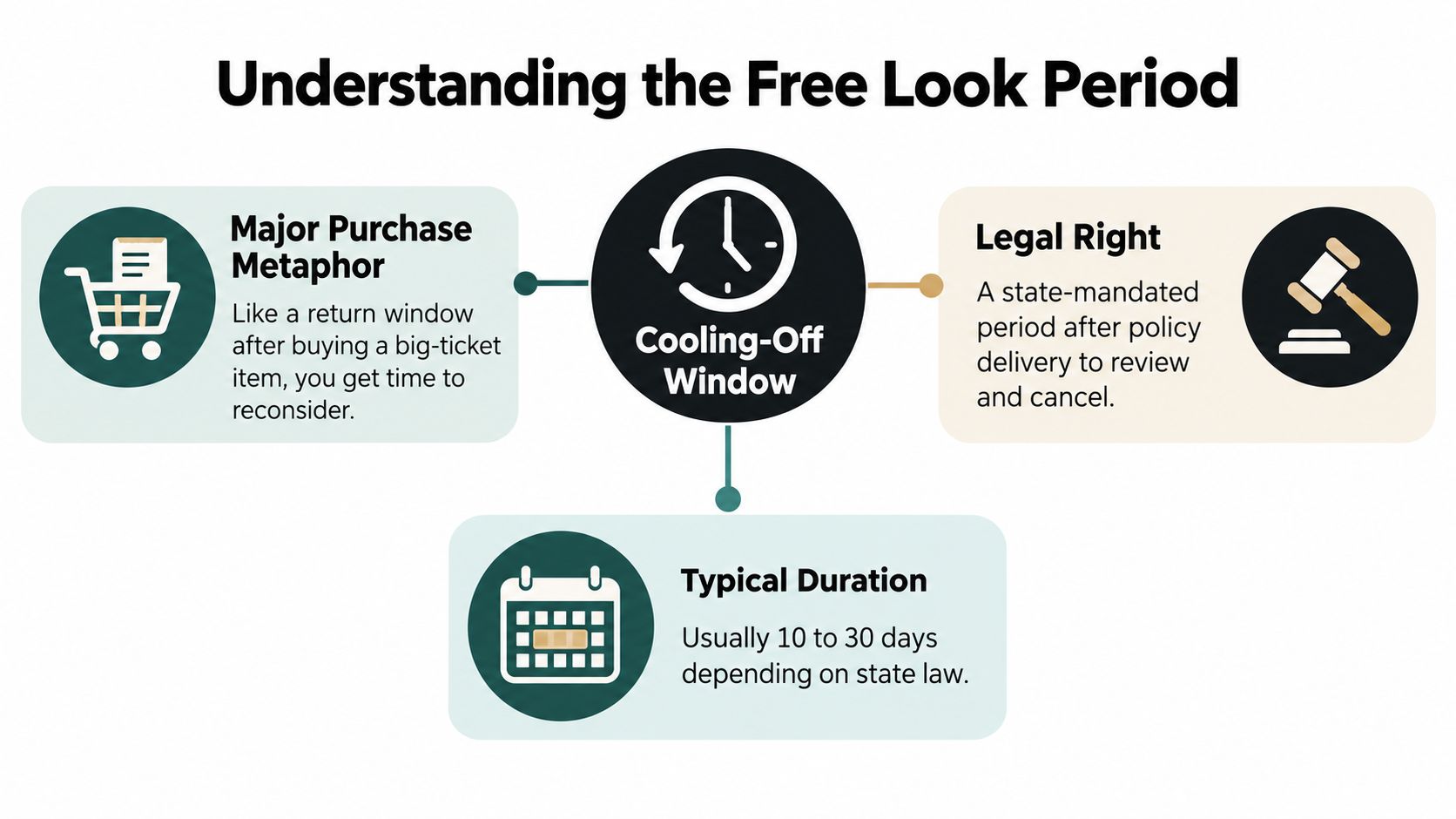
Think of a cooling-off window after a major purchase. You've committed, but you still have an opportunity to inspect what you received and reconsider. With life insurance, that familiar idea becomes a regulated cancellation right, not a retailer's return policy.
The National Association of Insurance Commissioners' consumer guide describes a free-look window that usually gives policyholders at least 10 days after receiving the policy to return it for a full premium refund. The key phrase is after receiving the policy. Your application date and underwriting approval date aren't substitutes for the delivery date.
This visual separates the purchase analogy from the legal protection.
Understand the right and its limits
The policyholder can reconsider without having to prove that the insurer did something wrong. A policy might be unsuitable because the premium doesn't fit the household budget, because the final terms aren't what the buyer expected, or because the buyer changes their mind.
The protection has several connected parts:
- An opportunity to examine the contract. You can read the issued coverage before the review deadline.
- A right to reject it without a cancellation penalty. This is more than permission to stop future payments.
- A full premium refund for a qualifying cancellation. Follow the applicable free-look provision rather than treating the request as an ordinary cancellation.
Don't confuse this with a risk-free claims trial. The free look period isn't an invitation to test whether the insurer will pay a claim, and it doesn't replace reading the exclusions or coverage conditions.
Recognize delivery in an online purchase
A paper policy gives you an obvious physical event to remember. Electronic delivery can be less noticeable: a document arrives, a portal becomes accessible, or a notification asks you to acknowledge receipt.
For that reason, ask the insurer to confirm the delivery date it recorded and the resulting deadline. Save the answer with the policy. Don't assume that the date printed beside “issued” is necessarily the date that started your review window.
The notice is typically near the beginning of the contract. Read its wording carefully, especially the instructions about where and how to return the policy. Understanding the cancellation right and completing a valid cancellation are related, but they aren't the same action.
How State Rules and Delivery Methods Change the Timeline
There isn't a single nationwide deadline you can safely apply to every purchase. Jurisdiction, delivery channel, consumer category, and replacement status can change the available review time.
New York provides a clear example. Its Department of Financial Services' life insurance guidance specifies a minimum 10-day and maximum 30-day free-look period, requires 30 days for policies offered through the mail, and requires the notice on the policy's cover page. Those distinctions matter even before you consider special transactions.
Free Look Period Duration by State and Channel
| Jurisdiction / Rule | Standard Window | Notes for Channel or Transaction |
|---|---|---|
| New York life insurance | 10 to 30 days | Policies offered through the mail must provide 30 days, under the department guidance cited above. |
| California senior protection | 30 days | Covered life policies receive a full-refund review period after receipt under California's senior protections. |
| New York replacement transactions | Special replacement window | Replacement rules require a longer period than the ordinary range; the specific requirement is discussed below. |
| India's historical policyholder-protection framework | Standard and extended electronic windows | Electronic receipt received longer review time under the historical framework, rather than being treated identically to physical delivery. |
| Washington refund rule | Separate from the cancellation window | The insurer's refund deadline follows policy return, rather than simply matching the buyer's review deadline. |
California's Senior Insurance Bill of Rights provides a 30-day review period for covered life policies after receipt, with a full premium refund if the policy is returned by the 30th day. This is a consumer-category protection, not a statement that every California buyer has the same rule.
Digital delivery deserves its own question
India's 2017 policyholder-protection framework provided a 15-day period after receipt of the policy document, extended to 30 days for electronically received policies. Treat this as a historical example of channel-sensitive regulation, not as confirmation of the current rule for an Indian purchase.
The broader lesson is that buying online doesn't automatically mean a shorter or longer review period. A regulator may distinguish electronic delivery, direct-response solicitation, or another channel. The NAIC's small-face-amount life insurance model, for example, uses a 10-day cancellation-and-refund provision as a baseline, illustrating why product frameworks also deserve attention.
Your deadline should come from your issued policy and applicable law, not from a search result describing an average.
Use the printed deadline as your working reference. If it appears inconsistent with your state's protections, ask the insurer or state regulator for clarification promptly. A contract's wording shouldn't be treated as overriding a legal consumer protection.
How to Cancel and Get a Full Refund Step by Step
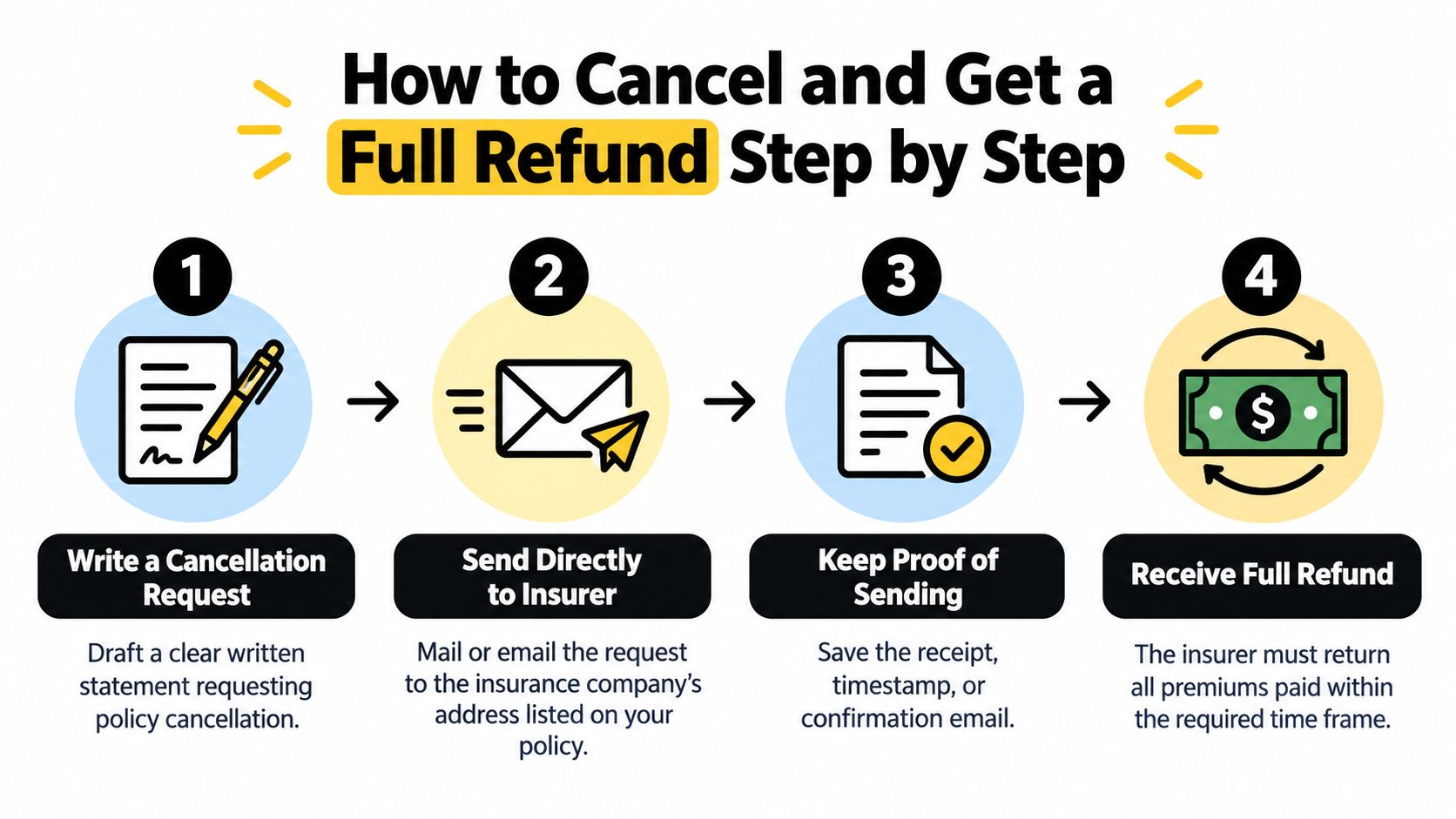
A good cancellation process leaves a clear record of what you requested, where you sent it, and when the insurer received it. Don't wait until the last available day to discover that the company needs a particular form or document.
The following visual gives you the basic sequence. Use it together with the cancellation instructions in your own policy.
A day-by-day working routine
These are suggested work stages, not additional legal deadlines. Move faster if your actual window is already close to ending.
- On delivery day, establish the clock. Save the delivery evidence, locate the free-look provision, and record the deadline.
- On your first review day, make the decision. Compare the contract with your expectations and gather any unanswered questions.
- On the day you decide to cancel, send written notice. Address it directly to the insurer through an accepted channel. Include the policy number, policyholder's name, insured person's name, and a clear request for free-look cancellation and a full premium refund.
- Immediately after sending, preserve proof. Save the submitted form, email timestamp, postal tracking, or portal confirmation. Return any documents the insurer's instructions require.
- During follow-up, confirm both outcomes. Request written acknowledgement of cancellation and the expected refund date. Retain the records until the money has arrived.
A phone call can help you identify the correct procedure, but don't rely on a conversation alone. Similarly, emailing an agent isn't a substitute for verifying that your request reached the insurer's designated cancellation channel.
Track the refund separately
Washington's life insurance consumer guide says premiums must be returned within 30 days after the policy is returned and provides a 10% penalty if the company keeps the money longer. That's a state-specific refund obligation, not a nationwide processing promise.
If you're cancelling to buy different coverage, use this guide to switching insurance providers to organize the transition. Ask when each policy's coverage starts or ends rather than assuming a refund means the replacement is ready.
For a visual companion to the written protocol, you can watch the embedded video.
What the Free Look Period Actually Lets You Verify
Use the review window as a contract comparison, not merely an escape hatch. Put the original quote beside the issued policy and check whether the insurance you received supports the decision you intended to make.
For example, a couple might be comfortable with the coverage description but discover that the final premium doesn't fit their household budget. Another buyer might find an incorrectly recorded application answer. These are hypothetical review situations, not evidence that a particular insurer routinely changes terms.
The checklist below highlights the main areas to inspect.
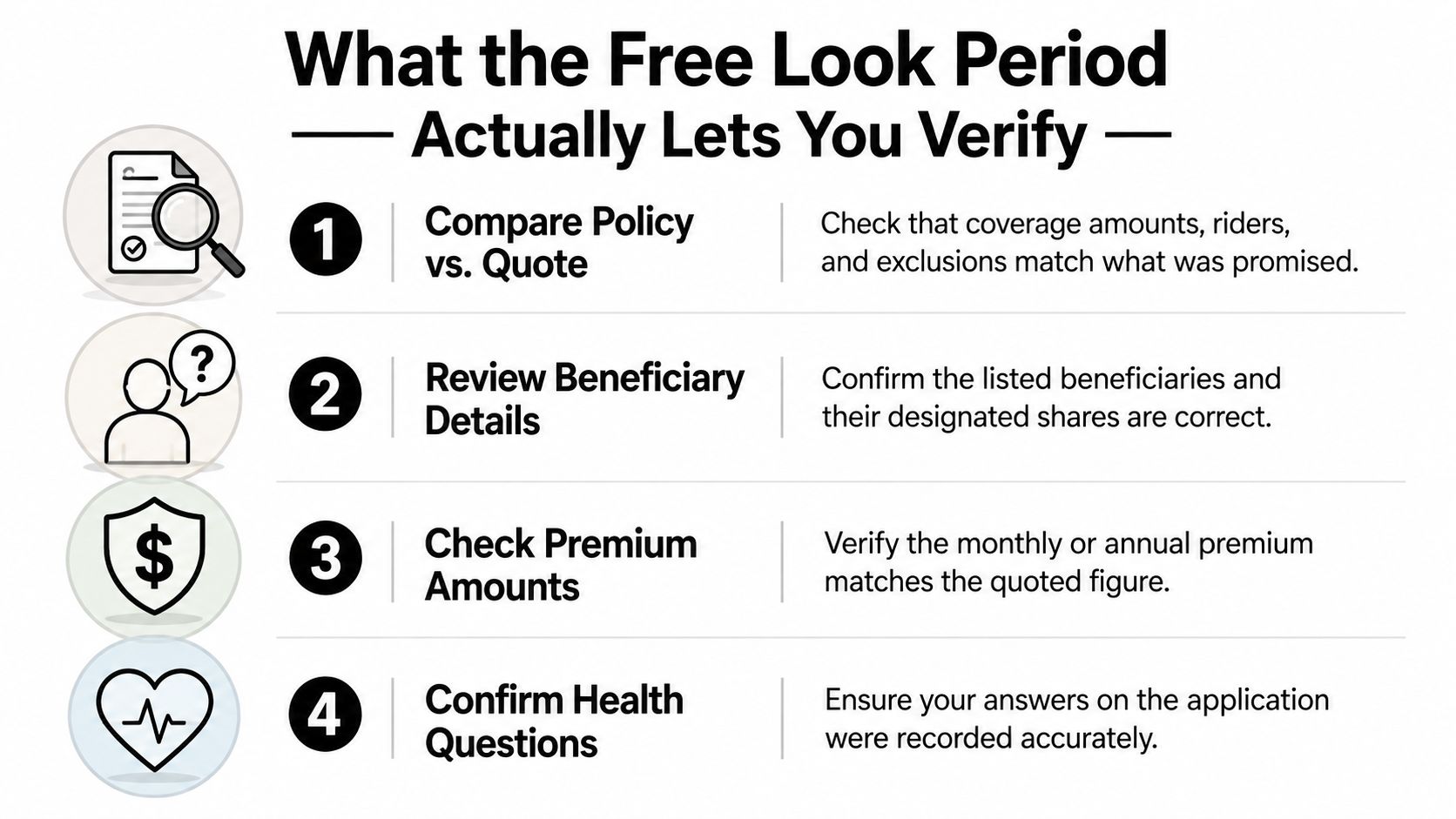
Compare what you expected with what you received
- Coverage amount and term length. Confirm that the insured amount and coverage duration match your intended protection.
- Premium and payment schedule. Check the final charge, payment frequency, and any provisions explaining future premium changes.
- Beneficiaries. Verify names, designated shares, and any backup beneficiary arrangements.
- Exclusions and riders. Read the limitations and confirm that the additional benefits you selected appear in the contract.
- Application and underwriting details. Check that your recorded answers are accurate and ask about unfamiliar final underwriting terms.
- Contestability provisions. Locate the wording rather than assuming the policy has no conditions affecting claim review.
If unfamiliar language slows you down, keep this guide to reading a life insurance policy beside the contract. Mark questions and ask for written explanations so you can compare the response with the policy wording.
Check fit beyond the immediate purchase
A family planning to move overseas has a different review question from one planning to stay in the same place. For that situation, Expat Global Medical offers a resource to help readers find expat coverage for living abroad. Use it to identify questions about residence and policy suitability, then confirm the answers with your insurer.
A policy can be in force during the free-look window, subject to its effective-date requirements and terms. Claims during that interval are unusual but possible; the cancellation right doesn't create a separate claims benefit.
Free-look cancellation generally rescinds the contract and returns the premium, taking you back to a pre-coverage position. Ask the insurer to confirm the coverage consequences in writing, especially if another policy or a claim is involved.
Common Misconceptions That Trip Up New Policyholders
The most troublesome misunderstandings sound reasonable. They usually come from treating an insurance contract like an ordinary online purchase.
Approval isn't the same as delivery
A buyer sees an approval message and assumes the review countdown has already started. Another sees a later email and assumes that opening it will restart the countdown.
Neither assumption is a reliable way to calculate the deadline. The delivery distinction explained earlier matters more than whichever date you happen to remember. Ask for the insurer's recorded delivery event if your messages or portal history are unclear.
A conversation isn't a complete cancellation record
An agent may be helpful and responsive, but a reassuring call doesn't give you the same evidence as a properly submitted request. The Texas Office of Public Insurance Counsel's explanation of life insurance rights confirms that insurers must refund premiums when a policyholder cancels within the free-look period.
The practical question is whether you completed the required return or cancellation procedure in time. Keep the written request and its acknowledgement together instead of assuming that someone else documented everything.
A cancellation right is easier to use when you can show the request, the destination, and the date.
Replacements aren't ordinary new purchases
Replacing existing life insurance deserves a separate review. New York's individual term-life product outline requires a 60-day free-look period in replacement situations, reflecting concerns including surrender costs, new contestability exposure, and possible deterioration in insurability.
That doesn't mean every replacement in every state receives the New York period. It means you should identify the transaction as a replacement before relying on a standard deadline.
- Review the old policy too. Consider whether you'll lose favorable age-based pricing or incur surrender costs.
- Understand fresh review conditions. This explanation of the life insurance contestability period can help you frame questions about new coverage.
- Confirm continuity. Ask what happens to the existing coverage before authorizing its cancellation.
A longer review window doesn't undo every consequence of surrendering an older policy. The safer approach is to examine the whole transition, not just the refund provision on the new contract.
A Practical Free Look Checklist for New Policyholders
You don't need a complicated system. You need a complete policy, a reliable deadline, and a record of your decision.
Create a folder named “Life insurance review” and keep the documents together. If you share household financial responsibilities, make sure the other person knows where to find it.
Your review routine
- Confirm receipt. Save the delivery message and resolve any uncertainty about the date with the insurer.
- Locate the deadline. Read the cover-page notice and cancellation provision. Check whether your jurisdiction, delivery method, or replacement status changes the rule.
- Compare the documents. Put the issued contract beside the quote and application, using the verification checklist above.
- Resolve questions promptly. Ask about discrepancies in writing while there's still time to decide.
- Choose deliberately. Keep the policy if it fits, or follow the written exit protocol if it doesn't.
- Close the record. If cancelling, retain confirmation and verify that the expected refund arrives.
For an electronic policy, include a specific question about digital delivery. The international example discussed earlier shows why you shouldn't assume that an online purchase follows the same timing as a paper policy, or that a historical rule is still current.
Your contract's printed deadline is the practical starting point, subject to applicable law. If the wording is unclear, ask for clarification rather than guessing or postponing the review.
The free look period is a built-in safety net for an important household decision. Using it deliberately doesn't mean you distrust the insurer. It means you're checking that the protection you bought is the protection your family needs.
Coveredly offers online term life insurance and guidance to help you understand the coverage you're considering. Visit to explore an option for your household, then use your delivered policy's free-look window to verify the terms before making your final decision.