You accept a new job, open the benefits packet, and see life insurance checked off for you. Maybe it's free. Maybe it costs very little through payroll. That usually feels like a win, and in many ways it is.
Then the central question shows up. Is your employer's life insurance enough, or do you also need your own policy?
That's the decision behind most searches for group vs individual life insurance. People aren't usually comparing abstract product features. They're trying to protect a spouse, cover a mortgage, make sure kids are okay, or avoid leaving a financial mess behind if life changes fast.
The tricky part is that both policy types can be useful. One is convenient and often inexpensive at work. The other is personal, portable, and built around your life instead of your employer's benefit menu. If you only compare monthly cost, group coverage often looks great. If you compare what happens across layoffs, promotions, health changes, and family milestones, the answer gets more nuanced.
Table of Contents
- Is Your Employer's Life Insurance Enough?
- Group vs Individual Insurance The Core Concepts
- A Detailed Comparison Across 5 Key Areas
- The Portability Problem Why Tying Insurance to a Job Is Risky
- Use Cases Which Policy Fits Your Life Stage
- Your Decision Framework Choosing the Right Strategy
- FAQs and Getting Your Foundational Coverage
Is Your Employer's Life Insurance Enough?
A common version of this starts on day one of a new job. You enroll in benefits, click through health insurance, then see basic life insurance included by the employer. You think, “Great, I've got coverage.” If you're single with no one depending on your income, that might be enough for now.
But life rarely stays still.
A few years later, you may have a partner, a mortgage, a child, or aging parents who rely on you in some way. The policy that looked fine when you were just trying to finish onboarding can start to feel thin when real responsibilities show up. That's where people start looking more closely at the difference between workplace coverage and a policy they own themselves.
For many employees, group life insurance works best as a starting layer. It's easy to accept, often low-cost, and simple to activate through HR. If you're new to the topic, this overview of basic life insurance through an employer helps explain why it's such a common first benefit.
The question behind the question
Individuals aren't really asking whether group life insurance is “good” or “bad.” They're asking whether it can carry the full job of protecting their family.
That's a different standard.
Group life insurance is often a helpful employee benefit. It just isn't always designed to be your entire protection plan.
An employer plan and an individual policy solve different problems. One gives you convenient access to coverage because you work somewhere. The other gives you coverage because you chose it, own it, and want it to stay with you no matter what happens at work.
If you remember one thing from this section, make it this: free coverage is valuable, but “included” doesn't automatically mean “enough.”
Group vs Individual Insurance The Core Concepts
The cleanest way to understand group vs individual life insurance is this.
Group life insurance is a rented benefit.
Individual life insurance is an owned policy.
That ownership difference shapes almost everything else.

What group life insurance really is
Group life insurance usually comes through an employer. The company buys coverage for a pool of employees, and workers can often enroll with little friction. In many workplaces, the employer pays all or part of the premium, coverage is often set at a fixed amount like 1 to 2 times salary, and underwriting is often minimal or waived, as described by CMF Group's explanation of group vs individual life insurance.
That setup makes group coverage easy to say yes to. It's built for convenience, not deep customization.
What individual life insurance really is
Individual life insurance is coverage you apply for yourself and own yourself. You pick the policy, the amount, the beneficiary setup, and the structure that matches your goals. It's tied to you, not your job.
A simple analogy helps here. Group coverage is like living in a furnished corporate apartment. It's useful, quick, and someone else arranged it. Individual coverage is like buying a home that fits your household and stays yours even if your job changes.
Ownership matters: If a policy is part of your compensation package, your access to it often depends on your employment. If it's your own policy, your coverage doesn't rely on your employer's next decision.
Why group coverage is so common
Group life insurance isn't some niche benefit. It's a massive employer-linked market. The global group life insurance market report from The Business Research Company estimates the market at $160.64 billion in 2026 and projects it will reach $231.69 billion by 2030. That scale helps explain why workplace coverage is often the default first layer of protection for many households.
That popularity can create a false sense of completeness. Common doesn't always mean sufficient. It often just means accessible.
The core trade-off
If you want the shortest possible summary, here it is:
- Group life insurance is easy to get and often inexpensive upfront.
- Individual life insurance gives you control, continuity, and a policy built around your life.
Both can belong in a sound plan. They just don't play the same role.
A Detailed Comparison Across 5 Key Areas
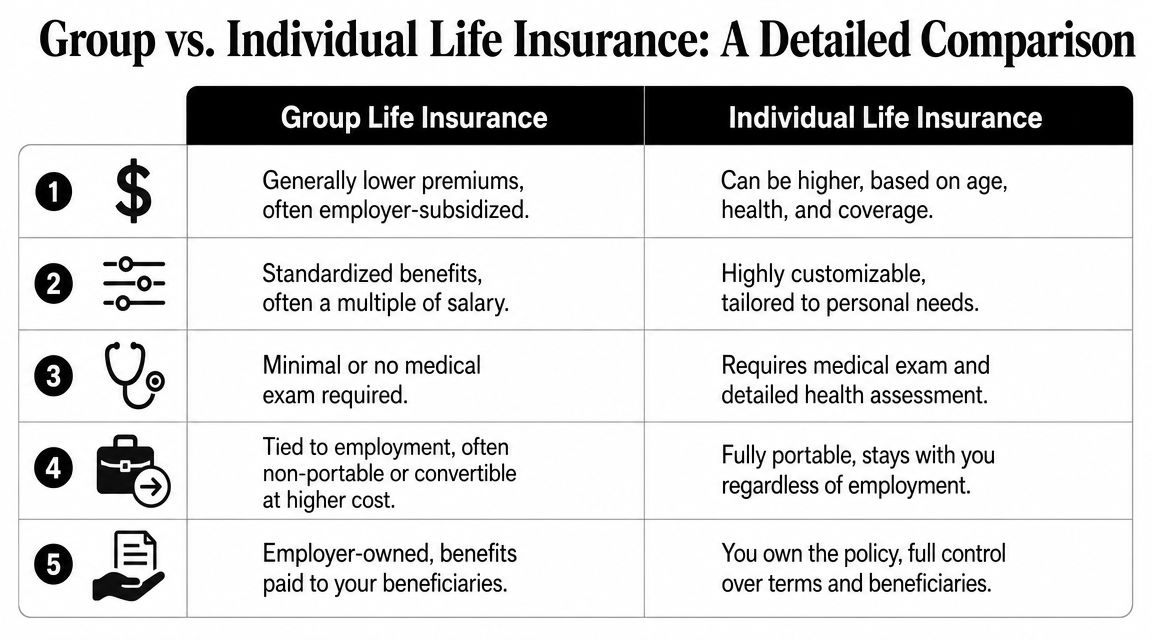
A side-by-side comparison quickly clarifies the trade-off. Group coverage often works well as a starting benefit. Individual coverage usually carries more of the long-term load, especially through promotions, layoffs, self-employment, and family changes.
| Feature | Group Life Insurance | Individual Life Insurance |
|---|---|---|
| Coverage design | Standardized, often employer-set | Chosen based on personal needs |
| Cost structure | Often subsidized by employer | Paid by the policyholder |
| Underwriting | Often limited or waived | Usually more personal health review |
| Portability | Commonly tied to employment | Stays with you if you keep paying |
| Ownership and control | Employer plan governs design | Policyholder controls the policy |
Coverage limits and customization
Group life insurance is built to cover a workforce efficiently. That usually means a flat benefit, or a formula tied to salary, instead of a number based on your mortgage, child care costs, income replacement period, or future college funding.
Individual coverage starts with your household math. A family with one child, a new home, and a spouse who depends on that income may need something very different from what an employer plan automatically provides.
A policy designed for administrative simplicity can still leave a family underinsured.
Cost and who pays
Group plans often win on short-term affordability. If an employer pays the base premium, taking that coverage is usually an easy yes.
The trade-off is that low out-of-pocket cost can hide the fact that the policy is not fully under your control. Individual coverage asks you to budget for premiums yourself, but you are paying for continuity as much as coverage. Over a working lifetime, that distinction matters.
Some households use both. If you are weighing whether layering coverage makes sense, this guide on having two life insurance policies at once can help clarify how the pieces fit together.
Underwriting process
Group coverage is often easier to get at enrollment. Many employer plans offer a base amount with limited health questions or no medical exam at all, which can be useful if you need coverage quickly.
Individual life insurance usually involves a closer review of your health, age, and personal history. That extra effort can work in your favor if you buy while healthy, because you are locking in coverage based on your own profile at that point in time. If your health changes later, an existing individual policy may become much more valuable than it looked on day one.
Portability and job changes
This category tends to matter more with time. Early in a career, employer coverage can feel sufficient because the job feels stable and the benefit is automatic. Later, real life intervenes. People switch employers, leave to raise children, start businesses, go part-time, or take a role with weaker benefits.
In those moments, group coverage can shrink or disappear right when buying new insurance becomes harder or more expensive. Individual coverage avoids that problem because it stays in place as long as you keep paying the premium.
A practical way to view it is simple. If a policy depends on your current payroll system, it should not be the only thing protecting your family.
Policy ownership and control
Ownership shapes how flexible the policy will be when life gets more complicated. With group life insurance, the employer chooses the insurer, the plan terms, and the available options. You are participating in that framework, not directing it.
With an individual policy, you control the core decisions. That becomes more useful after marriage, after a home purchase, after a divorce, or during a major career shift.
Examples where ownership matters:
- Changing beneficiaries after a marriage, divorce, or new child
- Matching coverage to debts and income needs instead of using a preset formula
- Keeping protection in force during career moves without depending on an HR department
- Building a long-term plan that still fits if your family or health situation changes
If the goal is convenience today, group coverage often has the edge. If the goal is protection that can keep up with decades of career moves and family changes, individual coverage usually offers the stronger foundation.
The Portability Problem Why Tying Insurance to a Job Is Risky
The biggest weakness in group-only coverage isn't usually the price or the paperwork. It's the fact that your life insurance may be attached to the same job that could change, disappear, or become a bad fit for your family.

That risk often hides in plain sight because everything feels stable until it isn't. You switch companies for a better role. You leave to start a business. Your employer cuts benefits. You take time off. In each of those moments, a group policy can stop being the dependable safety net you thought you had.
How the gap happens in real life
Consider a worker who relies only on employer life insurance. While employed, they feel covered and postpone buying a personal policy. Later, they change jobs during a stressful year, or they face a health issue that makes new coverage harder to secure on favorable terms.
That's when portability becomes more than an insurance term. It becomes a household risk.
The issue isn't rare. The Zebra reports that 30% of Americans with life insurance are only insured through a group plan, and 20% believe they do not have enough coverage, according to its life insurance statistics research. That points to a real coverage and portability gap, not a theoretical one.
Why timing matters
Insurance decisions get harder when made under pressure. If you wait until after a job change, after a diagnosis, or after a major family shift, your options may feel narrower than they did when life was calm.
That's why many households use group coverage as a bonus, not the base. If you're wondering whether layering protection can make sense, this guide on having two life insurance policies at the same time gives a practical explanation.
Here's a short walkthrough that helps clarify the portability issue:
What a portable policy changes
A personally owned policy doesn't care whether you get promoted, resign, relocate, or move from employee to founder. That consistency is valuable because careers are mobile now, even when intentions are stable.
Your income may come from different places over time. Your family's need for protection usually doesn't.
When people ask me which risk is easiest to underestimate in group vs individual life insurance, this is the one. It's not dramatic on the day you enroll at work. It becomes obvious later, usually when changing jobs is the last thing you wanted your protection plan to depend on.
Use Cases Which Policy Fits Your Life Stage
The right answer often depends less on ideology and more on where you are in life. A recent graduate, a newly married couple, and a business owner don't use life insurance for the same reason. They shouldn't shop for it the same way either.
Newly married and building a foundation
If you've just gotten married, your finances are starting to merge even if you still keep separate accounts. Rent or mortgage payments, shared debts, and future planning all become joint issues fast.
For this stage, group coverage can be a helpful extra if it comes with work. But many couples benefit from starting an individual policy while health is still favorable and before life gets more complicated. The point isn't to overbuy. It's to build a base layer you control from the beginning.
A simple way to think about it: getting your own policy early is like locking in your spot before the crowd shows up.
Young families with real monthly obligations
Often, group-only coverage starts to look thin. Once you have children, your life insurance job expands. It's not just funeral costs or a temporary cushion. It may need to support housing, childcare, day-to-day bills, and the surviving partner's breathing room while life gets rearranged.
A group policy can still help. It just may not be enough on its own because family obligations are rarely standardized.
For young families, a combined approach is often practical:
- Use the employer benefit: Take the basic coverage if it's offered, especially when the employer subsidizes it.
- Add an individual foundation: Build the main protection around your household expenses and the years your family would feel the loss of your income most sharply.
- Review after major changes: A new baby, home purchase, or one spouse leaving work can change the amount of protection that makes sense.
Families don't need the cheapest policy on paper. They need coverage that still works on an ordinary Tuesday after a life-changing event.
Business professionals changing jobs
People in growth years often move companies more than once. Better role, better pay, relocation, better flexibility. That mobility can be positive for your career and dangerous for insurance if all your coverage rides along with your employer.
This group usually benefits from treating workplace life insurance as a bonus and buying individual protection that stays put. That way, each resume update doesn't force a re-think of your family's safety net.
Business owners and self-directed planners
Business owners usually need control more than convenience. They may want coverage that supports personal family planning, protects loans, or fits a broader financial structure. Group life insurance generally doesn't solve those more customized needs.
An individual policy is often the better fit because it's built around the owner's situation, not an HR menu. Even professionals who aren't business owners but like to manage their finances intentionally often prefer that same control.
The broad pattern is simple. The more specific your life becomes, the more valuable ownership and portability become.
Your Decision Framework Choosing the Right Strategy
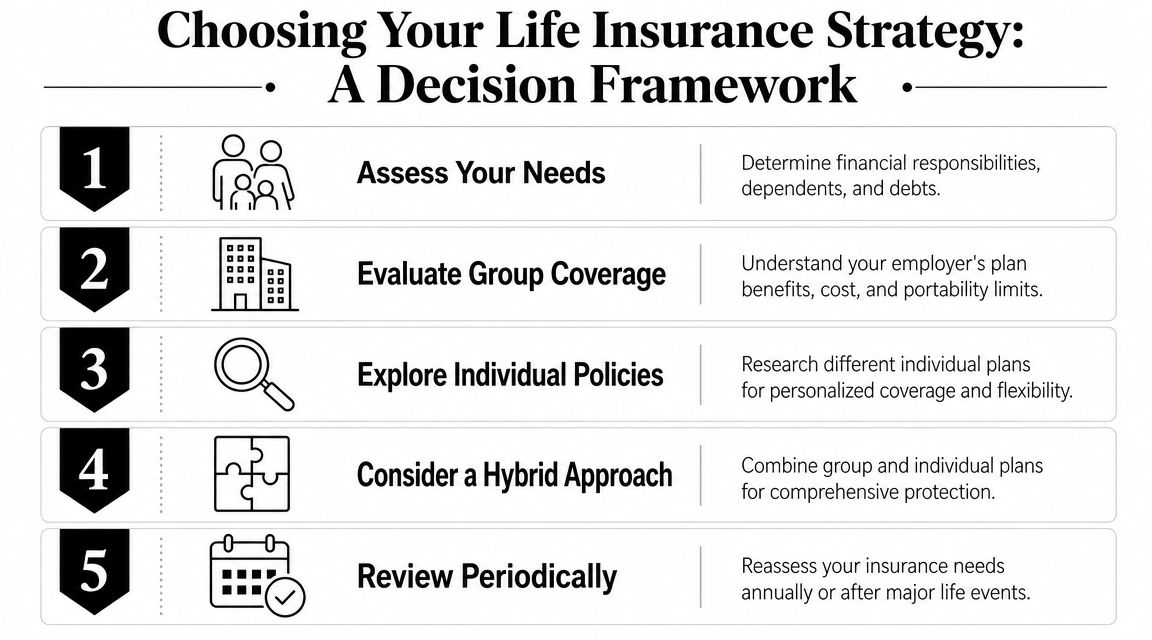
One doesn't typically need to choose between group life insurance and individual life insurance as if one must replace the other. The better question is which role each one should play.
Start with the risks your family would actually face
Before comparing policy types, list the obligations that would remain if you died unexpectedly. Think in practical terms, not insurance jargon.
A short checklist helps:
- Who depends on your income? A spouse, child, or parent changes the urgency.
- Which bills would keep arriving? Mortgage, rent, debt payments, and childcare don't pause.
- How stable is your employment path? If you expect role changes or career pivots, portability matters more.
- Would your health picture be easier to insure now than later? Waiting can change the conversation.
Evaluate your employer benefit honestly
Employer life insurance has real strengths. It's convenient, often affordable, and easy to activate. The mistake is assuming those strengths also make it a complete long-term strategy.
Look closely at what the plan can and can't do. Is the amount fixed? Can you control the structure? What happens if you leave? Those answers usually tell you whether the plan belongs in the “foundation” category or the “supplement” category.
Decide whether you need a hybrid approach
For many households, the strongest setup is simple. Keep the group coverage if it's valuable, but don't rely on it as your only line of defense.
That approach reflects the long-view question raised by Augusta Financial's discussion of the issue: the real question isn't just which policy is cheaper today, but which remains reliable if your health, job, or family situation changes. That's where individual coverage earns its place. It can lock in premiums and coverage independently of employment.
The best strategy is often to accept the free or low-cost workplace benefit and then build your main protection with a policy you own.
Recheck after major life changes
Life insurance shouldn't be a set-it-and-forget-it drawer document. Review it after events that change responsibility or vulnerability.
Examples include:
- Marriage: Shared finances usually increase the need for intentional coverage.
- Children: Protection needs often become larger and more time-sensitive.
- Home purchase: Long-term debt changes the stakes.
- Career transition: A new employer can improve, reduce, or remove workplace benefits.
If you want a practical next step, calculate your target before you shop. This guide on how much life insurance you may need can help you frame the decision around real obligations instead of guesswork.
FAQs and Getting Your Foundational Coverage
Can you have both group and individual life insurance?
Yes. In many cases, that's the most balanced setup. Group coverage can serve as a helpful add-on, while individual coverage acts as the policy you control and keep through job changes.
Is supplemental group life insurance enough?
Sometimes it helps, especially if you want extra workplace coverage and the pricing is attractive. But it still may carry the same limitations around portability, customization, and employer control. It's usually worth viewing it as additional coverage, not guaranteed lifelong infrastructure.
Is group life insurance better if you have health concerns?
It can be appealing because workplace plans often involve less underwriting upfront. The trade-off is that the policy usually isn't built to follow you over the long run. That's why many people focus not only on what's easiest to get today, but also on what remains dependable later.
What usually works best?
For a lot of households, the strongest answer is straightforward. Take the employer coverage if it's offered and valuable. Then build your main plan around an individual policy that isn't tied to your next job change, benefits renewal, or HR platform update.
Life insurance works best when it reduces uncertainty for the people you love. That's the point. Not paperwork, not product comparisons, and not checking a box during onboarding.
If you want a simple way to put foundational coverage in place, Coveredly offers digital, flexible life insurance built for real life. You can explore options, see what fits your needs, and get a free quote without turning the process into a project.